Writing & Grammar
Complete or Completed: Which Should You Use?
The confusion between complete and completed rarely comes from spelling — most writers can spell both words — but from grammar:…
Read MoreThe Writing & Grammar section of Clarifyra helps readers improve grammar, vocabulary, sentence structure, and word choice. Here, you can explore clearer alternatives to common phrases, useful transition words, academic expressions, and practical grammar guidance for essays, articles, reports, and everyday writing.
Our guides focus on more than just correctness. They explain differences in tone, formality, meaning, and context so you can choose wording that sounds natural and fits the situation. Whether you want to avoid repetition, strengthen a sentence, or understand a grammar point more clearly, this section is designed to make better writing easier.
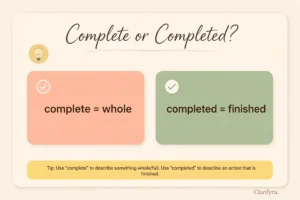
The confusion between complete and completed rarely comes from spelling — most writers can spell both words — but from grammar:…
Read More →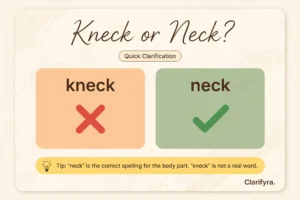
The correct spelling is neck — no k at the front. Kneck turns up in typed messages and schoolwork because English…
Read More →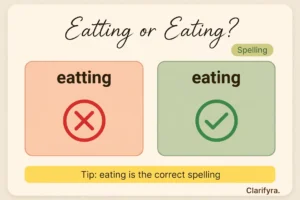
The correct spelling is eating — one t. Eatting, with a double t, is a common misspelling that comes from a…
Read More →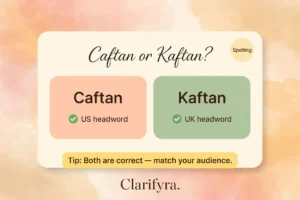
Caftan and kaftan are both correct — two spellings of the same garment, and every dictionary checked accepts both. The split…
Read More →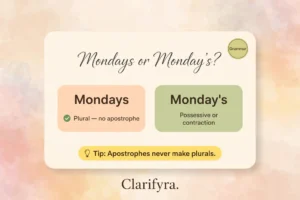
Mondays (no apostrophe) is the plural — more than one Monday: “I work Mondays.” Monday’s (with apostrophe) is either the possessive…
Read More →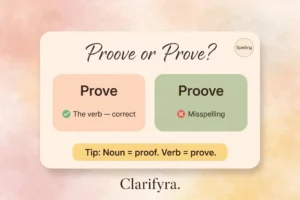
Prove is the correct modern spelling — the verb meaning to establish the truth of something. Proove is not a current…
Read More →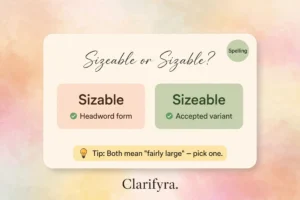
Sizable and sizeable are both correct — this isn’t a right/wrong question but a two-spellings question. Sizable is the headword spelling…
Read More →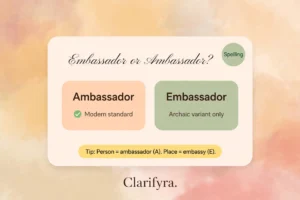
Ambassador is the correct modern spelling — it’s the headword in every dictionary checked. Embassador is not simply a typo, though:…
Read More →
Duffle and duffel are both correct — they’re alternative spellings of the same word, and every dictionary checked lists both. Duffel…
Read More →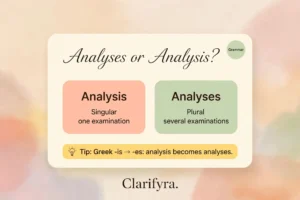
Analysis is the singular noun — one detailed examination (“an analysis of the data”). Analyses is its plural — more than…
Read More →