Duffle or Duffel: Which Spelling Is Correct?
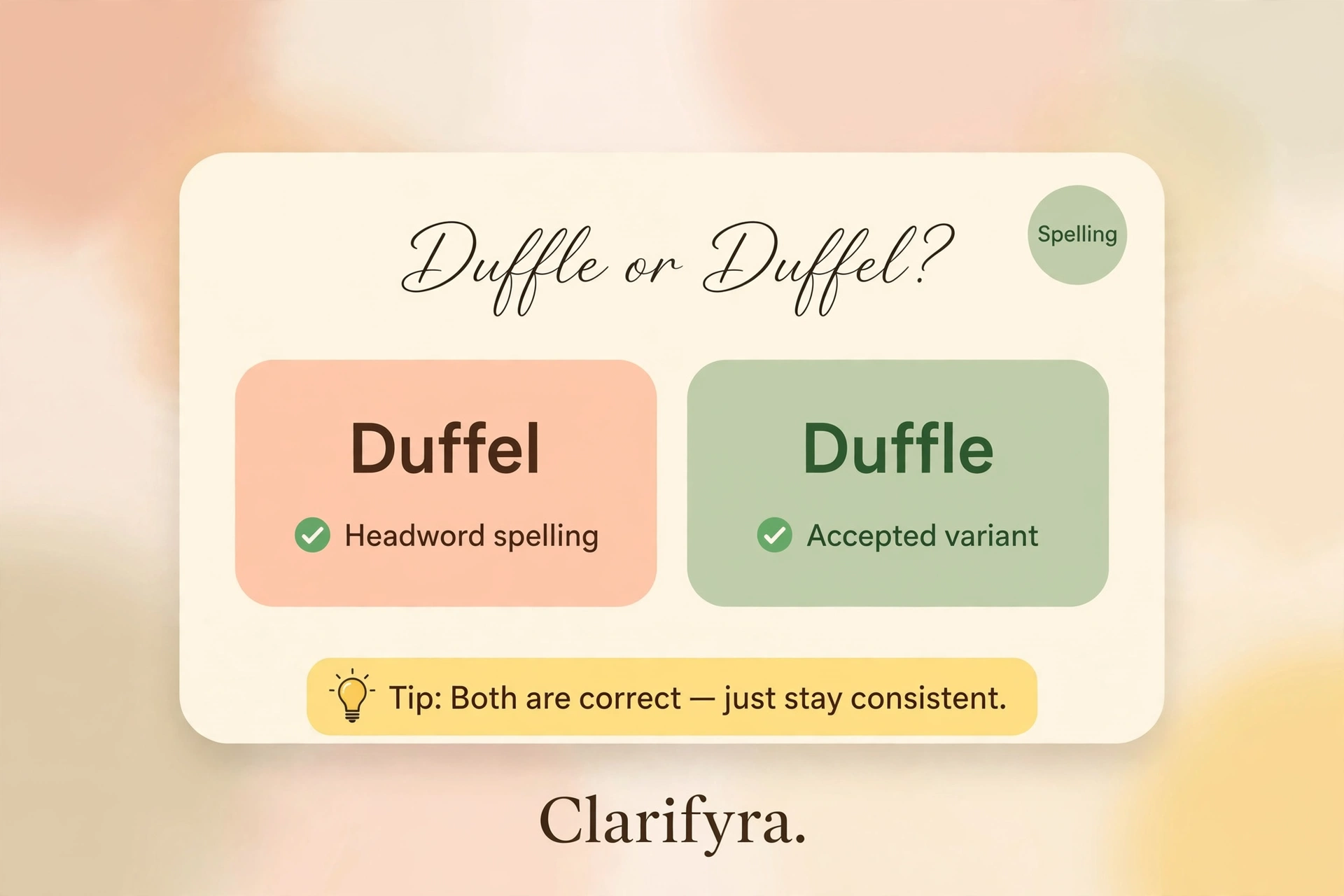
Duffle and duffel are both correct — they’re alternative spellings of the same word, and every dictionary checked lists both. Duffel is the headword spelling in the dictionaries (Collins, Merriam-Webster), with duffle given as the variant. So neither is a misspelling; duffel is simply the primary, dictionary-first form, whether you mean the bag, the coat, or the cloth.
Quick Answer
Duffel and duffle are both standard spellings — Collins’s British entry reads “duffel … or duffle” (ˈdʌfəl), and Collins’s American entries (Webster’s New World, Random House) give “or duffle” / “Also: duffle.” Duffel is the headword form in the dictionaries checked, so it’s the safer default. The word covers the cylindrical bag (“duffel bag,” first recorded 1903 per Merriam-Webster), the toggle-fastened wool coat (“duffle coat”), and the coarse woolen cloth itself. Pronounced /ˈdʌfəl/ (“DUF-uhl”) either way. Named after Duffel, a town in Belgium.
What the Dictionaries Say
The lexicographic picture is unusually clear here, and it’s the same on both sides of the Atlantic. Collins’s British English Dictionary headwords duffel with “or duffle” right in the entry line. Collins’s American entries say the same: Webster’s New World gives “or duffle,” and the Random House entry says “Also: duffle.” Merriam-Webster headwords duffel bag (“a soft oblong bag for personal belongings,” first known use 1903) and separately duffle coat.
That last detail is worth noticing: Merriam-Webster’s headword for the coat is spelled duffle coat, while its headword for the bag is duffle bag — wait, actually: MW’s headword for the bag is duffel bag and for the coat duffle coat. In practice, both spellings appear for both items, and no dictionary checked treats either spelling as wrong for either item. But it hints at why the two forms feel interchangeable — they’ve been swapping places in print for centuries.
The etymology is the same whichever spelling you choose: the word is named after Duffel, a town in Belgium (near Antwerp) where the original coarse woolen cloth was made. Collins dates the word to the 17th century; Random House gives [1640–50]. So the e in duffel actually reflects the place name — a small point in favor of the headword spelling.
The Three Meanings
Whichever spelling you use, the word covers the same three things:
1. The cloth. The original sense: a coarse woolen material with a thick nap, used for winter clothing and blankets. “A heavy duffel coat” literally means a coat made of duffel cloth.
2. The bag. The duffel bag (also duffle bag) — the soft, cylindrical, top-loading bag associated with soldiers, sailors, athletes, and travelers. Merriam-Webster defines it as “a soft oblong bag for personal belongings.” Collins’s American entry adds a chiefly US sense: a camper’s clothing and equipment generally (“pack your duffel”).
3. The coat. The duffle coat (also duffel coat) — the heavy woolen coat with toggle fasteners and usually a hood, the classic British naval and schoolchild garment. The toggles-and-hood design is what makes it a duffle coat rather than just a wool coat.
Which Spelling Should You Use?
Since both are correct, the choice comes down to consistency and audience:
- Default to duffel unless you have a reason not to. It’s the headword spelling in Collins (British and American) and in Merriam-Webster’s “duffel bag” entry, so it’s the form least likely to be questioned.
- Match your source or house style. If you’re writing about a product officially called a “Duffle Bag” by its manufacturer, use their spelling. Brand names and product titles outrank dictionary preferences.
- Be consistent within a document. Switching between duffel and duffle in the same article looks sloppier than either spelling on its own. Pick one and stick with it.
- Note the coat exception. Merriam-Webster headwords the garment as duffle coat — so if you’re writing about the toggle coat specifically and want maximum dictionary alignment, duffle coat has a slight edge there, while duffel bag has the edge for the bag. In practice, either spelling of either item is fine.
| Item | Headword spelling (MW) | Variant |
|---|---|---|
| The bag | duffel bag | duffle bag |
| The coat | duffle coat | duffel coat |
| The cloth | duffel | duffle |
From Seabag to Gym Bag: A Short History
The duffel bag’s biography explains why the word feels so rugged. Its direct ancestor is the sailor’s seabag — the cylindrical canvas sack issued to naval recruits for their kit, closed with a drawstring at the top. Armies adopted the same shape for the same reason: a soft cylinder holds a lot, weighs little, and survives being thrown into trucks, ships, and barracks. The civilian duffel bag — the gym bag, the weekender, the athlete’s kit bag — is that military sack with better zippers and nicer colors.
This history also explains one of the word’s standalone uses. Collins’s American entry records duffel alone meaning a traveler’s clothing and equipment generally: “pack your duffel.” That’s the seabag sense surviving into civilian speech — duffel as “all your stuff,” the way a sailor would have used it. You’ll hear it in hiking and military-adjacent contexts (“grab your duffel, we’re moving out”), and it takes either spelling, like everything else about this word.
Correct vs. Incorrect
- ✓ “He stuffed his kit into a duffel bag.” / ✓ “He stuffed his kit into a duffle bag.” (both correct)
- ✓ “She wore a navy duffle coat.” / ✓ “She wore a navy duffel coat.” (both correct)
- ✗ “He stuffed his kit into a duffel bag and threw on his duffle coat.” → pick one spelling per document for consistency
- ✗ “duffle” for the town in Belgium → ✓ Duffel (the place name keeps its e; it’s a proper noun)
- ✗ “duffle bag” for a hard-shell suitcase → use “suitcase” (a duffel/duffle bag is soft and cylindrical by definition)
Common Mistakes
1. “Correcting” duffle to duffel (or vice versa) as if one were wrong. The most common error around this word isn’t a misspelling — it’s a mis-correction. Someone writes duffle, a well-meaning editor “fixes” it to duffel, or the reverse. Both are listed in the dictionaries checked; the correction is unnecessary.
2. Inconsistency within one piece of writing. Using duffel bag in paragraph one and duffle bag in paragraph three is the one genuinely sloppy move available here. Choose a spelling at the start and keep it.
3. Misspelling the town. The Belgian town is Duffel — proper noun, capital D, with the e. Writing “Duffle, Belgium” is wrong even though “duffle” is fine for the bag.
4. Assuming “duffle” is the American spelling and “duffel” the British one (or the reverse). It’s not a regional split. Both dictionaries on both sides list both spellings with duffel as the headword. This isn’t a vise/vice situation — there’s no Atlantic divide here.
5. Calling any soft bag a duffel bag. A duffel bag is specifically the cylindrical, top-closure style. A backpack, a tote, or a hard suitcase isn’t a duffel bag regardless of spelling.
Frequently Asked Questions
Is “duffle” a misspelling of “duffel”?
No. Collins (British and American) and Merriam-Webster all record duffle as a legitimate variant spelling. Duffel is the headword form — the dictionary-first spelling — but duffle is fully standard, not an error.
Which is more common, “duffel” or “duffle”?
The dictionaries checked headword duffel, which generally reflects the more established or primary form. In practice both appear widely in print. For the coat specifically, Merriam-Webster’s headword is duffle coat, so duffle is well represented there.
How do you pronounce “duffel”?
/ˈdʌfəl/ (“DUF-uhl”) — Collins gives the same pronunciation for both spellings, British and American. The two spellings sound identical, so the choice is purely visual.
Why is it called a “duffel” bag?
Because the original bags (and coats) were made from duffel cloth, named after Duffel, Belgium, where it was woven. The bag inherited the cloth’s name, and the spelling variation came along with it.
What’s the plural — “duffels” or “duffles”?
Follow your chosen base spelling: duffels (from duffel) or duffles (from duffle). Either is fine; just stay consistent with the singular you picked.
The Takeaway
Duffle and duffel are both correct spellings of the same word — the bag, the toggle coat, and the Belgian-named cloth. Duffel is the headword spelling in the dictionaries checked, making it the safest default; Merriam-Webster notably headwords the garment as duffle coat. Pick one spelling, use it consistently, and never “correct” the other — the only wrong move here is inconsistency.