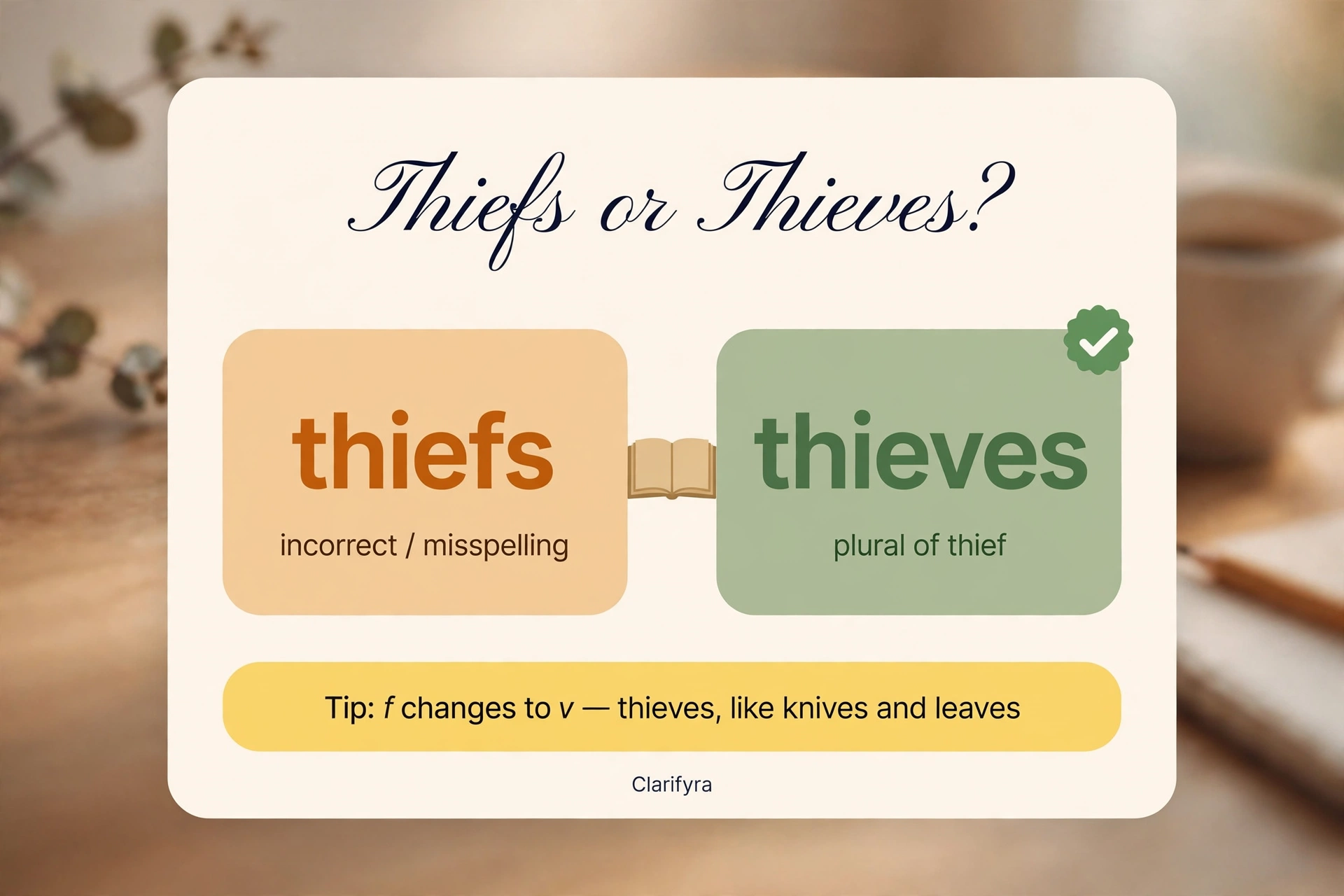
Thiefs or Thieves: Which Is Correct?
The plural of thief is thieves — thiefs is not the standard plural. One thief stole the painting; a gang of thieves stole the whole collection. Thiefs follows the most common plural rule in English (add -s), and it looks so reasonable that it has its own dictionary entry marked “nonstandard.” But Cambridge, Oxford, Merriam-Webster, and Collins all record only thieves.
Quick Answer
Thieves is the correct plural of thief. Cambridge lists “plural thieves” outright; Oxford gives plural thieves (/θiːvz/) for both British and American English; Merriam-Webster records thieves \ˈthēvz\; and Collins marks the plural thieves in both its British and American entries. Thiefs is not listed as a standard plural in any of those dictionaries — Wiktionary does list it, but explicitly labels it “(proscribed, nonstandard).” In formal or published writing, thieves is the only correct choice.
What the Dictionaries Record
All four major dictionaries agree on the same facts about thief:
- Cambridge defines thief as “a person who steals” (tagged B1) and lists “plural thieves.” Its example sentence is a tidy model: “The art gallery was broken into last night, and the thieves got away with two valuable paintings.”
- Oxford (Advanced Learner’s) gives the noun thief /θiːf/ with “(plural thieves, /θiːvz/)” — and shows the same pronunciation for UK and US. Its examples include “a gang of thieves” and “The thieves stole £70,000 worth of jewellery from his home.”
- Merriam-Webster defines thief as “one that steals especially stealthily or secretly; also one who commits theft or larceny,” and records the plural thieves \ˈthēvz\.
- Collins marks the word forms “plural thieves” in both its British entry (pronunciation θiːvz) and its American entry (θivz).
None of the four lists thiefs as a headword or an accepted variant. The closest anyone gets is Wiktionary, which records thiefs solely to label it “proscribed, nonstandard” — dictionary shorthand for “real people write this, but you shouldn’t.”
Pronunciation
| Variety | Pronunciation |
|---|---|
| British English | /θiːvz/ — THEEVZ |
| American English | /θiːvz/ — THEEVZ |
Say the singular thief (/θiːf/), then voice the final sound to /v/ and add a buzzing -z: theevz. Learners sometimes pronounce the plural with a voiceless -s, which is understandable — but the voiced /z/ is standard on both sides of the Atlantic.
The f → ves Rule (and Why It Exists)
Why does thief change its final f to ves instead of just adding -s? Because the spelling is following the mouth. In Old English, the sound spelled f was pronounced as a voiced v when it sat between vowels — and a plural ending puts a vowel (the plural -e-, later -es) right after that f. Over the centuries, the changed pronunciation became the changed spelling. Merriam-Webster puts it plainly: “The voiceless \f\ sound that ends these words became a voiced \v\ simply by habit of speech when the word in question was pluralized.”
The classic members of the club: shelf→shelves; wolf and calf become wolves and calves; the leaves on the trees; “a den of thieves”; two halves making a whole; wife→wives, knife→knives.
Oxford traces the word to Old English thīof/thēof, “of Germanic origin, related to Dutch dief and German Dieb,” and Merriam-Webster dates it to before the 12th century. The word was in place for the Old English between-vowels voicing — and kept the result.
Why “Chief” Doesn’t Follow the Rule
Here’s the trap: chief ends in the same three letters as thief but plurals as chiefs. Merriam-Webster flags the exact oddity: “Chief, despite ending in the same three letters as thief, gets pluralized as chiefs.” If the rule were about spelling, chiefs would be wrong. It isn’t about spelling — it’s about history.
Chief arrived in English via Old French — Merriam-Webster’s etymology traces it to Anglo-French chief, chef, from Latin caput (“head”), entering Middle English in the 14th century; Collins gives the same route (“[C13: from Old French, from Latin caput head]”). It simply wasn’t in English when the Old English voicing change ran its course, so it never picked up the -ves habit and plurals regularly. The honest version of the rule is this: the f→ves change is a relic of Old English, and mostly it only covers words that were there for it.
The other rule-breakers follow the same logic, and they’re worth knowing because they’re the words that tempt you to mistrust thieves:
| Word | Plural | Why it keeps the f |
|---|---|---|
| chief | chiefs | Later French borrowing; missed the Old English voicing change. |
| roof | roofs | Native word, but it simply never underwent the change — the rule was never universal. |
| belief | beliefs | Merriam-Webster lists it among the words that take standard -s. |
| serf | serfs | Later borrowing from French/Latin servus. |
| cliff | cliffs | Nearly all double-f words keep the f: tariffs, bailiffs, sheriffs, mastiffs, bluffs, cuffs, earmuffs (MW). |
The takeaway from the rule-breakers: you can’t reason your way to the right plural from the spelling alone. Chief/chiefs and roof/roofs are real, correct, dictionary-recorded plurals — and thief/thieves is equally real. Each word’s plural is a matter of recorded fact, which is why this article keeps pointing you at dictionaries rather than at the rule.
Why “Thiefs” Looks So Plausible
Thiefs is a completely logical mistake, which is why so many capable writers make it:
- Adding -s is the default. For the overwhelming majority of English nouns, the plural is just -s: cats, tables, ideas. Writers apply the default before they check the exceptions — and thiefs even sounds fine when you say it quickly.
- The correct rule looks unreliable. When you know chief→chiefs and roof→roofs, it’s natural to conclude the f→ves “rule” is dead — and to regularize thief along with them. The resemblance between chief and thief is actively misleading here.
- The verb thieve exists alongside it. English has the verb thieve (“to steal” — Collins lists it as thieve, θiːv; Oxford too: “He is always thieving my pencils”). Since the -ve spelling already lives in the verb, writers sometimes overcorrect in the wrong direction — or just reach for the simplest plural form.
- Thieves is also a verb form. Merriam-Webster notes that thieves is the third-person singular present of thieve (“someone’s been thieving my cookies” — present tense thieves). One spelling doing two jobs (plural noun and verb form) makes the word feel odd, and odd-feeling words invite “correction” to the regular form.
The memory hook that survives all of this: think of the mouth, not the letters. Say thief, then say several of them — your tongue voices the f into a v all by itself (theevz). The spelling thieves just writes down what you’re already saying.
Correct vs. Incorrect
| Incorrect ✗ | Correct ✓ | Note |
|---|---|---|
| The thiefs broke in through a window. | The thieves broke in through a window. | Standard plural noun. |
| Police arrested three thiefs. | The thieves stole £70,000 worth of jewellery from his home. | “Thieves stole £70,000 worth of jewellery” is Oxford’s own example pattern. |
| A gang of thiefs targeted the shop. | A gang of thieves targeted the shop. | Oxford’s example: “a gang of thieves.” |
| Identity thiefs stole her card details. | Identity thieves stole her card details. | Compound noun — the rule still applies: car thieves, jewel thieves, petty thieves. |
| The thief’s were caught. | The thieves were caught. | Don’t use an apostrophe to make a plural. |
✓ The thief’s mask was found at the scene. (singular possessive — one thief’s mask)
✓ The thieves’ hideout was raided at dawn. (plural possessive — the hideout of several thieves)
✗ The thieves’s hideout was raided. (plural possessive of a plural ending in s takes only an apostrophe)
Common Mistakes
1. Writing “thiefs.” The big one. ✗ “Two thiefs were arrested” → ✓ “Two thieves were arrested.” No major dictionary records thiefs as standard — Wiktionary marks it nonstandard, which in practice means “spelling error in anything formal.”
2. Writing “thiefes.” A halfway guess that keeps the f and adds -es: thiefes. It follows no real pattern — the plural is thieves, with the f changed to v, not kept.
3. Mixing up “thieves” with the verb “thieve.” Because thieves doubles as the third-person singular of thieve (“he thieves bicycles” — he steals them), learners sometimes produce ✗ “he is a thieves” or ✗ “the thieve ran away.” The noun pair is thief/thieves; the verb pair is thieve/thieves. Check which job the word is doing in your sentence.
4. Apostrophe plurals. ✗ “the thief’s were caught.” Apostrophes make possessives or contractions, never plain plurals.
5. Over-applying the f→ves rule to “chief.” The mirror-image error: having learned that thief→thieves, some writers pluralize ✗ “the chieves of the company.” It’s chiefs — the French borrowing kept its regular plural, as the section above shows.
6. Mispronouncing the plural. Saying /θiːvs/ (voiceless s) for thieves. The final sound is a voiced /z/ — theevz — in both British and American English, per Oxford and Collins.
FAQs
Is “thiefs” a word?
Not in standard English. Cambridge, Oxford, Collins, and Merriam-Webster all record only thieves as the plural of thief. Wiktionary is the one dictionary that lists thiefs, and it labels the form “proscribed, nonstandard” — meaning it shows up in real writing but isn’t accepted usage. In anything edited or formal, it’s a spelling error.
Why is it “thieves” and not “thiefs”?
Because the spelling preserves an Old English pronunciation habit: the f in words like thief was voiced to v when a plural vowel followed it. The plural spelling -ves writes down that voicing. Merriam-Webster describes it plainly: “The voiceless \f\ sound that ends these words became a voiced \v\ simply by habit of speech when the word in question was pluralized.”
Then why is “chiefs” correct and not “chieves”?
Because chief wasn’t in English when the voicing change happened. Merriam-Webster traces chief to Anglo-French (from Latin caput, “head”) entering Middle English in the 14th century — centuries after thief (Old English thēof, before the 12th century) had already absorbed the change. A later borrowing, a regular plural.
What about “roofs,” “beliefs,” and “cliffs”?
All correct — and all reasons the f→ves change can’t be treated as a universal rule. Merriam-Webster lists serfs, chiefs, briefs, beliefs, roofs, and reliefs as words that take standard -s, plus nearly all double-f words (tariffs, bailiffs, sheriffs, cliffs, mastiffs, bluffs, cuffs, earmuffs (MW).
Is “thieves” ever a verb?
Yes — thieves is also the third-person singular present of the verb thieve (“to steal”): “he thieves office supplies.” Context tells you which it is: “the thieves ran” (noun, plural subject) versus “he thieves pens” (verb, third-person singular). The noun thief itself is never a verb — thieve does that job.
What’s the difference between “thief’s” and “thieves’”?
Thief’s is the singular possessive — belonging to one thief (“the thief’s accomplice”). Thieves’ is the plural possessive — belonging to several thieves (“the thieves’ hideout”). Because the plural already ends in s, it takes only an apostrophe after it, never ’s.
The Takeaway
One thief, many thieves — and never thiefs in standard writing. The -ves plural is a fossil of Old English pronunciation, not a rule you can apply by formula: it covers old Germanic words like thief, wolf, calf, and knife, but misses later arrivals like chief and arbitrary holdouts like roof and belief. Cambridge, Oxford, Merriam-Webster, and Collins all record thieves (/θiːvz/) as the only standard plural. Write what your mouth already says — theevz — and you’ll spell it right.