Siting or Sighting: What’s the Difference?
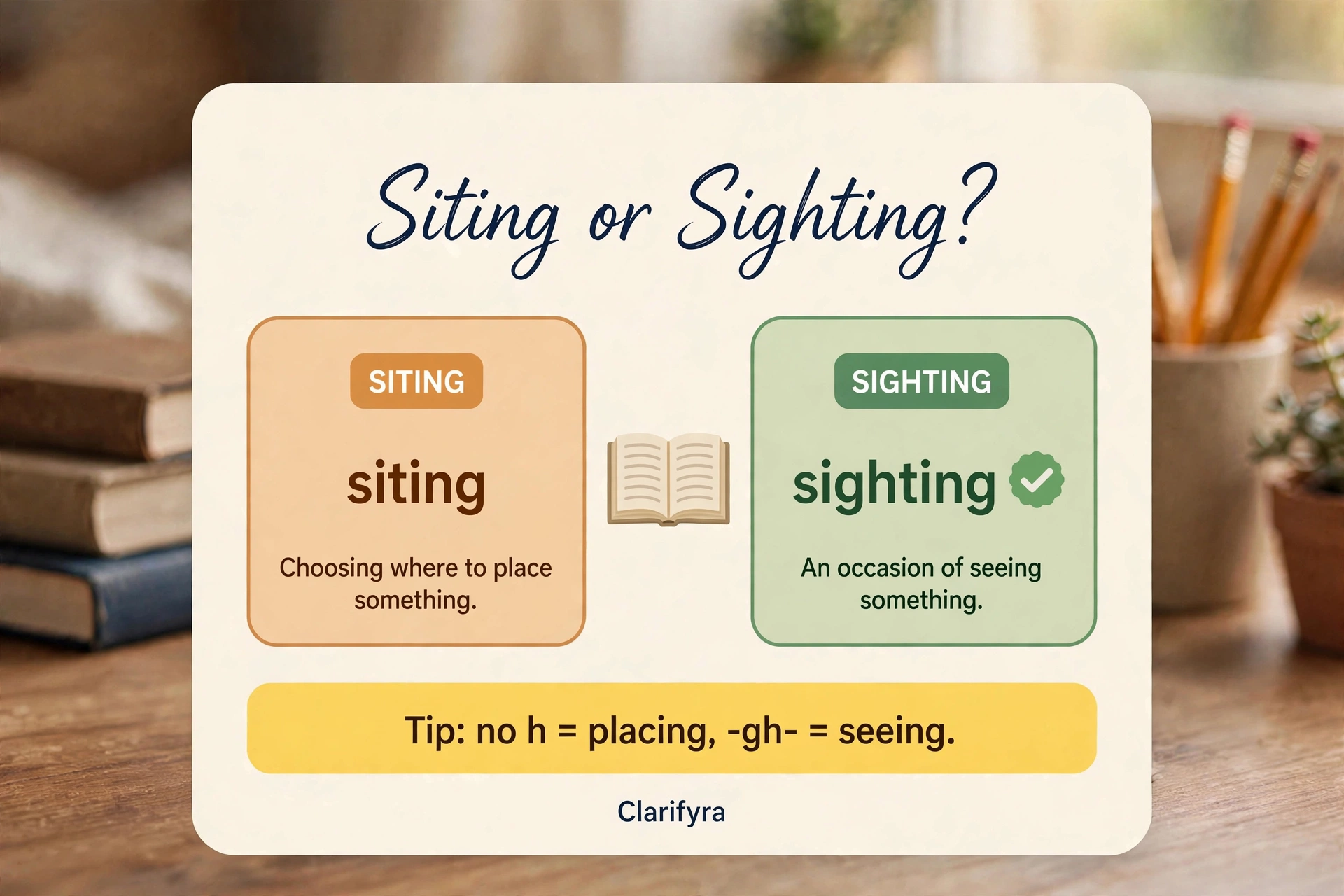
Siting is about placing things: choosing where something goes. Sighting is about seeing things: an occasion when something or someone is spotted. Both are pronounced /ˈsaɪtɪŋ/ (“SYE-ting”) — which is why they get swapped. The council approves the siting of a new power station (where to put it); a birdwatcher logs a sighting of a rare eagle (that they saw it). If your sentence is about location, it’s siting. If it’s about observation, it’s sighting.
Quick Answer
Siting (no h) is the -ing form of the verb site — “to build or place something in a particular position” (Oxford). It means the act of choosing or assigning a location: “the siting of the new school.” Sighting (with gh) is a noun meaning “an occasion when somebody sees somebody/something, especially something unusual or something that lasts for only a short time” (Oxford) — “a reported sighting of the comet.” Both are pronounced /ˈsaɪtɪŋ/, so the difference is entirely in the spelling and the meaning.
What “Siting” Means: Choosing a Location
Siting comes from the verb site, and it means one thing: putting something somewhere. The Oxford Advanced Learner’s Dictionary lists the verb forms explicitly — present simple site /saɪt/, past sited /ˈsaɪtɪd/, -ing form siting /ˈsaɪtɪŋ/ — and defines the verb as “to build or place something in a particular position,” usually used in the passive: “The castle is magnificently sited high up on a cliff”; “The fence is strategically sited to prevent anyone getting onto the beach.”
As an -ing word, siting appears in two roles:
- As a verb form: “They are siting the new data centre in the north of the county” — right now, they are choosing its location.
- As a noun meaning the act or process of choosing a site: Oxford’s example is “There was a meeting to discuss the siting of the new school.” Cambridge’s corpus examples show the same use: “the actual siting decisions were made,” “granting siting permits necessary for the operation of many types of facilities,” “the siting of particular services.”
Notice the company siting keeps: permits, decisions, councils, planning applications, environmental assessments. It lives in the world of planning documents, architecture, infrastructure, and business strategy. If the sentence involves choosing where something should stand, it’s siting — rooted in Latin situs, “place, position” (via the noun site), with the verb in use since the late 16th century.
What “Sighting” Means: An Occasion of Seeing
Sighting comes from sight, and it means one thing: someone saw something. The dictionaries agree on the core sense. Cambridge: “an occasion when you see something or someone, especially something that is rare or trying to hide” — “This is the first sighting of this particularly rare bird in this country.” Oxford: “an occasion when somebody sees somebody/something, especially something unusual or something that lasts for only a short time” — “a reported sighting of the Loch Ness monster”; “three confirmed sightings of an enemy plane.” Collins calls it a countable noun: “a sighting of something, especially something unusual or unexpected is an occasion on which it is seen.”
The typical subjects of sightings tell you the word’s territory: rare birds, comets, UFOs, tornadoes, whales, escaped animals, missing persons, celebrity appearances, enemy aircraft. Collins’ corpus examples include “tornado sightings in Illinois” and “the sighting of a rare sea bird”; Oxford’s include “three confirmed sightings of an enemy plane.” These are all observations — something appeared, someone saw it, and the seeing was worth recording. In short: siting is a decision; sighting is a report.
One more sense worth knowing, recorded by Collins for British English: sighting can also mean “another name for sight (sense 10)” — that is, “an observation or alignment made with” a sight, the device “used to assist the eye in making alignments or directional observations, esp such a device used in aiming a gun.” In plain terms: the sight picture a shooter lines up through a rifle’s sights can itself be called a sighting. This is a specialist sense — found in shooting sports and military contexts — a reminder that sighting always traces back to seeing, never to placing.
Why They Sound Identical
There is no way to hear the difference, because there isn’t one. Oxford’s verb-forms table gives site as /saɪt/ and siting as /ˈsaɪtɪŋ/ in both UK and US pronunciation; sighting is /ˈsaɪtɪŋ/ in both as well, with Cambridge recording UK /ˈsaɪ.tɪŋ/ and US /ˈsaɪ.t̬ɪŋ/. The parent words are homophones too: Oxford groups cite, sight, and site together as homophones, all /saɪt/, and Merriam-Webster devotes a usage note to the trio, warning that as “homophones — words that sound alike but are distinct — [they] are easily confused.” When you say “SYE-ting,” the listener can’t tell whether you mean placing or seeing — and neither can you when you hear it. Spelling has to be decided by meaning alone.
Siting vs Sighting at a Glance
| Word | Comes from | Part of speech | Core meaning | Example |
|---|---|---|---|---|
| siting | verb site | verb form / noun | choosing or assigning a location | “the siting of the new school” |
| sighting | noun/verb sight | noun (countable) | an occasion of seeing something | “a sighting of the rare bird” |
Correct vs Incorrect
The test for every sentence: is this about where something goes, or about someone seeing something?
- ✗ “The council debated the sighting of the wind farm.” → ✓ “The committee debated the siting of the wind farm.” (Choosing a location — from site.)
- ✗ “This was the first siting of the comet in 1,000 years.” → ✓ “This was the first sighting of the comet in 1,000 years.” (An occasion of seeing — from sight.)
- ✗ “There have been several sitings of the missing hiker across the county.” → ✓ “There have been several sightings of the missing hiker across the county.” (Reports of someone being seen.)
- ✗ “The company is sighting its new headquarters near the river.” → ✓ “The company is siting its new headquarters near the river.” (Placing the building — verb form of site.)
- ✓ “The siting and placing of the works varies a great deal.” (Cambridge corpus — about positioning sculptures.)
- ✓ “The police are following up a reported sighting of the man’s car.” (Oxford — about seeing.)
- ✓ “The range officer checked each shooter’s sighting before the match.” (Specialist sense — the alignment through the gun sight.)
Common Mistakes
1. Writing “sighting” for a planning decision. ✗ “the sighting of the new factory” → ✓ “the siting of the new factory.” This is an easy error to make, because sighting is the far more common word — your eye accepts it without question. But a factory’s location is a site decision, so it needs siting.
2. Writing “siting” for an observation. ✗ “a rare siting of the eagle” → ✓ “a rare sighting of the eagle.” The bird wasn’t positioned anywhere; it was seen.
3. Assuming “siting” is a misspelling. It looks odd — “siting” reads like “sitting” with a typo — and some writers “correct” it to sighting on instinct. It isn’t a misspelling: it’s the recorded -ing form of the verb site in the Oxford dictionary, and it appears throughout planning, architecture, and environmental writing. Trust the dictionaries, not the instinct.
4. Confusing “sighting” the noun with the verb sight. Sighting is also the present participle of the verb sight (“to see or glimpse”): “They spent the afternoon sighting whales from the cliffs” is correct — but it’s the verb sight at work, still about seeing, and it has nothing to do with site. Oxford’s example: “He was the first European to sight the island later named Hispaniola.”
5. Mixing up “site,” “sight,” and “cite” underneath. The -ing confusion is a symptom of the parent-word confusion. Quick check: site = a place (from Latin situs); sight = seeing (from Old English gesiht); cite = to quote or summon. If you can keep those three straight, the -ing forms follow: siting keeps the site spelling, sighting keeps the sight spelling.
6. Relying on the spellchecker. Both are real, recorded words, so neither gets flagged. This is a meaning error, not a spelling error — only knowing which meaning you intend will save you.
How to Remember It
Siting is site with -ing — sit something down somewhere. Think situate: siting, site, situate, situation all share the Latin root situs, “place, position,” and every one of them is about where. Sighting is sight with -ing — and sight has the -gh-, the same letter cluster that shows up in sight‘s own family of phrases: eyesight, sight unseen, catch sight of. So: no h → placing; gh → seeing. Or shorter still: if you could replace the word with “location decision,” it’s siting; if you could replace it with “observation,” it’s sighting.
Frequently Asked Questions
Are “siting” and “sighting” pronounced the same?
Yes. Both are /ˈsaɪtɪŋ/ (“SYE-ting”) in UK and US pronunciation — Cambridge and Oxford record identical stress and vowels for the two words. The difference is spelling and meaning only.
Is “siting” actually a real word?
Yes. It’s the recorded -ing form of the verb site (“to build or place something in a particular position”), listed in the Oxford verb-forms table, and used as a noun for the act of choosing a location — “the siting of the new school.” It’s standard in planning, architecture, business, and environmental writing. It only looks like a typo of “sitting.”
Which one do I use in business and planning documents?
Almost always siting: siting decisions, siting permits, siting criteria, “the proposed siting of the facility.” These are all about where something goes. You’d only write sighting in a business document if someone literally saw something — e.g., “a sighting of the prototype at the trade show” in a competitive-intelligence report.
Can “sighting” ever be a verb?
Not as its own headword — but sighting is the present participle of the verb sight (“to see, view, or glimpse”; also “to aim a firearm using the sight,” per Collins). So “sighting whales” is correct, and it’s still about seeing. There’s no verb *sighting related to site; that one’s verb form is siting.
What does “sighting” mean in shooting?
In Collins’ British English entry, sighting has a specialist second sense: an observation or alignment made with a gun sight — the lined-up picture a shooter sees through the sights. It’s a niche use; in general writing, sighting means an occasion of seeing something unusual.
What’s the difference between “site,” “sight,” and “cite”?
The three parent words: site (a place; also the verb meaning to locate something there), sight (the power of seeing; something seen; a gun’s aiming device; also a verb meaning to see or glimpse), and cite (to quote as evidence, or to summon to court). All pronounced /saɪt/. The -ing forms inherit their parents’ spellings: siting from site, sighting from sight. (There’s no common -ing form of cite in this confusion set.)
The Takeaway
Siting places; sighting sees. The council handles the siting of the power station; the birdwatcher reports the sighting of the eagle. They’re homophones with different jobs, so decide the meaning before you type — and remember: no h, it’s the location; -gh-, it’s the observation.