Saveable or Savable: Which Is Correct?
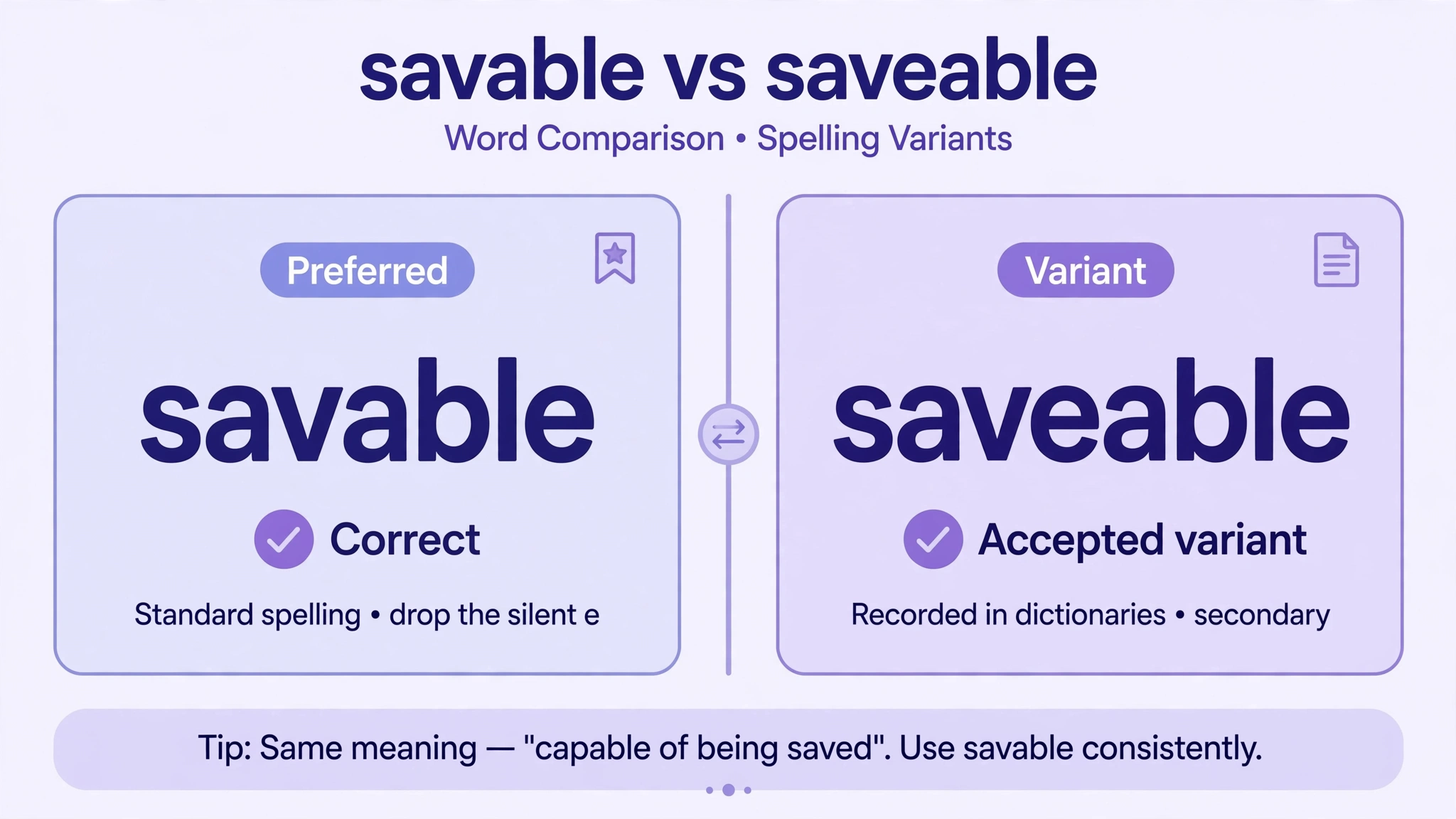
Savable is the standard spelling. It means “capable of being saved,” and it is the form Merriam-Webster uses as its headword and Collins lists first. Saveable — with the e kept — is not a mistake either: Collins and the American Heritage Dictionary both record it as an accepted variant. If you want one safe choice for everything, write savable.
Quick Answer
Savable is the preferred, dictionary-headword spelling (“capable of being saved”). Saveable is a recognized variant, not an error — Collins lists both, and the American Heritage Dictionary prints them side by side. Both are pronounced the same way (say-vuh-bul). Pick savable and use it consistently.
What the Dictionaries Actually Say
The surest way to settle a spelling pair is to open the dictionaries, so that is where this starts. Merriam-Webster’s headword is savable, defined simply as “capable of being saved,” with an etymology tracing back through Middle English sauvable. If you look up saveable on Merriam-Webster, the site redirects you to the entry for save, where savable is given as the adjective form. The message is clear: in Merriam-Webster’s house style, savable is the spelling.
Collins takes a broader view. In both its British and American English entries, Collins lists the derived forms as “savable … or saveable” — both spellings recorded, with savable placed first. The Free Dictionary’s entry, drawing on the American Heritage Dictionary and others, prints them as a pair: “sav′a·ble, save′a·ble adj.“
Two dictionaries notably carry neither spelling as a headword. The Cambridge Dictionary returns its generic landing page rather than an entry for both savable and saveable, and Oxford Learner’s Dictionaries returned no entry page for savable. That absence does not make the word illegitimate — plenty of productive -able formations go unlisted — but it does mean the learner’s dictionaries most students reach for will not adjudicate the pair. For that, Merriam-Webster and Collins are the authorities, and they agree on the ranking: savable first, saveable as the variant.
The Rule That Settles It: Drop the Silent E
The preference for savable is not arbitrary. It follows one of the most reliable rules in English spelling: when you add a suffix beginning with a vowel to a word ending in silent e, drop the e. Save + -ing gives saving, not saveing. Save + -ed gives saved. Save + -able gives savable. The e has already done its job — it lengthens the vowel in save — and the suffix’s own vowel takes over, so the extra letter is redundant.
The same pattern runs through the whole family of words like this: love → lovable, move → movable, like → likable, use → usable. English keeps the silent e only in a few guarded cases: after soft c and g, where the e protects the sound (noticeable, manageable, changeable), and where dropping it would create a genuinely different word (singeing versus singing). Save ends in -ve, not -ce or -ge, and savable cannot be misread as anything else — so none of the exceptions apply. The rule points one way: savable.
Why, then, does saveable exist at all? Because the exception-free logic of spelling rules meets the very human instinct to keep the verb visible. Writers who type saveable are spelling by morphology — save + -able — so that the root word stays recognizable, the same instinct that makes saveable feel “safer” to many people than the slightly unfamiliar-looking savable. That instinct is understandable, and it is exactly why major dictionaries record saveable as a variant rather than stamping it wrong.
A Misconception Worth Correcting
Some advice posts online claim that savable “is not a proper English word” and that saveable is the correct form. That is backwards. Merriam-Webster, Collins, and the American Heritage Dictionary all list savable — Merriam-Webster as the outright headword, the others with savable first. It is saveable that is the secondary form. If a spellchecker flags savable, that reflects the checker’s wordlist, not the word — Merriam-Webster, Collins, and the American Heritage Dictionary all list it. (Some dictionaries omit many productive -able words, which may be where the confusion started.)
Is There a US vs UK Split?
Unlike pairs such as enrol/enroll, this one does not break along regional lines. Merriam-Webster is an American dictionary and its headword is savable. Collins lists both spellings in its British English entry and in its American English entry, with savable first in each. So there is no “British saveable versus American savable” rule to learn. The guidance is the same on both sides of the Atlantic: prefer savable, accept saveable as a variant, and above all be consistent within a document.
What “Savable” Means and Where You Meet It
Savable is an adjective meaning “capable of being saved,” and it earns its keep in a handful of specific contexts. Computing is a common context: file formats, settings, presets, and documents are savable or not. Finance and everyday planning supply the rest: an amount of money can be savable if it can be set aside. The negative is unsavable — a file corrupted beyond recovery is unsavable, a situation beyond rescue is unsavable.
Do not confuse savable with salvageable. The two overlap — both involve rescue — but salvageable specifically means capable of being salvaged: recovered from wreckage, damage, or loss, like salvageable goods from a fire. Savable is the broader, plainer word. A document is savable; a shipwreck’s cargo is salvageable.
Pronunciation, for the record, is identical for both spellings: Collins gives British /ˈseɪvəbl/ and American /ˈseɪvəbəl/ — “SAY-vuh-bul.” Spelling choice changes nothing about how the word sounds.
Correct vs Incorrect
| Form | Status | Example |
|---|---|---|
| savable | Preferred — dictionary headword | Your custom settings are savable, so they survive a restart. |
| saveable | Accepted variant — not an error | The report is saveable as a PDF. |
| unsavable | Correct negative | The corrupted file proved unsavable. |
| save-able | Incorrect — no hyphen needed | ✗ Is this save-able? → ✓ Is this savable? |
| savabel / saveible | Misspellings — not words | ✗ A savabel preset. → ✓ A savable preset. |
Common Mistakes
1. Declaring “savable” wrong and “saveable” right.
✗ “Savable” isn’t a word — use “saveable.”
✓ Savable is Merriam-Webster’s headword spelling; saveable is the variant.
This is a widespread error about the pair, and it runs exactly counter to the dictionaries. If someone “corrects” your savable, you have the references on your side.
2. Mixing both spellings in one document.
✗ The preset is savable. All saveable presets are listed below.
✓ The preset is savable. All savable presets are listed below.
Whichever form your style guide or publication prefers, stick with it. Inconsistency reads as carelessness even when both spellings are defensible.
3. Hyphenating the suffix.
✗ The changes are save-able now.
✓ The changes are savable now.
-able attaches directly to the stem. Hyphens belong between compound adjectives (well-known), not between a root and its suffix.
4. Using “salvageable” when “savable” is meant.
✗ Make sure the file is salvageable before you close the app.
✓ Make sure the file is savable before you close the app.
Salvageable implies rescue from ruin. A file you simply want to keep is savable.
5. Letting an aggressive spellchecker rewrite “savable.”
✗ Accepting a red-squiggle “correction” to saveable (or to something unrelated) without checking.
✓ If your checker flags savable, add it to your custom dictionary.
Some checkers run on word lists that omit productive -able forms. The squiggle reflects the list, not the language.
FAQs
Is “saveable” a word?
Yes. Collins lists it as a variant of savable in both British and American English, and the American Heritage Dictionary prints sav′a·ble, save′a·ble together. It is less standard than savable, but it is not a misspelling.
Which spelling should I use in formal or academic writing?
Savable. It is the form Merriam-Webster uses as its headword, the form Collins lists first, and the form that follows the standard silent-e rule. Formal writing rewards the most standard option.
Is there a British vs American difference?
No. Both spellings are recorded in both varieties, and savable is the preferred form in both. This is a standard-versus-variant question, not a regional one.
Why does “save” lose its e but “notice” keeps it in “noticeable”?
Because of the sound the e protects. In noticeable, dropping the e would give noticable, pronounced with a hard c (“noti-KAY-bul”), so the e stays to keep the soft c. Save ends in -ve, and savable is pronounced exactly as expected, so there is nothing for the e to protect. The rule is: drop the silent e before a vowel suffix unless dropping it would change the pronunciation.
What is the opposite of “savable”?
Unsavable — formed with the regular un- prefix, the same way usable gives unusable.
How is “savable” pronounced?
Identically for both spellings: “SAY-vuh-bul” — British /ˈseɪvəbl/, American /ˈseɪvəbəl/ per Collins. The spelling you choose does not change the sound.
The Takeaway
Savable is the spelling to default to: it is Merriam-Webster’s headword, Collins’s first-listed form, and the natural product of the silent-e rule (save + -able, with the e dropped before the vowel suffix). Saveable is a genuine, dictionary-recorded variant — understandable, acceptable, but secondary. Choose savable, use it consistently, and you will be on the side the major dictionaries take.