Ours or Our’s: Which Is Correct?
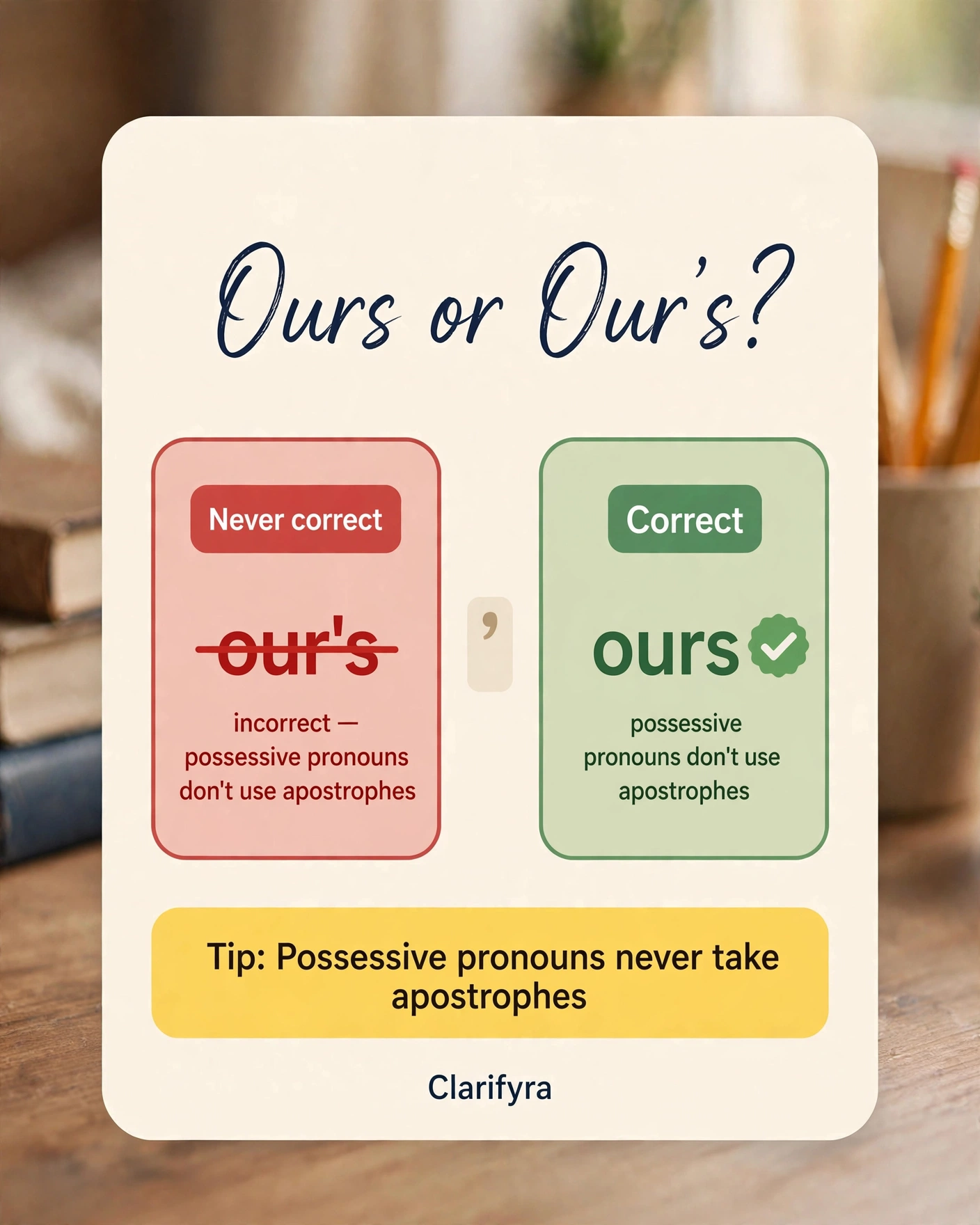
The correct spelling is ours — no apostrophe. Our’s is always wrong in standard English. Possessive pronouns never take apostrophes: ours, yours, hers, theirs, its. The confusion is completely understandable, because on almost every noun in English the apostrophe-s does mark possession — the dog’s bowl, Maria’s car, the team’s win — so “our’s” looks like it ought to be right. But pronouns play by a different rule, and the dictionaries are unanimous about it.
Quick Answer
Ours is the possessive pronoun (“The victory is ours“). Our’s — with an apostrophe — is never correct in standard English, not as a possessive and not as a contraction: no major dictionary gives it an entry. The variant ours’ (apostrophe after the s) is wrong too. Ours is the only correct spelling.
Why the Apostrophe Feels Right (and Isn’t)
Your instinct has a logic to it. English drilled the pattern into you early: possession = apostrophe-s. The cat’s whiskers. The children’s hour. So when you need the possessive form of “our,” your hand reaches for the apostrophe almost by reflex.
The catch is that possessive pronouns are a closed, irregular little family — mine, yours, his, hers, its, ours, theirs, whose — and they are already possessive by definition. Bolting an apostrophe onto one is like writing “the dog’s’s bowl”: the apostrophe has nothing left to mark.
It’s also the mirror image of the famous its/it’s mix-up: there, the apostrophe form is legitimate (a contraction of “it is”), while the possessive drops it. With ours, there is no contraction partner at all — no dictionary recognizes “our’s” as “our is” or “our has” — so the apostrophe version has no legitimate job to do.
What the Dictionaries Actually Say
All four major dictionaries list ours — no apostrophe — and none gives our’s an entry in any sense.
Cambridge defines ours as “the one(s) belonging to or connected with the person who is speaking and one or more other people” — and its grammar section carries the blanket rule quoted above: no ‘s after possessive pronouns, full stop.
Oxford Learner’s lists ours as a pronoun — “the one or ones that belong to us” — and adds a second, specifically British sense: ours informally means “our home,” as in “Do you fancy coming to ours for Sunday dinner?”
Merriam-Webster defines ours as “that which belongs to us — used without a following noun as a pronoun equivalent in meaning to the adjective our,” and traces its first known use to the 14th century. Seven centuries of written English, and the apostrophe never made it in.
Collins opens with a language note: “Ours is the first person plural possessive pronoun.” Its American dictionary adds the etymology — Middle English ures, from ure (our) + the genitive -s: “hence, in form, a double possessive.” The s at the end of ours already is the old possessive marker. Adding an apostrophe would be trying to make possessive something that’s already possessive twice over.
The Possessive-Pronoun Rule: No Apostrophes, Ever
English splits “belonging” words into two teams. Possessive determiners (sometimes called possessive adjectives) stand before a noun: our house, my keys, their car. Possessive pronouns stand alone, replacing the noun entirely: the house is ours, the keys are mine, the car is theirs. Here is the full set, so you can see that “ours” is behaving exactly like its siblings:
| Personal pronoun | Possessive determiner (before a noun) | Possessive pronoun (stands alone) |
|---|---|---|
| I | my | mine |
| you | your | yours |
| he | his | his |
| she | her | hers |
| it | its | its (rare; mostly used with own) |
| we | our | ours |
| they | their | theirs |
Scan the right-hand column: not a single apostrophe in it. You would never write her’s or their’s — and our’s breaks the rule in exactly the same way. The test is simple: if you can swap in yours or theirs without an apostrophe, ours needs none either.
Our vs Ours: Don’t Mix Up the Two Jobs
A separate confusion feeds the apostrophe habit: people sense that our and ours aren’t quite the same word and reach for punctuation to mark the difference. The difference is real, but it’s grammatical, not punctuational. Our is a determiner that stands before a noun; ours is a pronoun that replaces one:
| Our | Ours | |
|---|---|---|
| What it is | Possessive determiner | Possessive pronoun |
| Position | Always before a noun | Never before a noun — stands alone |
| Example | Our team won the match. | The match was ours. |
| Swap test | Replaceable by my, your, their | Replaceable by mine, yours, theirs |
✗ “Ours team won the match.” → ✓ “Our team won the match.”
✗ “The victory was our.” → ✓ “The victory was ours.”
Neither form ever takes an apostrophe. If you find yourself choosing between our’s and ours’, you’ve already gone wrong — the choice is between our and ours, and the apostrophe isn’t invited to either.
Ours vs Our’s in Real Sentences
Here’s the verdict applied, incorrect first so you can spot the pattern, then fixed:
✗ “That parking spot is our’s.” → ✓ “That parking spot is ours.”
✗ “The responsibility was our’s to share.” → ✓ “The responsibility was ours to share.”
✗ “Their garden is bigger than our’s.” → ✓ “Their garden is bigger than ours.”
✗ “The children took ours’ by mistake.” → ✓ “The children took ours by mistake.”
✗ “He’s an old friend of our’s.” → ✓ “He’s an old friend of ours.”
✗ “Ours house has a red door.” → ✓ “Our house has a red door.”
Note the fifth example: “a friend of ours” is the standard double possessive — of plus the possessive pronoun (“He’s a cousin of ours”). It still needs no apostrophe.
Common Mistakes
1. Writing “our’s” for the possessive pronoun. ✗ “The choice is our’s.” → ✓ “The choice is ours.” This is the mistake behind the whole article. Possessive pronouns never take apostrophes — Cambridge’s rule covers the entire family in one sentence.
2. Writing “ours'” with the apostrophe after the s. ✗ “The fault was ours’.” → ✓ “The fault was ours.” The trailing-apostrophe pattern belongs to plural nouns (the dogs’ bowls), not pronouns. There is no version of this word with an apostrophe anywhere.
3. “A friend of our’s.” ✗ → ✓ “a friend of ours.” The double possessive — a friend of mine, a colleague of hers, a cousin of ours — is standard English, and the pronoun in it stays apostrophe-free.
4. Putting “ours” before a noun. ✗ “Ours car broke down.” → ✓ “Our car broke down.” Ours replaces the noun; it never introduces one. If a noun follows, you want our.
5. Using “our” where the noun is missing. ✗ “The last slice is our.” → ✓ “The last slice is ours.” A determiner with no noun after it dangles. When the noun has already been named and you’re standing in for it, reach for the pronoun.
6. Typing “hours” for “ours.” In many accents the two are near-homophones — Oxford lists /ˈaʊəz/ for ours, and hours sounds all but identical. ✗ “The victory is hours.” → ✓ “The victory is ours.” Both are real words, so this one slips past a quick proofread; let the meaning, not the sound, choose the spelling.
How to Remember It
1. Run the sibling test. Would you write your’s? Their’s? Her’s? Ours is their sibling — one rule covers all seven.
2. Remember the fossil inside the word. Per Collins’s etymology, ours = our + the old genitive -s: a “double possessive” already. The possession is baked in. An apostrophe would be a third layer of marking on a word that needed none.
3. Read “our’s” literally. An apostrophe-s after a word usually signals a contraction — it’s = it is, who’s = who is. Try expanding “our’s” the same way: “The victory is our is.” Nonsense — no such contraction exists. If the expansion makes no sense, the apostrophe doesn’t belong.
4. Memorize Cambridge’s one-liner. “We don’t use ‘s after possessive pronouns.” Seven words, zero exceptions, and it fixes our’s, your’s, their’s, and her’s all at once.
Frequently Asked Questions
Is “our’s” ever correct?
No. In standard English there is no correct use of “our’s” — not as a possessive, not as a contraction. No major dictionary gives it an entry in any sense, while all four list ours as the possessive pronoun. If you mean “belonging to us,” write ours.
What about “ours'” — apostrophe after the s?
Also incorrect. The apostrophe-after-s pattern marks the possessive of plural nouns (the teachers’ lounge), and pronouns don’t participate in that system at all. “Ours” is already complete; there is no apostrophized version of it.
Could “our’s” be a contraction of “our is” or “our has”?
Not in standard English. Contractions like it’s (“it is”) and who’s (“who is”) are fully recorded in the dictionaries; “our’s” isn’t recorded as a contraction anywhere we checked. In practice, if you mean “our is,” write “our is” — and if you mean “belonging to us,” write “ours.”
What’s the difference between “our” and “ours”?
Our is a possessive determiner used before a noun (“our house”); ours is a possessive pronoun used in place of a noun (“the house is ours”). The quick test: if a noun comes right after it, use our; if the word stands alone, use ours.
Is “a friend of ours” correct? Why two possessives?
Yes — it’s the standard double possessive (double genitive), recorded by both Cambridge and Oxford (“He’s a cousin of ours”). English uses it after of with people: a friend of mine, a colleague of hers, an old flame of theirs. It looks redundant, but it’s idiomatic — just keep the apostrophe out of it.
Is the spelling the same in British and American English?
Yes — ours is spelled identically on both sides of the Atlantic, and the no-apostrophe rule holds in both. Pronunciation differs slightly: Oxford Learner’s gives /ˈaʊəz/ (and /ɑːz/) for British English and /ˈaʊərz/ (and /ɑːrz/) for American English. British English also has the informal “come round to ours,” meaning “come to our home.”
Final Takeaway
Ours — no apostrophe, ever. It’s the first-person plural possessive pronoun, one of seven siblings — mine, yours, his, hers, its, ours, theirs — that never take ‘s, because the s they end in is the old possessive marker. “Our’s” and “ours'” have no entry in any major dictionary and no legitimate job in standard English. Run the sibling test, memorize Cambridge’s one-liner, and you’ll never hesitate over this one again.