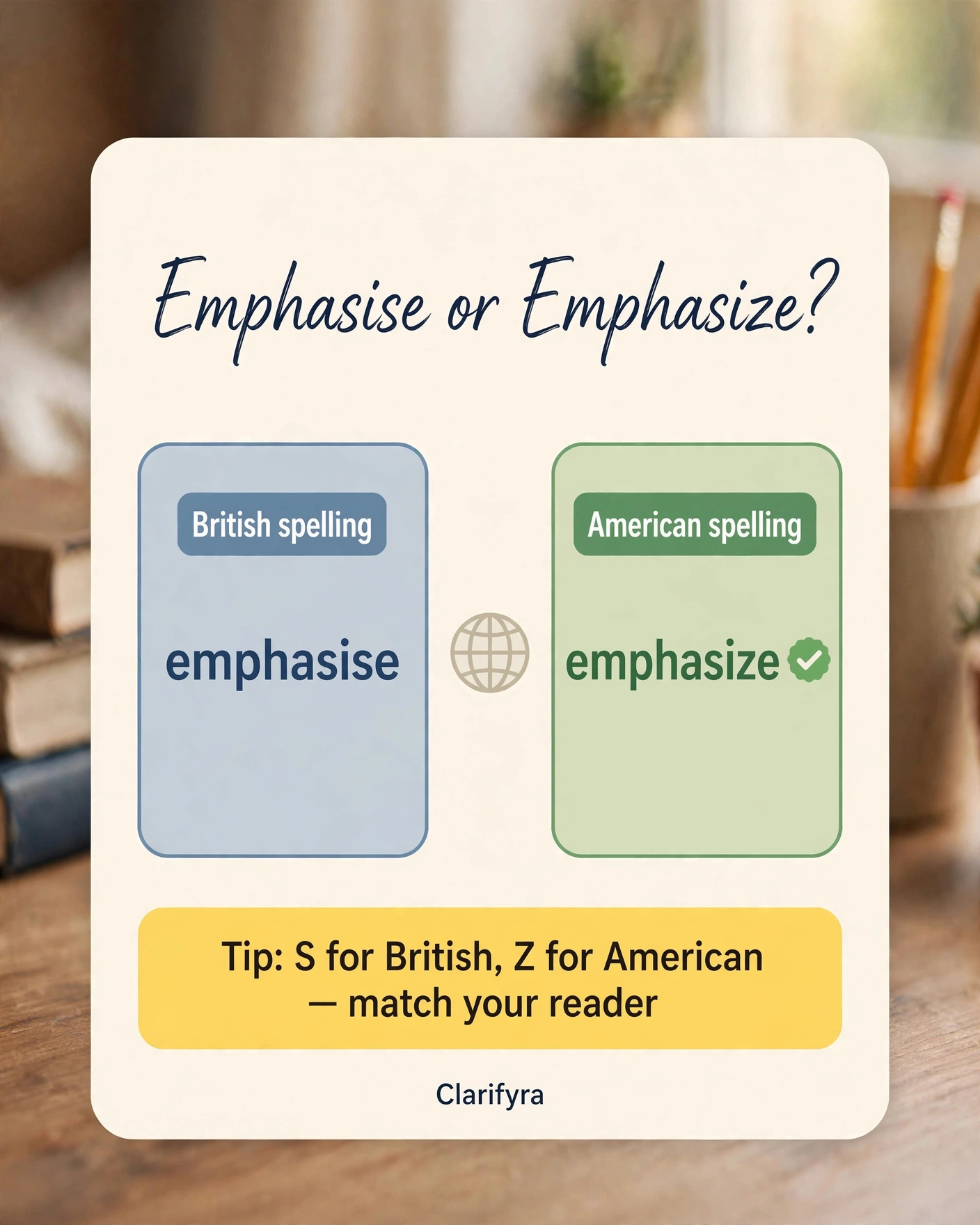
Emphasise or Emphasize: Which Is Correct?
The correct spelling depends on where you’re writing: emphasise is British English and emphasize is American English. Both are fully correct. Every major dictionary lists both forms and labels the difference as regional: Cambridge gives “emphasize, (also emphasise British)”, Oxford Learner’s notes “(British English also emphasise)”, Merriam-Webster calls “emphasise” the “British spelling of emphasize”, and Collins adds the regional note “in BRIT, also use emphasise”.
Quick Answer
Emphasise (British) and emphasize (American) are both correct spellings of the same transitive verb, meaning “to give special importance or prominence to something.” The noun is emphasis in both varieties. The pronunciation is identical on both sides of the Atlantic — /ˈemfəsaɪz/ — so this is a purely written split. Use the form your audience expects and stay consistent throughout your document.
What the Dictionaries Actually Say
We checked all four major dictionaries, and they agree on the facts — they just present them slightly differently:
| Dictionary | How it lists the word | Regional label |
|---|---|---|
| Cambridge | “emphasize, (also emphasise British)” | Emphasise marked as the British form; defined as “to lay or put emphasis on” |
| Oxford Learner’s | “emphasize … (British English also emphasise)” | British English form noted on the main entry |
| Merriam-Webster | “emphasise — British spelling of emphasize” | -ise given as the British variant |
| Collins | “emphasize … regional note: in BRIT, also use emphasise” | British regional note; “to give emphasis to; give special force or prominence to; stress” |
Two details are worth noticing. First, Cambridge is itself a British publisher, and its own editorial writing uses “emphasise” — you’ll see it in Cambridge’s grammar explanations. That tells you where mainstream British style lands. Second, Oxford Learner’s gives the same pronunciation for both forms — /ˈemfəsaɪz/ in both British and American audio. The s/z difference exists only on the page; the mouth always says “z”.
The Split Behind the Word: -ise vs -ize
Emphasise/emphasize isn’t an isolated quirk — it belongs to one of the largest and most predictable families of British/American spelling differences. The same split runs through dozens of verbs:
| British (-ise) | American (-ize) |
|---|---|
| organise | organize |
| realise | realize |
| recognise | recognize |
| prioritise | prioritize |
| characterise | characterize |
| apologise | apologize |
| utilise | utilize |
| emphasise | emphasize |
Mainstream British English prefers -ise for this family; American English uses -ize almost without exception. In UK media, -ise dominates — The Times switched in 1992, and the BBC, Telegraph, Economist, and Guardian all follow it; the British National Corpus (to 2002) shows -ise outnumbering -ize by about three to two.
Here’s the irony: Collins’s etymology dates this word to 1820–30, formed as emphasis + -ize — so the z came first, and the British s is the later adaptation. The same Atlantic split shows up across whole families of words — another classic example is fuelled vs fueled, where the two varieties disagree about doubling the consonant instead.
The Twist: British Publishing That Uses “Emphasize”
So “emphasize” is always American? Not quite. There’s a respectable British tradition that uses the -ize spelling too — it’s called Oxford spelling, and it’s the house style of Oxford University Press, most famously the Oxford English Dictionary. Journals like Nature, the Biochemical Journal, and The Times Literary Supplement use it as well, and it has its own language tag (en-GB-oxendict).
Oxford spelling applies where the ending derives from the Greek suffix -izo — roughly 200 verbs, and “emphasize” is one of them. So “emphasize” in a British-published journal or an OUP-style text isn’t an Americanism slipping through; it’s a deliberate British convention. Meanwhile the rest of British publishing (Cambridge University Press, the UK government, most newspapers) sticks with -ise — UK government style guidance even advises writers against “Americanisms,” noting the -ize spelling “is often seen as such.”
Canada, Australia, and the Rest of the World
Other English-speaking countries have picked their sides:
- Canada favors -ize. The Government of Canada’s own language portal notes that “the majority of us favour the traditional spelling ‘-ize'” for verbs like organize, civilize, and specialize, and Canadian editors’ guides explicitly advise: “Use the American form for ise/ize verbs.” A Canadian dictionary lists “emphasize” as the Canadian form, with “emphasise” as the British one. Usage data puts Canadian use of “emphasizing” at roughly 90% — while Canadians still spell “colour” and “centre” the British way.
- Australia, New Zealand, Ireland, and India favor -ise. In these countries the -ise spellings strongly prevail: the Macquarie Dictionary puts the preference for -ise in Australian English at about three to one, and Ireland is nearly unanimous. Usage data shows “emphasising” beating “emphasizing” by about 68 to 32 in Australia, 74 to 26 in New Zealand, and effectively 100 to 0 in Ireland.
Match your reader: “emphasise” for UK, Australian, and New Zealand audiences; “emphasize” for American and Canadian ones.
All the Verb Forms, in Both Varieties
The spelling split runs through every inflected form — and note that none of them double the consonant, because the stress falls on the first syllable (EM-pha-sise):
| Form | British | American |
|---|---|---|
| Base verb | emphasise | emphasize |
| Third-person singular | emphasises | emphasizes |
| Present participle | emphasising | emphasizing |
| Past tense / past participle | emphasised | emphasized |
Oxford Learner’s confirms the inflected forms directly (emphasizes /ˈemfəsaɪzɪz/, emphasized /ˈemfəsaɪzd/, emphasizing /ˈemfəsaɪzɪŋ/), and Collins lists them as word forms on the entry. One rule to remember: there’s no consonant doubling anywhere in the family — “emphasissed” is simply wrong. (Doubling rules have their own quirks elsewhere: see enrol or enroll, where British “enrol” becomes “enrolled” — with two l’s — in the past tense in both varieties.)
The Words That Don’t Play Along: Always -ise, and the -yse Exception
Two traps catch people who learn the -ise/-ize rule and then over-apply it:
1. Some words always keep -ise, in every variety. The -ize spelling is only legitimate where the ending is the Greek-derived verb suffix. In words like advertise, advise, compromise, devise, exercise, improvise, supervise, surprise, revise, televise, franchise, and merchandise, the -ise is part of the root itself — there is no -ize alternative anywhere. Writing “advertize” or “supervize” is wrong in British, American, and Oxford spelling alike. The Oxford spelling guides are explicit about this: don’t “correct” these to -z.
2. The -yse family keeps its y in British and Oxford spelling. Verbs like analyse, paralyse, catalyse, and dialyse come from Greek lysis (“loosening”), not from the -izo suffix — so British and Oxford spelling keep the -yse form, while American English uses “analyze” and “paralyze.” “Analize” is wrong everywhere; “analyze” is out of place in British English.
The Noun Is “Emphasis” — in Both Varieties
The spelling split stops at the verb. The noun is emphasis everywhere — no major dictionary records a noun “emphasize” or “emphasise,” so don’t write one. “The emphasis is on teamwork” is correct in London, New York, Toronto, and Sydney alike.
One more usage point, because it causes constant errors: the verb is transitive — it takes a direct object, no preposition. Collins’s verb patterns show it used as “VERB that” (“It’s been emphasized that no major policy changes can be expected”) and “V how” (“discuss pollution with your child, emphasizing how nice a clean street looks”). So say “emphasize that…” or “emphasize the importance of…” — never “emphasize on…”. If you want “on,” switch to the noun: “place emphasis on,” “put the emphasis on.”
Common Mistakes
1. Mixing both spellings in one document. ✗ “The report emphasises efficiency, and it also emphasizes teamwork.” → ✓ Pick one per document and stick with it.
2. Using the verb where the noun belongs. ✗ “The emphasize is on teamwork.” → ✓ “The emphasis is on teamwork.” The noun never changes; only the verb has two spellings.
3. Writing “emphasize on.” ✗ “The report emphasizes on cost.” → ✓ “The report emphasizes the cost.” / “The report places emphasis on cost.” The verb takes a direct object, not “on.”
4. “Correcting” someone else’s variety. ✗ Flagging British “emphasise” as a typo in a UK document — or “emphasize” in an American one. Spellcheckers set to the wrong locale do this constantly; set yours to match your audience’s variety.
5. Hypercorrecting words that never take -z. ✗ “advertize,” “supervize,” “surprize.” → ✓ advertise, supervise, surprise. These aren’t part of the -ise/-ize family at all — the -ise is part of the root.
6. Using “analyze” in British English. ✗ “The data was analyzed.” (in a British document) → ✓ “The data was analysed.” The -yse family follows its own rule, from a different Greek root.
Frequently Asked Questions
Is “emphasise” a misspelling of “emphasize”?
No — and it isn’t the other way around either. All four dictionaries we checked — Cambridge, Oxford Learner’s, Merriam-Webster, and Collins — list both forms, each with a regional label. “Emphasise” is simply the standard British spelling, just as “organise” and “realise” are.
Is there any difference in meaning or pronunciation?
None. The meaning is identical — “to give special importance or prominence to something” — and Oxford Learner’s gives the same pronunciation (/ˈemfəsaɪz/) for both forms in both British and American English. A purely written split.
What does Oxford University Press itself use?
“Emphasize.” OUP follows Oxford spelling, which uses -ize for the Greek-derived verb family even in British English — so an -ize ending isn’t automatically American. If your publisher follows OUP style, write “emphasize”; for standard British English, write “emphasise.”
Which spelling should I use in Canada?
Emphasize (with z). Canadian style favors the American form for -ize/-ise verbs — the Government of Canada’s language portal says the majority of Canadians favor “-ize” for verbs like organize and specialize — while keeping British forms elsewhere (colour, centre, travelled).
Which spelling should I use in Australia or New Zealand?
Emphasise (with s). The -ise spellings strongly prevail in Australia, New Zealand, Ireland, and India — the Macquarie Dictionary records about a three-to-one preference for -ise in Australian English.
Do all the other verb forms follow the same split?
Yes. The whole family moves together: emphasises/emphasizes, emphasising/emphasizing, emphasised/emphasized. There’s no consonant doubling in any of them — the stress is on the first syllable, so a single s is all you ever write.
Is it “emphasize on” or “emphasize that”?
“Emphasize that” (or “emphasize the importance of…”). The verb is transitive and takes a direct object — “emphasize on” isn’t standard English. If the sentence needs “on,” use the noun instead: “place emphasis on.”
Final Takeaway
Emphasise is British, emphasize is American, and both are correct — the dictionaries are unanimous on that. The split is written-only (even the pronunciation is identical), it runs through every verb form, and the noun “emphasis” never changes. Match your audience’s variety, watch for Oxford spelling in British academic texts, set your spellchecker to the right locale, and keep “emphasize on” out of your sentences.