Comming or Coming: Which Is Correct?
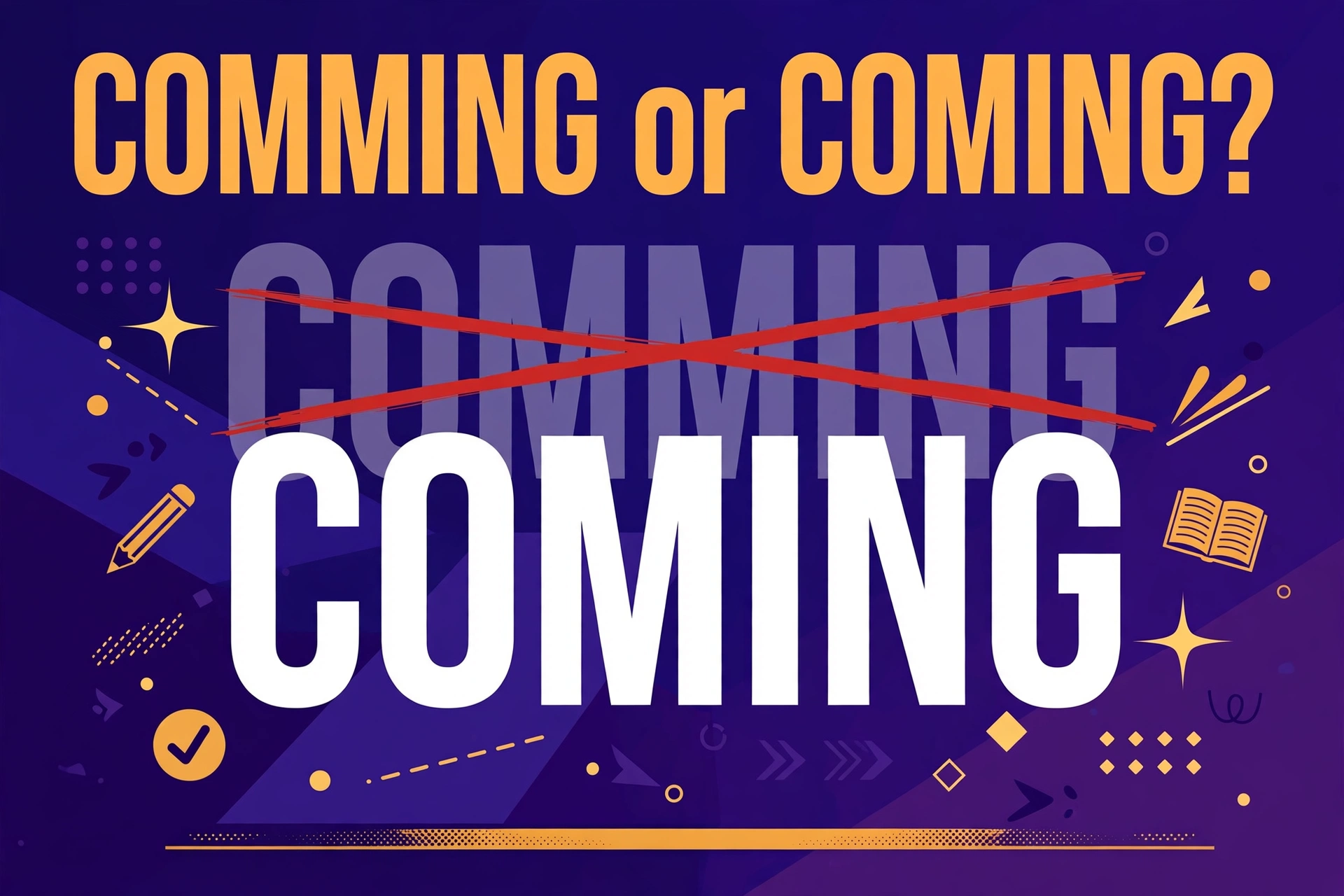
If you have ever hesitated between comming and coming — usually mid-text-message, thumb hovering over the keyboard — here is the short version: coming is the only correct spelling. Comming, with the double m, is a misspelling. No standard dictionary lists it. Cambridge Dictionary gives the forms of the verb come as “present participle coming | past tense came | past participle come” — one m, every time, in both British and American English.
The error deserves an explanation rather than just a red underline, because nobody writes comming out of carelessness. They write it because English genuinely has a consonant-doubling rule — run becomes running, swim becomes swimming — and come looks like a perfect candidate for the same treatment. It isn’t, and the reason is a different, quieter rule: verbs ending in a silent e drop the e before adding -ing. Come + -ing = coming. The extra m never had a job to do.
Why the Extra M Sneaks In
English spelling has a real rule that says: double the final consonant when a one-syllable verb ends in a single vowel followed by a single consonant. Run → running. Stop → stopping. Swim → swimming. Plan → planning. A learner who has internalised that pattern looks at come — short word, single vowel sound, ends in m — and doubles the m by analogy. The logic is sound; it is just aimed at the wrong rule.
The catch is the silent e. In run and swim, the consonant is the last letter. In come, the last letter is e, and that changes everything. When a verb ends in silent e, the e is dropped before -ing, and no doubling happens: write → writing, make → making, take → taking, hope → hoping, dance → dancing. Come belongs to this family, not to the run/swim family.
There is also a rhythm factor. In fast typing, doubling a consonant feels like emphasis — the finger just hits the key twice. Combined with the genuine running/swimming analogy, comming is one of the most natural misspellings in English. Natural, but still wrong.
The Silent-E Rule, Spelled Out
The rule is simple once stated plainly: if the verb ends in a silent e, drop the e and add -ing. Do not double the consonant.
- come → coming (not comming, not comeing)
- write → writing
- make → making
- take → taking
- live → living
- move → moving
Two fine-print cases are worth knowing so the rule doesn’t misfire elsewhere. First, verbs ending in -ee, -ye, or -oe keep the e: see → seeing, agree → agreeing, dye → dyeing (kept precisely to distinguish it from dying). Second, the doubling rule still applies where there is no silent e to drop: run → running, begin → beginning, admit → admitting. The two rules never compete, because they apply to different word shapes.
A Memory Hook: “Become” → “Becoming”
If you can spell becoming — and almost everyone can — you already know the pattern for coming. Become is built on come, follows the identical silent-e rule, and nobody writes becomming. When in doubt, test the word against its longer cousin: if becoming has one m, so does coming. Teachers report this is one of the few mnemonics that genuinely sticks, because it converts an abstract rule into a word the writer already spells correctly.
“Coming” in Real Sentences
- Are you coming to the party tonight?
- The train is coming — hurry up.
- She is coming home for the holidays.
- Winter is coming, and the heating bills with it.
- He kept coming back to the same question.
- The new album is coming out in March.
- They saw it coming from a mile away.
Notice that in every case coming is doing the work of the verb come in its -ing form — continuous tenses (“is coming”), gerunds (“coming home early is wise”), and participles (“the coming weeks”). The spelling doesn’t change with the job.
Correct vs. Incorrect
| Correct | Incorrect |
|---|---|
| I’m coming over after lunch. | I’m comming over after lunch. |
| The storm is coming this way. | The storm is comming this way. |
| She kept coming late to meetings. | She kept comeing late to meetings. |
| They’re becoming good friends. | They’re becomming good friends. |
| The coming year will be busy. | The comming year will be busy. |
| Christmas is coming! | Christmas is comming! |
Mistakes That Travel With This One
Comming rarely travels alone. The same uncertainty produces a small family of related errors:
- Comeing — keeping the silent e instead of dropping it. Wrong for the same reason comming is wrong: the rule is drop-then-add, not keep or double.
- Over-applying the double — writing becomming, overcomming. Same fix: one m throughout the come family.
- One caution on proximity: comming sits uncomfortably close to a vulgar slang term spelled with u. In professional writing, getting coming right matters twice — a typo here can change the register of your sentence entirely.
- Confusing came and come — the past tense is came (“she came yesterday”), the past participle is come (“she has come home”). Neither takes a double m either.
Frequently Asked Questions
Is “comming” ever correct?
No. It is not listed in Cambridge, Oxford Learner’s, Merriam-Webster, or Collins as a word in any sense. Cambridge lists the present participle of come as coming and nothing else. If you see comming in the wild, it is a typo.
Why isn’t it “comming” like “running”?
Because the doubling rule only applies when the verb ends in a single vowel + single consonant with no silent e — run, swim, stop. Come ends in a silent e, which triggers the drop-the-e rule instead. Two different word shapes, two different rules.
What about “become” — is it “becoming” or “becomming”?
Becoming, with one m. It follows the exact same silent-e rule as come, which makes it a handy check: whatever you do to become, do to come.
How is “coming” pronounced?
“KUM-ing,” with the stress on the first syllable. Cambridge gives come as /kʌm/ in both British and American English, and the -ing form adds an unstressed second syllable. The pronunciation is the same on both sides of the Atlantic.
Will spellcheck catch “comming”?
Usually, yes — because comming isn’t a word, most spellcheckers flag it. But don’t outsource the decision: autocorrect on phones has been known to “learn” misspellings from repeated use, and in handwritten or exam settings there is no safety net at all.
The Whole “Come” Family Keeps One M
The silent-e rule doesn’t stop at come. Every verb built on it behaves identically — which gives you a built-in spellcheck for the whole family:
- become → becoming (not becomming)
- overcome → overcoming
- welcome → welcoming
The adjectives built on the participle follow suit: upcoming (“the upcoming election”), oncoming (“oncoming traffic”), forthcoming. One m in every one of them, because the same silent e is dropped each time. The noun income is a different construction — a closed compound of in + come — but it keeps the single m too, which is why “inccomme” looks as wrong as it is.
A useful test when you hesitate: say the base verb aloud and listen for the silent e doing its job. In come, the e keeps the o long — without it you’d have “com” rhyming with “Tom.” That working e is dropped before -ing, and nothing is doubled to replace it. Run has no such e, so its consonant doubles instead. Two word shapes, two rules, zero exceptions in this family.
The Takeaway
Coming — one m — is the present participle of come, full stop. The double-m version is a misspelling born from a reasonable analogy with running and swimming, but come ends in a silent e, and silent-e verbs drop the e before -ing without doubling anything. Remember becoming, and you’ll never double the m again. Cambridge’s entry for come lists the forms for confirmation.