Shyer or Shier: Which Is Correct?
If you are unsure whether the comparative form of shy should be written as shyer or shier, you are not alone. The two forms look different because English has more than one spelling pattern for adjectives ending in -y. The good news is that this is not a case of one being right and the other being wrong. Both “shyer” and “shier” are accepted comparative forms of “shy.” They mean essentially the same thing: more shy, timid, reserved, or reluctant than someone or something else.
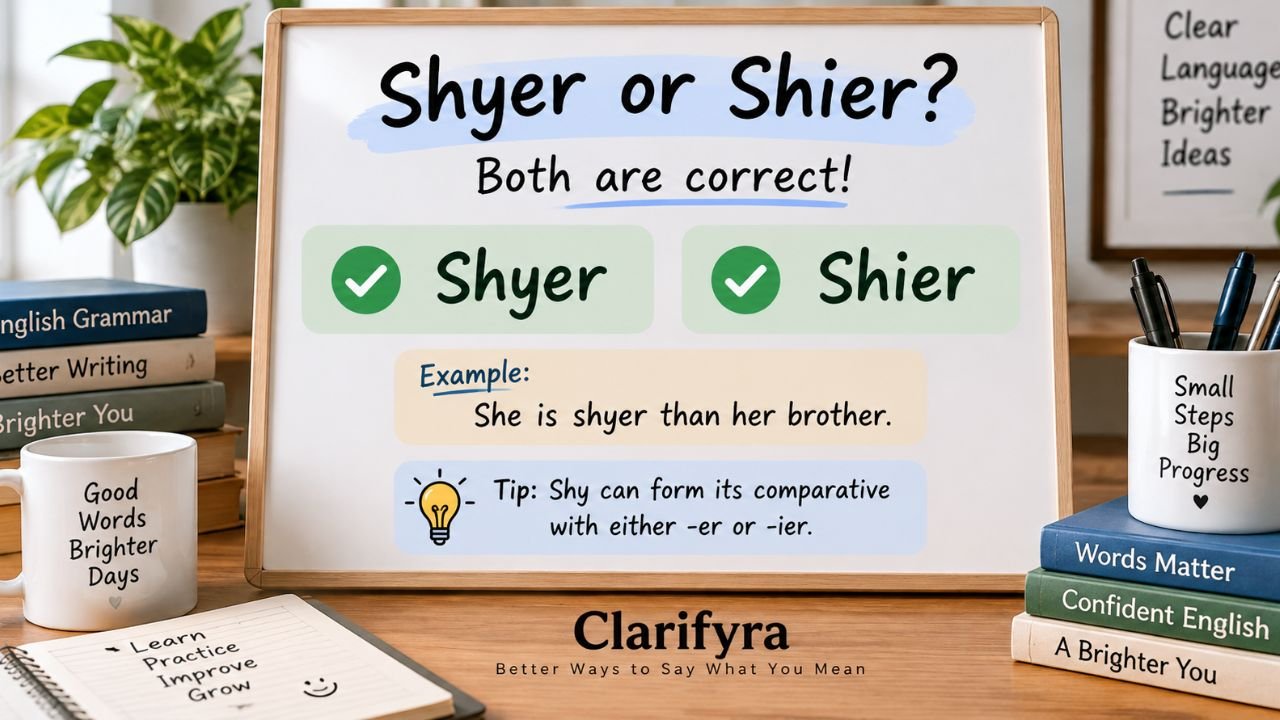
Both “shyer” and “shier” are correct. They are alternative comparative forms of the adjective shy and have the same basic meaning: “more shy.” You can write “She is shyer than her brother” or “She is shier than her brother.”
Shyer vs. Shier at a Glance
| Feature | Shyer | Shier |
|---|---|---|
| Correct spelling? | Yes | Yes |
| Base adjective | shy | shy |
| Form | Comparative | Comparative |
| Meaning | More shy | More shy |
| Typical example | She is shyer than me. | She is shier than me. |
| Misspelling? | No | No |
The important point is that neither spelling is simply an error. Both can be used as the comparative form of shy.
What Does “Shyer” Mean?
Shyer is the comparative form of shy. It describes someone or something that is more shy, timid, reserved, or hesitant than another person or thing.
For example:
- Mia is shyer than her older sister.
- The puppy became shyer around unfamiliar people.
- He was shyer when he first started school.
- Some children are naturally shyer in large groups.
The word is an adjective in these sentences because it describes a person or animal.
Shy → Shyer
The basic progression can be written as:
shy → shyer → shyest
Here, shyer expresses the comparative degree, while shyest expresses the superlative degree.
What Does “Shier” Mean?
Shier has the same basic meaning as shyer. It is also a comparative form of shy.
Examples include:
- Daniel is shier than his brother.
- The horse was shier around strangers.
- She became shier after moving to a new school.
- The shier students preferred smaller groups.
There is no meaningful difference in definition between shier and shyer. The main difference is simply the spelling.
The corresponding pattern can be shown as:
shy → shier → shiest
So English allows both:
shy → shyer → shyest
and:
shy → shier → shiest
Shyer or Shier Grammar: Why Are Both Correct?
The reason this can seem confusing is that English has a common spelling rule for adjectives ending in -y.
For example:
- happy → happier
- easy → easier
- busy → busier
In these words, the final y changes to i before -er.
That makes shier look like the expected form of shy. However, shy can also retain its y, producing shyer.
Major grammar references recognize this variation. The Cambridge Grammar of the English Language specifically discusses shyer/shier among adjectives that can have alternative comparative forms.
So neither spelling needs to be “corrected” when it is used as the comparative of shy.
What Is the Difference Between the Two?
There is no significant difference in meaning between shyer and shier.
Compare:
Anna is shyer than her cousin.
and:
Anna is shier than her cousin.
Both sentences say that Anna is more shy than her cousin.
The choice is therefore primarily a matter of spelling preference rather than a difference in grammar or meaning.
Which One Should You Use?
If you prefer the form that keeps the original y, use shyer.
If you prefer the traditional y → i pattern seen in words such as happier and busier, use shier.
Either is acceptable in standard English.
The most important thing is to use the form consistently within your own writing.
Shyer and Shier in Sentences
Seeing both forms in context makes the distinction easier.
Examples with “shyer”
- Liam is shyer than his classmates.
- The cat became shyer after moving to a new home.
- She was much shyer as a child.
- The shyer students often preferred working in pairs.
Examples with “shier”
- Liam is shier than his classmates.
- The cat became shier after moving to a new home.
- She was much shier as a child.
- The shier students often preferred working in pairs.
Notice that changing shyer to shier does not change the meaning of these sentences.
Is “Shier” a Real Word?
Yes. Shier is a real and accepted English word.
It is the comparative form of shy, meaning more shy. It should not be treated as a misspelling of shyer.
For example:
The younger dog is shier around visitors.
Here, shier correctly compares the dog’s level of shyness with that of another dog or with an earlier state.
Is “Shyer” a Real Word?
Yes. Shyer is also a standard word.
It is another comparative form of shy.
For example:
Mark is shyer in large groups than he is when talking to close friends.
There is no grammatical error in using shyer.
What Does the Oxford Dictionary Say?
The Oxford dictionary material associated with shy recognizes alternative comparative and superlative forms, including shyer and shier.
This is important because it confirms that the two forms should not be treated as a simple correct-versus-incorrect spelling pair.
Other major dictionary sources also record shier and shyer as comparative forms of shy. The underlying adjective remains the same, and both forms express the comparative meaning “more shy.”
What About “Shyest” and “Shiest”?
The same variation appears in the superlative forms.
Both of these are used:
- shyest
- shiest
They mean most shy.
The complete patterns are therefore:
| Degree | Y-form | I-form |
|---|---|---|
| Positive | shy | shy |
| Comparative | shyer | shier |
| Superlative | shyest | shiest |
For example:
Tom is shyer than Jack.
But:
Tom is the shyest person in the group.
Alternatively:
Tom is shier than Jack.
And:
Tom is the shiest person in the group.
Both patterns are grammatically possible.
Can You Say “More Shy”?
Yes. More shy is also possible, particularly when a writer wants to use an analytical comparative construction.
For example:
She became more shy after the experience.
However, shyer and shier are established comparative forms, so there is no need to avoid them.
In ordinary writing, you may encounter all three:
- shyer
- shier
- more shy
The first two are single-word comparative forms.
Common Mistakes to Avoid
1. Assuming “shier” is a misspelling
Because shyer is familiar to many readers, shier can look unusual. However, shier is correct.
2. Assuming “shyer” violates the -y to -i rule
The pattern in happy → happier does not mean every adjective ending in y must change in exactly the same way. Shy permits the form shyer.
3. Treating the two words as having different meanings
They do not normally have different meanings. Both mean more shy.
4. Mixing the forms unnecessarily
There is no grammatical reason to write shyer in one sentence and switch to shier in another. Choose the form you prefer and maintain consistency when practical.
Easy Way to Remember
A simple way to remember the distinction is:
Shy has two accepted comparative forms:
shy → shyer
shy → shier
Think of them as two spelling routes to the same destination. If you see either shyer or shier in a sentence where a comparison is being made, it does not automatically indicate a spelling mistake.
FAQ
Is it shyer or shier?
Both are correct. Shyer and shier are alternative comparative forms of shy. Both mean “more shy,” so either can be used when comparing two people, animals, or things.
Which is more correct, shyer or shier?
Neither is inherently more correct. Both forms are recognized in standard English. The choice is primarily a matter of spelling preference rather than a difference in grammatical correctness.
Is “shier” a proper English word?
Yes. Shier is the comparative form of shy and means “more shy.” It is a legitimate English word, not simply a misspelling of shyer.
Is “shyer” grammatically correct?
Yes. Shyer is a grammatically correct comparative form of shy. For example, “She is shyer than her brother” is a standard English sentence.
Are “shyer” and “shier” pronounced the same?
They are generally pronounced the same or very similarly in standard English. The difference is principally in their written form, not their meaning.
Are “shyest” and “shiest” both correct?
Yes. Both are accepted superlative forms of shy. They mean “most shy,” just as shyer and shier mean “more shy.”
Final Verdict
Shyer and shier are both correct. They are alternative comparative forms of shy, and neither should be automatically marked as a spelling mistake. If you are writing a sentence such as “She is ___ than her sister,” both shyer and shier work.
For clear, accurate word-choice guidance, Clarifyra helps you understand not only which forms are acceptable, but also how and when to use them naturally.