Focusses or Focuses: Which Spelling Is Correct?
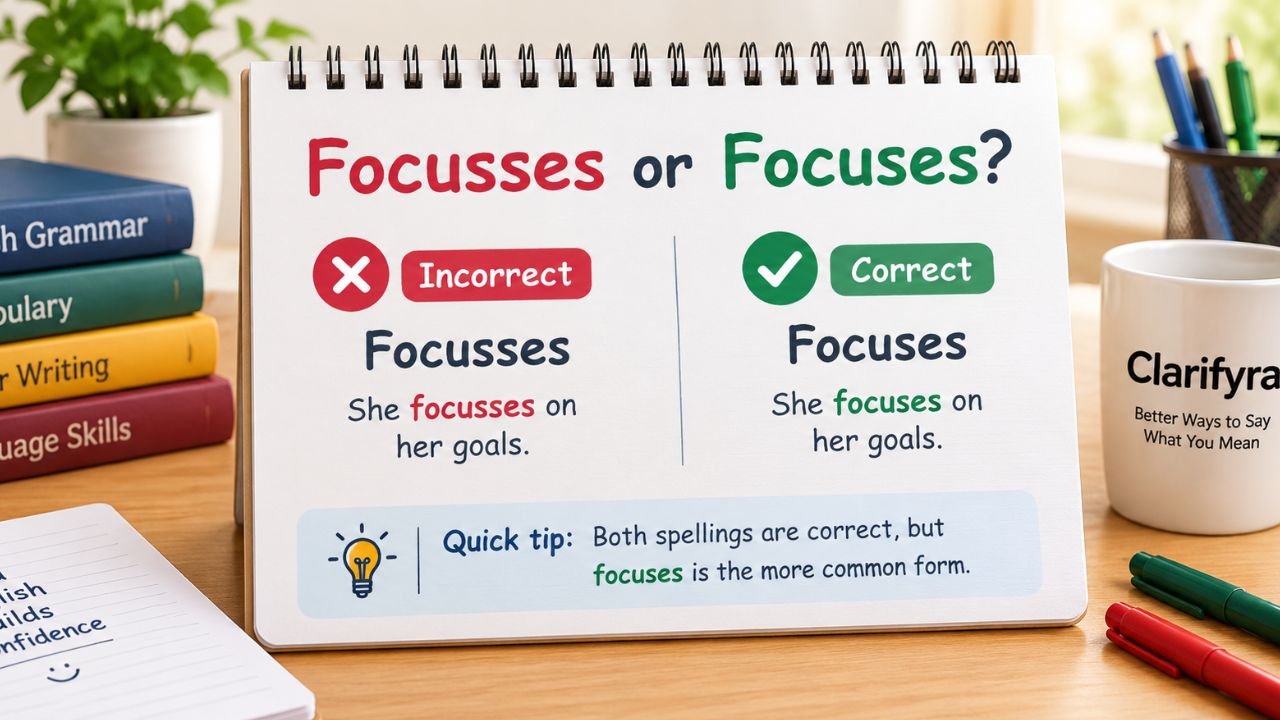
Both focusses or focuses are accepted spellings of the third-person singular form of the verb focus. However, focuses is the more widely used form, particularly in American English and general international writing. Focusses is also legitimate and is found in British, Canadian, Australian, and other varieties of English.
Both “focusses” and “focuses” are correct. “Focuses” is the more broadly used spelling, while “focusses” is an accepted alternative, especially in British and other Commonwealth varieties of English. In US English, focuses is the standard choice.
Focusses vs Focuses at a Glance
| Feature | Focuses | Focusses |
|---|---|---|
| Correct spelling? | Yes | Yes |
| Part of speech | Verb; also plural noun | Verb; also plural noun in some usage |
| Meaning as a verb | Directs attention toward something | Same |
| US English | Standard | Less usual |
| British English | Accepted | Accepted |
| Canadian English | Accepted | Accepted |
| Australian English | Common | Also used |
| Example | She focuses on grammar. | She focusses on grammar. |
The two forms have the same meaning when used as verbs. The main difference is spelling convention and regional preference, not meaning.
What Does “Focuses” Mean?
Focuses is the third-person singular present form of focus.
The verb focus means to direct attention, effort, discussion, or activity toward a particular subject or goal.
For example:
- The article focuses on English grammar.
- She focuses on improving her writing.
- The course focuses on practical communication.
- The report focuses on workplace safety.
Here, focuses is used with a singular subject such as he, she, it, or a singular noun.
The researcher focuses on language development.
The base verb is focus, but the third-person singular form takes an ending. English allows both focuses and focusses for this form.
What Does “Focusses” Mean?
Focusses has the same meaning as focuses when it is used as a verb.
For example:
The documentary focusses on environmental issues.
This means exactly the same thing as:
The documentary focuses on environmental issues.
The spelling with -ss- is an established variant rather than a random misspelling. Major dictionaries and language references recognize it.
So if you see focusses in British or Commonwealth writing, it does not automatically mean the writer has made a spelling mistake.
Why Are Both Spellings Correct?
The variation comes from the way English handles words ending in -s when suffixes are added.
The word focus already ends in s. Writers and style systems have traditionally handled the additional ending in two ways:
- focus + es → focuses
- focus + ses → focusses
Both forms have become established in English usage.
The same variation appears in related forms:
- focused / focussed
- focusing / focussing
Oxford lists these as alternative forms, while Cambridge’s publishing guidance allows focuses/focusing and focusses/focussing in British English.
The important point is that focusses is not simply an incorrect version of focuses.
British English: Focusses or Focuses?
Both spellings are acceptable in British English.
British writers may use:
The study focuses on pronunciation.
or:
The study focusses on pronunciation.
Both are grammatically correct.
Oxford records both forms, and Cambridge University Press states that British English can use either focusses/focussing or focuses/focusing, provided the spelling is used consistently.
This means it is too simplistic to say that focusses is British English and focuses is American English. British English accepts both.
For most general-purpose writing, focuses is an easy choice because it is familiar to readers in Britain as well as readers elsewhere.
US English: Which Form Should You Use?
In American English, focuses is the normal standard spelling.
For example:
The program focuses on reading comprehension.
The company focuses on customer service.
American English style guidance generally uses focuses, focused, and focusing.
If you are writing specifically for a US audience, focuses is therefore the safest and most natural choice.
That does not mean an American reader cannot understand focusses. It simply means the double-s spelling is much less usual in standard US writing.
Canadian English: Are Both Forms Correct?
Canadian English is particularly interesting because both spellings are explicitly accepted.
The Government of Canada’s Language Portal explains that focus may be spelled with either a single or double s before a suffix. It gives examples including:
- focuses / focusses
- focusing / focussing
- focused / focussed
So Canadian writers can use either:
The committee focuses on public safety.
or:
The committee focusses on public safety.
If you’re writing for a Canadian audience, consistency is more important than treating one of these forms as universally wrong.
Australian English: Focusses or Focuses?
Both forms can be found in Australian English.
Australian English shares many spelling conventions with British English, and focusses appears in Australian publications. Focuses is also widely used.
For example:
The campaign focuses on regional communities.
and:
The campaign focusses on regional communities.
Both can be understood and used as the third-person singular form of focus.
If your content is intended for a broad international audience, focuses is generally the simpler choice because it is familiar across American, British, Canadian, and Australian English.
Focuses or Focusses: Examples in Sentences
Because both forms have the same meaning, the choice usually depends on spelling preference or style.
Using “focuses”
- The lesson focuses on sentence structure.
- The book focuses on modern English usage.
- Our research focuses on language learning.
- The speaker focuses on practical solutions.
Using “focusses”
- The lesson focusses on sentence structure.
- The book focusses on modern English usage.
- Our research focusses on language learning.
- The speaker focusses on practical solutions.
There is no difference in meaning between the corresponding pairs.
Focuses vs Focusses in Formal Writing
Both forms can occur in formal writing, but the best choice depends on your intended variety of English and the style guide you are following.
If you are writing for an American publication, use focuses.
If you are writing in British English, either form may be acceptable, but follow the publication’s established style.
For Canadian English, both are documented as acceptable.
For Australian English, both forms occur, although focuses is a straightforward choice for broad readership.
Most importantly, do not switch unnecessarily between forms in the same piece of writing. Consistency makes your spelling look deliberate.
Focused or Focussed?
The same spelling variation occurs in the past tense and past participle.
Both are accepted:
- focused
- focussed
For example:
The discussion focused on grammar.
or:
The discussion focussed on grammar.
Oxford recognizes both forms.
American English normally uses focused, while British and Canadian usage can use either form.
Focusing or Focussing?
The present participle also has two accepted forms:
- focusing
- focussing
Examples:
She is focusing on her studies.
She is focussing on her studies.
Again, there is no difference in meaning.
Cambridge’s guidance specifically permits focuses/focusing and focusses/focussing for British English, while recommending the single-s forms for US spelling.
An Easy Way to Remember the Choice
If you want one spelling that works comfortably for a broad English-speaking audience, remember:
Focus → focuses
The single-s form is the most straightforward general choice.
If you’re following British or Canadian spelling conventions, however, don’t automatically mark focusses as an error. It is an established alternative.
A useful pattern to remember is:
- US English: focuses, focused, focusing
- British English: focuses/focusses, focused/focussed, focusing/focussing
- Canadian English: focuses/focusses, focused/focussed, focusing/focussing
Common Mistakes to Avoid
1. Calling “focusses” a universal misspelling
It isn’t. Focusses is a recognized variant.
2. Assuming British English always requires “focusses”
British English permits focuses as well. The choice can depend on the writer’s preferred style.
3. Assuming “focuses” is only American
It isn’t. Focuses is widely used in British, Canadian, Australian, and international English too.
4. Mixing spelling styles without reason
If you choose focusses, don’t randomly switch to focused and focusing without considering the style you’re following. A consistent spelling system is clearer.
FAQs
Is “focusses” a correct word?
Yes. Focusses is a recognized spelling of the third-person singular present form of focus. It is particularly associated with British and other Commonwealth varieties, although focuses is also accepted in those varieties.
Is “focuses” correct in British English?
Yes. Focuses is correct in British English. British English also accepts focusses, so neither spelling needs to be treated as universally wrong.
Which is preferred in US English, “focuses” or “focusses”?
Focuses is the standard choice in US English. American style generally uses focuses, focused, and focusing.
Which spelling is used in Canada?
Canadian English accepts both focuses and focusses. The Government of Canada’s Language Portal specifically documents both forms.
Is “focusses” the Australian spelling?
Focusses is used in Australian English, but focuses is also used. Australian writers can encounter both forms, so it is better not to describe one as the only correct Australian spelling.
Are “focused” and “focussed” both correct?
Yes. Focused and focussed are both established spellings. The single-s form is especially useful for US English, while both occur in British and Canadian usage.
The Bottom Line
Focusses and focuses are both correct. The main distinction is regional and stylistic rather than grammatical: focuses is the standard choice in US English and a widely used form internationally, while focusses remains an accepted alternative in British, Canadian, Australian, and related varieties.
For a general English website, focuses is the simplest choice, but readers should not assume that focusses is a spelling error. For more clear, practical explanations of confusing English forms, Clarifyra helps you choose wording that matches your intended meaning and audience.