Holliday or Holiday: Which Is Correct?
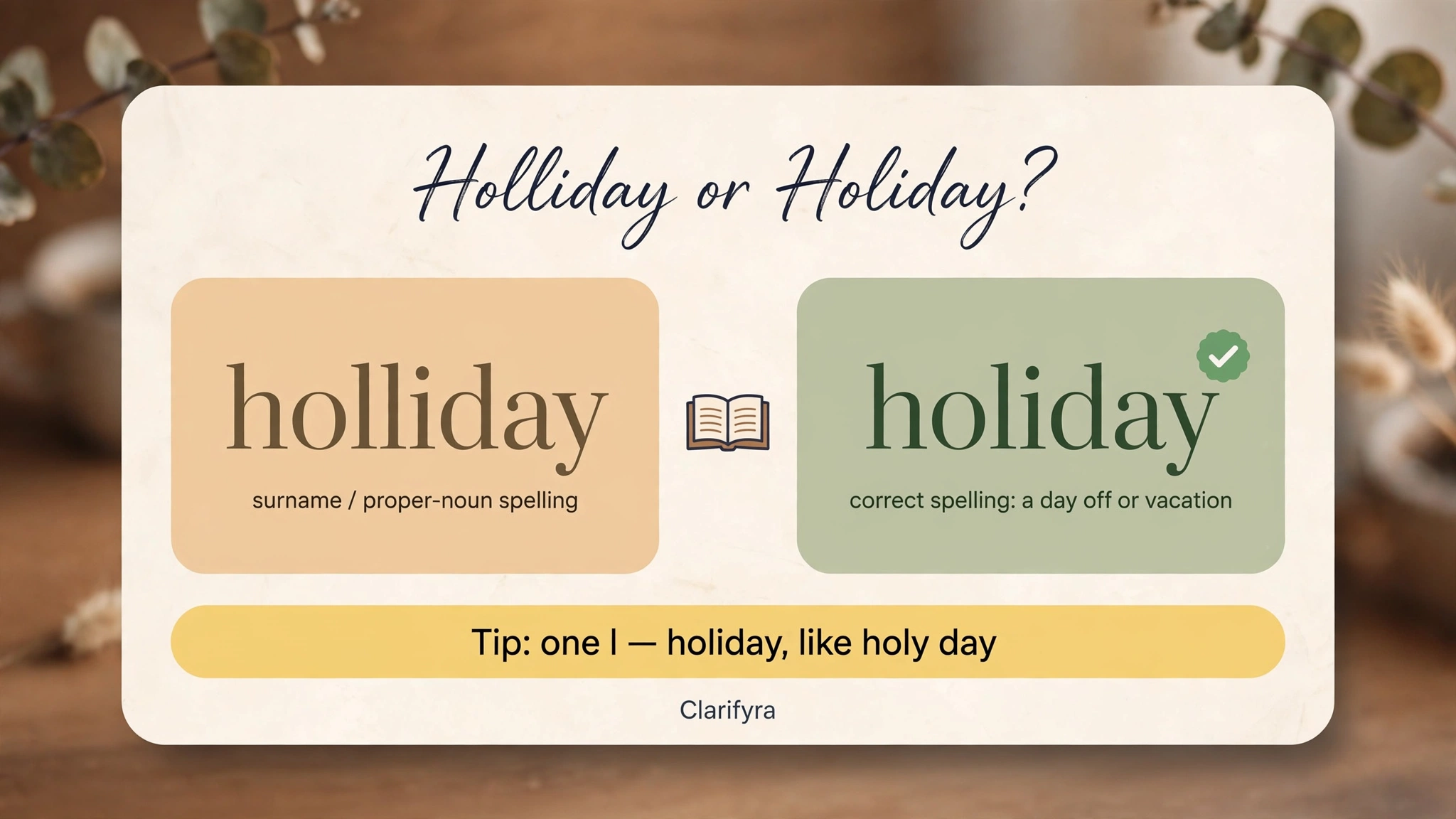
If you’ve ever hesitated between holliday and holiday, here’s the short answer: holiday, with one l, is the only correct spelling of the common noun. Holliday, with two ls, is not a variant spelling — it’s a proper noun, most familiar as a surname. So the Christmas break you’re planning is a holiday, while Doc Holliday, the dentist-gunfighter of the American West, is a person’s name.
Quick Answer
Holiday (one l) is the correct spelling of the common noun meaning a day off work, a religious festival, or — in British English — a vacation. Holliday (two ls) is a proper noun: a surname and the name of a few places in the United States. Writing “holliday” when you mean the noun is always a spelling error.
What “Holiday” Means
Holiday is a long-established English noun with three main jobs, and — with one notable split — they hold across both British and American English.
1. A day off by law or custom. This is the shared core meaning. Cambridge defines holiday as “an official day when you do not have to work or school,” and Collins’s American English entry calls it “a day fixed by law or custom on which ordinary business is suspended in commemoration of some event or in honor of some person.” Christmas Day, Thanksgiving, Eid, Diwali — all holidays in every variety of English.
2. A religious festival; a holy day. The American Heritage Dictionary lists “a religious feast day; a holy day” as a distinct sense, and Collins’s American entry includes “a religious feast day; holy day, especially any of several usually commemorative holy days observed in Judaism.” This sense is the oldest, and it explains the word’s shape: holiday comes from Old English hāligdæg, literally holy + day (via Middle English holidei). That etymology — confirmed by Collins, Webster’s New World, and the American Heritage Dictionary — is the easiest way to remember the spelling: holiday, like holy day, takes one l.
3. A vacation — but only in British English. Here’s the transatlantic split. In British English, holiday (often in the plural) means a period of leisure away from work or school: “We’re going to Spain for our summer holiday.” Collins’s British English entry marks this sense “mainly British” and notes the US and Canadian equivalent is vacation. Cambridge’s entry for holiday (“a time when someone does not go to work or school but is free to do what they want, such as travel or relax”) is tagged A1 and UK, with (US vacation) in the label. Americans use vacation for the trip and keep holiday for the public festival — so “I’m on holiday” sounds British, while “I’m on vacation” is the American default.
Holiday also works as a verb and an adjective. As a verb, to holiday means to take a vacation — Cambridge gives “We usually holiday in Spain” — and Collins marks it “chiefly British” (“to holiday at the seaside”), with past forms holidayed and holidaying. As an adjective or modifier, it means festive: “a holiday mood,” “holiday clothes.”
A couple of usage details worth filing away: the regular plural is holidays, and in American English the plural the holidays on its own usually means the Christmas–New Year period (“We were at home for the holidays,” per Cambridge).
Pronunciation
| Variety | Pronunciation |
|---|---|
| British English | /ˈhɒlədeɪ/ — HOL-uh-day |
| American English | /ˈhɑːlədeɪ/ — HAH-luh-day |
These are the Oxford Learner’s and Cambridge transcriptions. Three syllables, stress on the first. (The surname Holliday is pronounced the same way — more on that below.)
Where “Holliday” Is Legitimate: Proper Noun Only
Holliday, with two ls, is a genuine English word — just not the one you mean. It is strictly a proper noun:
- As a surname. The most famous bearer is John Henry Doc Holliday (1851–1887), the dentist, gambler, and gunfighter of the American West — a cultural fixture, and the reason many writers half-remember “double l” as the word’s natural shape. Actresses and athletes carry the name today as well.
- As a place name. Holliday is a village in Missouri, a city in Texas, and the name of unincorporated communities in Kansas and Pennsylvania.
- As a given name. It occasionally appears as a first name, following the same pattern as other surname-names.
A note on evidence: I checked Cambridge, Oxford Learner’s, Collins, and Merriam-Webster for a common-noun entry under holliday, and none lists one. It appears in dictionaries only as a proper noun (and in name resources as a surname etymology). So the honest position is this: lowercase holliday used as a common noun is a misspelling, not a recognized variant. A surname’s spelling does not transfer to the word it came from — that’s why we write Doc Holliday but a summer holiday.
Why the Double L Looks So Plausible
This misspelling is one of the stubborn ones, and it isn’t hard to see why it survives:
- English spelling habit. After a short vowel, English often doubles the consonant (holly, belly, hollow), so a writer hearing the short o in hol- naturally reaches for two ls. But holiday is a compound of holy + day, not a stem plus suffix — the doubled consonant never belonged there.
- The surname is everywhere. Doc Holliday is a cultural fixture, and the surname Holliday is common enough that writers half-remember “double l” as the word’s natural shape.
- Autocorrect doesn’t always rescue you. Because Holliday is a real capitalized name, spellcheckers may wave the lowercase version through instead of flagging it.
The memory hook that actually works: holiday is literally holy day — and holy has one l. If you can remember holy, you can’t misspell holiday.
Correct vs. Incorrect
| Incorrect ✗ | Correct ✓ | Note |
|---|---|---|
| Happy Hollidays! | Happy Holidays! | Greeting cards included — one l. |
| We went to Greece for our holliday. | We went to Greece for our holiday. | Vacation sense, British English. |
| Next Monday is a holliday. | Next Monday is a holiday. | Public day off, any variety. |
| Have a good holliday season. | Have a good holiday season. | Festive modifier. |
| Doc Holiday | Doc Holliday | The surname keeps its double l. |
✓ She took a week’s holiday in June.
✗ She took a week’s holliday in June.
✓ Holliday, Texas, is named for an early settler family.
✗ The whole office gets Hollidays off. (Unless you work for the Holliday family.)
Common Mistakes
- “Holliday season.” One of the most common sightings of the misspelling — festive shop signage, social posts, marketing emails. It’s always holiday season.
- Capitalizing the noun because of the name. Writers who know the surname sometimes write “a Holiday” with a capital H mid-sentence, or keep the double l to match. The common noun takes lowercase and one l.
- “Holiday” vs. “vacation” confusion in the same sentence. British and American speakers don’t just spell differently here — they split the meanings. If your audience is American, vacation is the natural word for the trip; holiday will read as “public festival.”
- Trusting the spellchecker. As noted, Holliday is a real name, so some tools won’t flag holliday in lowercase text. A manual once-over is worth it in anything formal.
FAQs
Is “holliday” a word?
Yes — but only as a proper noun. It’s an English surname (from the noun holiday) and the name of several US places. None of the major dictionaries list holliday as a common-noun variant of holiday. Lowercase holliday for the noun is a misspelling.
Why does the double l look so plausible?
Two reasons: the surname Holliday is genuinely common and familiar (Doc Holliday especially), so the doubled spelling sticks in memory; and English habitually doubles consonants after short vowels, making the extra l feel “right” by analogy. The etymology settles it: holiday = holy + day.
“Holiday” or “vacation” — which should I use?
For a trip in British English, holiday (“on holiday,” “summer holiday”); in American English, vacation. Both varieties use holiday for an official day off or religious festival.
Is “to holiday” a real verb?
Yes, in British English. Cambridge lists it (“We usually holiday in Spain”), and Collins marks it “chiefly British” — to holiday at the seaside. Americans would say vacation.
What’s the plural of “holiday”?
Holidays — regular, one l. Note the American idiom the holidays, meaning the Christmas and New Year period specifically.
The Takeaway
One word, one rule, one exception. The common noun is always holiday with a single l, whether you mean a public festival, a day off, or a British vacation — think holy day. The double-l spelling, Holliday, belongs to proper nouns: surnames, people like Doc Holliday, and places named after them. Get the l count right and you can’t go wrong.