Sweeped or Swept: Which Is Correct?
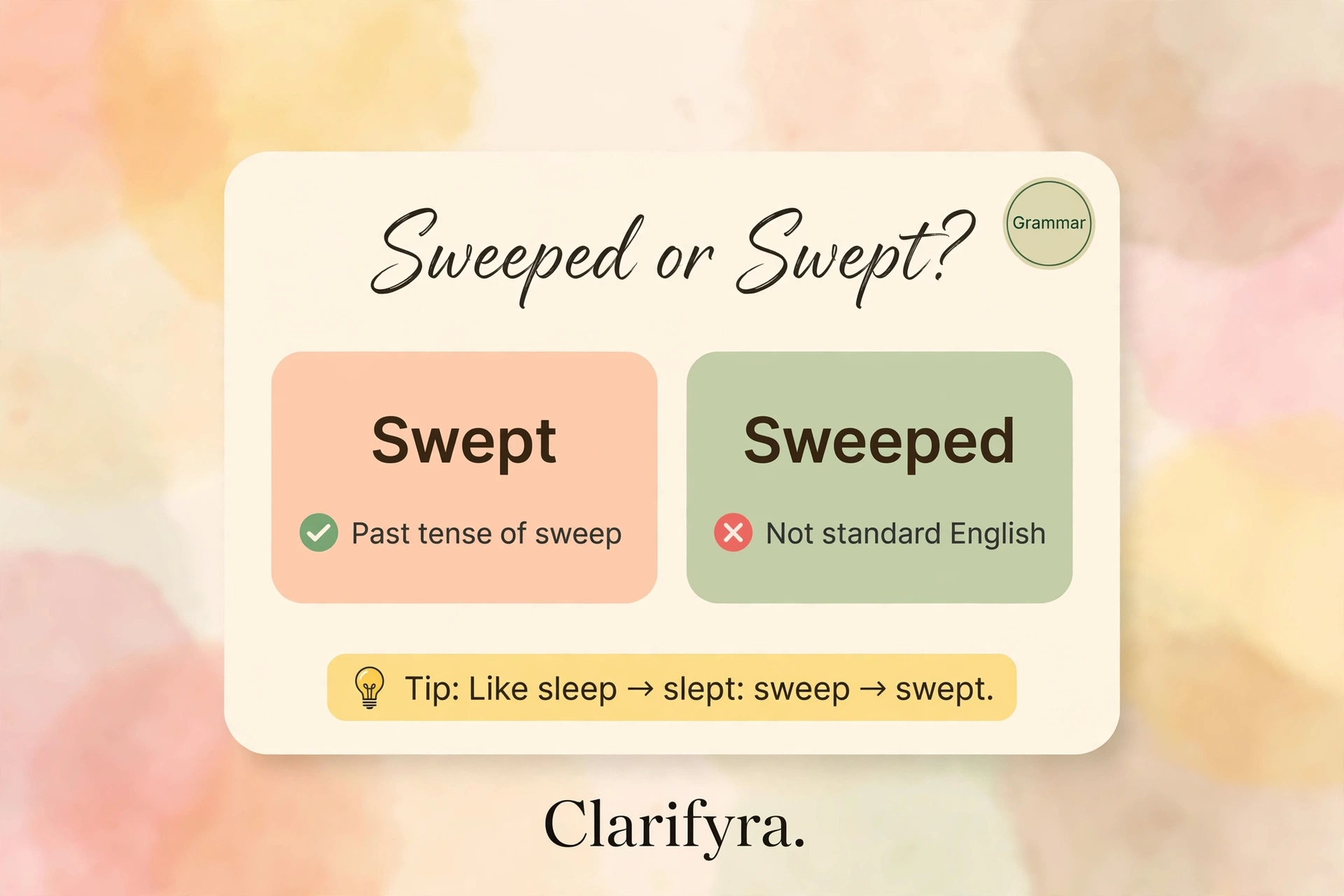
Swept is the correct past tense and past participle of sweep — in every variety of English. Sweeped is not listed as a headword in any of the major dictionaries checked; it’s a nonstandard form produced by treating the irregular verb sweep as if it were regular. “She swept the floor” is correct; “she sweeped the floor” is not.
Quick Answer
Swept is the past tense and past participle of sweep — Merriam-Webster’s entry for swept reads simply “past tense and past participle of sweep,” and its thesaurus entry says “past tense of sweep.” Sweeped appears as a headword in none of the dictionaries checked (Merriam-Webster, Cambridge, Collins); it’s an overregularization — sweep + -ed by analogy with regular verbs like walked — and should be avoided in all writing. Pronunciation: sweep /swiːp/ (“SWEEP”), swept /swept/ (“SWEPT”), the same in British and American English.
Why “Swept” and Not “Sweeped”
English has two kinds of verbs. Regular verbs form the past tense by adding -ed: walk/walked, clean/cleaned, paint/painted. Irregular verbs change their vowel or take an older ending: keep/kept, sleep/slept, weep/wept — and sweep/swept.
Sweep belongs to the irregular family of -eep → -ept verbs. Just as nobody writes “sleeped” or “keeped,” the standard past of sweep is swept. The form sweeped applies the regular -ed rule to a verb that doesn’t take it — a pattern linguists call overregularization. It’s the same instinct that makes young children say “goed” instead of “went”: the rule is real, but this verb is an exception to it.
The dictionaries are consistent on this. Merriam-Webster gives swept its own entry as the past tense and past participle of sweep. None of the dictionaries checked give sweeped a headword at all — not as a variant, not as a regional form, not as an archaism. If a spellchecker underlines sweeped, it’s right to.
The Many Meanings of “Sweep” (All Take “Swept”)
One reason sweep trips people up is that it has so many senses — and every one of them takes swept as its past tense:
- Clean with a broom: “She swept the kitchen floor.” (The original, literal sense.)
- Move swiftly: “Panic swept through the crowd.” / “The wind swept across the plain.”
- Search thoroughly: “Police swept the building.” / “They swept the room for bugs.”
- Win everything: “The team swept the series.” (Sports sense — winning every game.)
- Curve or extend: “The road swept down to the coast.” / “Her gaze swept the room.”
- Carry away: “The flood swept the bridge away.”
There’s no sense of sweep — literal or figurative — that takes sweeped. Whether you’re sweeping floors, elections, or search results, the past tense is swept.
A Bonus Sense: “Swept” as an Adjective
Swept has a second life as an adjective meaning “slanted backward” — swept wings on an aircraft, swept-back hair. Merriam-Webster lists this as its own adjective entry (“swept: slanted backward,” first known use 1903). So “a jet with swept wings” and “she swept the stage” use the same spelling for two different jobs. Sweeped fills neither of them.
Idioms Built on Sweep
Sweep anchors several idioms, and every one of them takes swept in the past tense — which makes them good practice ground:
- Make a clean sweep — to win everything or remove everything at once: “the party made a clean sweep of the council seats”; past: “they swept the awards.”
- Sweep under the rug (US) / sweep under the carpet (UK) — to conceal a problem: “the committee swept the complaints under the rug.”
- Sweep someone off their feet — to romance overwhelmingly: “he swept her off her feet.”
- Sweep the board — to win every prize or contest: “she swept the board at the championships.”
Notice the pattern: even in the most casual idiom, the past tense never becomes sweeped. “They sweeped the board” would draw the same red underline as “they sweeped the floor.” If you can say “they swept the nation” (the election sense), you can say “they swept” anywhere.
Correct vs. Incorrect
- ✓ “He swept the porch yesterday.” / ✗ “He sweeped the porch yesterday.”
- ✓ “She has swept every award this season.” / ✗ “She has sweeped every award this season.”
- ✓ “A wave of nostalgia swept over me.” / ✗ “A wave of nostalgia sweeped over me.”
- ✓ “The cleaners had already swept the hall.” / ✗ “The cleaners had already sweeped the hall.”
- ✓ “They swept the finals in three straight games.” / ✗ “They sweeped the finals…”
- ✓ “The curtains swept back to reveal the stage.” / ✗ “The curtains sweeped back…”
Common Mistakes
1. Adding -ed by analogy with regular verbs. This is the whole story of sweeped. Because most English verbs take -ed, the brain reaches for “sweeped” before the dictionary’s “swept” surfaces — especially in fast typing. If you catch yourself writing it, remember the sleep/slept, keep/kept, weep/wept family: sweep belongs with them.
2. Using “sweeped” in reported speech or casual writing “because it sounds natural.” It may sound natural, but it’s nonstandard in every register the dictionaries cover. There’s no informal-but-acceptable tier here the way there sometimes is with slang: sweeped is simply the wrong form, and editors will correct it.
3. Confusing “swept” with “swiped.” A different error, but a common one in fast writing: “he swiped the floor” (stole the floor?) or “the wave swiped over them.” Swipe means to steal or to strike with a sweeping motion of the hand or card — “she swiped her key card.” Keep swept for the past of sweep.
4. Forgetting the participle in perfect tenses. “The wind has sweep through” and “had sweeped” are both wrong; perfect tenses need the participle: “has swept,” “had swept.” The past tense and past participle of sweep are identical — swept, swept — so there’s only one form to learn.
5. Hypercorrecting to “swopt” or similar. Rare, but worth a line: some writers, told that sweeped is wrong, invent stranger forms. The only correct past is swept. One form, all senses, both countries.
Frequently Asked Questions
Is “sweeped” ever acceptable?
In standard English, no. None of the major dictionaries checked list sweeped as a headword — not as a variant, a regionalism, or an archaism. It’s a nonstandard overregularization. Use swept in all contexts, formal and informal.
Why do so many people write “sweeped”?
Because the regular -ed rule is the brain’s default. Most verbs you meet take -ed, so sweep gets regularized by analogy — the same process behind children’s “goed” and “eated.” Spellcheckers and dictionaries all reject it, which is why it mostly survives in unedited writing.
What’s the past participle of “sweep”?
Swept — the same as the past tense. “She swept the floor” (past), “she has swept the floor” (participle). Irregular verbs often merge the two forms, and sweep is one of them.
Is there a noun “sweep” too?
Yes — a sweep can be a single sweeping motion (“a sweep of the brush”), a chimney sweep, a comprehensive search (“a sweep of the area”), or a lottery (a “sweepstake”). The noun is always sweep; it never takes a past-tense form at all.
How is “swept” pronounced?
/swept/ (“SWEPT”) — just sweep with a t sound at the end. Cambridge and Merriam-Webster agree across British and American English. The vowel shortens from the long ee of sweep (/swiːp/) to the short e of swept, exactly as in sleep/slept and keep/kept.
The Takeaway
Swept is the past tense and past participle of sweep — for every sense (cleaning, rushing, searching, winning, curving) and in every variety of English. Sweeped is what you get when the regular -ed rule is applied to an irregular verb: understandable, common in unedited writing, and not accepted by any of the dictionaries checked. File sweep with sleep/slept and keep/kept, and the right form will come naturally.