Cutesy or Cutsie: Which Is Correct?
Here’s the answer to “cutesy or cutsie,” and it’s more nuanced than most spelling guides admit: cutesy is the standard spelling everywhere, and cutsie (with no e) is a misspelling — it’s not recorded in any of the major dictionaries checked. But there’s a third spelling worth knowing: cutesie (with the e), which Collins’s American dictionaries list as a legitimate variant of cutesy.
Quick Answer
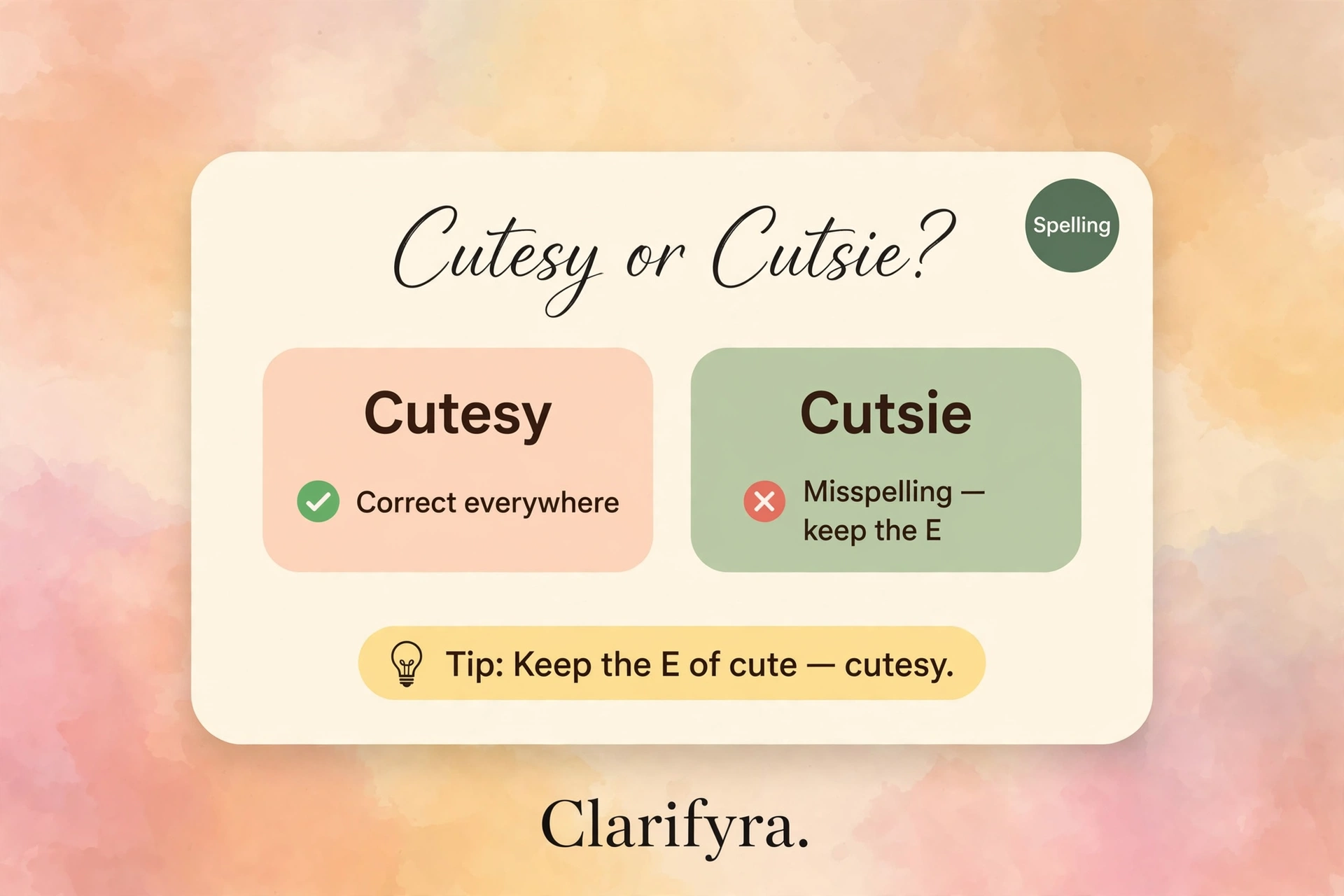
Cutesy is the correct spelling in every dictionary checked (Merriam-Webster, Cambridge, Collins): “self-consciously or excessively cute.” Cutsie — dropping the e — is not listed as a headword anywhere; it’s a misspelling. However, cutesie (keeping the e) is recorded as a variant spelling in Collins’s American entries (Webster’s New World and Random House). So the spelling ladder is: cutesy (standard) → cutesie (recorded American variant) → cutsie (incorrect). Pronounced /ˈkjuːt.si/ (“KYOOT-see”) in both British and American English.
What “Cutesy” Actually Means
Before the spelling, the meaning — because it shapes how the word is used. Merriam-Webster defines cutesy as “self-consciously or excessively cute.” Cambridge’s entry (in the Advanced Learner’s Dictionary) glosses it as “artificially attractive and pleasant, especially in a childish way.” Collins’s COBUILD dictionary marks it “[informal, disapproval]” and gives the example of “a cutesy shopping arcade.”
That disapproval tag matters. Cutesy is rarely a compliment: it describes cuteness that’s been laid on too thick, too deliberately — the greeting-card font, the baby-talk product name, the décor that’s trying a little too hard. When someone calls a design “cutesy,” they’re usually saying it’s cloying, not charming. Keep that tone in mind when you use it.
Word-building details from the dictionaries: cutesy is formed from cute + -sy (the same suffix you see in folksy). Merriam-Webster dates its first known use to 1914; Random House gives [1910–15]. Collins lists the comparative and superlative as cutesier and cutesiest (“a cutesier nickname”), and Merriam-Webster records the noun cutesiness.
Cutesy vs. Cutesie vs. Cutsie: The Three Spellings
This is where the keyword’s confusion comes from, so let’s separate the three spellings honestly.
Cutesy — the standard. Headword in Merriam-Webster, Cambridge, and Collins (British and American). This is the spelling to use in all edited writing, everywhere.
Cutesie — a recorded American variant. This is the important correction to the common advice that “any other spelling is wrong.” Collins’s American English entries list it explicitly: Webster’s New World gives “cutesy … or cutesie,” and the Random House entry reads “forcedly and consciously cute; coyly mannered … Also: cutesie.” So cutesie has dictionary backing as an alternative spelling — it’s the form the word takes when the -sy suffix is spelled -sie, keeping the e of cute. You don’t need to use it, but you can’t call it illiterate either.
Cutsie — the misspelling. Dropping the e gives you cut- + -sie, which breaks the connection to cute and isn’t recorded in any of the dictionaries checked. This is the spelling to avoid. If you’ve been writing cutsie, switch to cutesy (or, if you prefer the variant, cutesie).
| Spelling | Status | Use it? |
|---|---|---|
| cutesy | Standard headword (MW, Cambridge, Collins — UK & US) | Yes — the safe choice everywhere |
| cutesie | Recorded variant in Collins’s American dictionaries | Acceptable, mainly US; cutesy is still safer |
| cutsie | Not listed in any dictionary checked | No — a misspelling |
Pronunciation is identical for all three — /ˈkjuːt.si/ (“KYOOT-see”) in both British and American English, per Cambridge — so in speech the distinction vanishes. It’s purely a spelling question.
Don’t Confuse It With “Cutie”
Part of the reason cutsie feels plausible is the noun cutie — “an attractive person,” as in “he’s a real cutie.” That’s a different word (a noun, from cute + -ie), and its spelling is firmly cutie, never “cutee.” But cutie doesn’t license cutsie: the adjective’s suffix is -sy (as in folksy), not -sie-on-cut. Keep the e of cute in the adjective — cutesy — and the error disappears.
The -sy Suffix: Why the Word Stings
Part of cutesy‘s built-in side-eye comes from its suffix. The -sy ending (also spelled -sey) forms adjectives meaning “having the quality of X, with a hint of affectation”: folksy (deliberately plain-spoken), artsy (deliberately artistic). The suffix itself carries a flavor of trying a little too hard — which is why the disapproval tag follows cutesy into every dictionary. When Merriam-Webster defines it as “self-consciously or excessively cute,” the self-consciously is doing the real work: the word accuses its target of performing cuteness rather than possessing it. That’s also why cutesy stings more than its near-synonym adorable, which carries no such charge. Use cutesy when the performance is the point — the boutique hotel lobby, the influencer’s baby-talk captions — and reach for warmer words when it isn’t.
Correct vs. Incorrect
- ✓ “The café had a cutesy vintage theme.” (standard spelling)
- ✓ “The café had a cutesie vintage theme.” (recorded American variant — acceptable)
- ✗ “The café had a cutsie vintage theme.” → ✓ “…a cutesy vintage theme.” (no dictionary lists cutsie)
- ✓ “She gave the puppy the cutesiest little sweater.” (superlative)
- ✗ “He’s such a cutesy.” → ✓ “He’s such a cutie.” (noun = cutie, not cutesy)
- ✓ “The marketing was a bit too cutesy for my taste.” (note the disapproving tone)
- ✗ “The marketing was a bit too cutesy and charming.” (clashing tones — cutesy is rarely praise)
Common Mistakes
1. Writing “cutsie” with no e. This is the keyword’s exact question, and the answer is no: none of the major dictionaries checked list cutsie as a headword or variant. The e belongs there because the word is built on cute. Write cutesy.
2. “Correcting” someone’s “cutesie” too aggressively. The flip side: if you see cutesie in American writing, know that Collins’s American dictionaries record it as a variant before you red-pen it. It’s not the preferred spelling, but it has lexicographic backing — unlike cutsie.
3. Using “cutesy” as a compliment. Because the dictionaries flag it as disapproving (“self-consciously or excessively cute”), calling someone’s wedding décor “so cutesy!” can land as an insult. If you mean genuinely delightful, use charming, adorable, or lovely instead.
4. Mixing it up with “cutie.” Cutesy is the adjective (the cloying quality); cutie is the noun (the attractive person or thing). “What a cutesy baby!” describes the aesthetic; “what a cutie!” is the compliment.
5. Overusing it in formal writing. Cutesy is labeled informal in every dictionary checked. It fits reviews, blogs, and conversation; in a formal report, “overly sentimental” or “cloying” does the job without the slang register.
Frequently Asked Questions
Is “cutesie” actually a word?
Yes — with a caveat. Collins’s American dictionaries (Webster’s New World and Random House) list cutesie as an alternative spelling of cutesy. Merriam-Webster and Cambridge headword only cutesy. So cutesie is a genuine recorded variant, mainly American, but cutesy remains the standard spelling to default to.
Why is “cutsie” wrong but “cutesie” acceptable?
It comes down to the word’s construction: cute + -sy. Keeping the e (cutesy, cutesie) preserves the root cute; dropping it (cutsie) severs that link and produces a form no dictionary records. The -sie ending in cutesie is just an alternative spelling of the -sy suffix.
What’s the comparative — “cutesier” or “more cutesy”?
Collins lists cutesier and cutesiest as the standard comparative and superlative. Both “cutesier” and “more cutesy” will be understood, but the inflected forms are the dictionary forms.
Is “cutesy” positive or negative?
Usually negative or at best teasing. Every dictionary checked frames it as excessive or self-conscious cuteness, and Collins marks it as disapproval. “Cutesy-poo” (listed by Collins as slang) doubles down on the babyish, cloying sense.
How do you pronounce “cutesy”?
/ˈkjuːt.si/ (“KYOOT-see”) — Cambridge gives the same pronunciation for British and American English. The t stays crisp; it doesn’t soften the way it does in some -sy words.
The Takeaway
Cutesy is the standard spelling everywhere: “self-consciously or excessively cute,” usually with a disapproving edge. Cutesie is a recorded American variant (per Collins’s American dictionaries) — acceptable, but cutesy is the safer default. Cutsie, with no e, appears in none of the dictionaries checked: that’s the misspelling. Keep the e of cute, and you’ll never spell it wrong.