Vise or Vice: What’s the Difference?
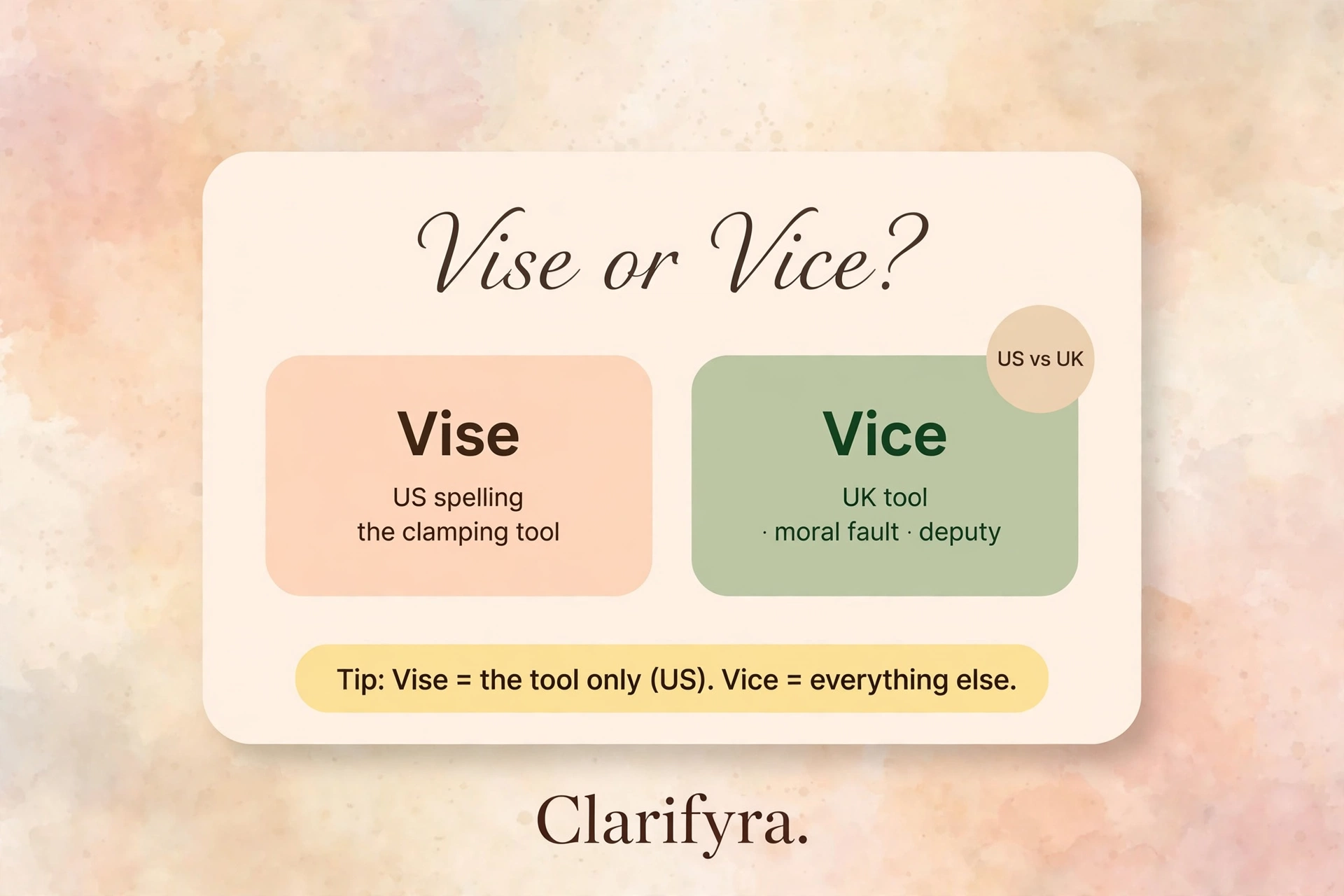
Here’s the short answer to “vise or vice”: if you mean the clamping tool with two jaws, vise is the American spelling and vice is the British spelling — same tool, same pronunciation (/vaɪs/), different sides of the Atlantic. But vice is also the only spelling for a moral failing (“his vices”) and for the deputy prefix (“vice president”). Vise never means any of those things.
Quick Answer
Vise (noun and verb) is the US spelling of the clamping tool: “he clamped the wood in the vise.” Vice is the UK spelling of that same tool — Cambridge marks it “mainly UK (US usually vise)” — and the only spelling everywhere for a moral fault (“a life of vice“) and for the deputy prefix (“vice president”). Merriam-Webster defines the vise as “any of various tools with two jaws for holding work” and records the verb vise (“vised; vising”): “to hold, force, or squeeze with or as if with a vise.” Both words are pronounced /vaɪs/ (“VYSE”).
“Vise”: The American Spelling of the Tool
In American English, the workshop tool is spelled vise. Merriam-Webster’s entry is unambiguous: a vise is “any of various tools with two jaws for holding work that close usually by a screw, lever, or cam” — the bench vise, the hand vise, the pin vise. The dictionary adds a figurative sense, “something likened to a vise,” as in “the economic vise of slow growth and rampant price increases.”
Vise is also a verb in American spelling: vised, vising — “to hold, force, or squeeze with or as if with a vise.” So “he vised the metal strip between two blocks” is standard in US usage. Merriam-Webster dates the noun to 1500 and the verb to 1602.
Here’s the twist the dictionaries reveal: the spelling vice came first for the tool. Merriam-Webster’s etymology traces vise (the noun) to Middle English vys, vice — “screw” — from Anglo-French, ultimately from Latin vitis (vine, something that winds). The American vise spelling is the later, respelled form; British English kept the older vice.
One more thing to file away: visé (with the accent) is a different word entirely — the past participle of French viser, meaning “visa” as a verb. It has nothing to do with the clamp, the moral failing, or the deputy.
“Vice”: Three Jobs, One Spelling
Vice does three jobs in English, and it keeps the same spelling for all of them on both sides of the Atlantic — except that in Britain it does a fourth job, the tool.
1. The tool (mainly UK). Cambridge lists “vice noun (TOOL)” as “[C] mainly UK (US usually vise)”: a strong tool for holding an object firmly, usually between two metal jaws. “The carpenter held the piece of wood in a vice” is the natural British sentence; an American reader would expect vise there.
2. The moral failing. This is the sense most people meet first: a bad habit, a moral fault, or criminal activity associated with prostitution, drugs, or gambling. “Smoking is not one of my vices.” The vice squad polices vice. This spelling is universal — no variety of English writes “vise” for the moral sense.
3. The deputy prefix. Vice- means “second in rank, acting as deputy for”: vice president, vice-chairman, vice-captain. Cambridge records it as a prefix with the pronunciation /vaɪs/ in both British and American English. (Hyphenation varies by house style — American dictionaries tend to write “vice president” as two words, British sources often hyphenate — but the spelling of vice itself never changes.)
The UK/US Split at a Glance
| Meaning | British spelling | American spelling |
|---|---|---|
| The clamping tool | vice | vise |
| To grip like the tool (verb) | vice (“viced; vicing”) | vise (“vised; vising”) |
| Moral failing | vice | vice |
| Deputy (vice president) | vice | vice |
The rule of thumb: vise is only ever the tool (and the verb that goes with it), and only in American spelling. Vice is everything else — plus the tool in British spelling. If you’re writing for an American audience and the sentence is about a workshop, reach for vise; in every other context, vice is the safe choice worldwide.
Pronunciation won’t help you tell them apart: both are /vaɪs/ (“VYSE”) in British and American English, per Cambridge and Merriam-Webster. They’re true homophones — the spelling is the whole difference.
Correct vs. Incorrect
- ✓ “He tightened the vise.” (US — the tool) / ✓ “He tightened the vice.” (UK — the same tool)
- ✗ “He tightened the vice.” → ✓ “He tightened the vise.” (in American writing)
- ✓ “Gambling was his vice.” (moral failing — every variety)
- ✗ “Gambling was his vise.” → ✓ “Gambling was his vice.” (Vise never means a moral failing.)
- ✓ “She was elected vice president.” (deputy — every variety)
- ✗ “She was elected vise president.” → ✓ “She was elected vice president.”
- ✓ “The recession held the country in a vise.” (US figurative) / ✓ “…in a vice.” (UK figurative)
- ✓ “He vised the bracket to the workbench.” (US verb) / ✓ “He viced the bracket to the workbench.” (UK verb)
Common Mistakes
1. Writing “vise” for the moral failing. This is the most frequent mix-up, and it always reads as an error: “a life of vise” is wrong everywhere. The dictionaries checked give the moral sense only under vice. If the sentence is about bad habits, corruption, or the vice squad, it’s vice — full stop, both countries.
2. Writing “vice” for the tool in American English. “He clamped it in the vice” will look like a typo to American readers, even though it’s perfectly correct British English. Match your spelling to your audience: vise for the US, vice for the UK.
3. “Vise versa.” The Latin phrase meaning “the other way round” is vice versa — always vice, never vise, in every variety of English. The vice here is the “in place of” sense, not the tool.
4. “Vise-like grip” in British writing. The adjective follows the same regional split as the noun: American vise-like (“viselike” in Merriam-Webster), British vice-like. “He has a grip like a vice” is the classic British phrasing Cambridge’s bilingual dictionaries use as their example sentence.
5. Assuming the verb doesn’t exist. Because vise looks like “just a noun with an American spelling,” writers sometimes avoid “vised” and “vising.” Merriam-Webster records both verb forms, so “the pressure vised the two sides together” is legitimate in US usage.
Frequently Asked Questions
Is “vice” wrong for the tool in American English?
In edited American writing, yes — use vise. Cambridge explicitly marks the tool sense of vice as “mainly UK (US usually vise)”. An American reader encountering “vice” for the clamp will most likely read it as a mistake, even though it’s the older and still standard British spelling.
Why do the two spellings exist at all?
History. Merriam-Webster’s etymology shows the tool was spelled vice (Middle English vys, vice) long before American English respelled it vise. British English simply never made that change. The moral-failing vice comes from a different Latin root (vitium, fault), which is why the two words converged in pronunciation but kept separate identities.
Can “vise” ever mean the deputy sense, as in “vise president”?
No. The prefix is always vice-: vice president, vice-chairman, vice-captain. “Vise president” is a misspelling in every dictionary checked.
What about “vise grip” — is that a brand name?
“Vise-Grip” is indeed a trademarked brand of locking pliers, which is part of why the vise spelling feels so natural to Americans in a workshop context. In generic writing, though, “vise grip” (lowercase) just means a tight, clamp-like hold — and in British writing it would be “vice grip.”
How do I remember which is which?
Think of it this way: vise has exactly one job — the tool, American style. Vice does everything else. If your sentence isn’t about a workshop clamp (or something gripped like one), the answer is vice.
The Takeaway
Vise is the American spelling of the clamping tool (noun and verb: vised, vising). Vice is the British spelling of that tool — and the only spelling, everywhere, for a moral failing and for the deputy prefix in vice president. They’re pronounced identically (/vaɪs/), so the spelling carries the whole meaning. Match the tool’s spelling to your audience, and let vice handle everything else.