Lay or Laid? The Lay vs. Lie Rule, Explained
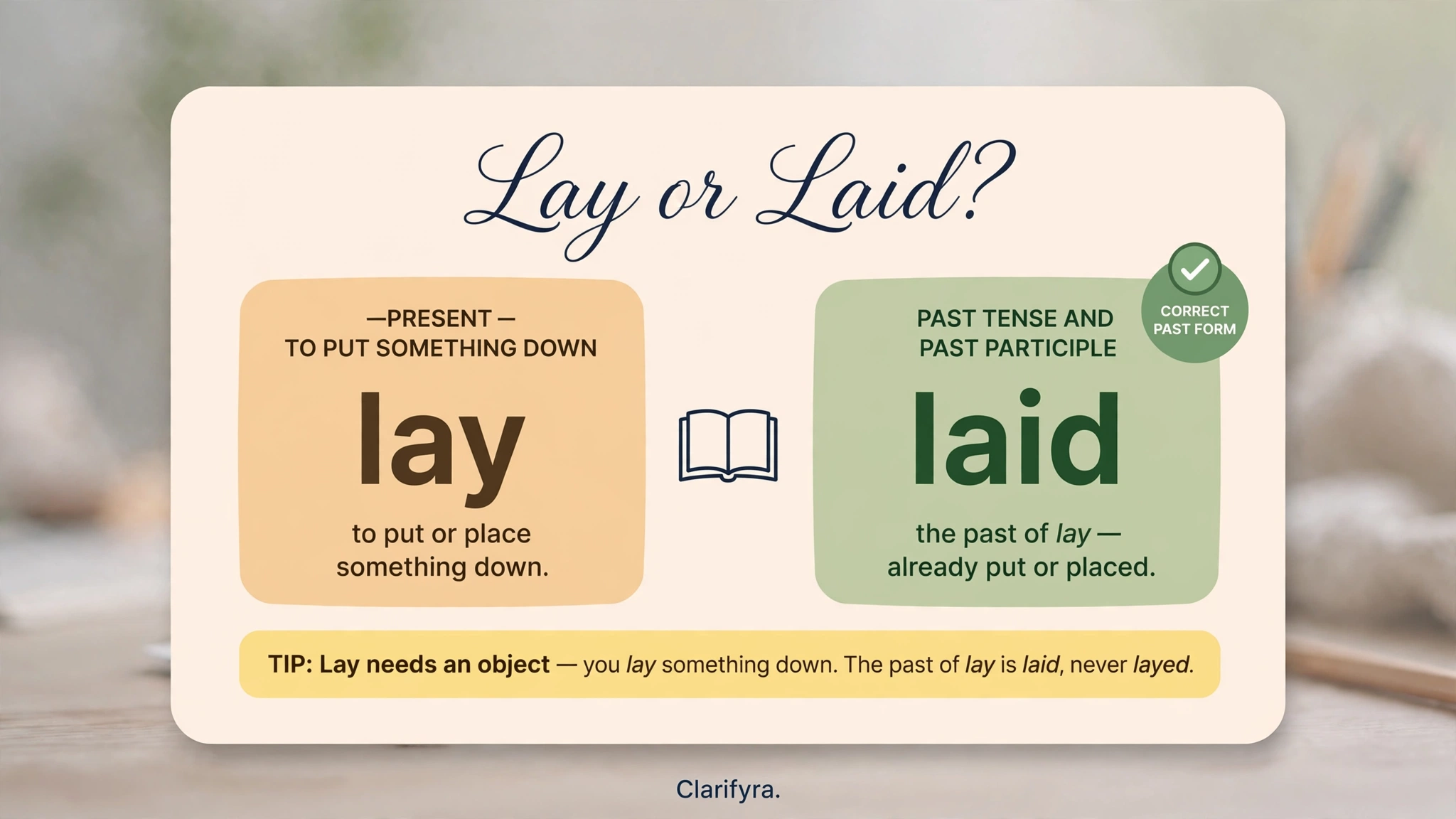
Here’s the short answer to “lay or laid”: laid is the past tense (and past participle) of the verb lay — “I laid the book on the table.” The catch is that lay is also the past tense of a different verb, lie — “I lay down for a nap.” The one-word test that sorts them out: lay (and its past laid) puts something down and needs an object; lie (past: lay, past participle: lain) is what a person or thing does on its own, and takes no object.
Quick Answer
Lay is a transitive verb meaning “to put something down”: lay / laid / laid / laying (“She laid the baby in the crib”). Lie is an intransitive verb meaning “to recline”: lie / lay / lain / lying (“He lay down for an hour”). The confusion exists because lay is both the present tense of “lay” and the past tense of “lie.” Cambridge records the past tense and past participle of lay as laid; Collins and Oxford record the forms of lie (recline) as lie, lay, lain. Layed is a misspelling — none of the dictionaries checked list it.
“Lay”: The Transitive Verb — It Needs an Object
Lay means to put or place something down. Merriam-Webster’s rundown of the pair puts it this way: lay’s most common meaning is “to place (something or someone) down in a flat position.” The grammar is the point: lay is transitive, so it must have a direct object — there has to be a thing or person being placed. “Lay it down” works because it is there to receive the action.
Its principal parts, confirmed across the dictionaries, are:
| Form | Word | Example |
|---|---|---|
| Present | lay | “I lay the book on the table.” |
| Past | laid | “I laid the book on the table.” |
| Past participle | laid | “I have laid the book on the table.” |
| Present participle | laying | “I am laying the book on the table.” |
Cambridge lists the past tense and past participle as laid (pronounced /leɪd/), and Collins agrees: “the past tense and past participle of lay.” The verb stretches beyond furniture — Cambridge records the egg-laying sense, the betting sense (“lay money on,” as in “I’d lay money on it”), and phrases like “lay claim to something.” In every one, the object is present: a hen lays eggs, you lay money on a horse, a company lays claim to a discovery.
Pronunciation is the same on both sides of the Atlantic: lay is /leɪ/ (“LAY”) and laid is /leɪd/ (“LAYD”) in both British and American English, per Cambridge.
“Lie”: The Intransitive Verb — Nobody Puts It Down
Lie, in the sense that causes all the trouble, means to recline — to be in a flat position on a surface. Merriam-Webster defines this lie as “to be in a flat position on a surface,” and it is intransitive: the person or thing reclines on their own, and no object follows. “You can lie down there” — you are the subject, and nothing is being put anywhere.
Its principal parts, per Oxford Learner’s Dictionaries and Collins, are:
| Form | Word | Example |
|---|---|---|
| Present | lie | “I lie down every afternoon.” |
| Past | lay | “Yesterday I lay down for an hour.” |
| Past participle | lain | “I have lain here since noon.” |
| Present participle | lying | “I am lying on the sofa.” |
Collins lists these word forms for lie (position or situation) exactly as above — lies, lying, lay, lain — and Oxford gives the same sequence with transcriptions: lie /laɪ/, lay /leɪ/, lain /leɪn/, lying /ˈlaɪɪŋ/, identical in British and American English.
One boundary to keep in mind: there’s a completely separate verb lie meaning “to tell an untruth.” It’s regular — Merriam-Webster gives lie, lied, have lied, lying, and Collins records lied as its past and past participle too. Lied never belongs to the reclining verb and lain never belongs to the untruth-telling verb.
The Collision: Why “Lay” Is the Past Tense of “Lie”
The word lay does two jobs: it is the present tense of “lay” (putting something down) and the past tense of “lie” (reclining). Same spelling, same pronunciation (/leɪ/), two different verbs — and Merriam-Webster notes the pair has been “tripping up English speakers for 700 years.”
The way through it: the object test. Lay (and laid) always puts something somewhere — ask “lay what?” and there must be an answer. Lie (past lay, participle lain) describes the subject itself reclining — “lay what?” gets no answer, and that’s the point.
- “She laid the baby in the crib.” — Lay what? The baby. → transitive lay, past tense laid. ✓
- “She lay down beside the crib.” — Lay what? Nothing — she reclined. → intransitive lie, past tense lay. ✓
- “The contractors laid the tiles on Monday.” — Lay what? The tiles. ✓
- “The tiles lay in stacks by the door.” — Nothing being put down; they’re just resting there. → lie, past tense lay. ✓
Notice the second and fourth examples: “lay” as a past tense, describing the subject’s own position, with no object in sight. That’s the usage that feels like a typo but isn’t.
Correct vs. Incorrect
The object test sorts every sentence below:
- ✗ “I’m going to lay down for a nap.” → ✓ “I’m going to lie down for a nap.” (No object — you are reclining.)
- ✗ “Last night I laid down early.” → ✓ “Last night I lay down early.” (Past tense of lie; there’s nothing being put down.)
- ✗ “I was laying on the beach all afternoon.” → ✓ “I was lying on the beach all afternoon.” (Present participle of lie — no object.)
- ✗ “He has laid in bed since noon.” → ✓ “He has lain in bed since noon.” (Past participle of lie is lain.)
- ✗ “She lay the report on my desk.” → ✓ “She laid the report on my desk.” (Past tense of transitive lay — the report is the object.)
- ✓ “The hens laid ten eggs yesterday.” (Transitive lay — the eggs are the object.)
- ✓ “I lay awake until two.” (Past tense of lie — the subject’s own state, no object.)
- ✗ “He layed the foundation last spring.” → ✓ “He laid the foundation last spring.” (Past tense of lay is laid, never layed.)
Common Mistakes
1. “I laid down for a nap.” A commonly heard version of this error. Laid is the past tense of transitive lay, so “I laid down” says you put something down — and leaves the reader waiting to hear what. The sentence you want is “I lay down for a nap,” with lay as the past tense of lie. It sounds odd to many ears precisely because lay “looks” present-tense; that discomfort is the confusion doing its work, not evidence you’re wrong.
2. “I’m going to lay down.” Merriam-Webster addresses this exact sentence: the careful form is “I’m going to lie down,” though the dictionary adds, forgivingly, that no one should be judged harshly for the mix-up after seven centuries of history. In writing, especially formal writing, keep the distinction.
3. “I was laying in bed.” The -ing forms get swapped just as often. Laying is the present participle of transitive lay — “she was laying the table” (object: the table). A person reclining is lying: “I was lying in bed.” No object after the verb means it can’t be laying.
4. “He had laid there for hours.” Past participles are where lain disappears from most people’s speech. But the dictionaries agree: the past participle of the reclining verb is lain — “he had lain there for hours.” Laid as a participle belongs only to the putting-down verb: “she had laid the files on his desk.”
5. Using “lied” for reclining. “He lied down” is wrong in every variety of standard English. Lied is the past tense of the tell-untruths verb only (“he lied about his age”). The reclining verb never takes -ed: lie, lay, lain.
What About “Layed”?
Layed is not a standard English word. Cambridge gives the past tense and past participle of lay as laid; Collins defines laid as “the past tense and past participle of lay”; Oxford’s word-form lists for lay and lie contain no layed. It comes from analogy with regular verbs — stay becomes stayed — but lay is irregular, and its recorded past form is laid. Usage guides treat layed as a misspelling; “layed out” for “laid out” is a classic sighting.
Frequently Asked Questions
Is “I lay down” really correct? It sounds wrong.
Yes — it’s the standard past tense of the intransitive verb lie (“to recline”), confirmed by Oxford and Collins. It sounds wrong because lay is identical in spelling and pronunciation (/leɪ/) to the present tense of “lay” (to put something down). Your ear is hearing the wrong verb. Trust the object test: nothing is being put down, so it’s lie — past tense lay.
What’s the difference between “laid” and “lain”?
They’re past participles of different verbs. Laid belongs to lay (transitive — to put something down): “she has laid the groundwork.” Lain belongs to lie (intransitive — to recline): “the letter has lain unopened for a week.”
Does “lay” always need an object?
As the transitive verb meaning “to put something down” — yes. Merriam-Webster is explicit: lay requires an object; “there has to be a thing or person being placed.” The one wrinkle: lay as the past tense of lie (“I lay down”) takes no object — but that’s the other verb wearing the same spelling.
What about “lie” meaning to tell untruths?
Same spelling, different verb, no overlap in forms: lie / lied / lied / lying (Merriam-Webster; Collins agrees on lied for past and past participle). The only shared form with the reclining verb is the present participle lying — “he is lying on the sofa” and “he is lying about his age” are spelled identically, and only context tells them apart.
“The hens lay eggs” — which verb is that?
Transitive lay — Cambridge lists the egg-laying sense, and the eggs are the direct object, so the past tense is laid: “the hens laid ten eggs yesterday.” Same verb as “she laid the table,” just with feathers involved.
Is it ever acceptable to use “lay” for reclining in the present tense?
In careful writing, no — “I’m going to lay down” is the classic mix-up, and the standard form is “I’m going to lie down.” Merriam-Webster’s take is characteristically humane: the correct form is lie, but the confusion is seven centuries old and “your dictionary forgives you.” Keep the distinction in anything edited or formal; the forgiving part is for conversation, not print.
The Takeaway
Two verbs, one shared spelling, one simple test. Lay puts something down and needs an object: lay, laid, laid, laying. Lie is what a person or thing does on its own: lie, lay, lain, lying. Laid is the past of lay; layed is a misspelling. And whenever a sentence with lay in it feels wrong, ask “lay what?” — no answer means you’re looking at the past tense of lie, and it was right all along.