Atheist or Agnostic: What’s the Difference?
The Short Answer
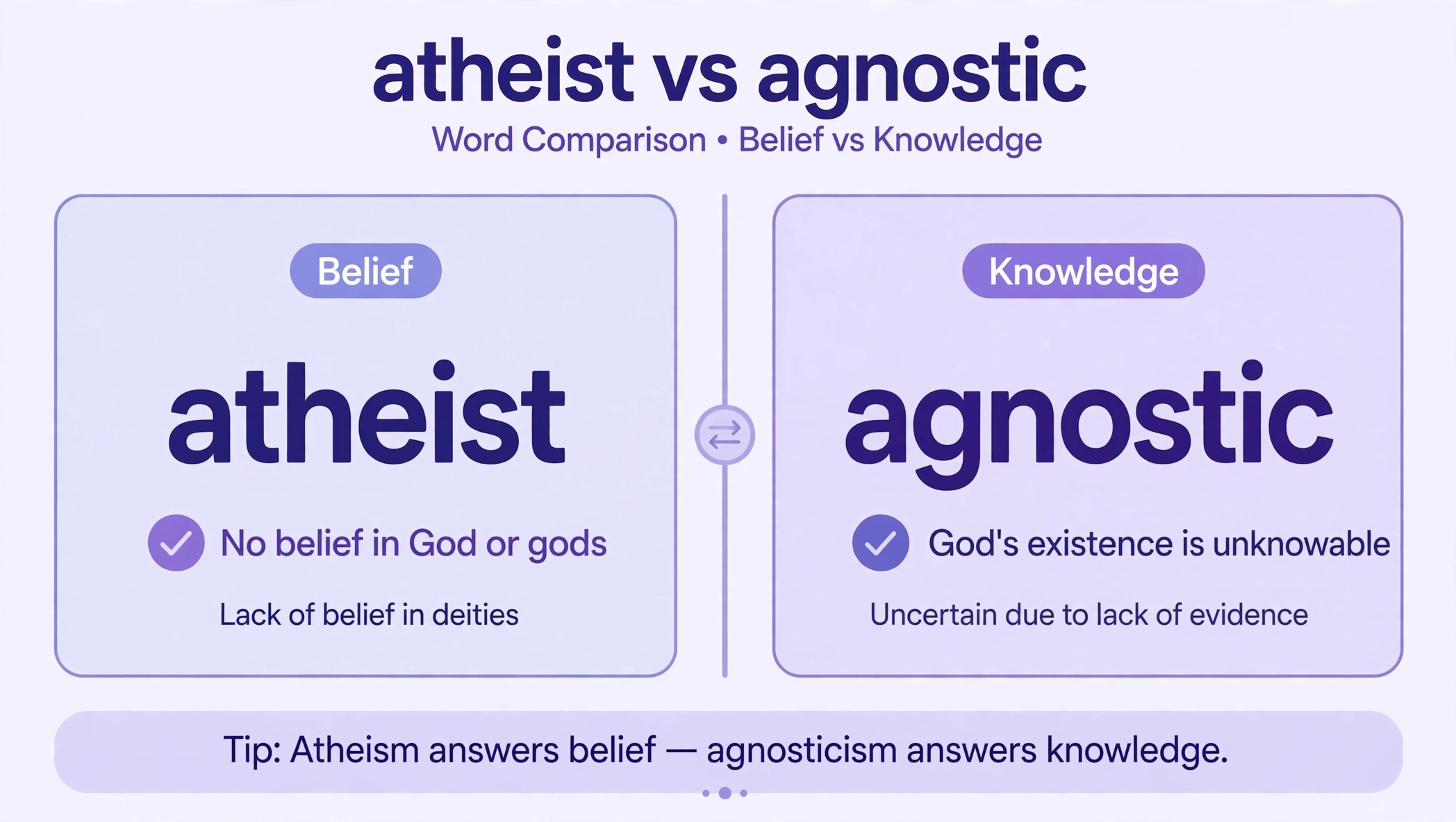
An atheist is someone who does not believe in God or any gods. An agnostic is someone who holds that it is not possible to know — or at least does not claim to know — whether God exists. In the standard framing used by the major dictionaries, atheism is a position on belief, and agnosticism is a position on knowledge.
Quick Answer
Atheist is a person who does not believe in the existence of a god or any gods (adjectives: atheistic, atheistical). Agnostic is a person who believes it is not possible to know — or does not claim to know — whether God exists. The core difference: atheism answers “Do you believe?”, agnosticism answers “Can it be known?” The labels can overlap: many people describe themselves as “agnostic atheists.”
What Does “Atheist” Mean?
Merriam-Webster defines atheist (noun) as someone “who does not believe in the existence of a god or any gods.” The Oxford Advanced Learner’s Dictionary puts it slightly more strongly: “a person who believes that God or gods do not exist.” Both describe a position on belief — the first frames it as a lack of belief, the second as a positive belief that no gods exist. In everyday usage the two overlap, and neither dictionary treats the distinction as a hard rule.
The word also works as an adjective: “an atheist worldview,” “atheist writers.” The related adjectives are atheistic and atheistical (Merriam-Webster lists both), with the adverb atheistically. Cambridge lists the noun and adjective forms with the pronunciation /ˈeɪ.θi.ɪst/ in both British and American English.
Real examples:
- She described herself as an atheist in the interview.
- He comes from a devout family but holds atheistic views himself.
What Does “Agnostic” Mean?
The Oxford Advanced Learner’s Dictionary defines agnostic (noun) as “a person who believes that it is not possible to know whether God exists or not.” Collins’ American English entry is close: “a person who believes that the human mind cannot know whether there is a God or an ultimate cause, or anything beyond material phenomena.”
Merriam-Webster gives the word two relevant senses: someone who holds that ultimate reality, such as God, is unknown and probably unknowable, and someone “not committed to believing in either the existence or nonexistence of God or a god.” That second sense is why “agnostic” often functions in conversation as the uncommitted middle position — not convinced either way.
As an adjective, agnostic means “relating to agnostics or their beliefs” (Collins). It also has a well-established non-religious use meaning neutral or non-committal: Collins gives the example “agnostic on nuclear energy,” and in computing “platform agnostic” is standard for technology that works across systems. So “agnostic” is not exclusively a religious term.
Real examples:
- He calls himself agnostic: he says no one can prove the question either way.
- The software is platform agnostic, running on Windows, Mac, and Linux alike.
The Real Difference: Belief vs Knowledge
The distinction Merriam-Webster draws in its “How Agnostic Differs From Atheist” note is the one most usage guides settle on:
- Atheism is about belief. An atheist does not believe that God exists.
- Agnosticism is about knowledge. An agnostic holds that the existence of God is unknown, unknowable, or at least not something they claim to know.
Because the two words answer different questions, they are not strict opposites. The opposite of atheist is theist — someone who believes in God or gods. The counterpart of agnostic in these discussions is gnostic (“claiming to know”), though outside this context that word more often refers to the ancient Gnostic religious movements.
Can You Be Both? Agnostic Atheists and Agnostic Theists
Yes — and many people are. Because atheism addresses belief and agnosticism addresses knowledge, the labels combine:
- Agnostic atheist: does not believe in God, but does not claim to know for certain that no god exists.
- Gnostic atheist: does not believe in God and claims to know that no god exists.
- Agnostic theist: believes in God, but does not claim certain knowledge.
These are real-world self-descriptions rather than standard dictionary headwords — none of the dictionaries consulted for this article lists “agnostic atheist” as its own entry. But the combinations follow directly from the belief/knowledge distinction above, and they explain why the two words are not mutually exclusive. Someone who says “I’m agnostic” may still hold beliefs about God; someone who says “I’m an atheist” may still admit uncertainty.
Where the Words Come From
Both words share the prefix a-, meaning “without,” but the rest of each word is different (Merriam-Webster):
- Atheist shares the root theo-, meaning “god,” with theology and theism. It reached English via the French athéisme; its first known English use dates to 1551.
- Agnostic comes from the Greek root gignōskein, “to know” — the same root behind know and prognosis. It was coined in 1869, attributed to the English biologist Thomas Henry Huxley, from a- (“not”) + gnōstos (“known”), after the word gnostic — Oxford breaks it down as a- (“not”) + gnostic (“relating to knowledge”).
So, roughly: atheist = “without god,” agnostic = “without knowledge.”
Correct vs Incorrect Usage
Getting these right mostly means not loading them with meanings the dictionaries don’t give:
- ✅ “After years of doubt, she now identifies as an atheist.” — describes a belief position. Correct.
- ✅ “He’s agnostic on the question; he says it’s unanswerable.” — describes a knowledge position. Correct.
- ❌ “He’s an atheist, so he hates religious people.” — atheism describes belief about gods, not hostility toward people. Incorrect and a strawman.
- ❌ “She’s just agnostic because she hasn’t made up her mind yet.” — partly misleading: for many agnostics, “we cannot know” is a settled philosophical position, not indecision.
- ❌ “Agnostics are halfway between atheists and believers.” — an agnostic’s stance on belief can sit anywhere; agnosticism is about knowledge, not a midpoint on a belief scale.
Common Mistakes and Confusions
Treating them as opposites. The pair is often presented as a spectrum — theist, agnostic, atheist — but the dictionaries define them along different axes (belief vs knowledge). The true opposite of atheist is theist.
Using “agnostic” to mean “undecided.” Merriam-Webster’s second sense does cover the uncommitted, but the word’s primary religious sense is stronger: a considered view that the question is unknowable. “I’m still deciding” is closer to “unsure” or “undecided.”
Assuming “atheist” means claiming proof. Both Merriam-Webster (“does not believe”) and common usage allow atheism to be a simple lack of belief, not a claim to have disproved God. Whether it should carry that stronger claim is a philosophical debate, not a settled dictionary fact.
Confusing the adjective senses. “Atheistic” only ever relates to atheism. “Agnostic” as an adjective can describe beliefs (“agnostic views”) or neutrality in general (“platform agnostic”). Don’t use “atheistic” where you mean neutral.
FAQs
Is an agnostic the same as an atheist?
No. An atheist does not believe in God or gods; an agnostic holds that God’s existence is unknown or unknowable. One is a claim about belief, the other about knowledge — and a person can be both.
What is an agnostic atheist?
Someone who does not believe in God but does not claim certain knowledge that no god exists. The label combines the two dictionary positions: no belief (atheism) plus no claimed knowledge (agnosticism).
What is the opposite of atheist?
Theist — a person who believes in the existence of a god or gods. “Agnostic” is not the direct opposite.
Can agnostics be religious?
As a matter of word meaning, agnosticism only describes a position on knowledge, so it doesn’t by itself rule belief in or out — hence “agnostic theist.” Whether particular religions accept that combination is a theological question, not a vocabulary one.
How do you pronounce “atheist” and “agnostic”?
Atheist: /ˈeɪ.θi.ɪst/ (AY-thee-ist) in both British and American English, per Cambridge. Agnostic: /æɡˈnɒstɪk/ in British English, /æɡˈnɑːstɪk/ in American English, per Oxford.
Is “agnostic” only about religion?
No. Beyond its religious sense, it is widely used to mean neutral or non-committal — “agnostic on nuclear energy” (Collins) or “platform agnostic” in technology.
The Takeaway
Atheist describes what someone believes: no belief in God or gods. Agnostic describes what someone claims to know: that the question is unknowable, or that they take no committed position. They answer different questions — belief vs knowledge — which is why the labels can overlap and why neither is quite the opposite of the other.