Withdrawal or Withdraw: Which Is Correct?
It is easy to confuse Withdrawal or Withdraw because they come from the same word family and are especially common in banking. However, they do not perform the same grammatical job. One is primarily a verb, while the other is a noun. There is also a frequent spelling mistake—withdrawl—that should be avoided in standard English. Understanding the difference makes phrases such as “withdraw money” and “make a withdrawal” much easier to use correctly.
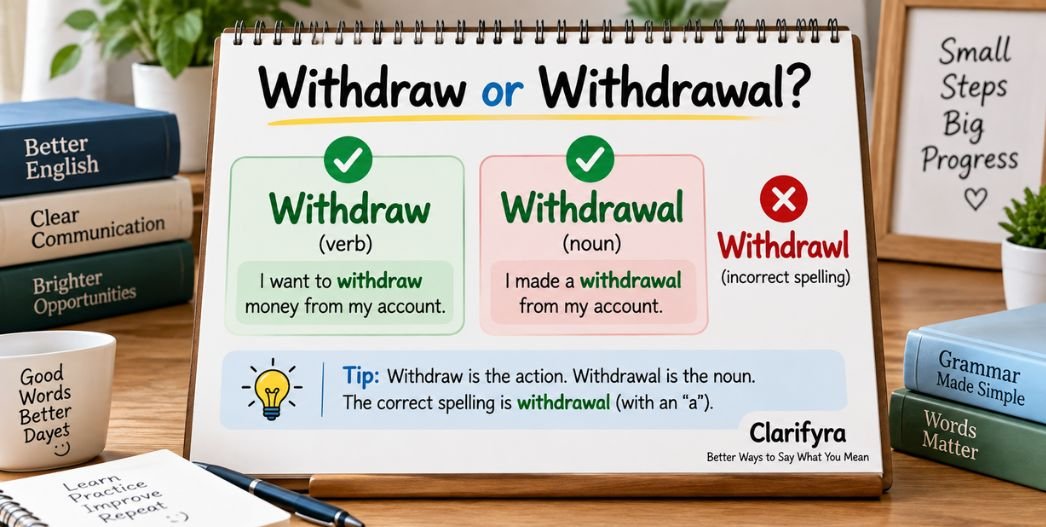
Withdraw is the verb, while withdrawal is the noun. You say “I want to withdraw money,” but “I made a withdrawal.” Withdrawl is an incorrect spelling; the correct spelling is withdrawal.
Withdraw vs Withdrawal: The Key Difference
Both withdraw and withdrawal are correct English words, but they are used differently.
| Feature | Withdraw | Withdrawal |
|---|---|---|
| Word type | Verb | Noun |
| Basic meaning | To take something out or away | The act or amount of taking something out |
| Banking example | I need to withdraw money. | I made a withdrawal. |
| Correct spelling? | Yes | Yes |
| Common mistake | I will withdrawal money. | I made a withdraw. |
| Past form | withdrew | — |
The simplest rule is:
Withdraw = the action
Withdrawal = the action or result as a noun
For example:
- I need to withdraw some cash.
- I made a cash withdrawal.
What Does “Withdraw” Mean?
Withdraw is a verb. It generally means to take something away, remove something, or take something out of a particular place or situation.
In banking, it means taking money from a bank account.
Examples:
- I need to withdraw $100 from my account.
- She went to the ATM to withdraw cash.
- He withdrew money before the trip.
- You can withdraw funds from your savings account.
The word can also be used outside banking:
- The team decided to withdraw from the competition.
- She chose to withdraw her application.
- The company withdrew its offer.
So, withdraw describes an action.
What Does “Withdrawal” Mean?
Withdrawal is a noun. It refers to the act of withdrawing something, the amount taken out, or the process of leaving or removing something.
In banking, a withdrawal is money taken from an account.
Examples:
- I made a withdrawal from my checking account.
- The ATM limits each cash withdrawal to $500.
- There was an unexpected withdrawal from the account.
- The bank charges a fee for some international withdrawals.
It can also have other meanings:
- The candidate announced his withdrawal from the competition.
- The company confirmed the withdrawal of its offer.
- The medication can sometimes cause withdrawal symptoms.
Because withdrawal is a noun, it normally does not replace the verb withdraw.
Is It “Withdraw Money” or “Withdrawal Money”?
The correct phrase is:
“Withdraw money.” ✅
For example:
I need to withdraw money from my bank account.
Using withdrawal as the verb is incorrect in standard English:
I need to withdrawal money from my bank account. ❌
Why? Because withdraw is the verb that describes the action. Withdrawal is the noun for that action.
Compare these two sentences:
- I want to withdraw money. ✅
- I want to make a withdrawal. ✅
Both are correct, but their grammatical structures are different.
A useful pattern
Verb: withdraw + object
She withdrew $200.
Noun: make + a withdrawal
She made a $200 withdrawal.
This pattern can help you choose the right form quickly.
Is “Withdrawl” Correct?
No. Withdrawl is a misspelling of withdrawal.
The correct spelling is:
withdrawal ✅
The incorrect spelling is:
withdrawl ❌
The error is understandable because withdraw is spelled without an “a” at the end, and it can be tempting to simply add a suffix while dropping a letter.
However, standard English requires the a:
withdraw + al → withdrawal
So if you are writing about money taken from a bank account, write withdrawal, not withdrawl.
Correct and incorrect examples
Correct:
There was a cash withdrawal from my account.
Incorrect:
There was a cash withdrawl from my account.
Correct:
The bank recorded three withdrawals.
Incorrect:
The bank recorded three withdrawls.
Why Are These Words Confused?
The confusion comes mainly from their close relationship.
Withdraw and withdrawal belong to the same word family and have related meanings. They also appear frequently in similar contexts, particularly banking.
The spelling can cause another problem. Because withdraw ends with “draw,” some writers expect the noun to be formed as though the ending were simply removed or shortened. That can lead to the incorrect form withdrawl.
There is an important distinction to remember:
- withdraw → verb
- withdrawal → noun
- withdrawl → misspelling
Correct Usage in Banking
Banking provides some of the clearest examples of the distinction.
Use “withdraw” when describing the action
- Can I withdraw cash from this ATM?
- I need to withdraw money before the store closes.
- She withdrew $300 yesterday.
- You can withdraw funds from your account.
Use “withdrawal” when naming the transaction or amount
- The ATM rejected my withdrawal.
- There is a daily withdrawal limit.
- I made a cash withdrawal this morning.
- The account shows two withdrawals.
A quick test is to ask:
Am I describing what someone does?
Use withdraw.
Am I naming the transaction or act?
Use withdrawal.
Withdraw, Withdrew, and Withdrawn
Another useful point is that withdraw has an irregular past tense.
| Form | Example |
|---|---|
| Present | I withdraw money every week. |
| Past | I withdrew money yesterday. |
| Past participle | I have withdrawn the money. |
| -ing form | She is withdrawing cash. |
The past tense is withdrew, not withdrawed.
For example:
He withdrew $50 from the ATM yesterday. ✅
Not:
He withdrawed $50 from the ATM yesterday. ❌
The past participle is withdrawn:
She has withdrawn the funds. ✅
Common Mistakes to Avoid
1. Using “withdrawal” as a verb
I need to withdrawal $50. ❌
Use:
I need to withdraw $50. ✅
2. Using “withdraw” as the noun
I made a withdraw from my account. ❌
Use:
I made a withdrawal from my account. ✅
3. Spelling “withdrawal” as “withdrawl”
The bank recorded a withdrawl. ❌
Use:
The bank recorded a withdrawal. ✅
4. Using “withdrawed” as the past tense
She withdrawed the money. ❌
Use:
She withdrew the money. ✅
5. Confusing the action with the transaction
I made a withdraw money. ❌
Better:
I withdrew money. ✅
Or:
I made a withdrawal. ✅
An Easy Way to Remember the Difference
Think of withdraw as an action word.
I withdraw money.
Think of withdrawal as the name of the action or transaction.
I make a withdrawal.
You can also remember the spelling with:
withdraw + al = withdrawal
The middle a is important. If you are writing the noun, don’t leave it out.
FAQ
Is it correct to say “withdrawal money”?
No. In standard English, use withdraw money when describing the action: I need to withdraw money from my account. You can use withdrawal as a noun instead: I made a withdrawal from my account.
Which is correct: withdrawal or withdrawl?
Withdrawal is correct. Withdrawl is a misspelling and should not be used in standard English. The noun is spelled w-i-t-h-d-r-a-w-a-l.
Is “withdraw” a noun or a verb?
Withdraw is primarily a verb. It describes an action, such as taking money from an account or removing something. The related noun is withdrawal.
Is “withdrawal” a verb?
No. Withdrawal is a noun. For example, The withdrawal was approved uses it as a noun. If you need a verb, use withdraw: I will withdraw the money.
What is the past tense of “withdraw”?
The simple past tense is withdrew. For example: She withdrew $100 yesterday. The past participle is withdrawn, as in She has withdrawn the money.
Is “withdrawl” ever acceptable?
Withdrawl is not the standard spelling of the noun. In formal and standard English writing, use withdrawal.
The Bottom Line
Use withdraw when you need a verb: I want to withdraw money. Use withdrawal when you need a noun: I made a withdrawal. And when spelling the noun, remember that withdrawl is incorrect—the standard spelling is withdrawal. For more clear explanations of confusing English words and forms, Clarifyra helps you choose the right way to say what you mean.