Prooving or Proving: Which Spelling Is Correct?
It is easy to see why prooving or proving can cause confusion. The verb prove ends in “ove,” and adding -ing may seem as though it should simply produce prooving. However, English spelling rules remove the final silent e before -ing is added. The result is proving, not prooving. The same spelling is used when talking about proving something is true and, in baking, about dough proving before it is baked.
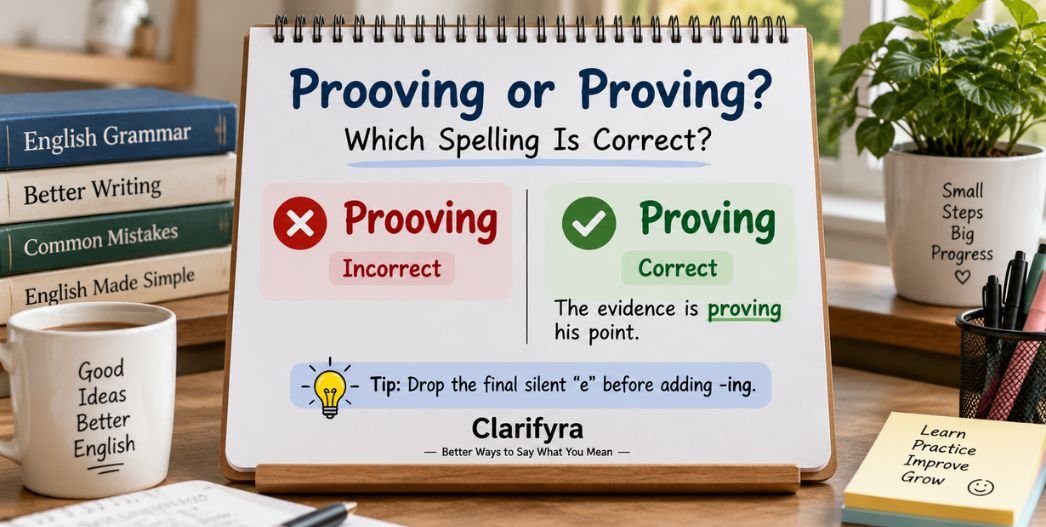
Proving is the correct spelling. Prooving is a misspelling and should not be used in standard English. Proving is the -ing form of prove, meaning to demonstrate or establish something, and it can also describe the process of dough rising before baking.
Proving vs. Prooving: The Difference
The distinction is straightforward:
| Form | Correct? | Meaning | Example |
|---|---|---|---|
| proving | ✅ Yes | Showing or establishing something; allowing dough to rise | She is proving her argument. |
| prooving | ❌ No | Incorrect spelling of proving | She is prooving her argument. |
Proving is the present participle and gerund form of prove. It can be used after forms of be in continuous tenses or as a gerund in a sentence.
For example:
- The evidence is proving useful.
- He is proving that the method works.
- Proving the claim required several experiments.
- The dough is proving in a warm kitchen.
By contrast, prooving is not the standard spelling of this verb form.
Why Is “Proving” Spelled Without the Extra “O”?
The spelling becomes easier to understand when you start with the base verb:
prove + ing → proving
The verb prove ends in a silent e. When a verb ending in a silent e takes -ing, the final e is generally dropped.
Compare:
- make → making
- write → writing
- move → moving
- give → giving
- take → taking
- prove → proving
Therefore, writing prooving incorrectly keeps the spelling pattern of prove instead of applying the usual spelling change.
The same principle explains why we write moving, rather than moveing, and writing, rather than writeing.
What Does “Proving” Mean?
Proving is the -ing form of the verb “prove.” The verb prove can mean to demonstrate that something is true, correct, effective, or valid.
For example:
- The experiment is proving the theory.
- She is proving her point with additional evidence.
- His actions are proving that he can be trusted.
- The results are proving useful to researchers.
The exact meaning depends on the sentence, but the central idea is demonstrating or establishing something.
Proving as a grammatical form
Because it ends in -ing, proving can serve different grammatical functions.
Present participle:
They are proving the new method works.
Here, proving forms part of the present continuous construction.
Gerund:
Proving the theory was difficult.
Here, proving functions as a noun-like form and acts as the subject of the sentence.
Is “Prooving” a Real Word?
In standard modern English, prooving is not the correct form of the verb prove. It should not be used as an alternative spelling of proving.
For example:
Correct:
The researchers are proving their hypothesis.
Incorrect:
The researchers are prooving their hypothesis.
The incorrect form is easy to produce because someone may add -ing to the whole spelling of prove without removing the final e. But the standard spelling rule gives proving.
What Does “Bread Proving” Mean?
There is another useful meaning of proving in baking.
When bread dough is proving, it is being left to rise before baking. Yeast produces carbon dioxide during fermentation, causing the dough to expand and develop its structure.
For example:
Leave the dough somewhere warm while it is proving.
Here, proving does not mean demonstrating that something is true. It refers to the rising stage of breadmaking.
The term proofing is also widely used for this process, particularly in American baking terminology. Both proving and proofing can therefore appear in recipes and baking instructions, depending on regional and stylistic usage.
However, prooving bread is not the standard spelling.
Correct:
Allow the dough to finish proving before baking.
Also used:
Allow the dough to finish proofing before baking.
Incorrect:
Allow the dough to finish prooving before baking.
So if you encounter the phrase bread proving, the word proving is correctly spelled.
Proving or Proofing: Are They the Same in Baking?
In baking, proving and proofing can refer to allowing yeast dough to rise. The terminology varies between varieties of English and among baking sources.
For example:
The dough needs another 30 minutes of proving.
and:
The dough needs another 30 minutes of proofing.
Both can describe the dough’s rising stage.
The important distinction for this spelling question is that neither of these terms is spelled prooving.
Correct Usage Examples
Here are some examples showing how proving works in different contexts.
Demonstrating something
The new evidence is proving that the original conclusion was incorrect.
Showing ability
She is proving herself to be an excellent problem-solver.
Establishing a point
The lawyer spent several hours proving the reliability of the evidence.
Testing an idea
The experiment is proving whether the process is effective.
Baking
The dough is proving beside the oven.
Gerund use
Proving the result took several attempts.
Notice that the spelling remains proving in every example.
Common Mistakes With “Proving”
1. Adding -ing without removing the final e
A frequent spelling error is:
prove + ing = prooving
The correct transformation is:
prove → proving
2. Using “prooving” when talking about bread
The baking sense does not change the spelling.
The dough is proving. ✅
Not:
The dough is prooving. ❌
3. Assuming two vowels must remain together
Because prove contains “ove,” it can look tempting to preserve the whole spelling before adding -ing. English spelling does not work that way here: the final silent e is removed.
4. Confusing “proving” with “proofing”
Both can occur in baking, but they are separate forms. Proving comes from prove, while proofing comes from proof. Neither should be spelled prooving.
An Easy Way to Remember the Spelling
Use this simple pattern:
Silent e + -ing → remove the e
So:
prove → proving
You can remember it alongside familiar examples:
move → moving
write → writing
make → making
prove → proving
If you remember to remove the final silent e, the spelling prooving becomes much easier to avoid.
Proving or Prooving: Which Is Correct?
If you are writing about demonstrating something, use proving:
The results are proving his theory correct.
If you are writing about bread or dough, use proving when that is the terminology you have chosen:
The dough is proving before it goes into the oven.
You may also encounter proofing in baking:
The dough is proofing before baking.
But prooving should not be used as the standard spelling in either context.
FAQ
Is “proving” or “prooving” correct?
Proving is correct. It is the -ing form of prove. The final silent e in prove is dropped before -ing is added. Prooving is a misspelling and is not the standard form.
What does “prooving” mean?
Prooving does not have a standard meaning as the -ing form of prove. It is generally a misspelling of proving. If you mean showing that something is true, use proving.
What does proving mean?
Proving means demonstrating or establishing that something is true, correct, valid, or effective. In baking, proving can also mean allowing dough to rise before it is baked.
Is “proving bread” correct?
Yes. Proving bread or, more naturally, proving dough can refer to allowing yeast dough to rise before baking. Proofing is another commonly used term for this process.
Why isn’t “prooving” spelled with two o’s?
The base verb is prove, which ends in a silent e. Before the suffix -ing is added, the final e is removed: prove → proving. Therefore, prooving is not the standard spelling.
Is “proofing” also correct for bread?
Yes. Proofing is widely used in baking to describe allowing dough to rise. Proving is also used, particularly in British English. The choice can depend on the variety of English and the terminology used by the recipe or baker.
The Bottom Line
Proving is the correct spelling, while prooving is a misspelling. The word can mean demonstrating that something is true or, in baking, allowing dough to rise. Remember the simple spelling pattern prove → proving, and you will know which form to use. For more clear explanations of confusing English forms, Clarifyra helps you choose better ways to say what you mean.