Palette or Pallet: What’s the Difference?
Palette and pallet are both correct English words, but they mean very different things. Palette is used for colors, painting, design, and makeup, while pallet usually refers to a flat platform used to store or transport goods. There is also a third word, palate, which sounds almost identical and is connected with the mouth and sense of taste. Because all three words are pronounced similarly, they are easy to mix up in writing.
Palette is correct when talking about colors, art, design, or makeup. Pallet means a flat platform used for shipping or storage. If you mean taste, food, or the roof of the mouth, the correct word is palate.
Palette vs Pallet: The Key Difference
The easiest way to separate these words is by meaning.
| Word | Main Meaning | Common Use | Example |
|---|---|---|---|
| Palette | A range of colors or an artist’s paint board | Art, design, makeup | The room has a warm color palette. |
| Pallet | A flat platform for moving or storing goods | Warehouses, shipping | The boxes were stacked on a pallet. |
| Palate | The roof of the mouth or sense of taste | Food and taste | The sauce was too spicy for my palate. |
So if you are choosing colors, use palette. If you are moving boxes, use pallet. If you are discussing flavor or taste, use palate.
Many English learners mix up similar-looking words such as Mat or Matt: What’s the Difference?
What Is “Palette”?
A palette is a noun. Traditionally, it refers to the flat board an artist uses to hold and mix paint.
The word is also widely used to describe a selected range of colors. This meaning appears in interior design, fashion, branding, digital design, cosmetics, and many other creative contexts.
Examples:
- The artist mixed several shades on her palette.
- We chose a neutral color palette for the living room.
- The website uses a blue-and-white palette.
- Her eyeshadow palette contains twelve colors.
In modern usage, you will often see palette used figuratively for a collection or range of colors rather than a physical artist’s board.
What Is “Pallet”?
A pallet is also a noun, but its meaning is completely different.
A pallet is a flat platform designed to hold goods so they can be stored, stacked, or moved easily. Pallets are especially common in warehouses, factories, supermarkets, and shipping operations.
Examples:
- The delivery arrived on a wooden pallet.
- Workers loaded the boxes onto a pallet.
- The forklift moved several pallets across the warehouse.
- The drinks were stacked securely on a plastic pallet.
If the context involves transportation, freight, storage, warehouses, or forklifts, pallet is usually the word you need.
Is It Color Palette or Pallet?
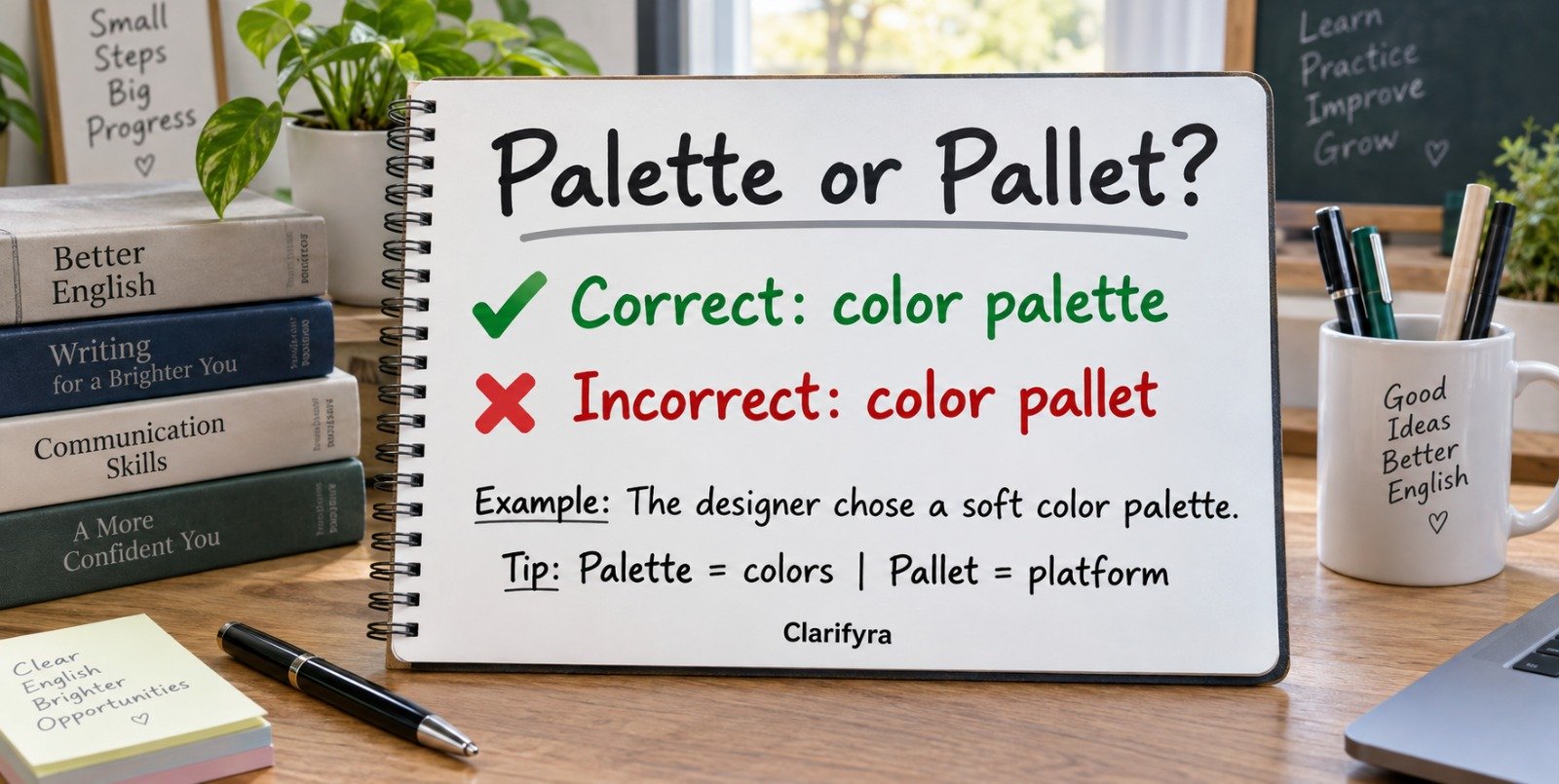
The correct phrase is color palette.
A color palette is a group of colors chosen to work together in a design, painting, room, website, brand identity, outfit, or other visual project.
Examples:
Correct: The designer chose a soft pastel color palette.
Correct: The brand uses a black, gold, and white color palette.
Incorrect: The designer chose a soft pastel color pallet.
The word pallet would only make sense if you were literally describing a shipping platform that had a certain color.
For example:
Correct: The warehouse replaced the damaged blue pallet.
That sentence refers to a physical platform, not a group of colors.
Makeup Palette or Pallet?
The correct expression is makeup palette.
A makeup palette is a case or tray containing several shades or cosmetic products, such as eyeshadow, blush, bronzer, contour, or highlighter.
Examples:
- She bought a new eyeshadow palette.
- This makeup palette contains several neutral shades.
- I prefer a small travel palette with basic colors.
Makeup pallet is normally incorrect because a pallet is a storage or shipping platform.
A useful rule is that if you are talking about several shades or colors arranged together, palette is almost always the right choice.
What About “Palette Food”?
When people write palette food, they usually mean palate.
The word palate refers literally to the roof of the mouth. It can also refer to a person’s ability to taste or appreciate flavors.
Examples:
- The soup was too salty for my palate.
- She has a refined palate for coffee.
- Spicy foods may not appeal to everyone’s palate.
So if you are talking about food, taste, flavor, or someone’s preferences in eating, palate is generally the correct spelling.
The word palette can occasionally appear in food writing when discussing visual colors, such as “a bright palette of red and green ingredients,” but that meaning refers to appearance rather than taste.
Palate vs Palette Pronunciation
Palate, palette, and pallet are generally pronounced the same way or nearly the same way in standard English.
They are commonly pronounced approximately as:
PAL-it
That similar pronunciation is one of the main reasons people confuse them in writing.
Because pronunciation does not clearly separate the words, context matters:
- Colors or art → palette
- Shipping or storage → pallet
- Mouth or taste → palate
You usually cannot determine the spelling just by hearing the word.
How Do You Spell “Palette” Like Taste?
If you mean taste, the correct spelling is palate, not palette.
For example:
Correct: The wine has a smooth finish on the palate.
Correct: This dish has a flavor that suits my palate.
Incorrect: This dish has a flavor that suits my palette.
One easy memory trick is to look at the end of the word:
palate → ate
Because ate relates to food, it can help you remember that palate is the word connected with taste.
Palette or Palate Cleanser?
The correct phrase is palate cleanser.
A palate cleanser is a food or drink used to refresh the sense of taste between different dishes or flavors.
Examples include light sorbets, plain crackers, water, or other mild foods depending on the meal.
Examples:
- Lemon sorbet was served as a palate cleanser.
- The chef offered a light palate cleanser before the next course.
- Water can help cleanse the palate between tastings.
Palette cleanser is incorrect when referring to food or taste because palette refers to colors, not the mouth.
The phrase can also be used figuratively for something refreshing that provides a change from something heavier or more intense, but the spelling remains palate cleanser.
Why Are Palette, Pallet, and Palate So Easy to Confuse?
The main reason is pronunciation.
The three words sound alike, yet their spellings and meanings are different. That makes them homophones or near-homophones in everyday speech.
Another reason is that palette and palate both appear in creative or descriptive writing. A chef may talk about the palate, while a food photographer may talk about a visual palette. Those contexts can sometimes overlap, which makes the spelling even more confusing.
The solution is to focus on meaning rather than sound.
Ask yourself:
- Am I talking about colors? Use palette.
- Am I talking about storage or shipping? Use pallet.
- Am I talking about taste or the mouth? Use palate.
Examples in Sentences
Here are some examples showing the three words in different contexts.
Palette
- The bedroom has a calming blue-and-gray palette.
- She mixed the paint directly on her palette.
- The designer selected a brighter palette for the logo.
- This makeup palette includes both matte and shimmer shades.
Pallet
- The boxes were delivered on a wooden pallet.
- A forklift lifted the loaded pallet.
- The warehouse had dozens of pallets ready for shipment.
- The workers wrapped the pallet before loading it onto the truck.
Palate
- The sauce has a smoky flavor that stays on the palate.
- Sweet foods appeal more to his palate than spicy dishes.
- The dentist examined the roof of her palate.
- A small sorbet worked as a palate cleanser.
Common Mistakes to Avoid
One frequent mistake is writing color pallet instead of color palette. If the subject is a collection of colors, palette is correct.
Another is writing makeup pallet. Cosmetics arranged by shade are placed in a palette, not a pallet.
Food-related writing causes another common mix-up. If you mean taste, write palate rather than palette.
Compare:
Correct: She prefers a neutral makeup palette.
Correct: The boxes were placed on a wooden pallet.
Correct: The wine has a pleasant taste on the palate.
These meanings are not interchangeable.
An Easy Way to Remember the Difference
Use three simple associations:
Palette = Paint
Think of an artist’s paint palette or a color palette.
Pallet = Platform
Think of a wooden platform carrying boxes.
Palate = Ate
The ending -ate can remind you of eating, food, and taste.
This gives you a quick rule:
Paint → Palette
Platform → Pallet
Taste → Palate
Final Verdict: Which Word Should You Use?
Use palette for colors, art, design, and makeup. Use pallet for a platform used in storage or shipping. If you mean taste, food, or the roof of the mouth, use palate instead.
Once you connect each spelling with its specific meaning, the distinction becomes simple: colors belong to a palette, goods sit on a pallet, and flavors are experienced by the palate. That clear separation is exactly the kind of practical English distinction Clarifyra aims to make easier to understand.
Frequently Asked Questions
Is it color palette or color pallet?
Color palette is correct when referring to a selection of colors used in art, design, branding, fashion, or decorating. A pallet is a physical platform used for moving or storing goods.
Is makeup palette or makeup pallet correct?
Makeup palette is correct. A makeup palette contains several cosmetic shades, such as eyeshadow, blush, or contour colors. Makeup pallet would normally be a spelling error.
Is palette related to food?
Usually not when discussing taste. For food and flavor, the correct word is palate. However, palette may be used figuratively to describe the visual colors of a dish.
How do you spell palate when talking about taste?
The correct spelling is palate. A helpful way to remember it is that palate ends in ate, which can remind you of eating and taste.
Is it palate cleanser or palette cleanser?
Palate cleanser is correct. It refers to something eaten or drunk between flavors to refresh your sense of taste.
Are palette, pallet, and palate pronounced the same?
They are generally pronounced the same or very similarly in English. Their meanings, rather than their pronunciation, determine which spelling you should use.
You May Also Read | Wandering or Wondering: What’s the Difference?