Synch vs Sync: What’s the Difference and Which Is Correct?
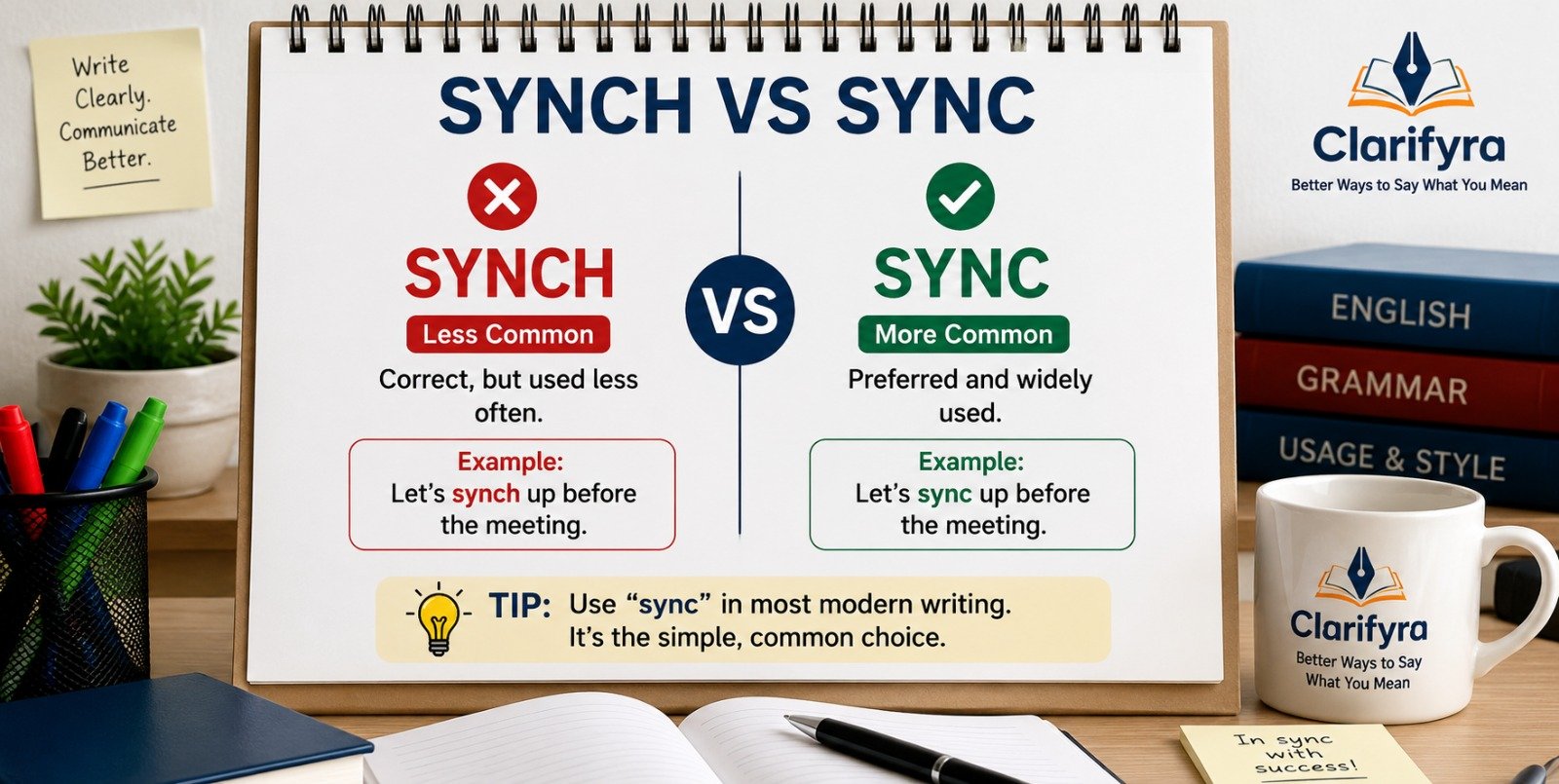
If you are deciding between synch and sync, the good news is that both spellings are valid. They are shortened forms related to synchronize and generally carry the same meaning. The important difference is usage: sync is the standard and much more common spelling in modern English, while synch is an accepted but less common variant. You are especially likely to see sync when talking about technology, meetings, teamwork, music, video, or anything that needs to work together.
Sync and synch are both correct, and they generally mean the same thing. However, sync is the more common modern spelling and is usually the best choice for phrases such as “sync up,” “sync meeting,” and “in sync.”
Synch vs Sync: What’s the Difference?
There is usually no difference in meaning between sync and synch. Both can be used as shortened forms of synchronize or synchronization.
The main distinction is how frequently each spelling is used.
| Feature | Sync | Synch |
|---|---|---|
| Correct word? | Yes | Yes |
| Basic meaning | Synchronize; synchronization | Same |
| Common in modern English? | Yes | Less common |
| Used as a verb? | Yes | Yes |
| Used as a noun? | Yes | Yes |
| Best general choice | Yes | Usually unnecessary |
For most everyday writing, sync is the simpler and more familiar choice.
For example:
Preferred: We need to sync our calendars.
Also possible: We need to synch our calendars.
Both communicate the same idea, but the first spelling will look more natural to most readers.
You May Also Read | Tear vs Tare: What’s the Difference and Which Is Correct?
What Is Sync?
Sync is an informal shortened form of synchronize or synchronization. As a verb, it means to make two or more things operate, happen, update, or correspond together.
For example:
- Please sync your phone with your computer.
- The app automatically syncs your files.
- We should sync our schedules before booking the meeting.
- The music needs to sync with the video.
It can also be used as a noun, particularly in expressions such as in sync and out of sync.
Consider these examples:
- The dancers moved in sync.
- The audio is out of sync with the picture.
- Our plans are finally in sync.
In these cases, sync refers to coordination, agreement, or things happening together.
Sync Meaning in Everyday English
The simplest sync meaning is:
to make things match, coordinate, or happen together.
The exact interpretation depends on the context.
If you sync two devices, you make their information correspond.
If two musicians are in sync, they are performing together at the right timing.
If coworkers need to get in sync, they need to coordinate their information, plans, or expectations.
This wider meaning is why the word appears far beyond computing.
What Is Synch?
Synch is an alternative spelling of sync.
It can have the same basic meanings and can function as either a noun or a verb.
For example:
- The soundtrack was not in synch with the video.
- We need to synch the sound and picture.
- The two departments are finally in synch.
These sentences are not inherently incorrect. However, replacing synch with sync would normally make them look more conventional:
- The soundtrack was not in sync with the video.
- We need to sync the sound and picture.
- The two departments are finally in sync.
Therefore, there is rarely a practical reason to choose synch when sync will do the same job more naturally.
Is Synch a Word?
Yes, synch is a real word. It should not be treated as a simple misspelling of sync.
Major dictionaries recognize it as an alternative form, although it is less commonly used.
That makes this different from a comparison where one version is clearly an incorrect spelling. Here, both forms are legitimate.
The useful rule is:
Sync = correct and common
Synch = correct but less common
So if you encounter synch in a book, article, subtitle, or other edited text, you should not automatically assume that it is an error.
Why Are Sync and Synch Confused?
The confusion makes sense because both forms come from words such as synchronize and synchronization.
Since those longer words contain “synch-”, some writers naturally expect the shortened form to keep the h and become synch.
English, however, often develops shorter informal forms that do not preserve every letter of the original word. Sync became the conventional shortened spelling.
Both forms are also pronounced the same way, so hearing the word gives you no clue about whether the speaker would spell it sync or synch.
For practical writing, remembering that sync is the common short form solves most of the confusion.
Sync or Synch Meeting?
When describing a workplace meeting, sync meeting is the better choice.
A sync meeting is generally a meeting where people coordinate plans, share updates, discuss progress, or make sure everyone has the same information.
Examples include:
- We have a team sync on Monday morning.
- Can we schedule a quick sync meeting?
- The weekly project sync starts at 10 a.m.
- I will share the update during our next sync.
Although synch meeting is understandable, it looks less natural in contemporary workplace English.
You may also see related phrases such as team sync, weekly sync, project sync, and sync call.
Synch or Sync Up?
Use sync up in most writing.
To sync up with someone means to coordinate, exchange information, or make sure both people understand the same plan or situation.
For example:
- Let’s sync up before the presentation.
- Can we sync up tomorrow morning?
- I need to sync up with the design team.
- We should sync up before making a decision.
In technology, the phrase may refer more literally to synchronization:
- The two databases need to sync up.
- Give the devices a few seconds to sync up.
Synch up can convey the same meaning, but sync up is the more natural spelling to use.
Sync or Synch in Gaming?
Sync is also the better general choice in gaming.
It can describe saved data, accounts, multiplayer information, animation timing, audio, controllers, or other elements that need to stay synchronized.
Examples:
- My saved game did not sync with the cloud.
- Wait for your account data to sync.
- The dialogue is slightly out of sync with the character animation.
- My progress should sync across both devices.
A writer could technically use synch, but sync matches the spelling readers are more likely to encounter in modern software and gaming contexts.
In Sync or In Synch?
Both expressions are valid, but in sync is the usual choice.
In sync means that things are coordinated, happening together, or in agreement.
For example:
- The dancers were perfectly in sync.
- The audio and video are in sync again.
- The departments need to work in sync.
- Jamie and Alex seem completely in sync about the plan.
Its opposite is out of sync.
For example:
- The subtitles are out of sync with the dialogue.
- Our schedules have been out of sync all week.
- The two teams seem out of sync on the project’s priorities.
These expressions can refer to literal timing or to people and ideas being coordinated.
What About Synced, Synched, Syncing, and Synching?
The spelling difference also appears in related verb forms.
| Base Form | Past Form | -ing Form |
|---|---|---|
| sync | synced | syncing |
| synch | synched | synching |
All of these forms can occur, but the forms based on sync are normally the simplest choice:
- My photos synced automatically.
- The app is syncing my contacts.
- Your account has synced successfully.
The alternative forms synched and synching are valid, but if you begin with the spelling sync, staying consistent with synced and syncing is clearer.
Correct Usage Examples
Here are several natural examples showing how sync is commonly used.
Technology:
My calendar will sync across all my devices.
Work:
Let’s have a quick sync before sending the proposal.
Music:
The performers remained perfectly in sync.
Video:
The sound is out of sync with the picture.
Gaming:
Your saved progress should sync automatically.
Teamwork:
We need to get everyone in sync before the launch.
You could replace sync with synch in some of these sentences without completely changing their meaning, but doing so would generally make the wording less conventional.
An Easy Way to Remember the Difference
Remember this simple rule:
Short word, short spelling: sync.
You usually do not need the extra h in everyday writing.
Think of common expressions such as:
- sync up
- in sync
- out of sync
- sync meeting
- sync files
If you automatically choose sync, you will be using the spelling that suits most modern contexts.
Common Mistakes to Avoid
One mistake is assuming that synch must be wrong because sync is more familiar. It is an accepted alternative, just a less common one.
Another mistake is using both spellings inconsistently in the same piece of writing:
Inconsistent: We need to sync the audio so everything stays in synch.
For cleaner writing, choose one spelling:
Better: We need to sync the audio so everything stays in sync.
It is also unnecessary to prefer synch simply because synchronize contains the letters synch. The established shortened form sync is perfectly correct.
Final Verdict: Synch or Sync?
Both spellings are valid and generally have the same meaning, but sync is the better choice for most modern writing. Use it for phrases such as sync up, sync meeting, in sync, and when discussing technology or games. Synch remains an accepted alternative rather than an outright misspelling. When clear, natural English is the goal, choosing sync consistently follows the straightforward approach readers expect from Clarifyra.
Frequently Asked Questions
Is synch a real word?
Yes. Synch is a recognized alternative spelling of sync. It can refer to synchronization or the act of synchronizing, although sync is the more common spelling.
Are sync and synch pronounced differently?
No. Both are pronounced the same way, like the word “sink.” The distinction is in spelling and frequency of use rather than pronunciation.
Should I write sync or synch in formal writing?
Sync is normally the better choice when the shortened form is appropriate. In highly formal or technical prose, you may sometimes prefer the full words synchronize or synchronization, depending on the context.
Is it “sync up” or “synch up”?
Both are understandable, but sync up is the conventional choice. It can mean coordinating with another person or causing systems or information to become synchronized.
Is it synced or synched?
Both synced and synched are accepted forms. Synced follows the more common spelling sync and is generally the better default for modern writing.
Can sync be both a noun and a verb?
Yes. As a verb, you can sync two devices. As a noun, people can be in sync, or coworkers can have a quick sync to coordinate their work.
You May Also Read | Equifax vs TransUnion: Which Credit Score Matters More?