Different Ways to Say Yes: 80+ Natural, Funny, Fancy & Creative Alternatives
“Yes” is simple, clear, and useful, but it does not always express exactly how you feel. Sometimes you want to sound enthusiastic, professional, playful, romantic, or especially polite. That is where learning different ways to say yes can make your English more expressive.
You might say “absolutely” when you strongly agree, “count me in” when accepting a plan, “certainly” in a professional setting, or “a thousand times yes” when the moment is emotional. The right choice depends on what you are agreeing to, who you are speaking with, and how much enthusiasm you want to show.
Quick Guide to Different Ways to Say Yes
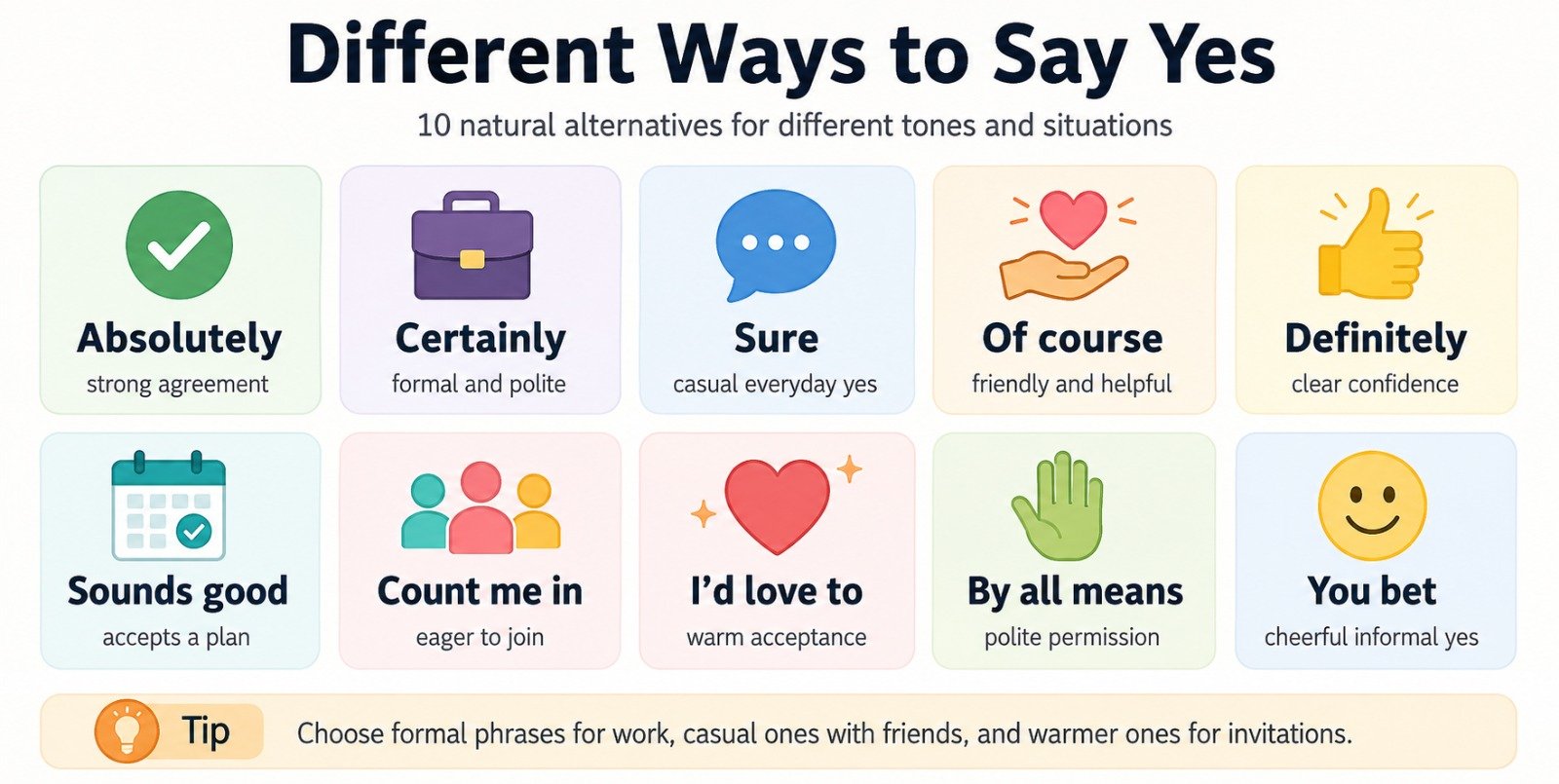
Not every alternative carries the same meaning. Some confirm information, some accept invitations, and others give permission or show strong agreement.
| Alternative | Tone | Best Used For | Example |
|---|---|---|---|
| Absolutely | Confident, enthusiastic | Strong agreement | “Absolutely, I agree.” |
| Certainly | Polite, formal | Professional requests | “Certainly, I can do that.” |
| Of course | Friendly, reassuring | Help or permission | “Of course you can.” |
| Definitely | Confident | Plans and strong agreement | “I’ll definitely be there.” |
| Sure | Casual, neutral | Everyday requests | “Sure, I can help.” |
| Sounds good | Friendly, casual | Accepting a plan | “Six o’clock? Sounds good.” |
| Count me in | Enthusiastic | Joining an activity | “Dinner on Friday? Count me in.” |
| I’d love to | Warm, enthusiastic | Invitations | “I’d love to come.” |
| By all means | Polite, formal | Giving permission | “By all means, go ahead.” |
| Consider it done | Confident | Accepting a task | “Consider it done.” |
| You bet | Informal, enthusiastic | Casual agreement | “You bet I’ll be there.” |
| Agreed | Direct, neutral | Decisions and proposals | “Agreed. Let’s proceed.” |
English-learning references similarly distinguish relaxed forms such as “yeah,” “yep,” and “yup” from more professional choices such as “certainly” and “absolutely.”
Everyday Alternatives That Sound Natural
You do not need an unusual expression every time you want another way to say yes. In everyday conversation, the most useful alternatives are usually short and familiar.
Other Ways to Say Yes Casually
Try:
- Yeah
- Yep
- Yup
- Sure
- Of course
- Definitely
- Absolutely
- For sure
- You bet
- Okay
- All right
- Sounds good
- Works for me
- I’m in
- Count me in
- Why not?
- Deal
- You got it
Examples:
“Want to grab lunch?”
“Sure.”
“Are you coming with us?”
“For sure!”
“Let’s meet around seven.”
“Works for me.”
“Do you want to join the road trip?”
“I’m in!”
Words such as “yeah,” “yup,” and “yep” are especially informal, so they fit conversations with friends much better than formal interviews or business correspondence.
Other Ways to Say Yes to a Plan
When somebody suggests doing something, phrases that accept the plan often sound better than a bare “yes.”
- Sounds good.
- Sounds like a plan.
- I’m in.
- Count me in.
- Let’s do it.
- Works for me.
- Why not?
- I’m up for it.
- That works.
- Deal.
Example:
“How about dinner at eight?”
Instead of simply replying, “Yes,” you could say:
“Sounds like a plan.”
Here, you are not merely confirming a fact. You are accepting a suggestion.
Professional and Polite Ways to Say Yes
Professional communication usually benefits from wording that is clear but not overly casual.
Other Ways to Say Yes Professionally
Useful options include:
- Certainly
- Absolutely
- I agree.
- That works for me.
- I’d be happy to.
- I’d be glad to.
- I can do that.
- I’m happy to proceed.
- I support that approach.
- That sounds reasonable.
- Consider it done.
- I can take care of that.
- I’m comfortable with that.
- I’m on board with the plan.
Request:
“Could you send the revised document this afternoon?”
Professional response:
“Certainly. I’ll send it this afternoon.”
Proposal:
“Should we move forward with the revised schedule?”
Professional response:
“I agree. That approach makes sense.”
“Certainly” is commonly used as a more formal affirmative response, while “absolutely” can add stronger enthusiasm or confidence.
Other Ways to Say Yes Politely
When accepting an invitation, offer, or request, adding warmth can make your answer sound more courteous.
- Yes, please.
- Of course.
- Certainly.
- With pleasure.
- I’d be happy to.
- I’d be delighted.
- I’d love to.
- That would be lovely.
- Thank you, I’d be glad to.
- By all means.
For example:
“Would you like to join us for dinner?”
“I’d be delighted. Thank you for inviting me.”
That feels warmer than simply saying “yes.”
How to Say Yes in a Fancy Way
A fancy response may sound polished, elegant, formal, or deliberately dramatic. It can work especially well in invitations, formal conversation, creative writing, or humorous situations where exaggerated formality is intentional.
Other Ways to Say Yes in a Fancy Way
Consider:
- Most certainly.
- Indeed.
- Absolutely.
- By all means.
- With pleasure.
- I would be delighted.
- I gladly accept.
- I would be honored.
- Without question.
- Without a doubt.
- Most assuredly.
- You have my approval.
- I wholeheartedly agree.
- I am entirely in agreement.
- It would be my pleasure.
Example:
“Would you care to accompany us this evening?”
“I would be delighted.”
Another:
“May I continue with the arrangements?”
“By all means.”
“By all means” is particularly useful when granting permission or encouraging someone to proceed, rather than as a universal substitute for every possible use of “yes.”
Creative Ways to Say Yes
Creative expressions are useful when you want to show personality rather than give a routine answer.
Other Ways to Say Yes Creatively
Try:
- Count me in.
- Sign me up.
- I’m all in.
- Let’s make it happen.
- You’ve got yourself a deal.
- I’m on board.
- That gets my vote.
- Consider it done.
- I wouldn’t miss it.
- Let’s roll.
- Say no more.
- I’m game.
- You had me convinced already.
- I’m ready when you are.
- That’s a green light from me.
- Make it happen.
- You don’t have to ask me twice.
- I’m sold.
- Let’s go for it.
- You can count on me.
Consider the difference:
“Would you like to join the project?”
“Sure.” is neutral.
“I’m all in.” suggests stronger commitment.
“Count me in.” emphasizes participation.
“Consider it done.” works only if you are accepting a task or promising to take action.
That difference matters because these phrases are related, but they are not interchangeable in every sentence.
Funny Ways to Say Yes
Humor gives you far more freedom, especially with friends and family. A funny affirmative can turn an ordinary question into playful banter.
Other Ways to Say Yes in a Funny Way
Try these when the situation is casual:
- Is the sky blue?
- Do fish swim?
- Does the sun rise?
- You bet your boots!
- A thousand times yes!
- Aye aye, captain!
- Roger that!
- That’s a giant yes from me.
- Where do I sign?
- You don’t need to ask me twice.
- My answer is aggressively yes.
- I thought you’d never ask.
- Yes with bells on!
- Absolutely positively!
- You had me before you finished asking.
- Consider me officially convinced.
- My calendar says yes.
- That’s going to be a yes from me.
- I’m already halfway there.
- Does pizza taste good?
These are intentionally playful, so they are usually a poor choice when answering a serious question, speaking to a client, or responding in a formal setting. Humorous alternatives are generally best treated as informal expressions rather than neutral synonyms.
Funny Ways to Say Yes With a Question
Sometimes the funniest answer is another question. The speaker asks something with such an obvious answer that it effectively means an enthusiastic “yes.”
Other Ways to Say Yes With a Question
- Is the sky blue?
- Do fish swim?
- Does the sun shine?
- Do birds fly?
- Is ice cold?
- Does coffee wake people up?
- Do dogs like treats?
- Is Friday better than Monday?
- Do kids like candy?
- Would I ever turn that down?
- Do you really have to ask?
- Is that even a question?
- How could I possibly refuse?
- Why wouldn’t I?
- Have you met me?
Example:
“Do you want another slice of pizza?”
“Is the sky blue?”
The response is humorous because both people understand that the implied answer is obviously yes.
Be careful with this style when tone is difficult to judge. In professional writing or with someone you do not know well, a rhetorical question can sound sarcastic rather than funny.
Enthusiastic Ways to Say Yes
Sometimes the most important part of the answer is not agreement but excitement.
Other Ways to Say Yes Enthusiastically
- Absolutely!
- Definitely!
- One hundred percent!
- I’d love to!
- Count me in!
- Sign me up!
- Of course!
- I can’t wait!
- That sounds amazing!
- Let’s do it!
- I’m totally in!
- Yes, please!
- You bet!
- Without a doubt!
- I wouldn’t miss it!
Compare:
“Would you like to come to the concert?”
“Yes.” confirms that you will go.
“I’d love to!” shows that you are pleased by the invitation.
“Count me in!” sounds lively and enthusiastic.
“I wouldn’t miss it!” suggests that the event matters to you.
A better alternative therefore does more than replace a word; it communicates your attitude.
Ways to Say Yes to Your Suitor or Romantic Partner
A romantic “yes” often carries much more emotion than everyday agreement. If someone is asking an important relationship question or making a proposal, sincerity matters more than finding the cleverest phrase.
Other Ways to Say Yes Romantically
Warm and heartfelt options include:
- With all my heart.
- A thousand times yes.
- Nothing would make me happier.
- Of course I will.
- I would love nothing more.
- You already know my answer.
- Always.
- My answer is and will be yes.
- I’d be honored.
- There’s nothing I want more.
- I can’t imagine saying anything else.
- You have my whole heart.
For a playful relationship:
- What took you so long?
- I thought you’d never ask!
- Do you really need to ask?
- Where do I sign?
- Obviously!
- Was there ever any doubt?
Example:
“Will you marry me?”
A sincere answer might be:
“A thousand times yes.”
Or simply:
“Yes. Absolutely yes.”
An important romantic decision should not be made less clear just to sound creative. If the moment calls for an unmistakable answer, a direct “yes” can be more meaningful than an elaborate phrase.
Saying Yes to Invitations and Offers
Accepting an invitation is another context where alternatives can communicate warmth.
Other Ways to Say Yes to an Invitation
- I’d love to.
- I’d be delighted.
- Count me in.
- Absolutely.
- I’ll be there.
- That sounds wonderful.
- I wouldn’t miss it.
- Sounds like fun.
- I’d be happy to join you.
- Consider me there.
- Thanks, I’d love to come.
- That would be lovely.
Invitation:
“Would you like to come to my birthday dinner?”
Warm response:
“I’d love to. Thanks for inviting me.”
For accepting an offer:
“Would you like some coffee?”
“Yes, please.”
“Could I help you with the boxes?”
“That would be great, thank you.”
The second response does not literally contain another synonym for “yes,” but it naturally communicates acceptance.
Different Ways to Say Yes in Text Messages
Text messages usually allow shorter, more informal responses.
Other Ways to Say Yes in a Text
- Yep!
- Yup!
- Yeah!
- Yesss!
- Sure!
- For sure!
- Definitely!
- Absolutely!
- 100%!
- I’m in!
- Deal!
- Sounds good!
- Perfect!
- Let’s do it!
- Count me in!
- Bet!
Text:
“Movie tonight?”
“100%. I’m in.”
“Want to grab coffee tomorrow?”
“Yep! Sounds good.”
Spellings such as “yesss” deliberately stretch the word to show enthusiasm. They can feel natural in casual messages but would look out of place in professional email.
Different Ways to Agree Without Literally Saying Yes
Sometimes you are responding to an opinion rather than a yes-or-no question. In that case, an agreement phrase may be more precise.
Other Ways to Say Yes When You Agree With Someone
- Exactly.
- I agree.
- Absolutely.
- I completely agree.
- I couldn’t agree more.
- That’s exactly right.
- You’re right.
- That makes sense.
- I’m with you on that.
- I’m fully on board.
- You have my support.
- That gets my vote.
Example:
“We should give everyone another day to review the proposal.”
“I completely agree.”
Using “I agree” here identifies exactly what your “yes” means: you support the other person’s opinion.
Not Every Alternative to “Yes” Is Interchangeable
This is one of the most useful distinctions to understand.
“Absolutely” expresses strong affirmation, but “sure” is usually more relaxed.
“Count me in” means you want to participate, so it would sound strange as an answer to a factual question.
“Consider it done” means you accept responsibility for doing something. It cannot naturally replace “yes” when someone asks whether a fact is true.
“By all means” often grants permission or encourages an action.
“I’d love to” works particularly well for invitations but not for confirming information.
For example:
“Did you lock the door?”
Natural: “Absolutely.” / “Yes, I did.”
Unnatural: “Count me in.”
Another example:
“Can I sit here?”
Natural: “Of course.” / “By all means.”
Odd in this context: “I’d love to.”
The best alternative is therefore determined by the function of the original “yes,” not simply by finding a synonym.
How to Choose the Best Way to Say Yes
Think about five things before choosing an expression.
Context: Are you confirming information, accepting a request, joining a plan, giving permission, or agreeing with an opinion?
Audience: “Yep” might be perfect with a friend but too casual for a formal interview.
Tone: “Absolutely!” adds enthusiasm, while “certainly” sounds more controlled and polite.
Relationship: Romantic and humorous responses depend heavily on how well you know the person.
Formality: Professional communication benefits from clear expressions such as “certainly,” “absolutely,” or “that works for me.”
There is also nothing wrong with simply saying “yes.” When clarity matters more than personality, the simplest answer can still be the best one.
Frequently Asked Questions
What is another way to say yes?
Common alternatives include sure, certainly, absolutely, definitely, of course, agreed, sounds good, and I’d love to. Choose one based on why you are saying yes. “Sounds good,” for example, suits a plan, while “certainly” fits a polite request.
What are the best other ways to say yes professionally?
Good professional choices include certainly, absolutely, I agree, that works for me, I’d be happy to, I can do that, and I’m happy to proceed. Avoid highly informal responses such as “yup” or “yeah” in more formal business situations.
How can I say yes without actually using the word yes?
You might say “count me in,” “sounds good,” “I’d love to,” “consider it done,” “you have my approval,” “I agree,” or “let’s do it.” The correct choice depends on whether you are accepting, agreeing, confirming, or giving permission.
What is a classy or fancy way to say yes?
Try “certainly,” “indeed,” “by all means,” “with pleasure,” “I would be delighted,” “I gladly accept,” or “I would be honored.” Some of these sound intentionally formal, so use them where that tone fits naturally.
What are funny ways to say yes?
Playful choices include “Is the sky blue?” “Do fish swim?” “Where do I sign?” “You don’t have to ask me twice,” and “A thousand times yes!” They work best in relaxed situations where humor will be understood.
How do you say yes enthusiastically?
Use expressions such as “Absolutely!” “Definitely!” “One hundred percent!” “Count me in!” “I’d love to!” or “I wouldn’t miss it!” These show more excitement than a neutral “yes.”
What is a romantic way to say yes?
Depending on the relationship and occasion, you might say “With all my heart,” “A thousand times yes,” “Nothing would make me happier,” or “You already know my answer.” For major commitments, clarity and sincerity should come before clever wording.
Is “of course” always a polite replacement for yes?
No. “Of course” is often friendly and reassuring, particularly when offering help or granting permission, but tone matters. In some situations it can accidentally imply that the answer should have been obvious. If that could sound dismissive, “certainly” or a straightforward “yes” may be safer.
Is “sure” the same as “yes”?
Not exactly. “Sure” often communicates agreement or willingness, especially in casual conversation, but its tone can range from enthusiastic to slightly hesitant depending on how it is spoken. A plain “yes” can sometimes sound clearer.
Should I use “yeah,” “yep,” or “yup” in formal writing?
Usually not. They are strongly associated with informal speech and casual messages. In professional writing, “yes,” “certainly,” “absolutely,” or a complete response such as “That works for me” will usually sound more appropriate.
Conclusion
There are many different ways to say yes, but the strongest choice is the one that fits what you are actually trying to communicate. Use relaxed expressions such as “sure” with friends, polished responses such as “certainly” at work, enthusiastic phrases such as “count me in” for exciting plans, and playful or romantic wording only when the relationship and moment support it.
The difference between a natural response and an awkward one often comes down to context, audience, tone, relationship, and formality. Clarifyra helps make those subtle differences easier to recognize, so you can choose a way of saying yes that sounds natural and means exactly what you intend.
You May Also Read | 55 Beautiful Ways to Say Rest in Peace with Meaningful Examples