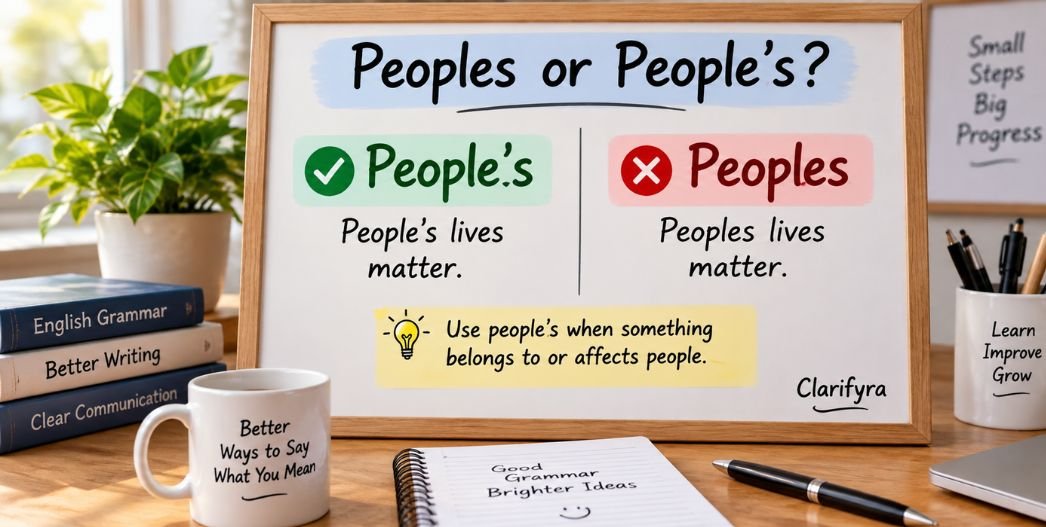
Peoples or People’s: Which Is Correct?
English apostrophes can make a simple sentence surprisingly confusing. People, people’s, peoples, and peoples’ are all possible forms, but they do not mean the same thing or serve the same grammatical purpose. The confusion becomes especially noticeable in expressions such as people’s lives, where writers may wonder whether peoples or peoples’ is appropriate.
The good news is that there is a straightforward rule: people’s is normally the possessive form used when referring to people in general, while peoples has a different plural meaning. Peoples’ is the possessive form of that specialized plural.
People’s is usually correct when you mean something belonging to or associated with people: “people’s lives” and “people’s opinions.” Peoples is also a correct word, but it means multiple distinct groups or communities. Its possessive form is peoples’, as in “the peoples’ traditions.”
People, People’s, Peoples, or Peoples’: The Quick Difference
The four forms look similar, but their grammatical jobs are different.
| Form | Function | Meaning | Example |
|---|---|---|---|
| people | Plural noun | More than one person | Many people agreed. |
| people’s | Possessive | Belonging to or associated with people | People’s opinions differ. |
| peoples | Plural noun | Several distinct peoples or communities | The peoples of the region have different traditions. |
| peoples’ | Possessive plural | Belonging to several distinct peoples | The peoples’ traditions were preserved. |
The important distinction is that people’s and peoples are not alternative spellings of the same word.
What Does “People” Mean?
People is normally the plural of person.
For example:
- One person entered the room.
- Three people entered the room.
- Many people enjoy reading.
- The people were waiting outside.
When you are talking about individuals generally, people is the ordinary plural form.
When this noun needs to show possession, it becomes people’s.
For example:
People’s lives can change unexpectedly.
People’s opinions are often different.
The decision affected people’s families.
Here, the apostrophe plus s shows that the following noun is associated with or belongs to people.
What Does “People’s” Mean?
People’s is the possessive form of people when people refers to individuals generally.
It can mean something like “belonging to people”, “associated with people,” or “affecting people.”
Examples include:
- people’s rights
- people’s choices
- people’s homes
- people’s experiences
- people’s concerns
- people’s lives
- people’s opinions
Consider this sentence:
The new policy could affect people’s lives.
The word people’s tells us whose lives are being discussed.
People’s Lives or Peoples’ Lives?
In ordinary contexts, people’s lives is the form you want.
People’s lives were affected by the flood. ✅
This means the lives of people in general or of a particular group of individuals.
Peoples’ lives is grammatically possible, but it has a more specific meaning. It refers to the lives of multiple distinct peoples or communities.
For example:
The book examines how migration changed different peoples’ lives.
Here, peoples refers to separate communities, not simply a collection of individual people.
What Does “Peoples” Mean?
Peoples is a real and correct English word. It is not simply an incorrect version of people’s.
It is used when people means a distinct community, nation, ethnic group, or cultural group, and the writer is referring to more than one such group.
For example:
The peoples of the region have different languages.
Several Indigenous peoples live in the area.
The museum documents the history of ancient peoples.
In these examples, peoples means distinct groups of people.
This is why saying simply “peoples is always wrong” would be inaccurate.
People’s vs Peoples: What’s the Difference?
The easiest way to distinguish them is to ask what you mean by people.
Use “people’s” for possession
If you mean something belongs to, affects, or concerns people generally, use people’s.
People’s needs should be considered.
The storm disrupted people’s lives.
People’s opinions vary.
Use “peoples” for distinct groups
If you are talking about several separate cultural, ethnic, national, or historical communities, use peoples.
The traditions of different peoples are represented in the exhibition.
Ancient peoples settled throughout the region.
The distinction can be summarized like this:
people → individuals or people generally
people’s → something belonging to or associated with people
peoples → several distinct communities
peoples’ → something belonging to several distinct communities
When Should You Use “Peoples’”?
Peoples’ is the possessive form of peoples.
Because peoples is already plural, its possessive form normally takes an apostrophe after the s:
peoples → peoples’
For example:
The peoples’ traditions have survived for centuries.
The agreement recognized the peoples’ rights.
The museum protects the cultural heritage of several peoples.
The meaning is different from the ordinary people’s construction.
Compare:
People’s traditions can change over time.
This refers broadly to traditions belonging to people.
The peoples’ traditions are distinct.
This refers to traditions belonging to several distinct groups.
Why Are These Forms So Easy to Confuse?
The confusion comes from the fact that four closely related forms are built from the same word:
- people
- people’s
- peoples
- peoples’
The apostrophe is particularly important because it indicates possession.
There is also a semantic difference between people and peoples. In everyday English, people usually refers to individuals collectively. In certain historical, cultural, political, or anthropological contexts, people can refer to a distinct community. The plural peoples can then distinguish several such communities.
That means the choice is not simply about where to put an apostrophe. You first need to determine what people means in the sentence.
Correct Usage Examples
Here are some examples showing the differences clearly.
People
Many people attended the event.
The organization helps people in rural communities.
People’s
The decision affected people’s lives.
People’s opinions differed on the issue.
The survey examined people’s experiences.
Peoples
The region is home to several Indigenous peoples.
Ancient peoples developed sophisticated trading networks.
The exhibition celebrates the cultures of different peoples.
Peoples’
The agreement protects the peoples’ traditions.
The book describes several peoples’ histories.
Researchers studied the different peoples’ languages.
These examples show why the forms cannot simply be substituted for one another.
Is “People’s” Grammatically Correct?
Yes. People’s is grammatically correct when it functions as the possessive form of people.
For example:
People’s lives matter to the community.
The law protects people’s rights.
We should respect people’s privacy.
The apostrophe comes before the s because this is the possessive form of the irregular plural noun people.
It follows the same basic pattern as other irregular plurals:
- child → children’s
- person → people’s
- woman → women’s
- man → men’s
Is “Peoples” a Correct Word?
Yes. Peoples is grammatically correct when it refers to multiple distinct groups of people.
It is less common than the ordinary plural people, because everyday English normally uses people for more than one person.
For instance, you would normally say:
Many people attended the meeting.
You would not normally say:
Many peoples attended the meeting.
But in a sentence discussing separate cultural or national communities, peoples can be exactly right:
The region’s different peoples have maintained their own traditions.
So peoples should not be treated as a misspelling.
Is “Peoples or People’s” the Same as “People’s or Peoples’”?
No. These comparisons involve different grammatical questions.
People’s vs peoples asks whether you need a possessive form or a plural noun.
People’s vs peoples’ compares two possessive forms with different meanings.
For example:
People’s rights are protected by the law.
Here, people means people generally.
The peoples’ rights were discussed during the negotiations.
Here, peoples refers to distinct groups.
The surrounding context determines which form is appropriate.
Common Mistakes to Avoid
1. Treating “peoples” as a misspelling
Peoples is a legitimate word. It has a specialized plural meaning involving distinct peoples or communities.
2. Writing “people’s” when you simply need “people”
Many people’s attended the event. ❌
Many people attended the event. ✅
The apostrophe should not be added merely because the noun is plural.
3. Using “peoples” for ordinary plural people
Five peoples were waiting outside. ❌
Five people were waiting outside. ✅
Unless peoples means distinct communities, people is the normal choice.
4. Using “people’s” when you mean several distinct peoples
In a historical or cultural context, peoples may be needed:
The customs of several peoples were documented. ✅
If possession is required:
The peoples’ customs were documented. ✅
5. Writing “people’s’”
The form people’s’ is not standard English.
Choose either:
- people’s — possessive of people
- peoples’ — possessive of peoples
An Easy Way to Remember the Difference
Think of the forms as a simple progression:
People = individuals
People’s = belonging to people
Peoples = distinct groups
Peoples’ = belonging to distinct groups
For the expression most likely to cause confusion, remember:
people’s lives = the lives of people
Only use peoples’ lives when peoples specifically means multiple distinct communities.
Frequently Asked Questions
Is “peoples or people’s” grammatically correct?
Both peoples and people’s can be grammatically correct, but they perform different jobs. People’s is possessive, while peoples is a plural noun referring to multiple distinct communities or groups.
Is it “people’s lives” or “peoples’ lives”?
People’s lives is correct when you mean the lives of people generally. Peoples’ lives is possible when peoples refers specifically to multiple distinct communities and you mean the lives belonging to those groups.
Is “peoples” a real word?
Yes. Peoples is a legitimate plural noun used particularly when referring to distinct cultural, ethnic, national, or historical groups. It should not automatically be treated as a spelling mistake.
Is “people’s” singular or plural?
People’s is possessive, not simply singular or plural. Its base noun, people, is normally plural when it means more than one person. The apostrophe and s indicate possession or association.
What is the possessive form of “peoples”?
The possessive form is peoples’ when referring to multiple distinct peoples. For example: “The peoples’ traditions were preserved.”
Should I write “people’s” or “peoples”?
Use people’s when something belongs to or concerns people generally. Use peoples when you mean several distinct groups. If those groups possess something, use peoples’.
The Bottom Line
People’s is the normal possessive form when you are talking about people generally, so people’s lives, people’s rights, and people’s opinions are standard constructions. Peoples is also correct, but it has a different meaning: it refers to multiple distinct peoples or communities. When that plural noun needs to show possession, use peoples’.
Once you separate the two meanings, the apostrophe becomes much easier to handle. For more clear explanations of confusing English forms and word choices, Clarifyra helps you better understand exactly which form fits the sentence.