Hayday or Heyday: Which Is Correct?
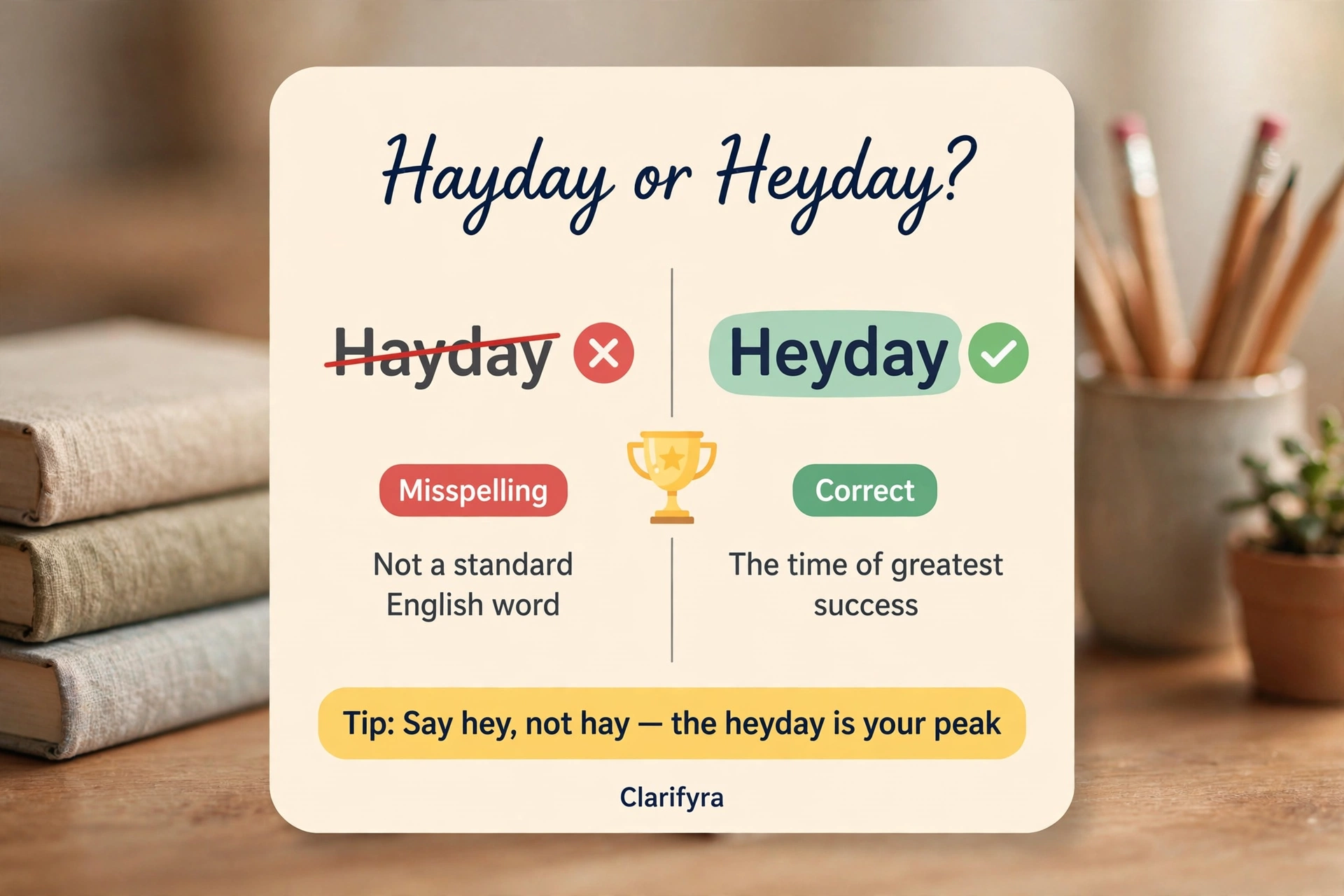
If you’re choosing between hayday and heyday, the answer is one letter: write heyday. It’s the only standard spelling — a noun meaning the period of a person or thing’s greatest success, popularity, or vigor. Hayday has no entry in the major dictionaries; it’s a misspelling that survives because “hey” and “hay” sound identical and because the image of a sunny farm day is more vivid than a correct spelling. Use heyday in every context, every time.
Quick Answer
Heyday is correct — the noun meaning “the time of greatest success or popularity” (“in its heyday, the band sold out stadiums”). Hayday is a misspelling; the major dictionaries have no entry for it. Pronounced /ˈheɪdeɪ/ (“HAY-day”) in both British and American English.
What “Heyday” Actually Means
Every major dictionary tells the same story. The Oxford Advanced Learner’s Dictionary defines heyday as a noun (usually singular): “the time when somebody/something had most power or success, or was most popular.” Merriam-Webster calls it “the period of one’s greatest popularity, vigor, or prosperity,” and Collins puts it simply: “the time of most power, popularity, vigour, etc; prime.” It’s a word about peaks — golden ages, prime years, the best days.
In practice, it almost always appears in one of two patterns: “in its heyday” (with a possessive) or “the heyday of” (followed by a person, group, era, or thing):
“In its heyday, the studio’s boast was that it had more stars than there are in heaven.”
“The 1950s were the heyday of rock and roll.”
“In her heyday, my grandmother was a celebrated ballroom dancer.”
“The heyday of the silent movie had passed by the time sound arrived.”
Note the tense: heyday usually looks backward. It describes a peak that is remembered, sometimes wistfully, sometimes with a hint that the peak has passed. You can use it for the present (“streaming services may be in their heyday right now”), but the word’s natural home is retrospective — which is why it pairs so often with phrases like “back in” and “during the.”
Why “Hayday” Isn’t the Right Spelling
Here’s the precise claim, kept honest: none of the four major references — Cambridge, Oxford, Merriam-Webster, Collins — has an entry for “hayday” as a noun meaning a peak period. It is a misspelling, not a variant. It doesn’t get the “less common variant” treatment that some unusual spellings earn; it simply isn’t recorded.
One small complication is worth mentioning for accuracy: the Random House dictionary notes a different old spelling, “heydey”, as an occasional historical form of heyday. “Hayday,” with an a, has no such pedigree. For the general lesson about recorded-but-archaic variants versus outright errors, inclosed vs enclosed walks through the distinction in full — the short version is that a dictionary noting an old spelling is never permission to use it today.
So why does “hayday” keep appearing? Three forces work together:
- The ear gives no clue. “Hey” and “hay” are pronounced identically — /heɪ/ — so there’s nothing in the sound to steer you toward the right spelling. The same silent-spelling trap catches people in faired vs fared, where identical pronunciation hides the correct letter.
- “Hay” is the more vivid word. Most people meet “hay” far earlier in life than “heyday” — hay bales, hayrides, farms. When a word you rarely write needs spelling, your brain reaches for the familiar pieces it knows, and “hay” + “day” assembles itself almost automatically.
- Modern reinforcement. The popular mobile farming game Hay Day (two words, a proper title) and the idiom “make hay while the sun shines” — which Cambridge defines as “to make good use of an opportunity while it lasts” — both keep “hay” and “day” glued together in readers’ minds. Neither has anything to do with “heyday,” but the association is strong enough to nudge a hesitant writer the wrong way.
A Quick Word on “Hay Day” (Two Words)
To avoid any confusion: the two-word phrase “hay day” is legitimate when you literally mean a day spent making or working with hay — “the crew put in a long hay day before the rain.” It’s just two ordinary words side by side, the way “snow day” or “work day” would be. And Hay Day is the proper title of a farming game. Neither of these is “heyday,” and “hayday” as one word is still not standard English. If you mean the peak of success, there’s only one spelling.
Pronunciation: UK and US
This one is refreshingly simple — British and American English agree completely. Both Oxford’s British and American entries give /ˈheɪdeɪ/: “HAY-day,” with the stress firmly on the first syllable and the second syllable rhyming with “day.” Cambridge transcribes it the same way (/ˈheidei/), and Merriam-Webster renders it ˈhā-ˌdā, which is the same sound in American dictionary notation.
The pronunciation is worth nailing down precisely because it doesn’t resolve the spelling. Say it out loud — “hay-day” and “hey-day” are identical. The difference lives entirely in the letters, which is exactly why this word has to be memorized rather than sounded out.
Correct vs Incorrect
Because the error is purely orthographic, the cleanest way to see it is in pairs:
- ✗ “In his hayday, he was the most famous chef in the city.” → ✓ “In his heyday, he was the most famous chef in the city.”
- ✗ “The hayday of disco was the late 1970s.” → ✓ “The heyday of disco was the late 1970s.”
- ✗ “That department store is past its hayday.” → ✓ “That department store is past its heyday.”
- ✗ “Vinyl records are enjoying a second hayday.” → ✓ “Vinyl records are enjoying a second heyday.”
Where the Word Comes From
“Heyday” has an unusually fun history, and knowing it makes the spelling stick. Oxford traces it to the late 16th century, when “heyday!” was an exclamation — a shout of joy, surprise, or exultation (think “Heyday, what a fine morning!”). Over time, that shout of high spirits became the noun for the time of high spirits: the peak, the prime, the best days. Collins gives the same 16th-century origin, noting it’s “probably based on hey.”
There’s an alternative theory recorded by Random House, which suggests “heyday” may be a variant of “high day” (a day of celebration), reshaped by confusion with the exclamation “heyday.” Either way, both accounts agree on one thing: the word’s first syllable is “hey” — the shout, not the farm. That’s your anchor.
A side note for the curious: the old exclamation still surfaces in classic literature — characters in Austen and Fielding cry “Heyday!” on being startled — and Merriam-Webster still lists “high spirits” as an archaic sense of the noun. But in modern writing, you need only the one meaning: the peak period.
Common Mistakes
1. Spelling it “hayday.” ✗ “The band was huge in its hayday.” → ✓ “The band was huge in its heyday.” The single most common error — and the one this article exists to kill.
2. Spelling it “heydey.” ✗ “…during the heydey of vaudeville.” → ✓ “…during the heyday of vaudeville.” The e/y swap is far rarer than the hay/hey swap, but dictionaries flag it as an old form only — modern spelling is always “heyday.”
3. Using the plural when you don’t need it. ✗ “In their heydays, both teams dominated.” → ✓ “In their heyday, both teams dominated.” Oxford marks “heyday” as usually singular; the plural “heydays” is possible but rare, and most sentences want the singular.
4. Dropping the article in “the heyday of.” ✗ “That was heyday of radio drama.” → ✓ “That was the heyday of radio drama.” The “of”-construction needs its article, just as “the golden age of” does.
5. Confusing it with the literal farm phrase. ✗ “The farmers had their heyday cutting the meadow.” (If you mean the workday, it’s “hay day” — two words.) The comedy writes itself: a golden age of agriculture described with a word that has nothing to do with farms.
How to Remember It
Think of a crowd at the absolute peak of a concert, hands in the air, shouting “Hey!” — that’s your heyday: the high point, the celebration, the shout of joy the word grew out of. The spelling keeps the exclamation it was born from. “Hay,” meanwhile, is for horses — it belongs in the barn, not in your sentence about someone’s prime.
If you want it in one line: the heyday is the “hey!” day, not the hay day.
Frequently Asked Questions
Is “hayday” ever correct?
No. It’s not a standard variant, an Americanism, or an acceptable alternative — it’s a misspelling. None of the major dictionaries (Cambridge, Oxford, Merriam-Webster, Collins) has an entry for it. Always write “heyday.”
How do you pronounce “heyday”?
/ˈheɪdeɪ/ — “HAY-day,” stressed on the first syllable. British and American pronunciation are identical, so this is one word where you don’t have to pick a side of the Atlantic.
What does “in its heyday” mean?
It means “during the period when it was at its best, most successful, or most popular” — as in “In its heyday, the magazine had a million subscribers.” The phrase usually carries a backward-looking, sometimes nostalgic tone.
Is the plural “heydays”?
Technically possible, but Oxford marks “heyday” as usually singular, and the plural is genuinely rare in real usage. In almost every sentence, the singular is the right choice — write “in their heyday,” not “in their heydays.”
Is “heydey” a word?
Not in modern standard English. Some older dictionaries note “heydey” as an occasional historical spelling of “heyday,” but it isn’t current usage. Write “heyday.”
Do British and American English spell it differently?
No — “heyday” is the standard spelling on both sides of the Atlantic, and the pronunciation is identical too (/ˈheɪdeɪ/). There’s no transatlantic split to navigate here.
What about “Hay Day,” the game?
Hay Day is a proper title (a farming game), written as two words — and it has nothing to do with the noun “heyday.” It’s one of the reasons the misspelling persists, but a game’s title doesn’t change the spelling of an English word.
Is “heyday” positive or negative?
Positive in itself — it names a peak. But the word often appears in sentences about decline (“since its heyday,” “past its heyday”), which can give it a slightly melancholy flavor in context. The word celebrates the summit; the sentence may mourn that it’s over.
Final Takeaway
Heyday is the only correct spelling — the noun for the period of greatest success, popularity, or vigor, pronounced “HAY-day” everywhere English is spoken. Hayday is what happens when a familiar word (“hay”) hijacks an unfamiliar one, helped along by identical pronunciation and a famous farming game. Remember the shout: the heyday is the “hey!” day. Keep the farm out of it, and you’ll never spell it wrong again.