Everyone or Everybody: Is There a Difference?
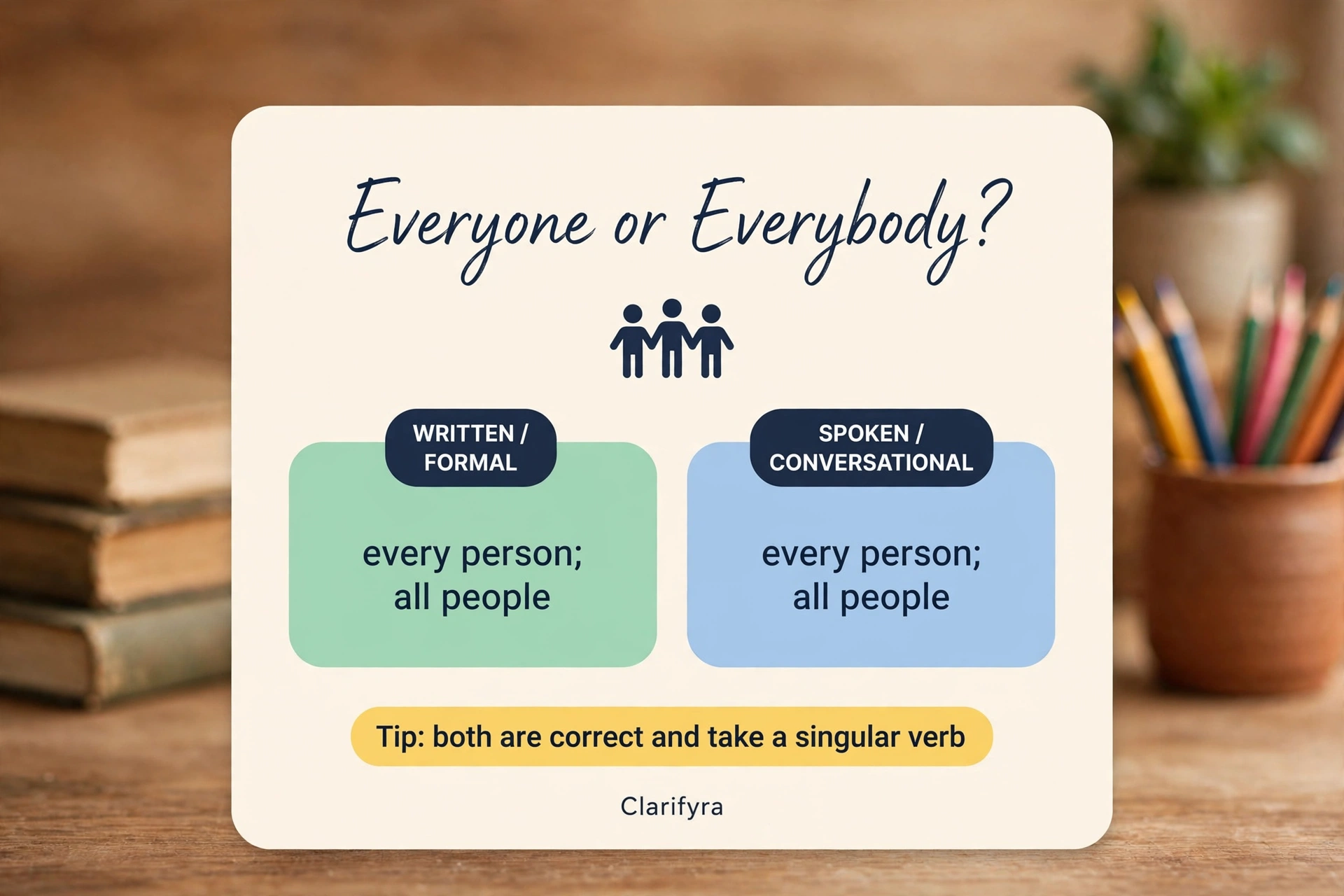
Everyone and everybody mean exactly the same thing: every person, all the people. There is no difference in meaning between them — Collins’ usage notes say so in plain terms, and Merriam-Webster defines “everybody” simply as “every person; everyone.” The only genuine difference is a tendency of register: everyone is more common in written English, while everybody is more common in spoken English. So in an essay, a report, or a formal email, “everyone” tends to be the natural choice; in conversation, “everybody” sounds a shade warmer and more relaxed. But this is a tendency, not a rule — nobody will mark you wrong for saying “everyone” out loud or writing “everybody” in a letter. The rule that actually matters is a grammar one: both words are grammatically singular, so both take a singular verb — “everyone is,” “everybody has,” never “are” or “have.”
Quick Answer
Everyone and everybody are interchangeable — both are indefinite pronouns meaning “every person.” Collins’ usage notes record the only consistent difference: everyone is more common in written English, everybody more common in speech. Both are grammatically singular and take singular verbs: “everyone is,” “everybody has.” Don’t confuse everyone with every one (two words), which means “each individual” and — unlike “everyone” — can refer to things as well as people.
What the Dictionaries Actually Say
The reference works are unusually unanimous on this pair, which is worth noting because it means the guidance below rests on settled lexicography rather than style-guide opinion:
- Cambridge Dictionary: “everyone” — pronoun, A2 level, meaning “every person,” with “(also everybody)” given as the alternative right in the headword.
- Collins COBUILD: “everyone (or everybody)” — an indefinite pronoun: “You use everyone to refer to all the people in a particular group,” or to refer to all people in general.
- Merriam-Webster lists “everybody” among the standard indefinite pronouns (alongside “either,” “none,” and “something”).
- Collins English Usage (the Collins Education grammar guide) states the position most precisely: “There is no difference in meaning between everyone and everybody, but everyone is more common in written English, and everybody is more common in spoken English.”
That last sentence is the whole article in one line. Everything else is detail — but as you’ll see, it’s detail that actually helps you write and speak more confidently.
The Real Difference: Written vs Spoken
Since the meaning is identical, the choice between the two is really a choice about tone and medium. Everyone has a slightly more formal, written feel; everybody feels more conversational. You can hear it in authentic dictionary examples:
“Would everyone who wishes to attend the dinner let me know by Friday afternoon?” — Cambridge (written, formal invitation)
“Everyone has the right to freedom of expression.” — Collins (statement of principle)
“Come to the table everybody — supper’s ready.” — Cambridge (spoken, at home)
“Why did you have to embarrass me in front of everybody like that?” — Cambridge (spoken, emotional)
Practically speaking: default to everyone in formal writing — academic work, business emails, official notices — and you’ll never go wrong. Reach for everybody when you’re speaking or writing as you speak (dialogue, chat messages, friendly emails). And if you swap them, nothing breaks: the meaning survives either way, which is exactly why the Britannica Dictionary’s usage column observes that native speakers essentially never stop to deliberate over the choice.
The Rule That Actually Matters: Singular Verbs
Both everyone and everybody are singular indefinite pronouns, even though they refer to many people. The verb that follows them is always singular. Collins’ usage guide states it flatly: “After everyone or everybody you use a singular form of a verb.”
“Everyone wants to find out what is going on.” — Collins
“Everybody is selling the same product.” — Collins
“Not everyone thinks that the government is being particularly generous.” — Collins COBUILD
The logic is that “everyone” refers to people one by one — every single person — rather than as a plural mass. The most common error with this pair is letting the plural meaning drag the verb into the plural:
- ✗ “Everyone are invited to the reception.” → ✓ “Everyone is invited to the reception.”
- ✗ “Everybody have a right to be heard.” → ✓ “Everybody has a right to be heard.”
- ✗ “Everyone were asked to leave.” → ✓ “Everyone was asked to leave.”
The pronoun problem: why “their” saves the sentence
Here’s the wrinkle that trips up careful writers. “Everyone” is singular, but it refers to people of unknown or mixed gender — so what pronoun do you use when you refer back to it? “Everyone must bring his ticket” feels outdated and exclusionary; “his or her” is clunky; and a singular “his” misfires grammatically in the other direction.
The standard solution, confirmed by both Collins and Britannica, is they / them / their. Collins’ usage note: “When you are referring back to everyone or everybody, you usually use they, them, or their.”
“Everyone has their own ideas about the best way to bring up children.” — Cambridge
“Will everyone please carry on as best they can.” — Collins
“Everybody had to bring their own paper.” — Collins
This is the normal, accepted pattern in modern English — the mismatch between the singular verb and the plural referring pronoun is something every major dictionary’s example sentences do without apology. In the most formal writing you can still use “his or her” (“Everyone has his or her own problems,” as Britannica puts it), but in ordinary writing and speech, their is the expected choice.
“Every One” (Two Words) Is a Different Thing
The one-word/two-word distinction is where real confusion lives. Everyone (one word) is the pronoun meaning “everybody.” Every one (two words) is a phrase meaning “each individual one” — and it can refer to things as well as people, which “everyone” can never do. Collins’ usage note draws the line explicitly: “Care should be taken to distinguish between everyone as a single word and every one as two words, the latter form correctly being used to refer to each individual person or thing in a particular group.”
“Everyone except Joe attended the concert.” — one word: all the people
“Every one of the phones has a camera.” — two words: each individual phone
“He read every one of her novels.” — Collins: each individual novel
Two reliable tests for when you need the two-word version:
- The “of” test. If the phrase is followed by “of” (“every one of the students,” “every one of them”), you need two words. “Everyone of the students” is wrong.
- The “each one” test. If you can replace the phrase with “each one” without changing the meaning, write it as two words: “She loved every one of them” → “She loved each one of them” works. “Everyone enjoyed the party” → “Each one enjoyed the party” sounds off, so one word it is.
Common errors follow the same pattern:
- ✗ “Every one knows the answer.” → ✓ “Everyone knows the answer.” (you mean all the people)
- ✗ “Everyone of the cookies was eaten.” → ✓ “Every one of the cookies was eaten.” (each individual cookie — and note: cookies aren’t people, so one-word “everyone” is impossible here)
The Same Pattern Runs Through the Whole Family
“Everyone/everybody” isn’t an isolated quirk — English has a whole set of -one / -body pairs that work the same way, and Collins’ usage note confirms they’re all interchangeable: anyone/anybody, someone/somebody, and no one/nobody. In each case the -one form skews slightly toward writing and the -body form toward speech, and every one of them is grammatically singular (“someone is,” “nobody was”).
One spelling note worth filing away: “no one” is normally written as two words in British English, while “nobody” is always one word. And if you ever need the plural of “nobody,” the spelling trap is real — the guide to nobodies vs nobodys untangles it.
Common Mistakes
1. Using a plural verb after “everyone” or “everybody.” ✗ “Everyone are welcome.” → ✓ “Everyone is welcome.” The plural meaning fools the ear; the grammar stays singular.
2. Writing “every one” when you mean “everyone.” ✗ “Every one should wash their hands.” → ✓ “Everyone should wash their hands.” If you mean “all the people,” it’s one word.
3. Using “everyone” for things. ✗ “Everyone of the files is corrupted.” → ✓ “Every one of the files is corrupted.” One-word “everyone” is people-only.
4. Defaulting to “his” as the referring pronoun. ✗ “Everyone must bring his own lunch.” → ✓ “Everyone must bring their own lunch.” Reserve “his or her” for the most formal writing.
5. Agonizing over the choice between the two. There is no hidden difference in meaning to uncover. Pick the one that fits your medium — everyone for writing, everybody for speaking — and move on. The energy is better spent getting the verb right.
How to Remember It
Match the word to the medium: everyone lives most comfortably on the written page, everybody in the spoken voice — and you can hear the difference in the words themselves, one crisp and formal, the other warm and physical. Then remember the one rule that never bends: whichever you choose, the verb stays singular — everyone is, everybody has, no exceptions.
Frequently Asked Questions
Is “everyone” singular or plural?
Grammatically singular, even though it refers to many people. It takes singular verbs (“everyone is,” “everyone has”) — Collins, Britannica, and Cambridge all confirm this, and every dictionary example uses the singular form.
Can “everyone” and “everybody” be used interchangeably?
Yes. Collins states there is no difference in meaning; the only pattern is that “everyone” appears more in written English and “everybody” more in spoken English. Neither choice is ever wrong in the other’s territory.
Is “everybody” informal or slang?
No — it’s standard English, recorded in every major dictionary. It’s simply more common in speech and casual contexts than in formal writing. There’s nothing incorrect or uneducated about it.
Is it “everyone is” or “everyone are”?
“Everyone is” — always. “Everyone are” is a common error caused by the plural meaning, but the pronoun is grammatically singular.
What’s the difference between “everyone” and “every one”?
Everyone (one word) is a pronoun meaning “everybody” — people only. Every one (two words) means “each individual one” and can refer to people or things: “every one of the reports.” If “of” follows, or you can substitute “each one,” use two words.
Can “everyone” refer to things?
No. “Everyone” refers to people only — that’s what makes it different from “every one,” which can refer to things (“every one of the chairs”).
Should I write “everyone’s” or “everyones” for the possessive?
“Everyone’s” — with the apostrophe: “everyone’s responsibility.” Like other pronouns, “everyone” forms its possessive with ‘s.
Final Takeaway
Everyone and everybody are the same word wearing different clothes: identical in meaning, freely interchangeable, differing only in that “everyone” prefers the page and “everybody” prefers the voice. The choice between them is a matter of tone, not correctness. What is a matter of correctness is the verb — singular, always — and the spelling of their two-word lookalike, every one, which means something else entirely. Get those two things right and the rest is simply preference.