Another Way to Say “as Well as”: 20+ Natural Alternatives
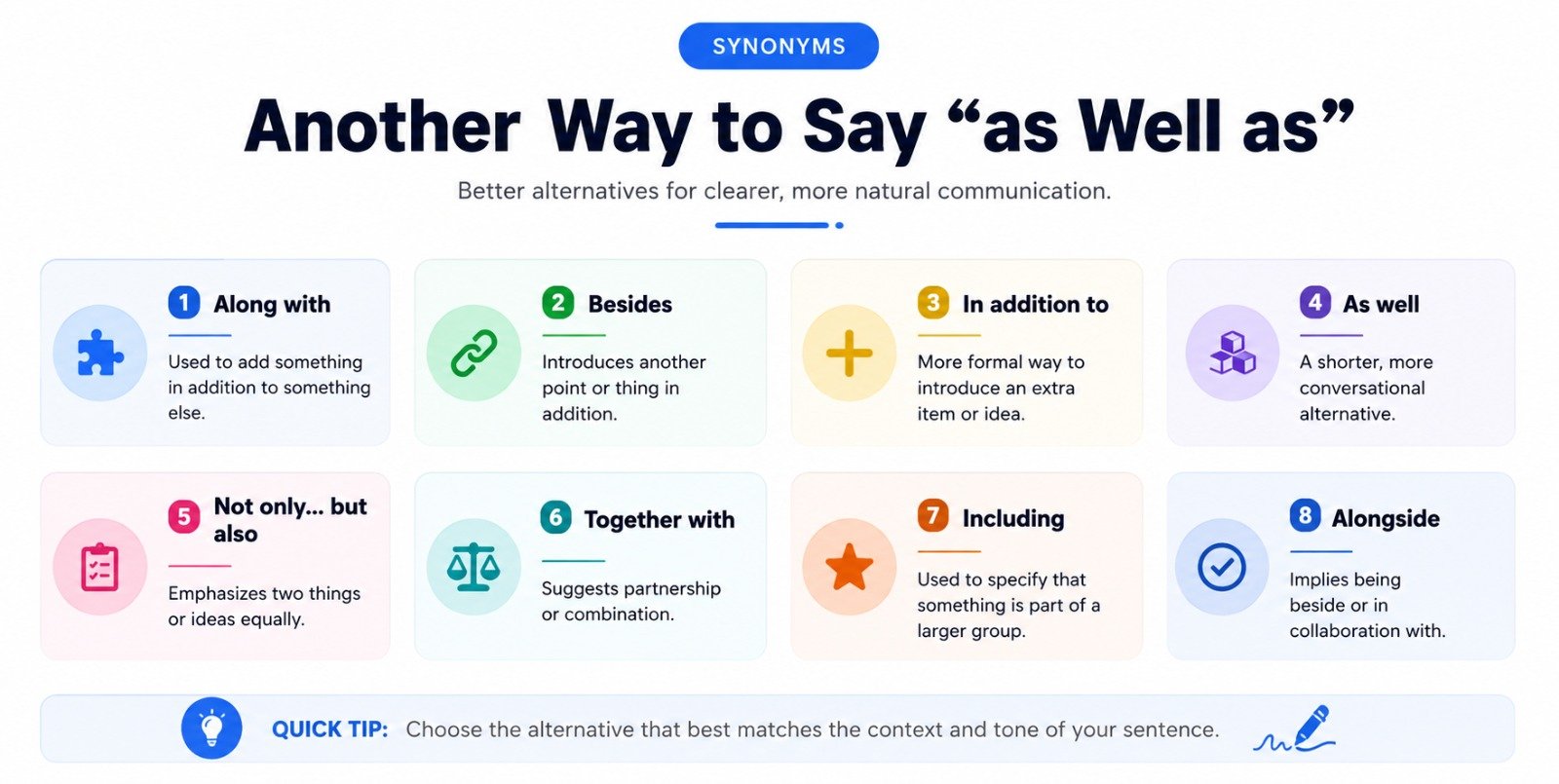
“As well as” is a useful phrase for adding another person, thing, action, or idea to a sentence, but repeating it can make your writing sound predictable. If you need another way to say “as well as,” options such as along with, in addition to, together with, besides, plus, and including can often work naturally.
The best choice depends on context. “In addition to” fits formal and academic writing, “along with” sounds natural in most situations, while “plus” is better suited to casual communication. Some alternatives also change the emphasis or grammatical structure of the sentence, so they shouldn’t automatically be treated as exact substitutes.
What Does “As Well as” Mean?
“As well as” most commonly means “in addition to.” It connects something with an additional person, thing, quality, or action. Cambridge Dictionary describes it as a multi-word preposition meaning “in addition to,” while Merriam-Webster also recognizes uses meaning “and in addition” or “besides.”
For example:
Original:
“Emma manages customer support as well as social media.”
Here, managing social media is an additional responsibility.
You could write:
“Emma manages customer support along with social media.”
or:
“Emma manages customer support in addition to social media.”
However, alternatives are not always interchangeable. The right wording depends on how formal the sentence is and whether you want both ideas to receive equal emphasis.
Best Alternatives to “As Well as” at a Glance
| Alternative | Tone | Best Used For |
|---|---|---|
| Along with | Neutral | Everyday and professional writing |
| In addition to | Formal | Essays, reports, business writing |
| Together with | Neutral/Formal | Professional and descriptive writing |
| Besides | Neutral | Adding another point or item |
| And | Neutral | Connecting equally important ideas |
| Plus | Casual | Conversation and informal writing |
| Including | Neutral | Adding examples or members of a group |
| Accompanied by | Formal | People, events, features, or conditions occurring together |
| Not to mention | Conversational | Adding an extra point for emphasis |
| On top of | Informal | Adding another responsibility, benefit, or problem |
| Over and above | Formal/Emphatic | Something additional beyond what is expected |
| In conjunction with | Formal | Technical, professional, or academic contexts |
The most natural replacement depends on the sentence. For example, including is useful when introducing an example but cannot replace “as well as” in every construction.
Other Ways to Say “As Well as” in Everyday Writing
Several alternatives work well when you simply need to add one thing to another.
Along With — Another Way to Say “As Well as”
Along with is one of the closest and most versatile alternatives. It works in everyday, business, and moderately formal writing.
As well as:
“The package includes free delivery as well as technical support.”
Alternative:
“The package includes free delivery along with technical support.”
“Along with” is especially useful when the second item is additional rather than equally important.
Together With — Another Way to Say “As Well as”
Together with has a slightly more formal feel and works well when two people, things, or factors are connected.
“The proposal, together with the supporting documents, was submitted on Friday.”
It can sound more polished than “plus” without becoming overly academic.
Besides — Another Way to Say “As Well as”
Besides can mean “in addition to” when it introduces another consideration.
“Besides managing the store, she handles online orders.”
This alternative often requires changing the structure of the original sentence rather than simply swapping one phrase for another.
Plus — A Casual Way to Say “As Well as”
Plus is short and conversational.
“The apartment has a balcony, plus a private parking space.”
It sounds natural in casual speech, advertisements, social posts, and informal writing but may be too relaxed for an academic paper or formal report.
Including — Another Way to Express Addition
Use including when the second element is an example, member, or part of a broader group.
“Several departments, including marketing and finance, attended the meeting.”
It does not always mean exactly the same thing as “as well as,” so use it only when the relationship between the items involves inclusion.
Formal and Professional Ways to Say “As Well as”
Professional writing usually benefits from straightforward alternatives rather than unusual synonyms.
In Addition To — A Formal Alternative to “As Well as”
In addition to is one of the strongest choices for reports, workplace communication, essays, and other formal contexts.
“In addition to improving response times, the new system reduced operating costs.”
It clearly signals that you are adding another point without sounding conversational.
In Conjunction With — A More Formal Alternative
In conjunction with means that two things are used, considered, or carried out together.
“The software should be used in conjunction with the company’s security procedures.”
This wording suits technical and professional contexts. It would sound unnecessarily formal in a casual sentence such as “I ordered fries as well as a drink.”
Accompanied By — When Two Things Occur Together
Accompanied by works when one thing appears, happens, or exists together with another.
“The presentation was accompanied by a detailed written report.”
It is particularly useful for events, symptoms, features, music, documents, and people traveling together.
Over and Above — For Something Extra
Over and above emphasizes that something is additional to what is already required or expected.
“Employees may receive bonuses over and above their regular salary.”
This is more specific than “as well as,” so it should only be used when the idea of something extra or beyond the normal amount is important.
Another Way to Say “As Well as” in an Essay
If you’re looking for another way to say “as well as” in an essay, the strongest choices are generally in addition to, along with, together with, and in suitable sentence structures.
Academic writing benefits from precision, so avoid replacing the phrase simply to sound more sophisticated.
In Addition To — Other Ways to Say “As Well as” in Academic Writing
“In addition to” works particularly well when introducing another reason, influence, method, or consideration.
Example:
“In addition to economic pressures, social factors influenced migration patterns.”
This is clear, formal, and appropriate for most essays.
Along With — A Natural Essay Alternative
“Along with” is slightly less formal but still perfectly suitable for many essays.
“Climate conditions, along with access to resources, affected agricultural development.”
Together With — A More Formal Essay Option
“Together with” can be useful when two factors contribute to the same result.
“The survey findings, together with previous studies, support this interpretation.”
And — When Both Ideas Deserve Equal Weight
Sometimes the best replacement is simply and.
“Accuracy and clarity are essential.”
However, “and” and “as well as” can carry different emphasis. “And” usually coordinates items equally, while “as well as” can present what follows as additional or less central information. Scribbr specifically cautions against assuming the two expressions are interchangeable in every sentence.
Can You Use “Furthermore,” “Moreover,” or “Additionally”?
Yes, but these words usually perform a different grammatical job.
Consider:
“Sarah studies history as well as literature.”
You cannot naturally change this to:
“Sarah studies history furthermore literature.”
Instead, a transition such as furthermore would introduce another statement:
“Sarah studies history. Furthermore, she studies literature.”
The same applies to moreover and additionally. They can communicate the broader idea of adding information, but they are not direct word-for-word replacements for “as well as.”
This distinction matters especially in essay writing.
“As Well as” vs. “And”
These expressions overlap, but they aren’t always identical.
Compare:
“Daniel and Mia are attending the conference.”
Here, Daniel and Mia are presented as equally important members of the subject.
Now consider:
“Daniel, as well as Mia, is attending the conference.”
The sentence focuses grammatically on Daniel, with Mia added as further information. This difference can also affect subject-verb agreement. Merriam-Webster gives the same type of structure in examples such as a singular subject followed by an “as well as” phrase.
Therefore, replacing every “as well as” with “and” can sometimes change both emphasis and grammar.
A practical rule is simple: use and when the items should have equal weight; consider as well as, along with, or together with when one element is being added to another.
More Other Ways to Say “As Well as” for Extra Emphasis
Sometimes you aren’t merely adding information; you want the additional point to stand out.
Not to Mention — An Emphatic Alternative
Not to mention introduces an additional point that strengthens what you’ve already said.
“The hotel is expensive, not to mention difficult to reach.”
It is natural in conversational and semi-formal English but is usually less suitable for highly academic writing.
On Top Of — An Informal Alternative
On top of is often used when adding another responsibility, problem, expense, or benefit.
“She manages the accounts on top of running the office.”
This expression is conversational and often carries a stronger sense of accumulation than “as well as.”
As an Added Bonus — For Positive Additional Information
When the additional information is clearly a benefit, you can restructure the sentence with as an added bonus.
“The course includes individual feedback. As an added bonus, students receive lifetime access to the materials.”
This isn’t a direct synonym, but it can produce more natural wording when the second point is clearly positive.
Another Way to Say “You as Well”
The keyword “another way to say you as well” belongs to a related but different use of as well.
When someone says:
“Have a great day!”
and you reply:
“You as well!”
you are returning the same good wish to them. In this conversational use, “as well” means something similar to “too” or “also.”
Natural alternatives include:
- You too
- Likewise
- Same to you
- And to you
- Right back at you
- Likewise, thank you
The tone matters.
Friendly:
“Have a great weekend!”
“You too!”
Professional:
“I hope you have a pleasant weekend.”
“Likewise, thank you.”
Playful:
“Hope you have an amazing day!”
“Right back at you!”
“Same to you” is also common, although its tone depends heavily on what was said first. It works best when returning a greeting, wish, or compliment.
Another Way to Say “As Well as Can Be Expected”
The expression “as well as can be expected” has another distinct meaning. It usually describes someone or something doing reasonably well considering difficult, uncertain, or imperfect circumstances.
Natural alternatives include:
- As well as could be expected
- Doing reasonably well
- Doing as well as possible
- Managing under the circumstances
- Coping as well as possible
- Doing okay, considering the circumstances
- Faring reasonably well
- Holding up well
- About as well as expected
For example:
Original:
“How is he doing after everything that happened?”
“As well as can be expected.”
Alternative:
“He’s holding up well, considering the circumstances.”
“Managing under the circumstances” may sound compassionate when discussing a difficult personal situation, while “performing about as well as expected” is more appropriate when discussing a project, company, system, or result.
How to Choose the Right Alternative
Rather than choosing the fanciest synonym, think about what relationship you want to show.
Use along with when you need a flexible alternative that works in most everyday and professional sentences.
Choose in addition to when the writing is formal, academic, or explanatory.
Use and when two elements deserve equal importance.
Choose plus or on top of for relaxed conversation and informal writing.
Use including only when the added information represents examples or members of a broader category.
Expressions such as furthermore and moreover are better for connecting statements than for directly connecting nouns or actions.
The sentence itself should determine the wording.
Common Mistakes to Avoid
Treating Every Alternative as Interchangeable
A thesaurus may place several expressions close together, but grammar and meaning still matter.
“In addition to,” “along with,” and “together with” are often close substitutes.
“Furthermore,” “plus,” “including,” and “not to mention” have more specific uses.
Writing “Aswell” Instead of “As Well”
The standard spelling is always as well, as two separate words. The same applies in as well as, might as well, and you as well.
Automatically Replacing “And”
“As well as” does not always coordinate two elements in exactly the same way as “and.” Check the emphasis and sentence grammar before making the change.
Choosing Formal Language Where Simple Language Is Better
“The café serves breakfast plus lunch” sounds natural in casual communication.
“The café serves breakfast in conjunction with lunch” does not.
A synonym is only useful when it fits the setting.
Frequently Asked Questions
What Is Another Way to Say “As Well as”?
Common alternatives include along with, in addition to, together with, besides, and, plus, and including. “Along with” is one of the most flexible replacements, while “in addition to” is particularly useful in formal writing.
What Is the Best Another Way to Say “As Well as” in an Essay?
For an essay, try in addition to, along with, together with, or and, depending on the sentence. “Furthermore,” “moreover,” and “additionally” can also introduce extra information, but they usually require a different sentence structure.
Is “Along With” the Same as “As Well as”?
They are often very close in meaning and both can mean “in addition to.” However, sentence structure and emphasis should still be checked before replacing one with the other.
Can I Replace “As Well as” With “And”?
Sometimes, but not always. And generally gives both connected elements equal weight, while as well as can treat the second element as additional information. The change can also affect subject-verb agreement in some constructions.
What Is a Formal Synonym for “As Well as”?
In addition to is one of the safest formal alternatives. Together with, along with, and, in certain technical contexts, in conjunction with are also useful.
What Is Another Way to Say “You as Well”?
Natural choices include you too, likewise, same to you, and and to you. “You too” is especially natural in everyday conversation, while “likewise” can sound slightly more polished.
What Can I Say Instead of “As Well as Can Be Expected”?
Depending on the situation, you can say doing as well as possible, managing under the circumstances, holding up well, coping as well as possible, or about as well as expected.
Is “As Well as” Formal?
“As well as” is neutral enough for both conversation and formal writing. In academic or highly formal contexts, in addition to or together with may sometimes provide a clearer alternative.
Conclusion
There isn’t one perfect replacement for “as well as.” Along with works naturally in a wide range of situations, in addition to is ideal when greater formality is needed, and and works when both ideas deserve equal weight. Meanwhile, expressions such as plus, not to mention, and on top of suit more conversational contexts.
Choosing the right wording is less about finding the longest synonym and more about matching the grammar, emphasis, and tone of your sentence. Clarifyra helps make those distinctions clearer so your alternatives sound natural rather than simply different.
You May Also Read | Another Way to Say “Because of This”: 25 Better Alternatives