Another Way to Say “In Contrast”: Better Alternatives for Writing
When two ideas, situations, or people differ noticeably, “in contrast” is a useful phrase for showing that difference. However, repeating it throughout an essay, report, email, or article can make your writing sound predictable. Finding another way to say in contrast can help you express comparisons more naturally while matching the tone and grammatical structure of your sentence.
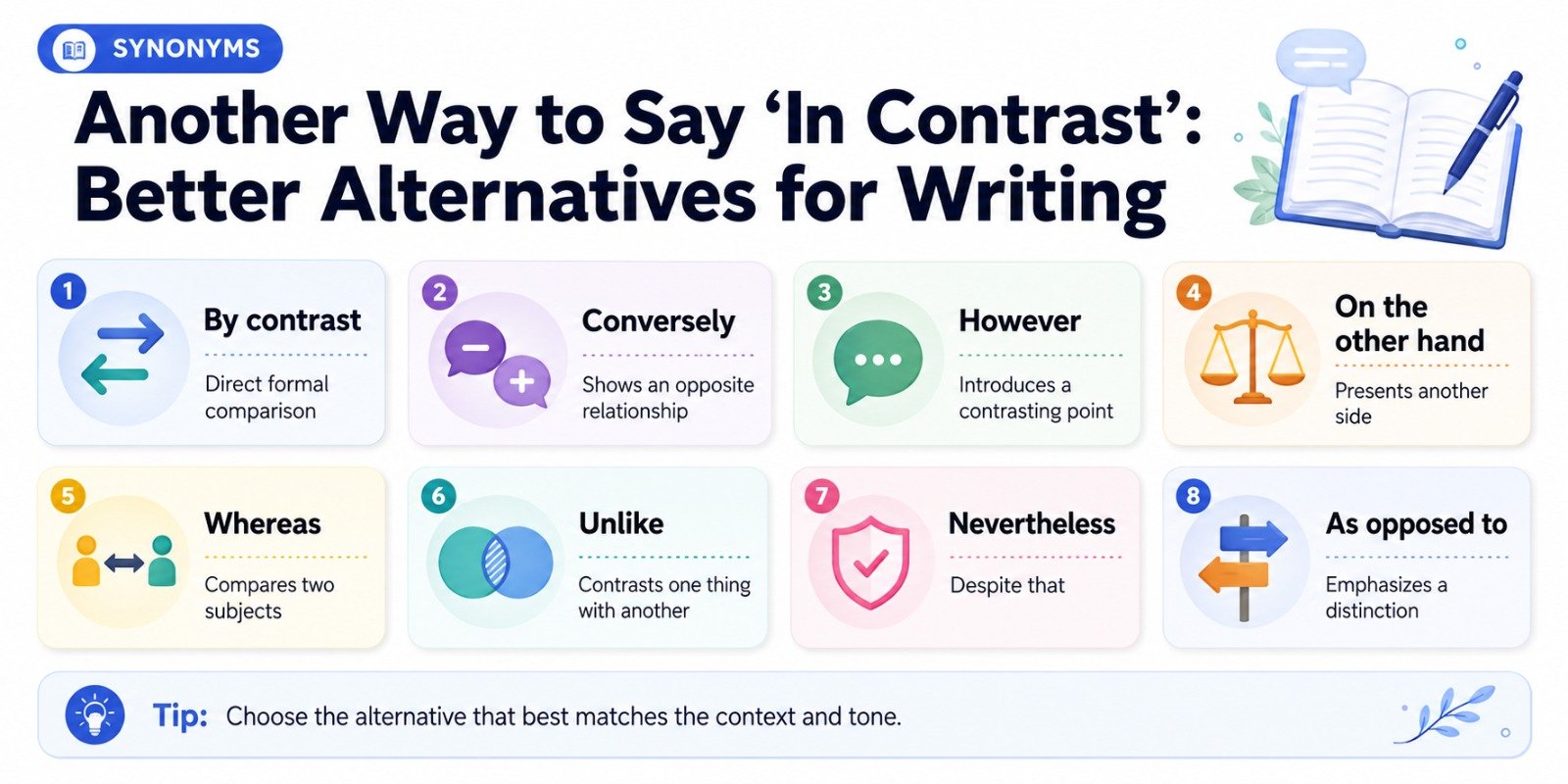
Some of the best alternatives include by contrast, conversely, however, whereas, unlike, on the other hand, nevertheless, and as opposed to. They aren’t all interchangeable, though, so choosing the right one depends on the type of contrast you want to show.
Alternatives to “In Contrast” at a Glance
The following options cover several types of contrast, from academic transitions to direct comparisons between people or things.
| Alternative | Tone | Best Used For | Example |
|---|---|---|---|
| By contrast | Formal | Direct comparisons | The first model is expensive. By contrast, the second is affordable. |
| Conversely | Formal | Opposite relationships | Exercise may improve energy; conversely, inactivity can reduce it. |
| However | Neutral/Formal | Opposing or qualifying ideas | The plan is simple. However, it may be costly. |
| On the other hand | Neutral | Presenting another side | Remote work is flexible. On the other hand, it can feel isolating. |
| Whereas | Formal/Neutral | Comparing two subjects in one sentence | Mia likes cities, whereas Noah prefers the countryside. |
| While | Neutral | Smooth direct comparisons | One option is cheaper, while the other is faster. |
| Unlike | Neutral/Formal | Contrasting nouns or people | Unlike his brother, Sam enjoys public speaking. |
| Nevertheless | Formal | Contrast despite a fact | The task was difficult. Nevertheless, she finished it. |
| Yet | Neutral | Short, direct contrast | The room is small yet comfortable. |
| As opposed to | Neutral/Formal | Distinguishing alternatives | We chose email as opposed to printed mail. |
| Compared with | Neutral/Formal | Measured comparisons | Compared with last year, sales are higher. |
| Still | Neutral | Softer counterpoint | The journey was long. Still, it was worthwhile. |
What Does “In Contrast” Mean?
In contrast is used to emphasize a noticeable difference between two ideas, situations, people, objects, or results.
For example:
The northern region receives heavy rainfall. In contrast, the southern region is much drier.
The phrase tells the reader that the second statement differs significantly from the first.
You may also see “in contrast to”, which has a slightly different grammatical structure:
In contrast to the northern region, the south receives very little rainfall.
Here, “in contrast to” is followed directly by the thing being compared.
Understanding that difference matters because some alternatives work better for one structure than the other.
Formal and Academic Alternatives to “In Contrast”
Essays, reports, research papers, and professional documents often need transitions that clearly show how ideas differ.
Other Ways to Say “In Contrast”: By Contrast
By contrast is one of the closest alternatives to in contrast. It works especially well when two facts, situations, or results are being compared directly.
The previous system required several manual steps. By contrast, the new system is largely automated.
It sounds polished and is particularly useful in academic and professional writing.
Other Ways to Say “In Contrast”: Conversely
Conversely introduces a relationship that is opposite or reversed rather than merely different.
Higher demand can push prices upward. Conversely, declining demand may cause prices to fall.
Use it when the second statement represents a logical opposite. It can sound unnatural if the two ideas are merely different rather than reversed.
Other Ways to Say “In Contrast”: However
However is one of the most versatile contrast transitions in English.
The apartment is spacious. However, it is farther from the city center.
It signals disagreement, limitation, or an unexpected difference. Unlike in contrast, however, it doesn’t necessarily compare two matching subjects directly.
Other Ways to Say “In Contrast”: Whereas
Whereas works especially well when comparing two things within the same sentence.
Sophie prefers to work early in the morning, whereas Daniel is more productive at night.
This makes it useful in essays, reports, and comparison writing where two characteristics are placed side by side.
Other Ways to Say “In Contrast”: Nevertheless
Nevertheless means something closer to “despite that” than simply “in contrast.”
The evidence was limited. Nevertheless, the researchers reached a useful conclusion.
The second statement remains true despite the difficulty or fact mentioned first. That makes nevertheless a contrast expression, but not a direct synonym in every sentence.
Natural Alternatives for General Writing
Formal vocabulary isn’t always necessary. Blog posts, workplace communication, and everyday explanations often sound more natural with conversational transitions.
Other Ways to Say “In Contrast”: On the Other Hand
On the other hand presents another side of an issue or situation.
Living downtown makes commuting easier. On the other hand, housing can be much more expensive.
It is especially useful when discussing advantages and disadvantages or two different perspectives.
Other Ways to Say “In Contrast”: While
While can connect two contrasting ideas smoothly within one sentence.
The basic package offers fewer features, while the premium plan includes advanced tools.
This use of while means something similar to whereas, although it generally sounds a little less formal.
Other Ways to Say “In Contrast”: Yet
Yet provides a concise way to connect contrasting qualities.
The design is simple yet surprisingly effective.
It works best when the contrast can be expressed briefly. It isn’t usually a replacement for in contrast at the beginning of a detailed comparison.
Other Ways to Say “In Contrast”: Still
Still introduces a softer counterpoint.
The project took longer than expected. Still, the final result was impressive.
It often implies that the second point remains true despite what was just mentioned.
Other Ways to Say “In Contrast”: That Said
That said is useful when acknowledging one point before introducing a qualification or different perspective.
Working from home offers more flexibility. That said, some people find it harder to separate work from personal life.
It feels natural in articles, professional conversations, and less formal business writing, but it may be too conversational for highly formal academic work.
Another Way to Say “In Contrast To”
The phrase “in contrast to” usually comes before a noun, person, group, or situation being compared:
In contrast to her colleagues, Nina prefers working independently.
Several alternatives can make this construction shorter or more natural.
Other Ways to Say “In Contrast To”: Unlike
Unlike is often the cleanest replacement.
Unlike her colleagues, Nina prefers working independently.
It is concise, natural, and suitable for both everyday and formal writing.
Other Ways to Say “In Contrast To”: Compared With
Compared with works well when evaluating measurable or observable differences.
Compared with the older model, the new version uses less energy.
It doesn’t always imply an opposite. It simply establishes a comparison.
Other Ways to Say “In Contrast To”: As Opposed To
As opposed to emphasizes the distinction between two choices, approaches, or characteristics.
The company chose a subscription model as opposed to a one-time purchase system.
It is especially useful when explaining alternatives or deliberate choices.
Other Ways to Say “In Contrast To”: Different From
Sometimes a straightforward construction is better than a transition phrase.
Their new strategy is significantly different from the approach they used last year.
This wording works when the sentence needs to describe difference directly rather than introduce a separate contrasting statement.
“In Contrast” vs. “By Contrast”
These two expressions are very similar and can often be used in the same situations:
The first course focuses heavily on theory. In contrast, the second emphasizes practical experience.
The first course focuses heavily on theory. By contrast, the second emphasizes practical experience.
By contrast may sound slightly more concise and formal, while in contrast is equally acceptable in most general and academic contexts.
When looking for a better way to say in contrast without changing the meaning much, by contrast is usually one of the safest choices.
“In Contrast” vs. “Conversely”
These phrases aren’t identical.
In contrast indicates that two things are noticeably different:
Maya enjoys crowded social events. In contrast, Lena prefers quiet gatherings.
Conversely is stronger when the relationship is reversed:
Increasing supply may reduce prices. Conversely, restricting supply may cause prices to rise.
Think of in contrast as “this is different” and conversely as closer to “the opposite is also true.”
“In Contrast” vs. “However”
However is commonly used for contrast, but it serves a broader purpose.
The restaurant received excellent reviews. However, the prices were relatively high.
The second point doesn’t directly compare the restaurant with another restaurant. It simply introduces a limitation or opposing fact.
Compare that with:
The downtown restaurant is expensive. In contrast, the suburban location offers much lower prices.
Here, in contrast clearly compares two corresponding subjects.
“In Contrast” vs. “On the Other Hand”
In contrast emphasizes a clear difference between two things.
On the other hand often introduces another perspective, consideration, advantage, or disadvantage.
Public transportation is inexpensive. In contrast, taking a taxi can be costly.
This is a direct comparison.
Driving gives you greater flexibility. On the other hand, parking can be difficult.
This presents another side of the same decision.
Use on the other hand when balancing arguments and in contrast when highlighting a direct difference.
Not Every Alternative Is Interchangeable
Replacing transitions mechanically can change what a sentence means.
Consider these examples:
By contrast = direct difference
The older device is heavy. By contrast, the newer version is lightweight.
Conversely = reverse relationship
More preparation can improve performance. Conversely, poor preparation may reduce it.
Nevertheless = despite that fact
The weather was terrible. Nevertheless, the event continued.
However = opposing or qualifying information
The proposal is promising. However, its cost remains a concern.
Unlike = direct comparison before a noun
Unlike the original design, the revised version is easier to use.
They all express some kind of contrast, but they perform different jobs in a sentence.
How to Choose the Best Alternative
Choosing another way of saying in contrast to or in contrast becomes easier when you identify the relationship between your ideas.
Use by contrast when you want the closest formal substitute.
Use conversely when the second idea represents an opposite or reversed relationship.
Use however when you want to introduce a complication, limitation, or conflicting point.
Use whereas or while when two subjects are being compared within a single sentence.
Use unlike when the comparison comes directly before a person, object, or group.
Use on the other hand when you are presenting another side of an argument.
Use nevertheless when something remains true despite what was mentioned beforehand.
A good transition shouldn’t simply sound different. It should accurately describe the relationship between your ideas.
Frequently Asked Questions
What is another way to say “in contrast”?
You can use by contrast, conversely, however, on the other hand, whereas, while, unlike, or as opposed to. The best option depends on whether you are showing a direct difference, an opposite relationship, or another side of an argument.
What is another way to say “in contrast to”?
Natural alternatives include unlike, compared with, as opposed to, different from, and sometimes whereas. For example, “In contrast to the previous version” can often become “Unlike the previous version.”
What is the best formal alternative to “in contrast”?
By contrast is usually the closest formal alternative. Conversely is also suitable for formal writing when the second idea represents an opposite or reversed relationship.
Can I say “however” instead of “in contrast”?
Sometimes, but the meaning changes slightly. However introduces conflicting or qualifying information, while in contrast more clearly compares one thing with another.
Is “conversely” the same as “in contrast”?
Not exactly. Conversely generally suggests that the second idea is the reverse or logical opposite of the first. In contrast only requires a noticeable difference.
What can I use instead of “in contrast” in an essay?
Strong essay alternatives include by contrast, conversely, however, whereas, nevertheless, unlike, and on the other hand. Choose according to the logical relationship rather than simply varying vocabulary.
Is “whereas” a formal way to show contrast?
Yes. Whereas is common in formal and academic writing when two subjects or situations are contrasted within the same sentence.
Is “unlike” another way of saying “in contrast to”?
Yes, in many sentences. For example, “In contrast to his sister, Leo enjoys mathematics” can naturally become “Unlike his sister, Leo enjoys mathematics.”
Conclusion
The best alternative to “in contrast” depends on what kind of difference you’re trying to express. By contrast works well for direct comparisons, conversely emphasizes an opposite relationship, however introduces an opposing point, and unlike is particularly useful when contrasting one person or thing directly with another.
Small differences between transition words can change the logic and tone of a sentence, so the strongest choice is the one that accurately connects your ideas. Clarifyra makes these distinctions easier to understand, helping you choose wording that sounds natural and fits the context.
You May Also Read | What to Say Instead of “In Conclusion”: 40+ Natural Alternatives