How to Say Thank God in A Non Religious Way
“Thank God” is a common English expression used to show relief, gratitude, happiness, or satisfaction after something turns out well. But if you prefer secular wording, you may be wondering How to Say Thank God in A Non Religious Way without sounding awkward or unnatural.
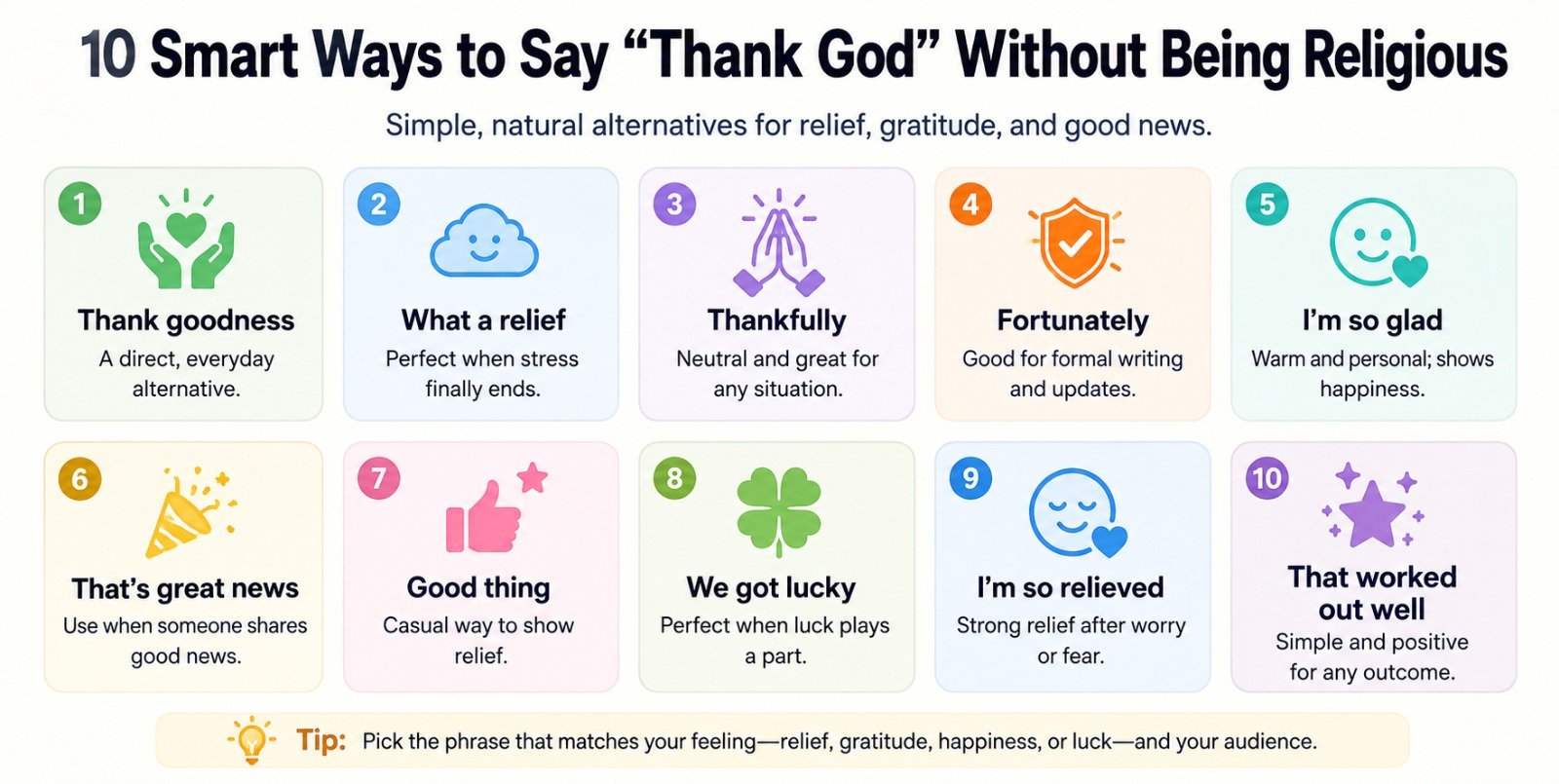
Fortunately, there are many natural alternatives. You can say “thank goodness,” “what a relief,” “thankfully,” “fortunately,” “I’m so glad,” or “we got lucky,” depending on the emotion and situation. The best replacement is not always the phrase that sounds most similar. It is the one that communicates what you actually mean.
Best Non-Religious Alternatives to “Thank God”
| Alternative | Tone | Meaning or Emotion | Best Used For |
|---|---|---|---|
| Thank goodness | Casual, neutral | Relief | Everyday conversation |
| What a relief | Neutral | Strong relief | Stressful situations ending well |
| Thankfully | Neutral, professional | Relief or gratitude | Writing and workplace communication |
| Fortunately | Formal, neutral | Positive outcome | Reports, emails, formal writing |
| I’m so relieved | Personal, warm | Relief | Emotional conversations |
| I’m so glad | Friendly, warm | Happiness | Friends and family |
| That’s great news | Positive, neutral | Happiness | Responding to good news |
| Good thing | Casual | Relief | Informal situations |
| We got lucky | Casual | Good fortune | Unexpected positive outcomes |
| That’s reassuring | Professional | Relief | Workplace or serious situations |
| I’m grateful | Sincere | Gratitude | Personal appreciation |
| That worked out well | Neutral | Satisfaction | Work and everyday conversation |
| Phew | Very casual | Immediate relief | Speech and text messages |
| That’s a load off my mind | Conversational | Strong relief | Personal worries |
| What a lucky break | Casual | Luck | Unexpected good fortune |
What Does “Thank God” Usually Mean?
Although “Thank God” contains an explicit religious reference, people often use it in everyday speech simply to react emotionally.
For example:
“Thank God nobody was hurt.”
Here, the main emotion is relief.
“Thank God the package finally arrived.”
This expresses relief after frustration or uncertainty.
“Thank God you got the job.”
This may express happiness, relief, or both.
That means learning How to Say Thank God in A Non Religious Way is really about identifying the emotion behind the sentence first.
Other Ways to Say “Thank God” for Relief
When a problem ends well, direct expressions of relief often sound more natural than a literal substitute.
What a Relief
“What a relief” is one of the strongest secular alternatives.
Example:
“What a relief! Everyone made it home safely.”
Use it when stress, fear, or uncertainty has just ended.
I’m So Relieved
This version is more personal.
Example:
“I’m so relieved the test results came back okay.”
It works particularly well when you want to tell someone how strongly you were worried.
That’s a Huge Relief
Use this when the concern was serious.
Example:
“They found my missing documents. That’s a huge relief.”
That’s a Load Off My Mind
This conversational idiom means that a major worry has disappeared.
Example:
“The payment finally went through. That’s a load off my mind.”
Phew
“Phew” expresses immediate relief.
Example:
“Phew, we made the train.”
It is natural in casual speech and texts but usually too informal for professional writing.
Other Ways to Say “Thank God” Without Mentioning Religion
If you want a familiar reaction without directly referring to God, these choices work well.
Thank Goodness
“Thank goodness” is probably the closest everyday alternative to “Thank God.”
Example:
“Thank goodness you remembered the tickets.”
It keeps a similar emotional feeling while removing the direct reference to God.
Thankfully
“Thankfully” works especially well when introducing a complete sentence.
Instead of:
“Thank God nobody was injured.”
Write:
“Thankfully, nobody was injured.”
It sounds neutral and natural in both everyday and professional English.
Fortunately
“Fortunately” emphasizes a positive outcome rather than gratitude.
Example:
“Fortunately, the damage was minor.”
It is especially useful in formal writing, reports, and business communication.
Luckily
“Luckily” is more conversational than “fortunately.”
Example:
“Luckily, I had a spare key.”
Use it when chance or good fortune genuinely affected the result.
Other Ways to Say “Thank God” When You’re Happy
Sometimes “Thank God” is really a reaction to good news rather than relief.
I’m So Glad
This sounds warm and personal.
Example:
“I’m so glad you’re feeling better.”
It is a very natural alternative to “Thank God you’re okay.”
That’s Great News
Use this when someone gives you a positive update.
Example:
“You got the job? That’s great news!”
That’s Wonderful
This sounds warmer and more enthusiastic.
Example:
“You’re coming home next week? That’s wonderful.”
I’m Happy to Hear That
This is polite and suitable for both personal and professional conversations.
Example:
“The problem has been resolved? I’m happy to hear that.”
Other Ways to Say “Thank God” When You Feel Grateful
Relief and gratitude are related, but they are not identical.
If gratitude is the main emotion, these expressions are better choices.
I’m Grateful
Example:
“I’m grateful everything worked out.”
This focuses directly on appreciation.
I’m Thankful
Example:
“I’m thankful that everyone is safe.”
“Thankful” may appear in religious contexts, but it can also be completely secular.
I Really Appreciate That
Use this when another person has helped you.
Example:
“You stayed late to help me. I really appreciate that.”
This is not a direct replacement in every sentence because it specifically expresses appreciation toward another person.
How to Say Thank God in A Non Religious Way at Work
Professional situations usually benefit from neutral language, especially when communicating with colleagues, clients, or a broad audience.
Other Ways to Say “Thank God” Professionally
Thankfully
“Thankfully, the issue was resolved before the presentation.”
This is simple, neutral, and professional.
Fortunately
“Fortunately, no customer information was affected.”
This sounds factual and controlled.
That’s Reassuring
“The technical team confirmed there is no security issue. That’s reassuring.”
Use it when new information removes concern.
I’m Glad to Hear That
“I’m glad to hear that the client approved the final version.”
This sounds friendly without being overly casual.
That Worked Out Well
“The replacement arrived before the deadline. That worked out well.”
This works when you want to acknowledge a positive result without sounding emotional.
Casual Ways to Express the Same Feeling
With friends and family, shorter expressions often sound more natural.
Other Ways to Say “Thank God” Casually
Good Thing
“Good thing we checked the weather before leaving.”
This emphasizes that something helpful happened.
We Got Lucky
“We got lucky and found the last two seats.”
This focuses on chance rather than gratitude.
What a Lucky Break
“They had one appointment left. What a lucky break!”
Use it when something unexpectedly works in your favor.
That Was Close
“That was close! I almost missed the deadline.”
This expresses relief after narrowly avoiding a problem.
Crisis Averted
“The files were backed up after all. Crisis averted.”
This can sound lightly humorous in casual conversation.
Other Ways to Say “Thank God” in a Text Message
Text messages usually benefit from short, expressive wording.
You could write:
“Phew, that’s a relief.”
“So glad you’re okay!”
“Thank goodness!”
“That worked out!”
“We got lucky.”
“Good thing you checked.”
“What a relief.”
“That’s such good news.”
For a serious situation, “I’m so relieved you’re okay” usually sounds more appropriate than a playful phrase.
Formal and Written Alternatives
Formal writing often sounds stronger when the writer describes the positive outcome directly.
Instead of:
“Thank God the system continued working.”
Write:
“Fortunately, the system continued working.”
Instead of:
“Thank God no errors occurred.”
Write:
“Thankfully, no errors occurred.”
In highly objective writing, even “thankfully” may sound slightly emotional.
A more neutral version could simply be:
“No errors occurred during the test.”
That is an important distinction because the best replacement depends on the purpose of the sentence.
Not Every Alternative Is Interchangeable
Knowing How to Say Thank God in A Non Religious Way does not mean replacing it with the same phrase every time.
Each alternative emphasizes something different.
Fortunately means that the outcome was favorable.
What a relief means that worry or stress has ended.
We got lucky suggests chance played an important role.
I’m grateful emphasizes appreciation.
That’s great news reacts positively to information.
Thank goodness is the closest conversational substitute in tone and structure.
For example:
“Thank God you weren’t injured.”
Natural alternatives include:
“I’m so glad you weren’t injured.”
“What a relief that you weren’t injured.”
“Thankfully, you weren’t injured.”
But:
“We got lucky you weren’t injured.”
changes the focus to luck and may sound less personal.
The wording should preserve the intended feeling, not just replace individual words.
Is “Thank Goodness” Non-Religious?
In modern everyday English, “thank goodness” is generally treated as a religiously neutral expression.
For example:
“Thank goodness we made it on time.”
Most speakers would understand this as an expression of relief rather than a literal act of thanking a spiritual being.
However, if you want wording that feels completely detached from religious language, choose:
“What a relief.”
“Fortunately.”
“Thankfully.”
“I’m glad.”
“I’m relieved.”
Is “Thank Heavens” Non-Religious?
Not completely.
“Thank heavens” avoids saying “God,” but the word “heavens” still has religious or spiritual associations.
If your goal is simply to use a softer expression, it may work.
If your aim is specifically to use secular wording, “thank goodness,” “fortunately,” “what a relief,” or “I’m so glad” are clearer options.
Do Non-Religious People Still Say “Thank God”?
Yes, some do.
“Thank God” can function as an idiomatic expression in everyday English, so a person may use it without intending a literal statement of religious belief.
Others prefer to avoid it completely.
Neither approach requires a special rule. The important thing is choosing wording that suits your beliefs, audience, and situation.
How to Choose the Right Alternative
Think about the feeling you are trying to express.
Use “what a relief” or “I’m so relieved” after worry.
Use “thank goodness” when you want a familiar conversational replacement.
Use “thankfully” for flexible neutral wording.
Use “fortunately” for formal or professional contexts.
Use “I’m so glad” when you want warmth.
Use “we got lucky” when chance mattered.
Use “I’m grateful” when appreciation is the main emotion.
This approach sounds more natural than treating all alternatives as exact synonyms.
Frequently Asked Questions
How to Say Thank God in A Non Religious Way naturally?
Natural options include “thank goodness,” “what a relief,” “thankfully,” “fortunately,” “I’m so glad,” and “we got lucky.” Choose according to the emotion you want to express.
What is the best non-religious alternative to “Thank God”?
“Thank goodness” is the closest casual substitute. “What a relief” is better for relief, while “fortunately” is more appropriate in formal writing.
What can an atheist say instead of “Thank God”?
There is no special phrase required. Common secular choices include “thank goodness,” “what a relief,” “I’m glad,” “thankfully,” “fortunately,” and “we got lucky.”
What can I say instead of “Thank God you’re okay”?
Natural alternatives include “I’m so glad you’re okay,” “I’m relieved you’re okay,” “What a relief that you’re okay,” and “I’m so happy you’re safe.”
Can I say “thankfully” instead of “Thank God”?
Yes. “Thankfully” works especially well when introducing a positive outcome, such as “Thankfully, everyone arrived safely.”
What should I say instead of “Thank God” at work?
Professional options include “thankfully,” “fortunately,” “that’s reassuring,” “I’m glad to hear that,” and “that worked out well.”
Is “luckily” the same as “Thank God”?
No. “Luckily” emphasizes chance or good fortune, while “Thank God” may communicate relief, gratitude, or religious belief.
Can I use “fortunately” instead of “Thank God” in an essay?
Yes, when you are describing a favorable outcome. “Fortunately” is usually much more suitable for formal or academic writing.
Conclusion
If you are deciding How to Say Thank God in A Non Religious Way, start by identifying the emotion behind the original phrase. “Thank goodness” works well in casual conversation, “what a relief” clearly expresses relief, “fortunately” fits formal writing, and “I’m so glad” sounds warm and personal.
The right expression depends on context, audience, relationship, tone, and formality. Clarifyra helps make these small differences easier to understand so you can choose wording that sounds natural and accurately reflects what you mean.
You May Also Read | Other Ways to Say “Thank You for Confirming” With Examples