Other Ways to Say “Thank You for Confirming” With Examples
“Thank you for confirming” is a simple, polite way to acknowledge that someone has verified a detail, accepted an arrangement, or let you know something is settled. It works well in most professional situations, but repeating the same phrase in every email can start to sound mechanical.
Depending on the situation, you might prefer something warmer like “I appreciate your confirmation,” more casual like “Thanks for confirming,” or more specific like “Thank you for confirming the meeting time.” The best alternative depends on what was confirmed and how formal you need to sound.
What Does “Thank You for Confirming” Mean?
The thank you for confirming meaning is straightforward: you are showing appreciation because another person has verified or acknowledged something.
For example:
- A coworker confirms a meeting time.
- A client approves a proposed date.
- A customer acknowledges receiving a document.
- A manager verifies a project detail.
- Someone confirms that they will attend an event.
In each case, the phrase shows that you have received and understood their confirmation.
There is also a small difference between confirmation and clarification. Confirmation verifies something that was already proposed or understood, while clarification makes something less confusing.
For example:
Confirmation:
“Friday at 10 a.m. works for me.”
Reply:
“Thank you for confirming.”
Clarification:
“The meeting is online rather than in the office.”
Reply:
“Thank you for clarifying.”
Using the more precise response makes your message sound more natural.
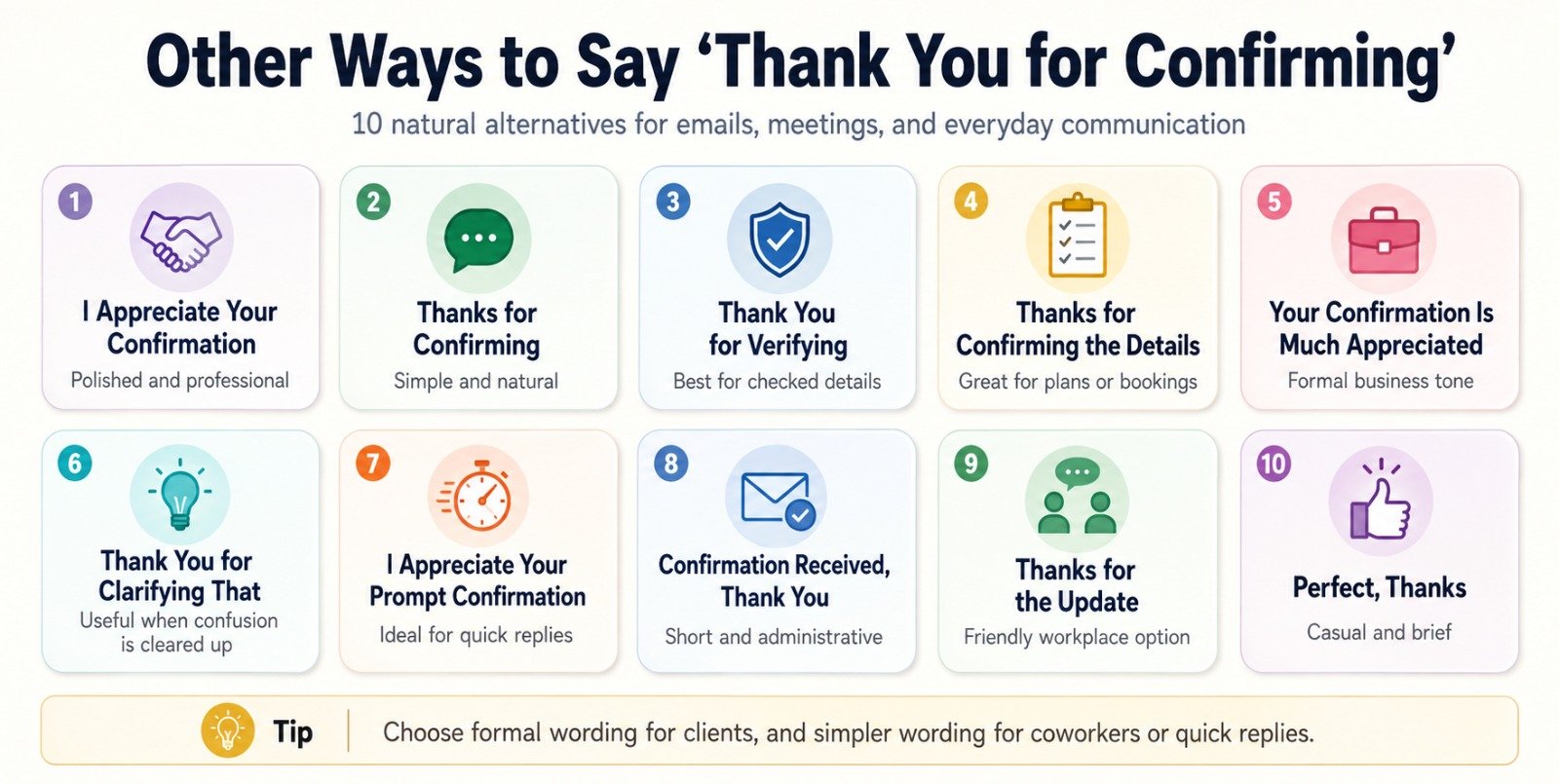
Quick Comparison of Alternatives
| Alternative | Tone | Best Used For |
|---|---|---|
| I appreciate your confirmation | Professional | Clients, managers, business emails |
| Thanks for confirming | Casual-professional | Coworkers and quick replies |
| Thank you for verifying | Professional | Facts, information, records |
| Thanks for confirming the details | Neutral | Schedules, bookings, arrangements |
| Your confirmation is much appreciated | Formal | Polite business correspondence |
| Thank you for clarifying that | Neutral | Clearing up uncertainty |
| I appreciate your prompt confirmation | Formal | Quick responses |
| Confirmation received, thank you | Concise-professional | Administrative communication |
| Thanks for the update | Friendly | Informal workplace communication |
| Perfect, thanks | Casual | Colleagues and familiar contacts |
These expressions aren’t always interchangeable. “Thank you for verifying” is best when someone checked the accuracy of information, while “thank you for clarifying” suits situations where they removed confusion. “Perfect, thanks” would sound too casual in some client or formal correspondence.
Professional Ways to Say “Thank You for Confirming”
Professional communication often benefits from wording that sounds appreciative without being overly personal. The following alternatives work particularly well in emails, workplace messages, and client conversations.
I Appreciate Your Confirmation
“I appreciate your confirmation” is one of the strongest professional alternatives. It sounds polished and slightly more formal than “thanks for confirming.”
Example:
“I appreciate your confirmation. We’ll proceed with the scheduled delivery on Monday.”
This option works particularly well when communicating with clients, suppliers, managers, or external contacts.
Thank You for Verifying
Use this when the other person has checked that information is correct rather than simply agreeing to something.
Example:
“Thank you for verifying the account details before we process the request.”
It works well with records, figures, addresses, documents, and other information that may need checking.
Your Confirmation Is Much Appreciated
This is more formal and slightly less conversational.
Example:
“Your confirmation is much appreciated. We’ll finalize the arrangements accordingly.”
It can be useful in formal correspondence, although using it repeatedly may sound stiff.
I Appreciate Your Prompt Confirmation
If someone responded quickly, this phrase acknowledges both the confirmation and their timely reply.
Example:
“I appreciate your prompt confirmation. This allows us to complete the schedule today.”
It suits time-sensitive workplace communication especially well.
Thank You for Taking the Time to Confirm
This is a warmer option when the person had to check something before replying.
Example:
“Thank you for taking the time to confirm the figures with your team.”
It recognizes the effort behind the response rather than treating the confirmation as automatic.
We Appreciate Your Confirmation
“We appreciate your confirmation” works well when you are writing on behalf of a company, department, or team.
Example:
“We appreciate your confirmation and look forward to working with you on the project.”
Use “I appreciate” when writing personally and “we appreciate” when speaking for an organization.
Friendly and Casual Ways to Say “Thanks for Confirming”
Not every confirmation needs formal business language. With coworkers, familiar clients, friends, or teammates, shorter wording often sounds more natural.
Thanks for Confirming
“Thanks for confirming” has the same basic meaning as “thank you for confirming,” but it is more conversational.
Example:
“Thanks for confirming. I’ll see you at 3.”
This is one of the most natural choices for everyday workplace communication.
Thanks for Confirming the Details
Adding what was confirmed makes your response clearer.
Example:
“Thanks for confirming the details. I’ve updated the calendar invitation.”
This works well for bookings, appointments, travel plans, schedules, and project arrangements.
Thanks for Getting Back to Me
This phrase focuses more on the response than the confirmation itself.
Example:
“Thanks for getting back to me. Thursday afternoon works perfectly.”
It is useful when a person has replied to a question about availability or arrangements.
Thanks for the Update
Use this when the person’s confirmation also provides new information.
Example:
“Thanks for the update. I’ll adjust the delivery schedule accordingly.”
It is friendly and professional enough for most internal workplace messages.
Perfect, Thanks
A very short option can be enough when the relationship and context are informal.
Example:
“Perfect, thanks. See you tomorrow.”
This sounds natural between coworkers or people who communicate regularly, but it may be too brief for formal business correspondence.
Other Ways to Say “Thank You for Confirming” a Meeting or Schedule
Confirmation phrases become more useful when they identify exactly what the other person confirmed.
Thank You for Confirming the Meeting Time
This is direct and leaves no uncertainty about what you are acknowledging.
Example:
“Thank you for confirming the meeting time. I’ll join the call at 11 a.m.”
Thank You for Confirming Your Availability
Use this when organizing interviews, meetings, appointments, or events.
Example:
“Thank you for confirming your availability for Wednesday afternoon.”
Thanks for Confirming the Schedule
This is slightly more relaxed and works well between coworkers or project partners.
Example:
“Thanks for confirming the schedule. I’ve shared the updated timeline with the team.”
Thank You for Confirming the Arrangement
This works when several details have already been discussed and agreed upon.
Example:
“Thank you for confirming the arrangement. We’ll have everything ready before your arrival.”
Being specific can make a short email more useful because the recipient immediately knows which detail you are acknowledging.
How to Say “Thank You for the Confirmation Email”
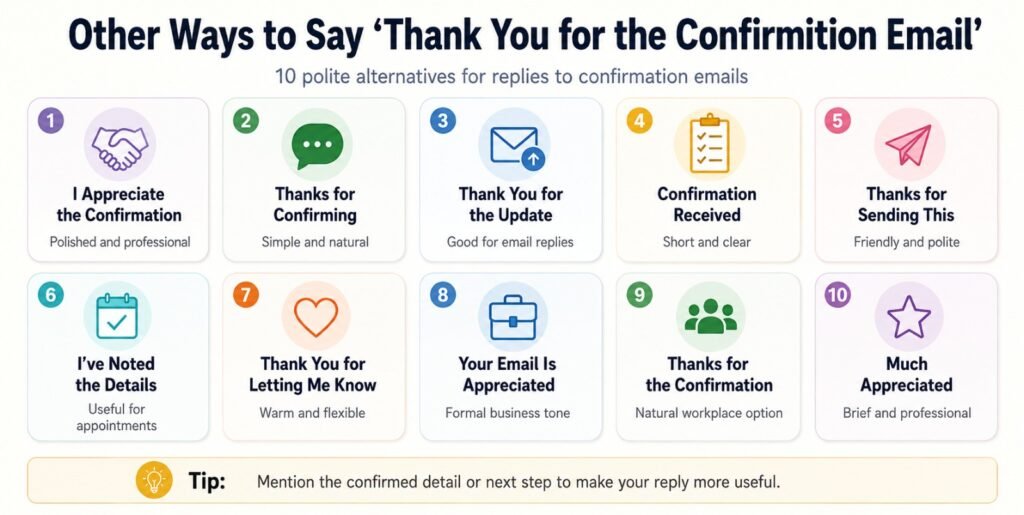
You can say “Thank you for the confirmation email”, and the sentence is grammatically correct. However, it can sometimes sound more natural to thank the person for the actual information they confirmed rather than for the email itself.
For instance:
Natural:
“Thank you for the confirmation email. I’ve noted the appointment details.”
More specific:
“Thank you for confirming my appointment for Tuesday.”
Professional:
“I appreciate your confirmation. I’ve updated my calendar accordingly.”
Concise:
“Confirmation received, thank you.”
A good confirmation-email reply often does two things: acknowledges the message and briefly confirms the next step.
For example:
“Thank you for confirming the meeting for Thursday at 2 p.m. I’ll send the agenda beforehand.”
That response creates a clearer communication trail than simply writing “thanks.”
“Thank You for Confirming” vs. “Thank You for the Confirmation”
Both expressions are correct, but they are structured differently.
“Thank you for confirming” thanks the person for an action.
“Thank you for confirming your attendance.”
“Thank you for the confirmation” thanks them for the confirmation itself.
“Thank you for the confirmation. We’ll reserve your place.”
In ordinary communication, “thank you for confirming” tends to sound slightly more direct and conversational. “Thank you for the confirmation” can feel a little more formal or administrative.
Neither is automatically better. The surrounding sentence matters more.
Thank You for Confirming Receipt Meaning
The thank you for confirming receipt meaning is different from simply confirming an arrangement.
When someone confirms receipt, they are telling you that they successfully received something you sent, such as:
- An email
- A document
- A payment
- An application
- A contract
- A file
- An order
Therefore, “thank you for confirming receipt” means:
“Thank you for letting me know that you received what I sent.”
For example:
“Thank you for confirming receipt of the signed agreement.”
This does not necessarily mean the recipient agrees with the document. It only means they have acknowledged receiving it.
Thank You for Confirming Receipt of the Documents
This wording is appropriate in formal and administrative correspondence.
Example:
“Thank you for confirming receipt of the documents. Please let me know if you need anything further.”
Confirmation Received, Thank You
This reverses the perspective. Instead of thanking someone for acknowledging your document, you are acknowledging that you received their confirmation.
Example:
“Confirmation received, thank you. We’ll proceed with the next stage.”
It is concise and useful when lengthy correspondence isn’t necessary.
When “Thank You for Confirming” Isn’t the Best Choice
Although the phrase is widely appropriate, another expression may be more precise in certain situations.
Use “thank you for clarifying” when someone has explained a confusing point.
Use “thank you for verifying” when they actively checked whether information was accurate.
Use “thank you for approving” when they formally gave permission.
Use “thank you for acknowledging receipt” when the central point is proving that an item was received.
Use “thanks for letting me know” when the conversation is casual and formal confirmation language would feel unnecessarily stiff.
Compare:
“Thank you for confirming the address.”
This works if the person verified that an existing address is correct.
“Thank you for clarifying the address.”
This works better if there was uncertainty over which address should be used.
Small differences like these help your response match what the other person actually did.
Email Examples for Different Situations
To a Client
“Thank you for confirming the appointment. I’ve reserved Tuesday at 10 a.m. and look forward to speaking with you.”
To a Manager
“I appreciate your confirmation. I’ll move forward with the revised timeline and update the team today.”
To a Coworker
“Thanks for confirming. I’ll add it to the calendar.”
After Receiving Documents
“Thank you for confirming receipt of the documents. Please let me know if any additional information is required.”
After Someone Checks Information
“Thank you for verifying those details. I’ll use the corrected information in the final version.”
After a Quick Response
“I appreciate your prompt confirmation. We can now finalize the arrangements.”
The most natural response usually reflects both what was confirmed and what happens next.
How to Choose the Right Confirmation Phrase
Start by considering your relationship with the recipient.
For a client, manager, supplier, or new professional contact, phrases such as “I appreciate your confirmation” or “Thank you for confirming the details” are safe choices.
For a coworker or someone you communicate with regularly, “Thanks for confirming” is usually enough.
If accuracy was checked, choose “Thank you for verifying.”
If confusion was resolved, choose “Thank you for clarifying.”
And if the person simply acknowledged receiving something, “Thank you for confirming receipt” communicates that exact meaning.
The best alternative isn’t necessarily the most formal one. It is the one that accurately reflects the situation.
Frequently Asked Questions
What is another way to say “thank you for confirming”?
Natural alternatives include “I appreciate your confirmation,” “Thanks for confirming,” “Thank you for verifying,” “Thanks for confirming the details,” and “Your confirmation is much appreciated.” The best choice depends on what was confirmed and how formal the conversation is.
Is “thanks for confirming” professional?
Yes. “Thanks for confirming” is suitable for most everyday workplace communication. For more formal situations involving clients, senior managers, or official correspondence, “Thank you for confirming” or “I appreciate your confirmation” may sound more polished.
What does “thanks for confirming” mean?
“Thanks for confirming” means you appreciate someone verifying, approving, or acknowledging a piece of information. It is simply a more casual version of “thank you for confirming.”
Is “thank you for the confirmation email” correct?
Yes, “thank you for the confirmation email” is grammatically correct. However, it can sound more natural to specify what was confirmed, such as “Thank you for confirming my appointment” or “Thank you for confirming the booking details.”
What does “thank you for confirming receipt” mean?
It means you are thanking someone for acknowledging that they received something you sent. The item could be an email, document, payment, application, contract, or file.
What is a professional response to a confirmation email?
A professional response can be as simple as:
“I appreciate your confirmation. I’ve noted the details and will proceed accordingly.”
When appropriate, mentioning the confirmed date, time, or next action makes the response clearer.
Should I say “thank you for confirming” or “thank you for your confirmation”?
Both are correct. “Thank you for confirming” sounds slightly more conversational because it focuses on the person’s action. “Thank you for your confirmation” is somewhat more formal because it focuses on the confirmation itself.
Final Thoughts
“Thank you for confirming” is already polite and professional, so there is no need to replace it simply for the sake of sounding different. Choose another expression when it better reflects the situation: “I appreciate your confirmation” for a polished business tone, “thanks for confirming” for everyday communication, “thank you for verifying” for checked information, or “thank you for confirming receipt” when acknowledging delivery of something important.
The small wording choice should match what the recipient actually did and the level of formality you want to maintain. Clarifyra focuses on those practical differences so you can say what you mean without making everyday messages sound stiff, vague, or repetitive.
You May Also Read | Other Ways to Say “Have a Good Rest of Your Day”: Meaning, Usage and Better Alternatives