50 Ways to Say Goodbye Lyrics: Meaning, Spanish and Other Goodbye Phrases
The phrase “50 Ways to Say Goodbye Lyrics” usually points to Train’s playful breakup song, but it also raises a useful language question: how many different ways can you actually say goodbye? Train’s song approaches parting with humor and exaggeration, while everyday goodbyes can sound warm, casual, funny, affectionate, formal, or even romantic depending on who you’re talking to.
This article explains the meaning behind Train’s “50 Ways to Say Goodbye” without reproducing copyrighted lyrics, then explores natural alternatives you can use in English, Spanish, and other languages.
What Does “50 Ways to Say Goodbye” Mean?
“50 Ways to Say Goodbye” is a song by the American pop-rock band Train. It appeared on the band’s 2012 album California 37 and was written by Pat Monahan, Espen Lind, and Amund Bjørklund.
Despite its title, the song isn’t really a list of 50 farewell expressions.
Instead, it tells a comic breakup story. The narrator has been left by his girlfriend and feels embarrassed about explaining what happened. Rather than simply telling people that the relationship ended, he invents increasingly absurd stories to explain why she is gone.
That exaggerated storytelling is the central joke of the song.
The energetic pop-rock arrangement, combined with mariachi-style brass, also creates a funny contrast: the subject is heartbreak, but the music feels lively and theatrical.
Train “50 Ways to Say Goodbye” at a Glance
| Detail | Information |
|---|---|
| Song | 50 Ways to Say Goodbye |
| Artist | Train |
| Album | California 37 |
| Release era | 2012 |
| Songwriters | Pat Monahan, Espen Lind, Amund Bjørklund |
| Main theme | Breakup, embarrassment, and humorous excuses |
| Musical feel | Upbeat pop rock with prominent brass |
| Mood | Funny, dramatic, energetic |
| Does it literally list 50 farewells? | No |
| Best interpretation | A humorous story about someone struggling to accept a breakup |
What Are the “50 Ways to Say Goodbye Lyrics” About?
The song’s narrator is dealing with rejection badly. His partner has left, but instead of acknowledging the breakup honestly, he imagines outrageous explanations for her absence.
That makes the lyrics less about how to say goodbye and more about how someone avoids admitting that goodbye has already happened.
The humor comes from three things:
- The explanations become increasingly unbelievable.
- The narrator seems more worried about embarrassment than heartbreak.
- The upbeat sound makes the dramatic situation feel intentionally over-the-top.
The song therefore works as both a breakup track and a comedy song.
Because song lyrics are copyrighted, the complete lyrics aren’t reproduced here. The meaning, however, is straightforward: the narrator would rather invent an absurd story than say, “She left me.”
Why Is It Called “50 Ways to Say Goodbye”?
The title is deliberately playful.
It suggests that the narrator has dozens of possible ways to explain someone’s disappearance, even though the song itself does not provide 50 actual expressions for saying goodbye.
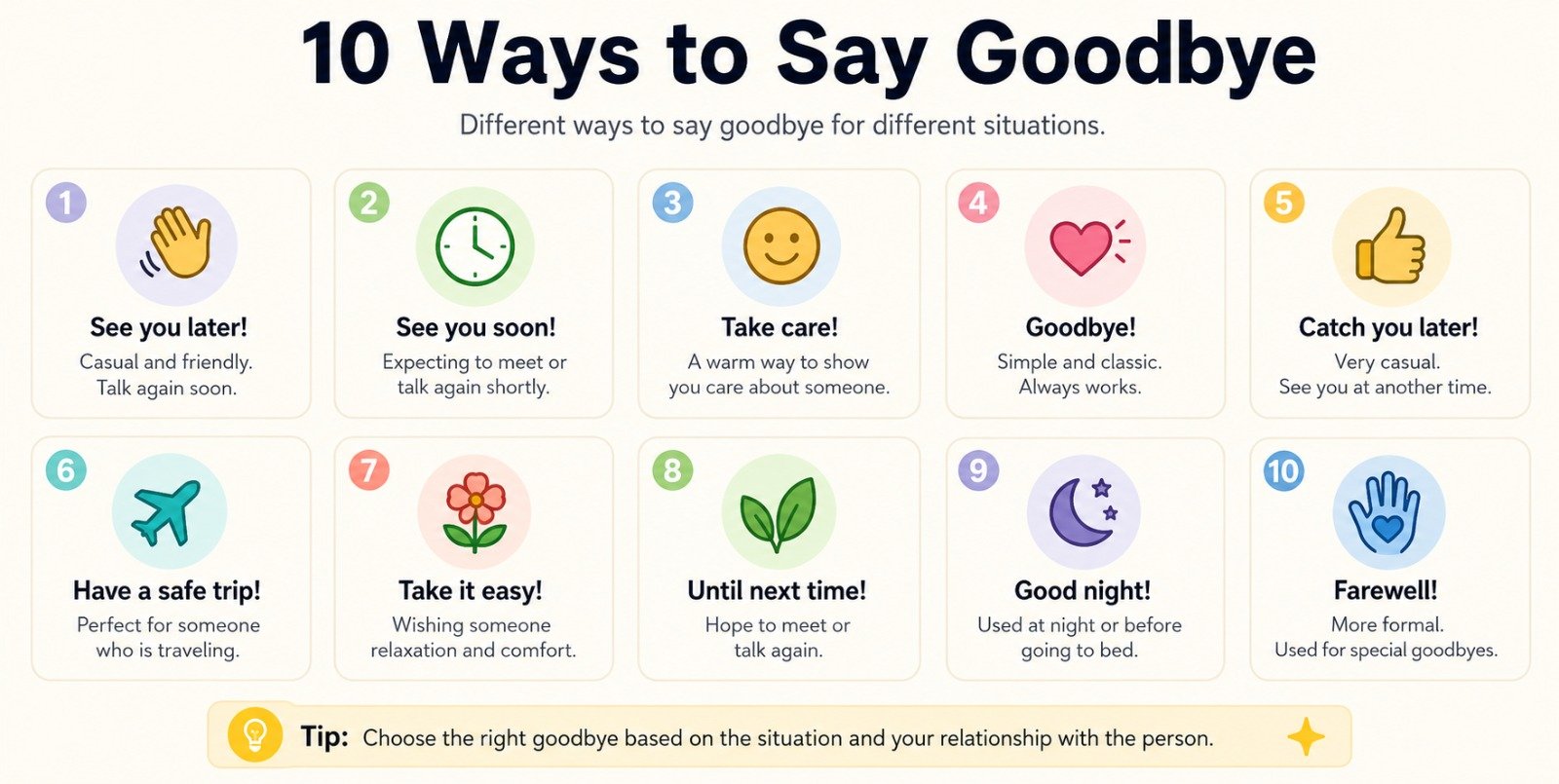
In ordinary conversation, however, there really are plenty of ways to say goodbye. The best choice depends on your relationship, mood, and whether you expect to see the person again.
Here are some of the most useful ones.
| Expression | Tone | Best For |
| Goodbye | Neutral | General situations |
| Bye | Casual | Everyday conversations |
| See you later | Friendly | Friends and coworkers |
| Take care | Warm | Friends, family, colleagues |
| Talk soon | Friendly | Texts and calls |
| Until next time | Warm | Someone you expect to meet again |
| Farewell | Formal/dramatic | Ceremonial or emotional departures |
| Catch you later | Very casual | Friends |
| Safe travels | Caring | Someone leaving on a trip |
| Have a good one | Casual | Everyday departures |
These expressions are not completely interchangeable. “Farewell,” for example, sounds much more formal or final than “see you later,” while “safe travels” only makes sense when someone is going somewhere.
Other Ways to Say Goodbye in Everyday English
When the departure is ordinary and you expect to see the person again, a lighter phrase usually sounds more natural than a dramatic “goodbye.”
Other Ways to Say “Goodbye” Casually
See you later
Friendly and natural when you’re likely to meet again.
Example:
“Thanks for stopping by. See you later!”
Catch you later
More relaxed and informal. It works best with friends or people you know well.
Example:
“I’ve got to get going. Catch you later.”
See you around
Useful when you expect to cross paths again but don’t have specific plans.
Example:
“Good talking to you. See you around.”
I’m off
A casual way to announce that you’re leaving rather than directly saying goodbye.
Example:
“I’m off now. Have a good evening.”
Have a good one
Common in relaxed everyday conversation and useful when you don’t want a lengthy farewell.
Example:
“Thanks for your help. Have a good one!”
Other Ways to Say “Goodbye” Warmly
Warm farewells communicate care without sounding overly emotional.
Take care
One of the most versatile choices. It works with friends, relatives, coworkers, and acquaintances.
Example:
“It was lovely seeing you. Take care.”
Talk soon
Ideal for texts, calls, and online conversations.
Example:
“I need to head into a meeting. Talk soon!”
Until next time
A little warmer and more intentional than “see you.”
Example:
“Thanks for a wonderful afternoon. Until next time.”
Keep in touch
Best when you may not see the person regularly.
Example:
“It’s been great working with you. Keep in touch.”
Safe travels
Appropriate when someone is leaving for a journey.
Example:
“Enjoy your trip, and safe travels!”
Funny Ways to Say Goodbye
Train’s song makes goodbye funny by turning a breakup into an exaggerated story. In real life, humorous farewells work best with friends, siblings, coworkers you know well, or casual group chats.
Other Ways to Say “Goodbye” When You Want to Be Funny
- I’m out of here.
- Time to disappear.
- Catch you on the flip side.
- I’m leaving before someone gives me more work.
- Consider this my dramatic exit.
- See you in the next episode.
- I must return to my mysterious life.
- Time for me to vanish.
- Exit mode activated.
- Farewell, fellow humans.
- Try not to miss me too much.
- I’ve officially left the chat.
- Until our paths cross again.
- I’m off to pretend I have plans.
- My work here is done.
A funny goodbye depends heavily on context. “I’m leaving before someone gives me more work” could be amusing among friendly coworkers, but it would be inappropriate at a formal client meeting.
Likewise, deliberately dramatic phrases such as “Farewell, fellow humans” are playful precisely because they’re not normal formal goodbyes.
Sweet Ways to Say Goodbye
A sweet goodbye can make a departure feel less abrupt. These expressions work especially well with close friends, family members, and partners.
Other Ways to Say “Goodbye” Sweetly
Take care of yourself
More caring than a simple “take care.”
Example:
“Text me when you get home, and take care of yourself.”
I’ll miss you
Best when there will genuinely be some time before you meet again.
Example:
“Have an amazing semester. I’ll miss you.”
I can’t wait to see you again
Affectionate and forward-looking.
Example:
“Have a safe flight. I can’t wait to see you again.”
Goodbye for now
Makes the separation sound temporary rather than final.
Example:
“It’s goodbye for now, but we’ll talk tomorrow.”
Until we meet again
Warm and slightly sentimental.
Example:
“Until we meet again, take good care of yourself.”
Message me when you get home
Not technically a synonym for goodbye, but a caring closing phrase that often replaces one.
Example:
“Drive safely and message me when you get home.”
Romantic Ways to Say Goodbye
Goodbyes between partners often emphasize affection or anticipation rather than the departure itself.
Other Ways to Say “Goodbye” to Someone You Love
- I already miss you.
- Come back soon.
- I’ll be thinking about you.
- Can’t wait until I see you again.
- Get home safely, love.
- Until tomorrow, sweetheart.
- Save me a hug for next time.
- This isn’t goodbye, just see you soon.
- Call me when you get there.
- I wish you didn’t have to go.
These aren’t interchangeable with neutral goodbyes. Saying “I already miss you” to a business contact would obviously be too intimate, while “get home safely” may be perfectly appropriate for both a partner and a close friend.
8 Ways to Say Goodbye in Spanish
Spanish offers several natural farewell expressions, and the right one depends on formality, region, and whether you expect to see the person again.
Other Ways to Say “Goodbye” in Spanish
| Spanish Expression | Natural English Meaning | Typical Use |
| Adiós | Goodbye | General farewell |
| Hasta luego | See you later | Common, neutral |
| Nos vemos | See you | Casual |
| Hasta pronto | See you soon | When expecting to meet again |
| Chao | Bye | Casual; common in many regions |
| Cuídate | Take care | Informal, warm |
| Hasta la próxima | Until next time | Friendly |
| Nos vemos mañana | See you tomorrow | When meeting the next day |
1. Adiós
Adiós is the classic Spanish equivalent of “goodbye.” It can be used naturally, although in everyday conversation speakers often choose phrases that imply seeing each other again.
2. Hasta Luego
Hasta luego literally relates to “until later” and naturally means “see you later.”
It works in many everyday situations.
3. Nos Vemos
Nos vemos is a relaxed way to say “see you.”
It’s especially natural among friends, classmates, and coworkers.
4. Hasta Pronto
Use hasta pronto when you expect to see someone again relatively soon.
The natural English equivalent is “see you soon.”
5. Chao
Chao is an informal “bye” used in various Spanish-speaking regions.
Usage varies by country, so it can feel more common in some places than others.
6. Cuídate
Cuídate means “take care” when speaking informally to one person.
It adds warmth rather than simply marking the end of a conversation.
7. Hasta la Próxima
Hasta la próxima means “until next time.”
It works well when you know another meeting or conversation will happen.
8. Nos Vemos Mañana
Nos vemos mañana means “see you tomorrow.”
Unlike a general goodbye, it specifically tells the listener when you expect to see them again.
Is “Adiós” Always the Best Way to Say Goodbye in Spanish?
No.
Although adiós is correct, Spanish speakers frequently choose expressions based on what happens next.
If you’ll meet the person tomorrow, nos vemos mañana is more specific.
If you’re leaving a friend casually, nos vemos or chao may sound more relaxed.
If you want to sound caring, cuídate adds warmth.
This is why translations shouldn’t be treated as simple one-to-one replacements. The natural expression depends on the social situation.
Creative Ways to Say Goodbye Without Saying “Goodbye”
You don’t always need the actual word goodbye. English speakers often end conversations by referring to the next meeting, wishing someone well, or announcing their departure.
Other Ways to Say Goodbye Without Using the Word “Goodbye”
See you soon
Best when another meeting is expected.
Talk to you later
Natural for phone calls, texts, and casual conversations.
Enjoy the rest of your day
Polite and useful with customers, coworkers, and acquaintances.
Get home safely
Shows concern when someone is traveling home.
Have a great weekend
A natural workplace farewell on Friday or before time off.
I’ll let you get back to it
A polite way to end a conversation without sounding abrupt.
It was great seeing you
Warmly signals that the interaction is ending.
We’ll catch up soon
Friendly when you plan to reconnect.
Professional Ways to End a Conversation
Professional goodbyes tend to be restrained, polite, and appropriate to the relationship.
Other Ways to Say “Goodbye” Professionally
- Have a great afternoon.
- Enjoy the rest of your day.
- Speak with you soon.
- I look forward to speaking again.
- Thank you for your time.
- Have a pleasant evening.
- I’ll follow up shortly.
- Take care.
- Have a great weekend.
- Until our next meeting.
Consider the situation carefully.
“Speak with you soon” works naturally after a business call.
“I look forward to speaking again” is slightly more formal and can suit clients or new professional contacts.
“Take care” is warmer but still acceptable in many workplaces.
Goodbye Phrases for Text Messages
Text conversations rarely need a formal farewell. Short expressions feel more natural.
Other Ways to Say “Goodbye” in a Text
- Talk later!
- Catch you later.
- TTYL.
- Text you soon.
- Night!
- Later!
- Speak tomorrow.
- Have fun!
- Get home safe.
- Chat soon.
- See ya!
- Bye for now.
TTYL, meaning “talk to you later,” is very casual and better suited to friends than professional messages.
By contrast, “Speak tomorrow” can work perfectly well with a coworker.
100 Ways to Say Goodbye in Different Languages: What to Keep in Mind
The idea of learning 100 ways to say goodbye in different languages is appealing, but translations need context.
A language may have several farewell expressions depending on:
- whether the speaker or listener is leaving
- whether the situation is formal
- whether the people are friends
- whether they expect to meet again
- regional usage
- age and social relationship
Here are several common examples:
| Language | Common Farewell | Approximate English Meaning |
| Spanish | Adiós | Goodbye |
| French | Au revoir | Goodbye / until we see each other again |
| Italian | Arrivederci | Goodbye |
| German | Auf Wiedersehen | Goodbye |
| Portuguese | Adeus | Goodbye |
| Dutch | Tot ziens | See you |
| Japanese | Sayōnara | Goodbye |
| Mandarin Chinese | Zàijiàn | See you again |
| Korean | Annyeonghi gaseyo | Goodbye, said to someone leaving |
| Greek | Antío | Goodbye |
A long multilingual list can be fun, but learning the context is more useful than memorizing a literal translation. For example, a formal farewell in one language may sound unnatural among close friends.
Goodbye, Farewell, Bye, and See You: What’s the Difference?
These common expressions overlap, but they don’t carry exactly the same tone.
Goodbye is neutral and works almost anywhere.
Bye is shorter and more casual.
Farewell sounds formal, literary, emotional, or final. Because of that, it may sound unusually dramatic in everyday conversation.
See you implies that you expect to meet the person again.
Compare:
“Goodbye, Daniel.”
This simply marks the departure.
“See you tomorrow, Daniel.”
This clearly suggests another meeting.
“Farewell, Daniel.”
This can sound as though Daniel is leaving for a very long time.
Small wording differences change the emotional effect considerably.
When Should You Avoid Funny Goodbye Phrases?
Funny farewells aren’t suitable everywhere.
Avoid humorous or exaggerated expressions during:
- funerals or bereavement
- serious relationship conversations
- formal ceremonies
- sensitive workplace discussions
- conversations where someone is genuinely upset
- permanent or emotionally difficult departures
In those situations, simple wording usually sounds more thoughtful.
“Take care,” “I wish you well,” or “I’m glad we had this time together” can feel much more appropriate than a joke.
How to Choose the Right Way to Say Goodbye
Think about three things: relationship, situation, and emotional tone.
With a friend, “catch you later” sounds perfectly natural.
With a customer, “enjoy the rest of your day” is usually better.
With someone you love, “I can’t wait to see you again” adds affection.
When someone is traveling, “safe travels” communicates care.
And when the departure feels more significant, a warm phrase such as “until we meet again” may fit better than a casual “bye.”
There isn’t one universally better replacement. The best farewell is the one that matches what the moment actually means.
Frequently Asked Questions
What is the meaning of “50 Ways to Say Goodbye” by Train?
The song is a humorous breakup story about a narrator who struggles to admit that his girlfriend left him. Instead, he imagines ridiculous explanations for why she is no longer around.
Does Train actually give 50 ways to say goodbye in the song?
No. The title is part of the song’s joke and concept rather than a literal promise of 50 different farewell expressions.
Who sings “50 Ways to Say Goodbye”?
The song is performed by the American pop-rock band Train and appeared on the album California 37.
What are some funny ways to say goodbye?
Natural humorous choices include “catch you on the flip side,” “consider this my dramatic exit,” “I’m officially leaving the chat,” and “try not to miss me too much.” Use them with people who understand your sense of humor.
What are some sweet ways to say goodbye?
Try “take care of yourself,” “I’ll miss you,” “I can’t wait to see you again,” “goodbye for now,” or “until we meet again.” The right choice depends on how close you are to the person.
What are 8 ways to say goodbye in Spanish?
Eight useful expressions are adiós, hasta luego, nos vemos, hasta pronto, chao, cuídate, hasta la próxima, and nos vemos mañana. They differ in tone and context rather than functioning as perfect synonyms.
What can I say instead of “goodbye”?
For everyday conversations, try see you later, take care, talk soon, until next time, catch you later, have a good one, or see you around.
Is “farewell” the same as “goodbye”?
Not exactly. “Goodbye” is neutral, while “farewell” usually feels more formal, emotional, literary, or final.
Choosing a Goodbye That Fits the Moment
The humor behind “50 Ways to Say Goodbye Lyrics” works because Train turns an uncomfortable breakup into an exaggerated story, but real-life farewells usually work best when they’re simple and suited to the relationship. Use a casual “see you later” with friends, a warm “take care” when you want to show concern, something playful when the situation welcomes humor, or a more affectionate phrase when saying goodbye to someone close.
The smallest change in wording can make a farewell sound funny, caring, professional, romantic, or final. Clarifyra helps make those differences clearer so your goodbye can sound like what you actually mean.
You May Also Read | Other Ways to Say “Thank You for Confirming” With Examples