Nobodies or Nobody’s: Which Is Correct?
It is easy to confuse nobodies and nobody’s because they look almost identical, but the apostrophe changes the grammatical function. One is the plural form of nobody when it is used as a noun, while the other can show possession or form a contraction. The difference becomes especially clear in familiar expressions such as “Nobody’s perfect,” “nobody’s business,” and “nobody’s fault.” Understanding what the apostrophe is doing makes it much easier to choose the right form in your own writing.
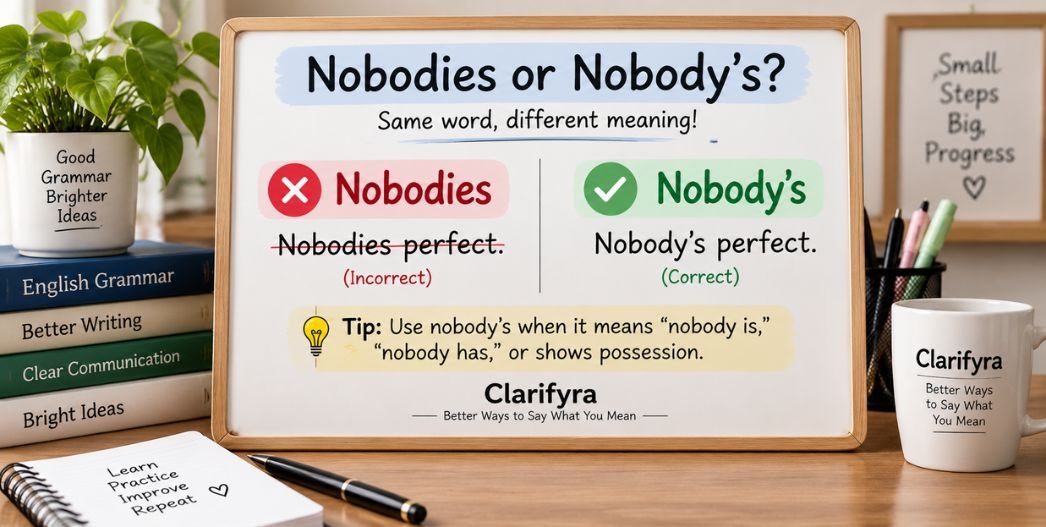
Nobodies is the plural of the noun nobody, meaning multiple unimportant or unknown people. Nobody’s is either possessive or a contraction of nobody is or nobody has. For example, “They were nobodies” is correct, while “Nobody’s perfect” means “Nobody is perfect.”
Nobodies or Nobody’s: What’s the Difference?
Both nobodies and nobody’s can be correct, but they are used differently.
| Form | Grammatical function | Meaning | Example |
|---|---|---|---|
| nobodies | Plural noun | More than one nobody | The actors were once nobodies. |
| nobody’s | Possessive | Belonging to or associated with nobody | It was nobody’s fault. |
| nobody’s | Contraction | Nobody is | Nobody’s perfect. |
| nobody’s | Contraction | Nobody has | Nobody’s finished yet. |
The key is the apostrophe. In nobody’s, it has a grammatical purpose. In nobodies, there is no apostrophe because the word is simply plural.
What Does “Nobodies” Mean?
Nobodies is the plural form of the noun nobody when nobody means a person who has little importance, influence, recognition, or status.
For example:
- The two musicians were nobodies before their first hit.
- Several political nobodies became famous after appearing on the show.
- They entered the competition as complete nobodies.
- The novel follows a group of nobodies who dream of becoming famous.
Here, nobodies refers to multiple people. It is similar to saying unknown people or people of little importance.
There is an important distinction between this noun use and the pronoun nobody.
Compare:
Nobody called me.
Here, nobody means no person.
They were nobodies before the movie.
Here, nobodies is a plural noun referring to people considered unimportant or unknown.
What Does “Nobody’s” Mean?
Nobody’s has several possible meanings depending on the sentence.
1. “Nobody’s” can mean “nobody is”
This is a contraction:
nobody + is = nobody’s
For example:
Nobody’s perfect.
This means:
Nobody is perfect.
Another example:
Nobody’s ready yet.
This means:
Nobody is ready yet.
The apostrophe represents letters omitted from is.
2. “Nobody’s” can mean “nobody has”
The same spelling can also be a contraction of nobody has.
For example:
Nobody’s finished the assignment.
This means:
Nobody has finished the assignment.
Another example:
Nobody’s seen my keys.
This means:
Nobody has seen my keys.
The surrounding verb usually makes the intended meaning clear.
3. “Nobody’s” can be possessive
Nobody’s can also indicate possession or association.
For example:
It was nobody’s fault.
The meaning is essentially the fault of nobody.
Another example:
That is nobody’s responsibility.
Here, the responsibility does not belong to any person.
This possessive use is why phrases such as nobody’s fault and nobody’s business contain an apostrophe.
Why Is “Nobody’s Perfect” Correct?
“Nobody’s perfect” is a contraction of:
Nobody is perfect.
It is a familiar expression used to acknowledge that everyone makes mistakes or has imperfections.
For example:
I made a mistake in the report, but nobody’s perfect.
The apostrophe is essential because nobody’s represents nobody is.
So:
- ✅ Nobody’s perfect.
- ❌ Nobodies perfect.
The second version does not work because nobodies is the plural noun form. It does not mean nobody is.
In formal writing, you can always expand the contraction:
Nobody is perfect.
In everyday English, nobody’s perfect is completely natural.
What Does “Nobody’s Business” Mean?
The expression nobody’s business usually means something that is not another person’s concern or something they have no right to interfere with.
For example:
What I do with my free time is nobody’s business.
This means that other people do not need to know or concern themselves with the speaker’s private activities.
Here, nobody’s is possessive.
Think of it as:
the business of nobody
Therefore, the apostrophe is appropriate.
“Like Nobody’s Business”
There is also a separate idiomatic expression:
She can play the piano like nobody’s business.
Like nobody’s business means to a very high degree, extremely well, quickly, or energetically, depending on context.
For example:
He can fix old cars like nobody’s business.
The phrase does not literally mean that the cars belong to nobody. It functions as an idiom.
What Does “Nobody’s Fault” Mean?
Nobody’s fault means that no person is responsible for something that happened.
For example:
The delay was nobody’s fault.
This means that nobody was responsible for causing the delay.
Another example:
It was nobody’s fault that the event had to be canceled.
Again, nobody’s is possessive.
You can think of the phrase as:
the fault of nobody
That is why the correct spelling is:
- ✅ nobody’s fault
- ❌ nobodies fault
The version without the apostrophe, nobodies fault, incorrectly uses the plural noun form.
How to Tell Which Form You Need
A simple substitution test can help.
Test 1: Try “nobody is”
If nobody is makes sense, use nobody’s.
Nobody’s perfect.
→ Nobody is perfect.
Nobody’s available.
→ Nobody is available.
Test 2: Try “nobody has”
If nobody has works, nobody’s can be used as the contraction.
Nobody’s finished.
→ Nobody has finished.
Nobody’s told me.
→ Nobody has told me.
Test 3: Look for possession
If you mean something belongs to, concerns, or is the responsibility of nobody, use nobody’s.
It was nobody’s fault.
That is nobody’s business.
Nobody’s responsibility has been established.
Test 4: Are you describing several people?
If you mean multiple people who are nobodies, use nobodies.
The performers were nobodies when they started.
There is no apostrophe because you are simply making the noun plural.
Common Mistakes
Mistake 1: Writing “nobodies perfect”
Incorrect:
Nobodies perfect.
Correct:
Nobody’s perfect.
The correct version means nobody is perfect.
Mistake 2: Writing “nobodies fault”
Incorrect:
It was nobodies fault.
Correct:
It was nobody’s fault.
The apostrophe shows the possessive relationship.
Mistake 3: Using “nobody’s” as the plural
Incorrect:
Several nobody’s became famous.
Correct:
Several nobodies became famous.
You do not normally use an apostrophe to make an English noun plural.
Mistake 4: Assuming every apostrophe-s means possession
In nobody’s perfect, the apostrophe does not indicate possession. It marks a contraction:
nobody’s = nobody is
In nobody’s fault, however, it is possessive.
Examples Side by Side
Seeing the forms in different contexts makes the distinction easier:
Plural noun:
The two writers were nobodies at the beginning of their careers.
Contraction of “nobody is”:
Nobody’s perfect, so mistakes are inevitable.
Contraction of “nobody has”:
Nobody’s contacted the office yet.
Possessive:
The accident was nobody’s fault.
Possessive:
My personal life is nobody’s business.
These examples demonstrate why the apostrophe cannot simply be added or removed based on appearance. The correct form depends on the grammatical meaning.
An Easy Way to Remember the Difference
Think of the apostrophe in nobody’s as a signal that something has been changed or expressed grammatically.
If nobody’s can be expanded to nobody is or nobody has, it is a contraction:
Nobody’s = Nobody is / Nobody has
If it indicates possession or responsibility, it is possessive:
nobody’s fault
nobody’s business
Without the apostrophe, nobodies is simply the plural noun:
one nobody → two nobodies
A useful shortcut is:
Nobodies = more than one person
Nobody’s = nobody is, nobody has, or belonging to nobody
FAQ
Is “nobodies” a real word?
Yes. Nobodies is the plural of the noun nobody when it refers to people who are unknown, unimportant, or lacking influence. For example, The actors were nobodies before their breakthrough.
Is “nobody’s” grammatically correct?
Yes. Nobody’s is grammatically correct when it is possessive or when it is a contraction of nobody is or nobody has. The intended meaning depends on the sentence.
Is it “nobody’s fault” or “nobodies fault”?
The correct expression is “nobody’s fault.” The apostrophe indicates the possessive relationship, meaning that no person is responsible for the fault.
What does “nobody’s perfect” mean?
“Nobody’s perfect” means “nobody is perfect.” It is commonly used to acknowledge that everyone makes mistakes or has imperfections.
What does “nobody’s business” mean?
“Nobody’s business” generally means that something is not another person’s concern or is private. For example, How I spend my money is nobody’s business.
How do I remember the difference?
Use nobodies when you mean multiple people who are nobodies. Use nobody’s when you can expand it to nobody is, nobody has, or when it shows possession, as in nobody’s fault.
The Bottom Line
Nobodies and nobody’s are both correct forms, but they serve different grammatical purposes. Nobodies is the plural noun, while nobody’s can mean nobody is, nobody has, or indicate possession. Once you check whether the sentence refers to multiple people, a contraction, or possession, the choice becomes straightforward. For more clear explanations of confusing English forms, Clarifyra helps you find better ways to say what you mean.