Caftan or Kaftan: Which Spelling Is Correct?
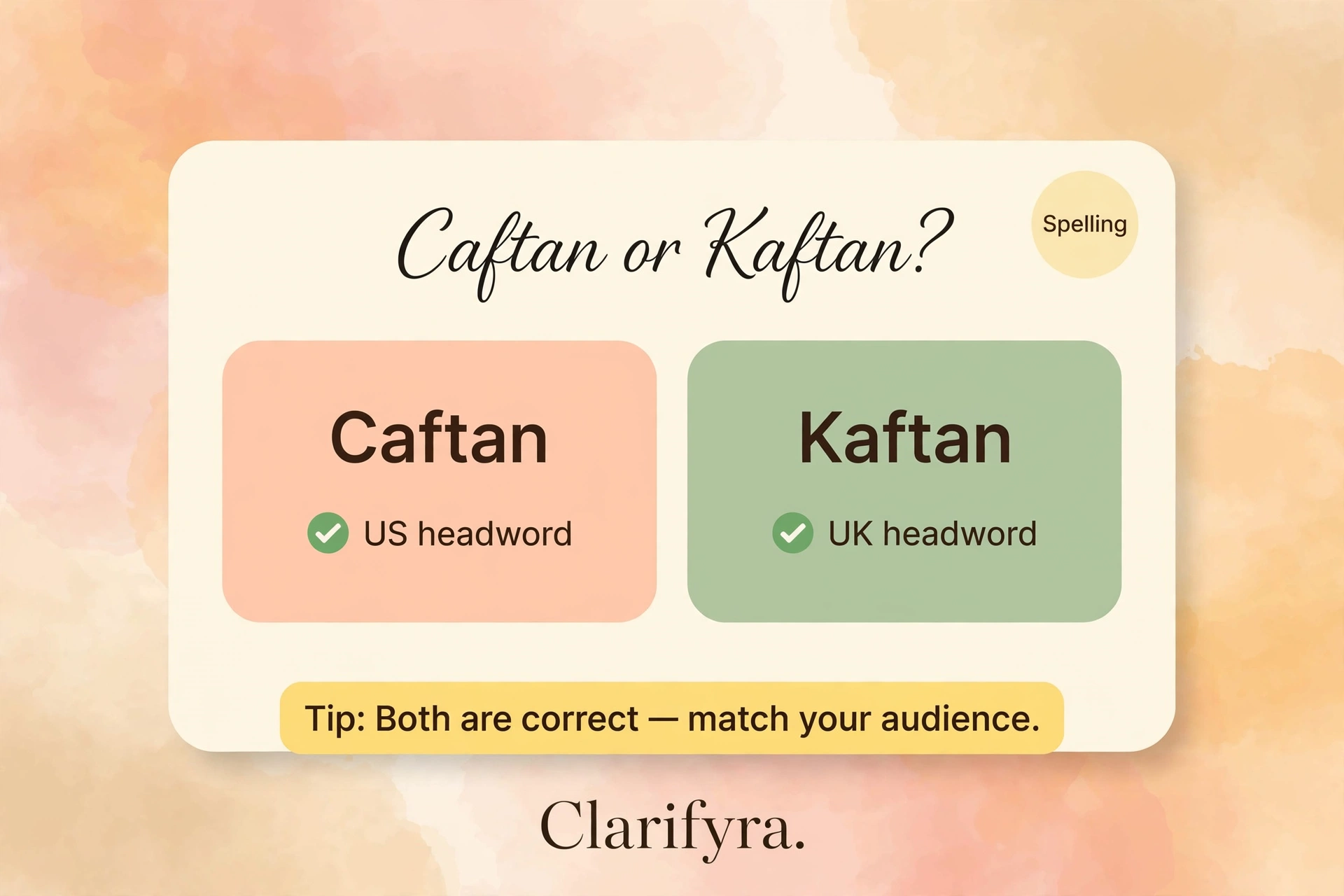
Caftan and kaftan are both correct — two spellings of the same garment, and every dictionary checked accepts both. The split is mildly regional in the dictionaries: Collins’s British English Dictionary headwords kaftan (listing “caftan” as “a variant spelling of kaftan”), while Collins’s American dictionaries headword caftan (“Also: kaftan”). Kaftan with a k is closer to the original Turkish qaftān. Neither is a misspelling — pick one and stay consistent.
Quick Answer
Caftan and kaftan are alternative spellings of the same noun: a long, loose, belted garment — originally a Middle Eastern coatlike robe, now also a Western dress style with long wide sleeves. Collins’s British entry headwords kaftan (“caftan … a variant spelling of kaftan”); Collins’s American entries (Webster’s New World, Random House) headword caftan (“Also: kaftan”). Etymology: 16th century, from Turkish qaftān (via Russian and Persian). Pronunciation: UK /ˈkæftæn/ (“KAF-tan”); US (ˈkæftən, ˈkæfˌtæn, kɑfˈtɑn). Plurals: caftans/kaftans.
What the Dictionaries Record
The reference picture here is a genuine transatlantic mirror image — unusual and worth stating precisely. On the British side, Collins’s British English Dictionary makes kaftan the headword and defines “caftan” as “a variant spelling of kaftan.” The COBUILD entry likewise leads with kaftan (“also caftan“). On the American side, it’s reversed: Webster’s New World headwords caftan (“a long coatlike garment … Also: kaftan“), and Random House does the same (“Also: kaftan“).
So which is “primary”? It depends which dictionary — and which country — you ask. That’s the honest answer, and it’s more useful than crowning a winner: an American reader is likelier to meet caftan first, a British reader kaftan, and neither spelling will look wrong to either. What matters is that both are fully standard, defined identically, in all the dictionaries checked.
The etymology slightly favors the k. The word entered English in the 16th century from Turkish qaftān (Collins; Random House traces it through Russian kaftán and Persian qaftān). The k spelling preserves the original consonant; the c spelling is the naturalized English/French-influenced form (compare how English often renders foreign k as c). If you like your spellings etymologically transparent, kaftan has the edge.
What the Garment Is
Both spellings denote the same two garments — the historical one and the modern Western borrowing:
1. The Middle Eastern robe. The original: a long, coatlike garment with full sleeves, worn belted over other clothing — the Ottoman court garment, the North African ceremonial robe. “The sultan’s kaftan was embroidered with gold thread.”
2. The Western dress. The borrowed fashion sense: a loose, long-sleeved dress, often worn as elegant loungewear or resort wear. “She wore a silk caftan by the pool.” This is the sense most modern readers meet first, and it’s the one that fills fashion pages every summer.
Collins’s American entry captures both in one definition: “a long coatlike garment worn in the Near East” and “a long, loose dress with wide sleeves, worn esp. by Western women.” Same word, same garment family — only the initial letter varies.
Which Spelling Should You Use?
- Match your audience’s dictionary. Writing for a primarily American readership? Caftan is the headword in American dictionaries. For a British readership? Kaftan leads in Collins’s British entries. This is the closest thing to a rule here.
- Consider the etymological argument. Kaftan is closer to Turkish qaftān. Writers on Middle Eastern textiles, Ottoman history, or fashion history often prefer kaftan for this reason.
- Follow fashion-industry usage in context. Western fashion writing uses both, but if you’re naming a specific designer’s garment, use the spelling the designer uses.
- Be consistent. As with every free-variation pair, switching mid-document is the only real error available. Caftans pairs with caftan; kaftans pairs with kaftan.
| Dictionary | Headword | Variant listed |
|---|---|---|
| Collins British English Dictionary | kaftan | caftan (“a variant spelling of kaftan”) |
| Collins COBUILD (British) | kaftan | also caftan |
| Webster’s New World (American) | caftan | Also: kaftan |
| Random House (American) | caftan | Also: kaftan |
The Western Caftan: What It Looks Like
If your image of a caftan comes from fashion pages rather than history books, you’re picturing the Western borrowing: a loose, usually ankle-length dress with long wide sleeves, often belted or sashed, worn as elegant resort wear or evening loungewear. Typical fabrics are silk, cotton, and linen — materials that drape rather than cling — and typical decoration is embroidery or border patterning at the neckline, cuffs, and hem, echoing the ornament of the Ottoman originals.
The Western caftan’s appeal is architectural: it’s one of the few garments designed around drape instead of tailoring, which is why it suits such a range of bodies and occasions — poolside cover-up in cotton, dinner dress in embroidered silk. Whatever the fabric or occasion, the spelling rules don’t change: caftan or kaftan, your choice, consistent throughout. Fashion copy uses both, sometimes in the same magazine issue — which is fine across articles, just not within one.
Correct vs. Incorrect
- ✓ “She draped a silk kaftan over her shoulders.” / ✓ “She draped a silk caftan over her shoulders.” (both correct)
- ✓ “The museum displayed Ottoman kaftans.” / ✓ “…displayed Ottoman caftans.” (plurals follow the chosen spelling)
- ✗ “She bought a kaftan and two caftans.” → pick one spelling per document
- ✗ “She wore a caften.” → ✓ “…a caftan.” (no such word as “caften”)
- ✗ “She wore a kaftran.” → ✓ “…a kaftan.” (watch the consonant cluster)
Common Mistakes
1. “Correcting” one spelling to the other. The recurring theme of this batch: the most common error with free-variation pairs is the unnecessary correction. Caftan and kaftan are both headworded in major dictionaries — “fixing” either one is itself the mistake.
2. Inconsistency, especially in plurals. “Kaftan” in the headline and “caftans” in the caption is the sloppy version of this word. Lock in the initial letter at the start — c or k — and carry it through singular and plural alike.
3. Confusing it with “caftan” lookalikes. The -aftan ending invites typos: “caften,” “kafton,” “cafetan.” The ending is -aftan in both spellings: c-a-f-t-a-n, k-a-f-t-a-n.
4. Assuming the garment senses differ by spelling. Some writers guess that kaftan means the Middle Eastern robe and caftan the Western dress (or vice versa). The dictionaries don’t support that: both spellings cover both senses. The difference is orthographic and mildly regional, not semantic.
5. Mispronouncing the stress. The stress is on the first syllable: “KAF-tan” (UK /ˈkæftæn/; US variants (ˈkæftən, ˈkæfˌtæn, kɑfˈtɑn) per Collins). Don’t stress the second syllable (“kaf-TAN”) — that’s not a recorded pronunciation.
Frequently Asked Questions
Is it “caftan” or “kaftan”?
Both are correct. Collins’s British dictionaries headword kaftan; Collins’s American dictionaries headword caftan. Kaftan is closer to the original Turkish qaftān. Choose by audience, or by etymological preference, and stay consistent.
Where does the word come from?
Turkish qaftān, entering English in the 16th century via Russian and Persian forms (Random House dates it [1585–95]). It named the long belted robe of the Ottoman world before Western fashion borrowed both the garment and the word.
How do you pronounce “kaftan”?
UK: /ˈkæftæn/ (“KAF-tan”). US: (ˈkæftən, ˈkæfˌtæn, kɑfˈtɑn) — the same word with a little more vowel variation, per Collins. Stress always on the first syllable; both spellings sound the same.
What’s the plural?
Caftans or kaftans — regular -s plural, following whichever singular spelling you’ve chosen. No irregular plural here despite the exotic etymology.
Is a caftan the same as a kimono or an abaya?
Related but distinct. A kimono is the Japanese wrapped robe; an abaya is the long cloak-like garment worn over clothes in parts of the Arab world; a caftan/kaftan is the belted, sleeved robe of Ottoman and North African origin (and its Western fashion descendant). Cousins in the long-robe family, not synonyms.
The Takeaway
Caftan and kaftan are the same word in two spellings — the long belted robe of the Middle East and its Western fashion descendant. American dictionaries headword caftan; British dictionaries headword kaftan (closer to Turkish qaftān); every dictionary checked accepts both. Match the spelling to your audience, keep it consistent through singular and plural, and spend your proofreading energy elsewhere — this pair has no wrong answer.