Sore or Soar: What’s the Difference?
Sore and soar are homophones — both pronounced /sɔːr/ — with completely unrelated meanings. Sore is mainly an adjective meaning painful or aching (a sore throat), and in American English it also means upset or angry (a sore loser). Soar is a verb meaning to fly high or to rise dramatically (the eagle soared; prices soared). There is no etymological connection between them: sore comes from Old English sār (pain), while soar comes, via French, from Latin aura (breeze). Same sound, different planets.
Quick Answer
Use sore for pain and tenderness (sore muscles, a sore throat), for an infected spot on the body (noun: a cold sore), and — especially in American English — for being upset or resentful (sore loser, still sore about it). Use soar for rising high: birds gliding on air currents (soaring eagles), prices or numbers climbing fast (soaring costs), and spirits or hopes lifting (her spirits soared). Both say /sɔːr/; only the spelling tells them apart.
“Sore”: pain, tenderness — and, in America, hurt feelings
Sore is the body word. Its central adjective sense, across all dictionaries, is “painful” — a part of the body that hurts because of injury, infection, or overuse. Longman gives the textbook examples: I had a sore throat and aching limbs; my arms are sore from all the lifting. As a noun it names the painful spot itself: Collins defines it as “a sore, usually infected spot on the body, as an ulcer, boil, or blister” — the word behind cold sores and bedsores.
The pronunciation is straightforward: /sɔː/ in British English, /sɔːr/ in American English — exactly the same sound as soar. The spelling carries a thousand years of history: Collins traces sore to Old English sār, related to Old Norse sārr and Gothic sair, and ultimately to the same Indo-European root behind Latin saevus, “raging.” Pain is the word’s original territory, and it never left.
But sore travelled. In American English it developed the informal sense Longman records: “upset, angry, and annoyed, especially because you have not been treated fairly” — Mac’s still sore because I didn’t invite him; don’t be sore at me. The famous fixed phrase “sore loser” belongs here: someone who takes defeat badly, resentful rather than gracious. British English knows the phrase too, though the “upset” sense of sore is marked as especially American.
Other fixed expressions keep sore busy: a “sore point” or “sore subject” is a topic that provokes irritation; “stick out like a sore thumb” means to be conspicuously out of place; “a sight for sore eyes” is a welcome sight; and in British English, sore still works as an intensifier for serious difficulty — in sore need of funds, a sore trial. All of these orbit the original meaning: a place where it hurts to be touched.
“Soar”: rising high on the air
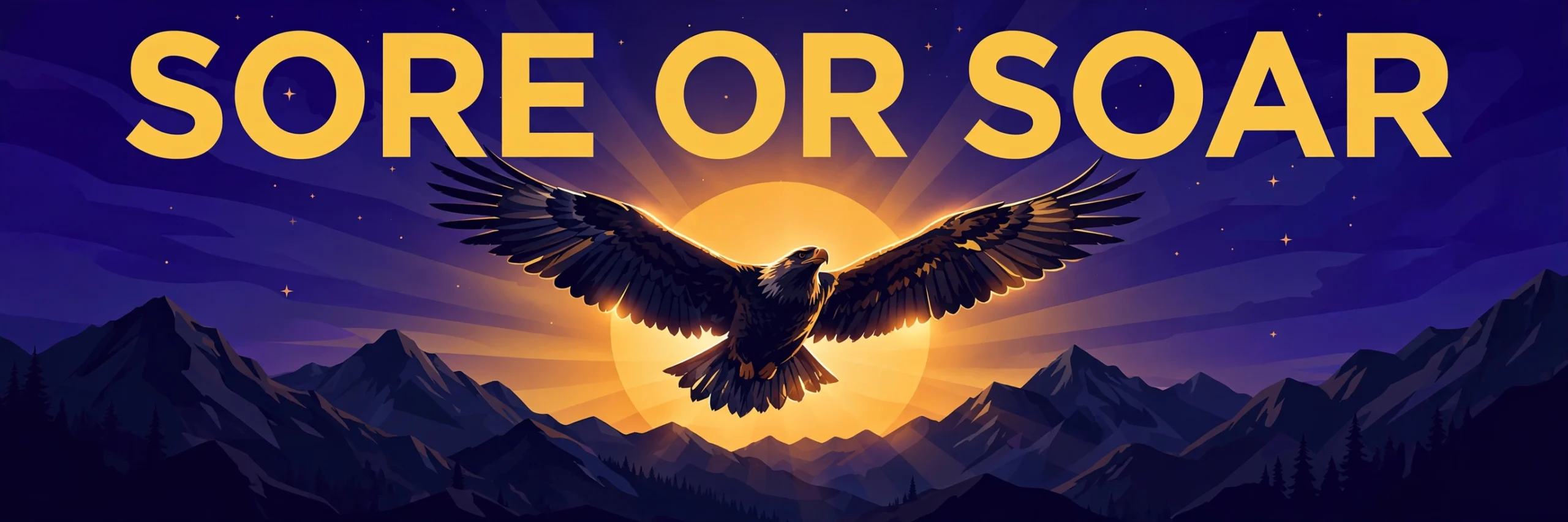
Soar is the sky word. Merriam-Webster defines the intransitive verb as “to fly aloft or about,” “to sail or hover in the air often at a great height,” and — figuratively — “to rise or increase dramatically (as in position, value, or price)” and “to ascend to a higher or more exalted level.” Collins adds the aviation-specific sense of gliding without engine power on air currents. The images that belong to soar are eagles circling, gliders hanging on thermals, stock charts climbing, and spirits lifting: stocks soared, makes my spirits soar, soaring prices.
The etymology is the mnemonic. Collins traces soar to the 14th century, from Old French essorer, from Vulgar Latin *exaurāre — “to expose to the breezes” — built from Latin ex- plus aura, “breeze, air.” Soaring is literally aura-ing: moving on the air. Remember that soar contains air rearranged — soar is what things do in the air — and the spelling will take care of itself.
Note the grammar: soar is intransitive — things soar, you don’t soar things. There is no standard “she soared the kite” (you fly a kite). And the noun exists too, though it is rarer: “the act of soaring,” as in the eagle’s effortless soar. In everyday writing, though, you will meet soar as a verb and as the adjective soaring modifying prices, ambitions, melodies, and birds.
Sore vs soar at a glance
| Sore (/sɔːr/) | Soar (/sɔːr/) | |
|---|---|---|
| Main meaning | Painful, aching; (US) upset, resentful | To fly high; to rise dramatically |
| Part of speech | Adjective (also a noun: a painful spot) | Verb, intransitive (also a rare noun: the act of soaring) |
| Fixed phrases | sore loser, sore throat, sore point, stick out like a sore thumb, a sight for sore eyes | soaring prices, spirits soar, soar to new heights |
| Mnemonic | Sore = pain, from Old English sār | Soar contains “air” — it happens in the air |
| Origin | Old English sār; akin to German sehr | 14th c., Old French essorer ← Latin aura, “breeze” |
| Example | Her feet were sore after the hike. | The hawk soared above the valley. |
Correct and incorrect, in sentences
- ✓ My throat is sore and I can barely swallow. — painful; the adjective sore.
- ✓ Don’t be a sore loser — congratulate the winners. — resentful about defeat; the American-leaning sense of sore.
- ✓ The eagle soared on the warm air currents. — flying high; the verb soar.
- ✓ House prices have soared beyond our budget. — risen dramatically; figurative soar.
- ✓ Good news after the exam made her spirits soar. — lifted to a higher emotional level.
- ✗ The pain in my shoulder will soar if I lift that. — wrong: pain doesn’t rise into the sky; it gets worse. Write the pain will get worse, or keep sore: my shoulder is sore.
- ✗ Watch the eagles sore over the cliffs at dusk. — wrong: birds soar; sore is for pain.
- ✗ He was a soar loser and refused to shake hands. — wrong: the fixed phrase is sore loser.
- ✗ Temperatures will sore above 30 degrees this weekend. — wrong: temperatures soar.
Common mistakes
Writing “soar” for anything painful. Because the words sound identical, the eye sometimes grabs soar when the sentence needs sore — “soar throat,” “soar muscles,” “my feet are soar.” These are pure homophone slips. The air mnemonic fixes them: if the sentence has nothing to do with air, height, or rising, it cannot be soar.
Writing “sore” for rising. The mirror error: “prices are sore,” “his spirits sore,” “the balloon sored into the sky.” Prices, spirits, balloons, and birds soar. If something is going up — literally or figuratively — the word has an a in it.
Using “sore” for “upset” in formal British writing. The “angry, resentful” sense is marked as especially American and informal in learner dictionaries. Don’t be sore about it is perfectly natural in conversation and in American prose, but in formal British writing resentful, aggrieved, or upset fit the register better.
Making “soar” transitive. Soar doesn’t take an object in standard English. “The pilot soared the glider” is wrong; the pilot flew the glider, or the glider soared. Keep the verb intransitive and it behaves.
FAQs
Are “sore” and “soar” true homophones?
Yes. Both are pronounced /sɔː/ in British English and /sɔːr/ in American English — identically, with no difference in stress, vowel, or length. No one can hear which word you mean, which is exactly why this pair is a spelling problem rather than a speaking problem.
Is a “sore loser” one word or two?
Two words: sore loser, with sore as the adjective. It means someone who handles defeat badly — resentful, ungracious, making excuses. The phrase uses the American “upset/resentful” sense of sore and is now understood on both sides of the Atlantic.
Can “soar” be a noun?
Yes, though it is uncommon. Merriam-Webster lists soar as a noun meaning “the act of soaring” or “the range, distance, or height attained in soaring.” You will meet it far more often as a verb or in the adjective soaring — soaring temperatures, soaring ambition.
Why is it spelled “soar” and not “sore” for rising?
Because they are different words with different histories. Soar came through Old French essorer from Latin aura (breeze) — it is the air word, and the oa spelling marks that French lineage. Sore is the native Germanic word from Old English sār (pain). English simply kept both spellings as the pronunciations converged.
What’s the easiest way to remember which is which?
Soar contains the letters of air — and soaring happens in the air. Everything else in this pair is sore: pain, aching muscles, sore throats, sore losers, sore points. If it hurts, it’s sore; if it flies or rises, it’s soar.
Takeaway
Sore is for pain — aching bodies, sore throats, and (especially in American English) bruised feelings, as in sore loser. Soar is for rising — eagles on thermals, prices climbing, spirits lifting — and it carries the air in its spelling and its Latin root. They sound exactly the same, /sɔːr/, and they share nothing else: not meaning, not origin, not word class. When the sentence goes up, write soar; when it hurts, write sore.