Bearly or Barely: Which Spelling Is Correct?
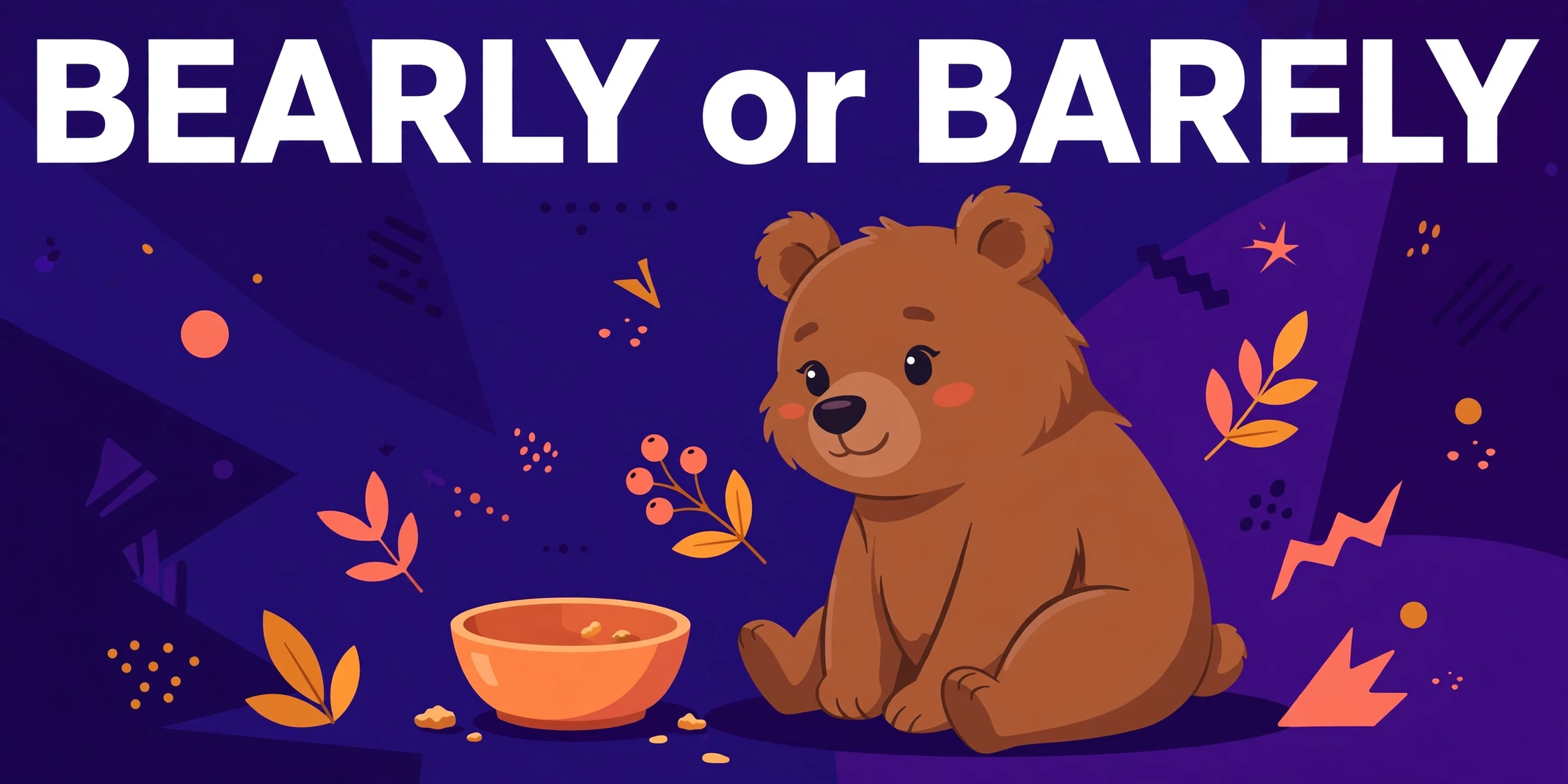
Barely is the correct spelling. It is an adverb meaning only just, almost not, or no more than. Bearly is not a standard English word at all — it is a misspelling of barely that appears when the writer’s mind drifts to bear, the animal or the verb. There is no sentence in standard English where bearly is the right choice, and no dictionary lists it as a headword.
The error is easy to make. Bare and bear are homophones, and barely is built from bare plus -ly. A writer who hears “BARE-lee” and thinks of the animal, or of the verb bear as in “I can’t bear it”, can easily write bearly. The spelling is wrong even though the sound is right.
Quick Answer: Barely is correct and bearly is a misspelling. Barely is an adverb meaning only just or almost not — “She barely made the train”, “I could barely hear him”. It comes from bare + -ly, not from bear. There is no standard word bearly; use barely every time.
What Does Barely Mean?
Barely is an adverb, and Oxford gives it four connected senses. The first is the most common: in a way that is just possible but only with difficulty. “He could barely read and write”, “The music was barely audible”, “She was barely able to stand”. In each case the action happens, but only just — the margin is thin.
The second sense is closely related: in a way that almost does not happen or exist. “She barely acknowledged his presence”, “There was barely any smell”. The third sense is about amount: just, and certainly not more than a particular amount, age, or time. “Barely 50% of the population voted”, “He was barely 20 years old”. The fourth sense is about time: only a very short time before something else happened. “I had barely started speaking when he interrupted me.”
Merriam-Webster‘s entry is shorter but agrees: barely means in a meagre manner, plainly — “a barely furnished room” — and, in its second sense, almost not. Collins adds the same two core meanings and notes an archaic sense, “openly”, which survives in old texts but is not current. The modern word is entirely about small margins: almost not, just enough, no more than.
The word is old. Merriam-Webster dates its first known use to around 1513, and Collins traces it to Middle English and Old English bærlīċe, from bare plus -ly. That origin is the whole story of the spelling: barely is bare with an -ly ending, and the e after the a belongs to bare. There is no bear in it.
Why Writers Write “Bearly”
The misspelling has one cause: bare and bear sound identical. Both are pronounced /beər/ in British English and /ber/ in American English, and both are common words. Bare is the adjective meaning uncovered or minimal — “bare feet”, “the bare necessities”, “a bare room”. Bear is the noun for the animal and a verb with a long list of senses: to endure (“I can’t bear it”), to carry (“arrived bearing gifts”), to give birth (“bore a child”), to produce (“a tree that bears fruit”), and to support (“columns that bear the roof”).
When a writer needs barely, the sound “BARE-lee” offers two spellings, and the wrong one is often the more familiar. Bear is the more common word in everyday use — people talk about bears, and about bearing things, far more often than they talk about bare walls or bare necessities. So the hand writes bear plus ly, producing bearly.
There is one more trap: the pun. Bearly does appear in the wild as a deliberate joke — on mugs, cards, and T-shirts, usually with a picture of a bear: “I’m bearly awake”. That is wordplay, not standard English, and it works precisely because the reader knows the correct word is barely.
Barely or Bearly: The Difference at a Glance
| Word | Status | Meaning | Example |
|---|---|---|---|
| barely | standard word (adverb) | only just; almost not | We barely caught the bus. |
| bearly | not a standard word | — (misspelling of barely) | ✗ We bearly caught the bus. |
| bare | standard word (adjective) | uncovered; minimal | He walked on the bare floor. |
| bear | standard word (noun/verb) | the animal; to endure, carry | I can’t bear the noise. |
| barley | standard word (noun) | a cereal grain | Barley grows in the field. |
The table makes the position clear. Barely is the only correct form for the adverb. Bearly has no entry in the dictionaries consulted for this article — searches of Cambridge, Merriam-Webster, Oxford, and Collins return only barely, and Wiktionary lists bearly merely as an anagram of barely, not as a word in its own right.
Pronunciation: Barely in UK and US English
Oxford gives barely as /ˈbeəli/ in British English and /ˈbeərli/ in American English — “BARE-lee” in both, with the British vowel a little longer and the American r more audible. Cambridge Learner’s Dictionary agrees: /ˈbeəli/ in the UK, /ˈbeər·li/ in the US. The stress falls on the first syllable, and the word is two syllables: bare-ly.
The awkward truth is that bearly, if it were a word, would be pronounced exactly the same way — bear plus ly gives the same sounds as bare plus ly. Pronunciation cannot settle this pair. The spelling has to be learned as a fact: barely comes from bare, so it is spelled with bare.
The Grammar of Barely: Three Rules
Barely is a negative word, and that fact governs how it behaves in a sentence. Oxford’s grammar note on hardly, scarcely, and barely sets out the rules, and they are worth learning because they are the rules that catch even confident writers.
Rule 1: do not use barely with another negative. Barely, hardly, and scarcely already carry negative force, so adding not or never creates a double negative. “I can barely believe it” is correct; “I can’t barely believe it” is wrong. Collins makes the same point: “he had barely had (not he hadn’t barely had) time to think”. If the sentence already contains barely, it does not need not as well.
Rule 2: barely pairs with when, not than. When one thing follows immediately after another, the pattern is “barely had… when…”: “We had barely sat down at the table when the doorbell rang”, “Barely had she recovered from this trauma when Martin contracted whooping cough”. No sooner takes than (“No sooner had we sat down than the doorbell rang”), but barely takes when. Mixing the two — “barely had we sat down than…” — is a common slip.
Rule 3: barely can open a sentence, with inversion. In formal, written English, barely can be placed at the beginning of the sentence, and the subject and verb are then reversed: “Barely had she recovered when the phone rang”, “Barely a minute had passed before the lights went out”. This is a literary device, not everyday style, and it should be used sparingly — but it is correct, and it is one of the signs of a writer who knows the word well.
Correct vs Incorrect
| Correct | Incorrect | Why |
|---|---|---|
| We barely made it to the station. | We bearly made it to the station. | Bearly is not a word; the adverb is barely. |
| She could barely walk after the hike. | She could bearly walk after the hike. | Same error — bare + -ly, not bear + -ly. |
| I can barely hear you. | I can’t barely hear you. | Barely is already negative; do not add not. |
| Barely had we sat down when the phone rang. | Barely had we sat down than the phone rang. | Barely pairs with when, not than. |
| He was barely twenty when he left home. | He was bearly twenty when he left home. | The amount sense still takes barely. |
| The bear slept through the winter. | The bare slept through the winter. | The animal is bear; bare means uncovered. |
Common Mistakes
Writing “bearly” for “barely”. This is the whole error, and it appears in every context where barely is used: “I bearly slept”, “There was bearly any food left”, “He bearly passed the exam”. The fix is a memory hook: barely contains bare, and bare is the word for almost nothing — bare walls, bare cupboards, bare minimum. When something is barely there, it is almost bare. If you can remember “barely = bare + ly”, the bear never gets in.
Writing “bare” for “bear” (and the reverse). The root confusion sits underneath the bearly error. “The bare necessities” is correct — the phrase means the minimum, from bare — while “a grizzly bare” is wrong; the animal is a bear. The same test works for the verb: “I can’t bear it” (endure) and “bare your shoulders” (uncover) are the two poles.
Using “barely” with a double negative. “I didn’t barely eat anything” and “She couldn’t barely speak” are both wrong, and both are common in speech. The rule from the grammar section applies: barely already says “almost not”, so the sentence needs no other negative. Write “I barely ate anything” and “She could barely speak”.
Confusing “barely” with “barley”. Barley is a cereal grain, and it is an anagram of barely — the same letters in a different order. The grain is spelled barley with the r before the l; the adverb is barely with the r after the l. Say them aloud — “BAR-lee” against “BARE-lee” — and the difference is clear.
Frequently Asked Questions
Is “bearly” a real word?
Not in standard English. No entry for bearly was found in the Cambridge, Merriam-Webster, Oxford, or Collins dictionaries consulted for this article, and Wiktionary lists it only as an anagram of barely. It appears as a deliberate pun — “bearly awake” on a mug with a bear on it — but in ordinary writing it is a misspelling of barely.
What is the difference between “barely” and “hardly”?
The two overlap heavily: both mean almost not, and both are negative words. The main difference is that hardly can mean “almost never” (“She hardly ever calls”), while barely cannot, and that barely is the natural choice for amounts and ages (“barely twenty”, “barely 50%”).
Can “barely” start a sentence?
Yes, in formal writing, with inversion: “Barely had we finished when the rain began.” In everyday writing it is more natural to keep barely in the middle of the sentence: “We had barely finished when the rain began.”
How do I remember the spelling of “barely”?
Think of bare. Barely is bare + -ly: when something is barely there, it is almost bare. There is no bear in barely, and if you picture a bear in the word, you have the wrong spelling.
The Takeaway
Barely is the only correct spelling of the adverb, and it comes from bare, not from bear. Remember the root and the spelling follows: bare + -ly = barely. Use it without another negative, pair it with when rather than than, and leave the bear out of it — unless the bear is the point of the joke.