Roster or Roaster: What’s the Difference?
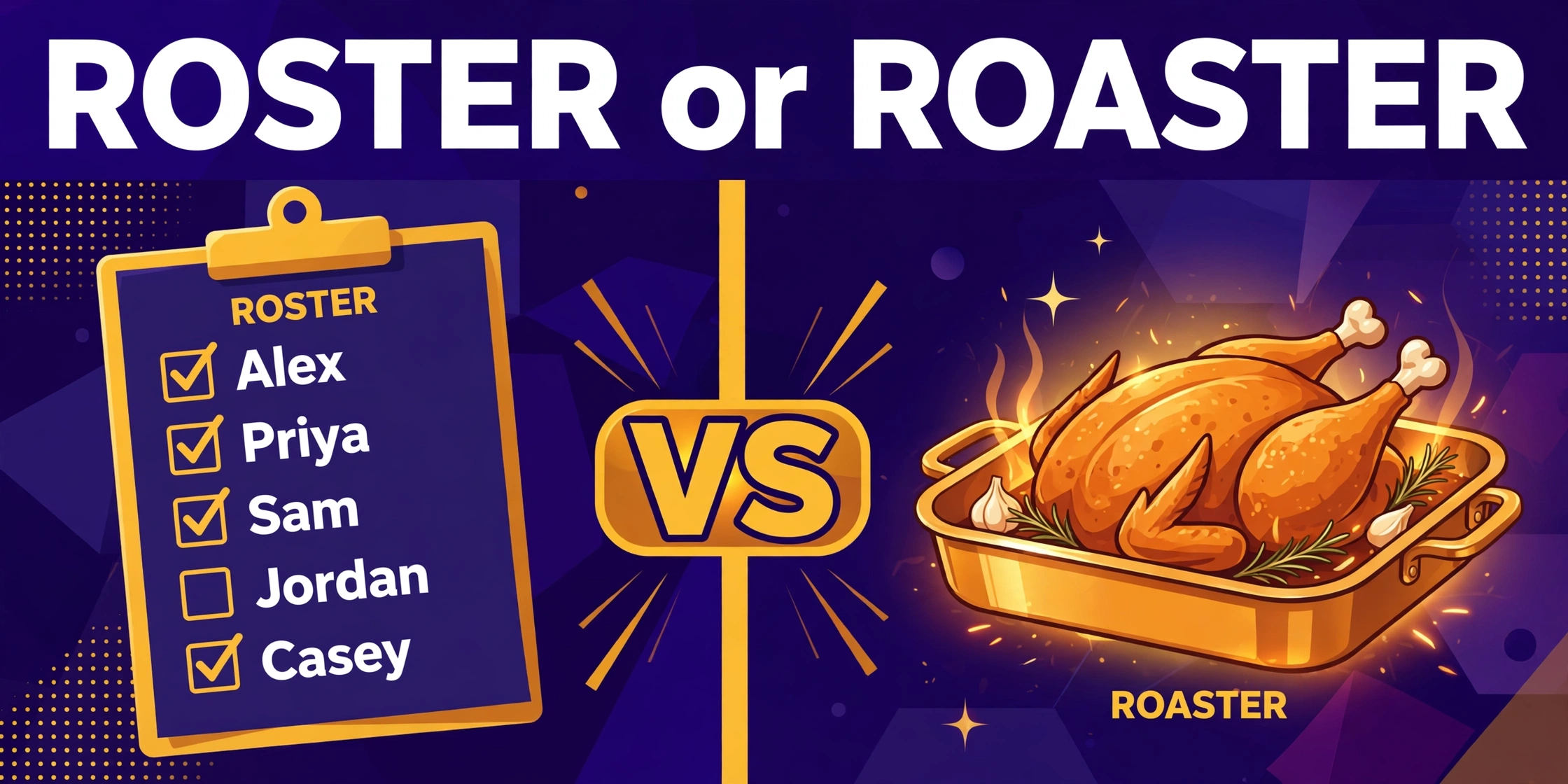
If you have ever stared at a team list and wondered whether it belonged on a roster or in a roaster, you are not alone. The two words look almost identical, sound nearly the same in fast speech, and even share a distant family history. They mean completely different things, though, and swapping them changes a sentence from sensible to silly: a football team has a roster, while a chicken goes in a roaster.
This guide explains exactly what each word means, how to pronounce them, where the confusion comes from, and how to choose the right one every time — with examples from sport, work, school, and the kitchen.
Quick Answer
Roster is a noun (and sometimes a verb) meaning a list of people, usually with the jobs or shifts they have been given. Roaster is a noun meaning a person or thing that roasts — most often a pan, an oven, a coffee-roasting machine, or a chicken suitable for roasting. If it is a list of names, write roster. If heat and cooking are involved, write roaster.
What Does Roster Mean?
A roster is a list. Cambridge Dictionary defines it as “a list of people’s names, often with the jobs they have been given to do”, and notes that in British English the word rota is often used for the same idea. Merriam-Webster gives the same core sense: “a roll or list of personnel”, including a list that shows the order in which a duty is to be performed, and the people listed on such a list.
In practice, a roster answers the question “who is doing what, and when?” A school keeps a roster of pupils in a class. A football club publishes its first-team roster. A hospital pins up a duty roster so every nurse knows which shifts she is working. A manager checks the roster before a match or a shift to see who is available.
Cambridge also records a second, closely related sense: a plan that shows who must do which jobs and when they must do them. That is why the words roster, schedule, and rota overlap so often. A schedule can cover times and events in general; a roster is specifically about people and their turns.
Roster can also be a verb, though this use is less common in everyday writing. To roster someone is to place their name on a roster: “She was rostered to work the Saturday shift.” The past forms are rostered and rostering. If that verb sounds unfamiliar, that is normal — most writers use the noun, and use verbs such as schedule or put on the rota instead.
Roster in Real Sentences
- The coach named a 26-player roster for the tournament.
- Her name has been added to the team roster.
- Please check the duty roster before you swap a shift.
- The school published the class roster on the noticeboard.
- Only players on the active roster can take part in the match.
Notice what all of these have in common: people, names, and organisation. No heat, no cooking, no oven.
What Does Roaster Mean?
A roaster is built from the verb roast plus the suffix -er, which so often means “a person or thing that does something”. Collins Dictionary defines it plainly as “a person or thing that roasts”, and lists a young pig or chicken suitable for roasting as a further sense. Cambridge defines a coffee roaster as a person or company that roasts coffee beans, or a device for roasting them.
So a roaster is one of three things, depending on context:
- A device or pan: a roasting pan, an electric roaster, a coffee-roasting machine. “She bought a new roaster for the Thanksgiving turkey.”
- A person or business: someone who roasts coffee beans for a living, or a company that does so. “The company was founded in 1988 by coffee roaster Bill Fishbein” — an example Cambridge itself gives.
- A bird or animal for roasting: a roasting chicken, sold as a “roaster” in a butcher’s or supermarket.
In American informal use, roaster has also come to mean someone who teases or mocks another person in a comic “roast” — a performer at a roast, or a comedian known for sharp jokes. That sense is real but narrow; in most writing, the cooking sense is the one readers expect.
Roaster in Real Sentences
- Put the chicken in the roaster and cover it with foil.
- Our local coffee roaster buys beans directly from small farms.
- She had an electric roaster that had belonged to her grandmother.
- The butcher sells fresh roasters every Friday.
- He works as a roaster at a speciality coffee company.
Roster or Roaster: The Difference at a Glance
| Roster | Roaster | |
|---|---|---|
| Part of speech | Noun (also a verb) | Noun |
| Core meaning | A list of people, with jobs or shifts | A person or thing that roasts |
| Think of | Names on a page | Heat, an oven, a pan |
| Typical contexts | Sport, work, school, the military | Cooking, coffee, butchery, comedy |
| Plural | Rosters | Roasters |
| Example | The team roster has 40 players. | Put the turkey in the roaster. |
How to Pronounce Roster and Roaster
The two words are close in sound, which is part of the problem. Cambridge gives roster as UK /ˈrɒs.tər/ and US /ˈrɑː.stɚ/ — the first vowel is the short “o” of sock or lot. Roaster is UK /ˈrəʊ.stər/ and US /ˈroʊ.stɚ/ — a longer “oh” sound, the same vowel as in roast itself.
In other words, roaster rhymes with toaster and coaster, while roster has the shorter vowel of cost and foster. In rapid speech the difference can shrink, especially in accents where the vowel before “st” is similar, so spelling — not sound — is the reliable guide. If you can hear the word roast inside it, with its long “o”, you are dealing with a roaster.
There is also a third lookalike worth keeping separate: rooster, a male chicken, pronounced UK /ˈruː.stər/ and US /ˈruː.stɚ/. A rooster is a bird; a roster is a list; a roaster is a pan or a person who roasts. The three words share the letters R-O-S-T, and only the vowel and the extra letters tell them apart.
Why the Two Words Get Mixed Up
The confusion is not carelessness alone — the words really are related. Merriam-Webster traces roster to Dutch rooster, literally a gridiron, named for the ruled parallel lines of a list, first used in English in 1727. The same Dutch word is the ancestor of the cooking sense too: a gridiron is a frame for roasting over heat. So both words grew out of the same root, then went in opposite directions — one towards lists and organisation, the other towards cooking.
That shared history explains why spellcheckers and autocorrect are little help. Both words are correctly spelled English words, so a spellchecker will accept either one in either sentence. Only meaning can catch the error, which is why a quick sense-check matters: does this sentence need a list, or does it need heat?
Typing is the other culprit. The difference is a single letter — the “a” in roa-ster — and the two words sit next to each other in the mind because they are near-homophones. A fast typist writing about a team list can easily produce roaster without noticing, especially when the brain is already thinking about the word roast from a different context.
Correct vs Incorrect
| Incorrect | Correct | Why |
|---|---|---|
| The coach published the team roaster. | The coach published the team roster. | A team list is a roster, not a cooking pan. |
| Check the duty roaster before Friday. | Check the duty roster before Friday. | A duty list is a roster. |
| Put the chicken on the roster. | Put the chicken in the roaster. | The chicken goes in a roasting pan. |
| Our coffee roster buys beans from Ethiopia. | Our coffee roaster buys beans from Ethiopia. | The person or company that roasts coffee is a roaster. |
| He was rostered to cook the turkey. | He was asked to roast the turkey. | Rostered means put on a list, not asked to cook. |
Common Mistakes to Avoid
1. Using “roaster” for any list
This is the most frequent error, and it usually appears in sport and workplace writing: “the Christmas roaster”, “the staff roaster”, “the exam roaster”. If the sentence is about people and their turns, the word is roster every time.
2. Using “roster” for a cooking pan
The reverse mistake is rarer but it happens, usually when someone is writing quickly: “Put the potatoes in the roster.” A pan is a roaster. Remember the “a” in roaster is the “a” in roast.
3. Confusing roster with rooster
A rooster crows at dawn. It has never been a list. If your sentence is about a bird, you need the double “o”; if it is about a list, you need the single “o” of roster.
4. Trusting spellcheck to catch the swap
Spellcheck will not flag roaster in “the team roaster” because roaster is a real word. Read the sentence back and ask what it literally says. If the literal meaning involves cooking, and you meant a list, you have the wrong word.
How to Remember the Difference
Two small tricks cover almost every case. First, roaster contains roast. If you can see the word roast inside it — R-O-A-S-T — the word is about cooking. Second, a roster is a roll of names. Merriam-Webster’s first definition is “a roll or list of personnel”, and roll and roster both start with “ro” and contain no “a”.
Another way to think about it: a roster tells you who; a roaster tells you how something is cooked. Who is on the team? Check the roster. How is the turkey cooked? In a roaster. Keep those two questions in mind and the choice becomes automatic.
FAQs
Is “roaster” ever correct for a list of people?
No. A list of people, players, workers, or pupils is a roster. Roaster always involves roasting — a person, a device, or an animal for roasting — or, informally, a comedian who “roasts” someone with jokes.
Can “roster” be a verb?
Yes. Cambridge and Merriam-Webster both record the verb use: to roster someone is to put their name on a roster. “She was rostered for the night shift” is correct, though in everyday writing “she was scheduled for the night shift” is more common.
Is “roster” British or American?
It is used in both, though British English often prefers rota for a duty list, as Cambridge notes. American English uses roster very widely, especially in sport — an “active roster” is a standard term in American professional leagues.
What is a coffee roaster?
Either a person or company that roasts coffee beans, or the machine that does the roasting. Cambridge defines both senses under the collocation coffee roaster. A coffee roaster is never a list.
Are roster and roaster pronounced the same?
Almost, but not quite. Roster has a short vowel (UK /ˈrɒs.tər/, US /ˈrɑː.stɚ/), while roaster has the long “oh” of roast (UK /ˈrəʊ.stər/, US /ˈroʊ.stɚ/). In fast speech the difference is easy to miss, which is why the spelling matters.
The Takeaway
Roster is a list of people and their turns. Roaster is a person or thing that roasts. The single letter “a” — the “a” in roast — is the whole difference. Check whether your sentence needs names or heat, and you will choose correctly every time. For more on easily confused words, see the dictionary entries for roster and roaster at Cambridge Dictionary.