Site or Sight: What’s the Difference?
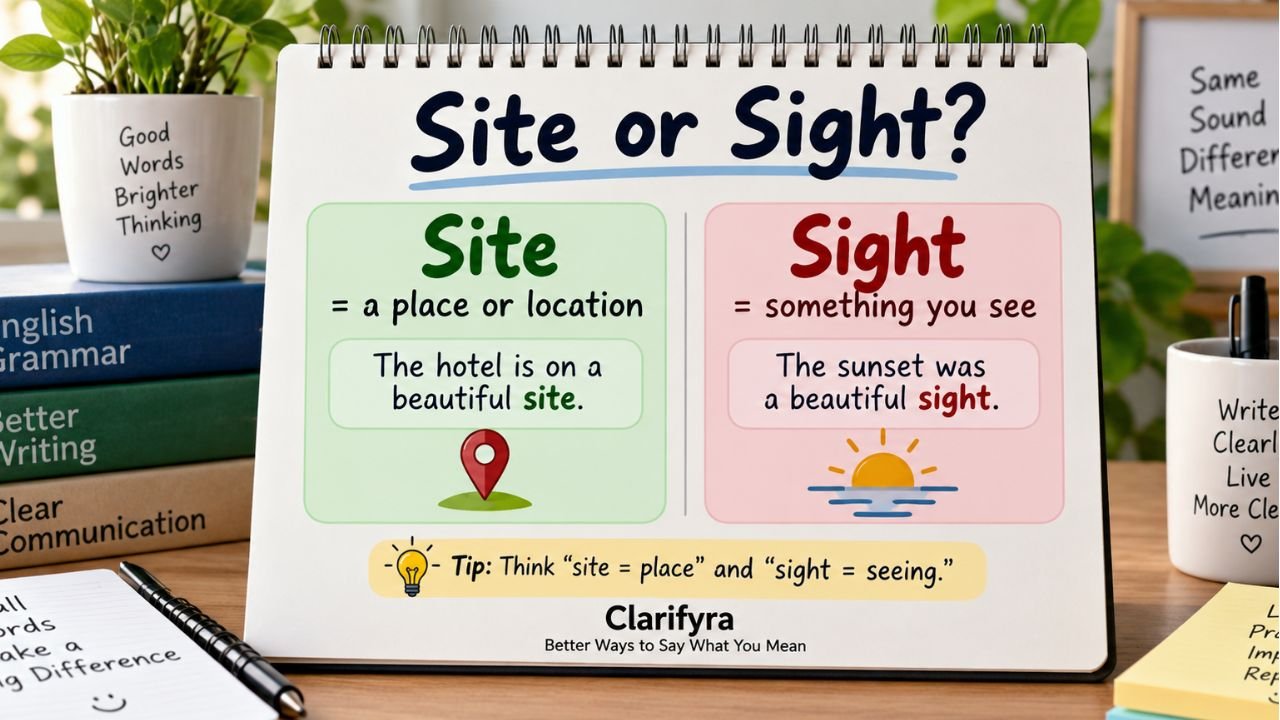
“Site” and “sight” are easy to mix up because they sound exactly alike, but they do not mean the same thing. Site is generally used for a place, location, or website, while sight relates to seeing, vision, or something that can be seen. The confusion becomes especially noticeable in travel expressions such as sightseeing, where using site instead of sight creates an incorrect spelling. Understanding the meaning behind each word makes the choice much easier.
Site means a place, location, or website, while sight relates to vision or something you see. Both are correct words, but they cannot normally be substituted for one another. When talking about visiting interesting places, the correct spelling is sightseeing, not “site seeing.”
Site vs. Sight at a Glance
| Feature | Site | Sight |
|---|---|---|
| Basic meaning | A place or location | Vision or something seen |
| Typical word type | Noun; occasionally verb | Noun |
| Common examples | construction site, website, historic site | beautiful sight, sight of a bird, eyesight |
| Travel use | A place or attraction location | Something worth seeing |
| Example | The hotel is on an excellent site. | The mountain is an amazing sight. |
The easiest rule is:
Site = place
Sight = seeing or something seen
This distinction is also reflected in educational grammar material: a site is a specific location, whereas sight can refer to the ability to see, something seen, or something worth seeing.
What Does “Site” Mean?
Site is primarily a noun referring to a particular place, location, or area.
You can use it for physical locations, especially places associated with construction, history, events, or other activities. It is also commonly used for a website.
Examples
- The workers arrived at the construction site early.
- The museum stands on an important historical site.
- They chose a beautiful site for the wedding.
- The company plans to build a new factory on the site.
- Visit our official site for more information.
The word can therefore describe both a physical location and, in modern English, an internet location.
“Site” in travel contexts
A tourist destination can be described as a site when the focus is on the location itself.
For example:
The ancient temple is an important archaeological site.
Here, site identifies the physical place.
What Does “Sight” Mean?
Sight has several related meanings, all connected with seeing.
It can refer to the ability to see:
Her sight has improved.
It can also refer to something that you see:
The sunset was a beautiful sight.
And it can describe something notable or impressive to look at:
The decorated palace was quite a sight.
This is why expressions such as a beautiful sight, an amazing sight, and the sight of something use sight rather than site.
Scholastic’s grammar guidance similarly distinguishes sight as the ability to see, something seen, or something worth seeing.
Why Are These Words Confused?
The main reason is pronunciation. Site and sight are homophones: they have the same pronunciation but different spellings and meanings. Dictionary.com also groups site, sight, and cite as classic homophones.
That means you cannot always determine the correct spelling simply by hearing the word.
For example, if someone says:
“It was a beautiful sight.”
You hear site and sight the same way. Only the meaning tells you which spelling belongs on the page.
A useful question is:
Am I talking about a place, or am I talking about seeing?
- Place → site
- Seeing/vision/something seen → sight
Site or Sightseeing: Which Is Correct?
When you mean the activity of visiting interesting places while traveling, the correct form is:
sightseeing
Not:
site seeing ❌
And normally not:
sight seeing ❌
For example:
We spent the afternoon sightseeing in Rome.
They went sightseeing around the old city.
We booked a sightseeing tour.
The spelling sightseeing reflects the idea of seeing sights. Current grammar resources specifically identify sightseeing as the standard form and explain that site seeing results from confusing the homophones.
What about “seeing sites”?
This is different.
We spent the morning seeing the historical sites.
That sentence can be perfectly correct because sites means locations. You are literally visiting or viewing particular places.
Compare:
We went sightseeing around the city.
with:
We spent the day seeing historical sites.
Both can be correct, but the grammatical structures and meanings are different.
Is It “On Site” or “On Sight”?
Both on site and on sight are real expressions, but they mean different things.
On site
On site means at the particular location.
Examples:
- The engineer is on site.
- Our technicians are currently on site.
- The inspection will take place on site.
- The manager arrived on site this morning.
The phrase is commonly used in construction, engineering, business, events, and other situations involving a physical location. QuillBot likewise distinguishes on site as meaning “at the location.”
On sight
On sight means as soon as something or someone is seen.
For example:
The guard was instructed to report the intruder on sight.
So the distinction is:
on site = at a location
on sight = immediately when seen
Changing site to sight changes the meaning considerably.
Eye Site or Eyesight?
When talking about the ability to see, the usual word is sight, and the especially common compound is eyesight.
Correct:
She has excellent eyesight.
His sight is getting weaker.
Incorrect when referring to vision:
She has excellent eye site. ❌
There is an important distinction between eyesight and eye site. Eyesight is a single word referring to visual ability. Eye site would literally suggest a location associated with an eye and is not the normal term for vision.
A Beautiful Site or Sight?
Both expressions can be correct because they describe different things.
A beautiful sight
Use sight when something looks beautiful or impressive.
The sunrise was a beautiful sight.
The snow-covered mountains were a beautiful sight.
Here, the emphasis is on what the person sees.
A beautiful site
Use site when you mean a beautiful location.
They found a beautiful site for their new home.
The couple chose a beautiful site beside the lake for their ceremony.
A simple test helps:
beautiful thing you see → beautiful sight
beautiful location → beautiful site
Tourist Site or Tourist Sight?
Again, both words can work, depending on the intended meaning.
A tourist site is a location visited by tourists, especially a historical, cultural, archaeological, or notable location.
The castle is an important tourist site.
A sight can be something tourists visit specifically because it is interesting or impressive to see.
The old cathedral is one of the city’s most famous sights.
In travel writing, you will also frequently encounter tourist attraction, place of interest, and sightseeing attraction.
The important distinction remains the same: site emphasizes the location, while sight emphasizes what is seen.
Pretty Site or Sight?
The same principle applies to pretty.
A pretty sight
Use this when something looks attractive:
The colorful garden was a pretty sight.
The village was a pretty sight from the hill.
A pretty site
Use this when describing a location:
They discovered a pretty site near the river.
So both forms are grammatically possible, but they communicate different ideas.
“What a Site or Sight?”
The natural expression is usually:
What a sight!
This means that something is remarkable, impressive, surprising, funny, or unusual to look at.
For example:
What a sight! The entire valley is covered with snow.
What a sight! Hundreds of balloons filled the sky.
By contrast, what a site could be grammatically possible if site refers to a location:
What a site for a new restaurant!
But this is not the same expression. If you are reacting to something impressive that you can see, use “What a sight!”
“Shot on Site” or “Shot on Sight”?
These phrases illustrate the difference particularly clearly.
Shot on site
Shot on site can mean filmed or photographed at a particular location.
The documentary was shot on site in several historic buildings.
Here, site means location.
Shot on sight
Shot on sight has a completely different meaning: being shot immediately when seen.
The order was to shoot the target on sight.
Because this expression can carry a serious meaning, writers should be especially careful not to substitute site and sight. The broader distinction between on site and on sight is also documented by English-language reference material.
Is It “Seeing Site or Sight”?
If you mean the activity of visiting attractions while traveling, use:
sightseeing
Examples:
We are going sightseeing tomorrow.
They spent three days sightseeing in London.
She loves sightseeing when she travels.
The verb is sightsee:
We plan to sightsee after breakfast.
The noun is sightseeing:
Sightseeing was the highlight of our trip.
The adjective also appears in compounds:
We joined a sightseeing tour.
Current grammar references consistently give sightseeing as the standard spelling.
Site or Sight: Examples in Sentences
Here are some side-by-side examples to make the distinction easier to remember.
Examples with “site”
- The construction site is closed today.
- They selected a site for the new school.
- The castle stands on a historic site.
- The archaeological site attracts many visitors.
- Please visit our site for additional information.
Examples with “sight”
- The waterfall was an incredible sight.
- He began to lose his sight.
- We caught sight of a deer in the forest.
- The fireworks were an amazing sight.
- The decorated street was quite a sight.
Examples with “sightseeing”
- We went sightseeing after lunch.
- They booked a sightseeing tour.
- She spent the weekend sightseeing in Paris.
Quite the Site or Sight?
The natural expression is:
Quite the sight
It describes something particularly impressive, remarkable, unusual, or noticeable.
The crowd outside the stadium was quite the sight.
The snow-covered city was quite the sight.
Quite the site is possible only when site genuinely means a location, but it does not have the same idiomatic sense.
Common Mistakes to Avoid
1. Writing “site seeing” for tourism
❌ We went site seeing in Paris.
✅ We went sightseeing in Paris.
2. Using “site” for vision
❌ She has poor site.
✅ She has poor sight.
Or, more naturally:
✅ She has poor eyesight.
3. Confusing “on site” and “on sight”
❌ The technician is on sight.
✅ The technician is on site.
But:
✅ The guard noticed the problem on sight.
4. Assuming every travel-related use requires “sight”
A physical location can still be a site:
The ancient ruins are an important archaeological site.
The key is meaning, not the general topic.
An Easy Way to Remember the Difference
Try this simple association:
Sight → see
Both words connect naturally with vision.
Think:
I see with my sight.
Then remember:
Site → place
A construction site is a place. A historic site is a place. A website is an online location.
For sightseeing, remember:
You are seeing sights, so you go sightseeing.
This is a practical way to avoid the tempting but incorrect spelling site seeing.
FAQ
Is “site or sight” the correct spelling?
Both site and sight are correct English words. The correct choice depends on meaning. Use site for a place or location and sight for vision or something seen.
Is “site seeing” correct?
Not when you mean the travel activity of visiting interesting places. The standard spelling is sightseeing, written as one word.
Is it “on site” or “on sight”?
Both are correct but have different meanings. On site means at a particular location, while on sight means when something is seen or immediately upon seeing it.
Should I write “a beautiful site” or “a beautiful sight”?
Both can be correct. A beautiful sight means something beautiful that you see. A beautiful site means a beautiful place or location.
Is “tourist site” correct?
Yes. Tourist site can refer to a location that tourists visit, particularly a historical or cultural location. Tourist sight can also be used when the emphasis is on something visitors see.
How can I remember site and sight?
Use the simple rule: site = place; sight = seeing. If you could replace the word with location, choose site. If you mean vision or something seen, choose sight.
The Bottom Line
Site and sight are both correct, but their meanings are different. Use site for a place, location, or website, and use sight for vision or something that can be seen. When referring to travel and visiting attractions, write sightseeing as one word. Once you connect sight with seeing and site with a place, the distinction becomes much easier to remember. That kind of clear, practical word guidance is exactly what Clarifyra aims to provide: better ways to say what you mean.