45+ Other Ways to Say “Sorry” for Every Situation
“Sorry” can do a lot of jobs. It can acknowledge a small mistake, express deep regret, show sympathy, or smooth over an awkward moment. But because the word covers so many situations, it isn’t always the most precise or sincere choice.
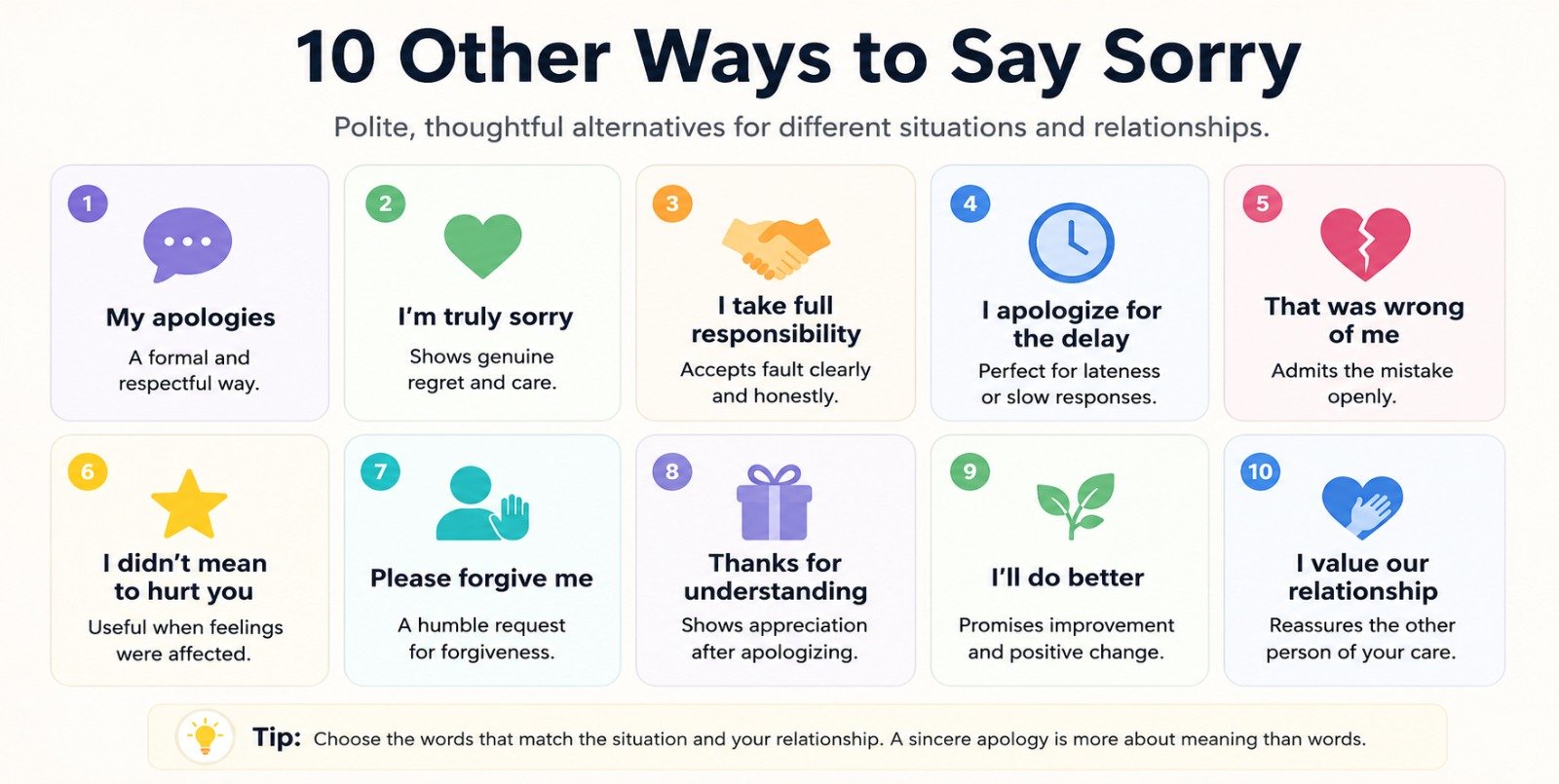
Learning other ways to say sorry helps you match your words to what actually happened. “My bad” may be perfect after a harmless mistake between friends, while “I take full responsibility” carries the weight needed for a serious error. And when someone is grieving, phrases such as “My heart goes out to you” express sympathy rather than an apology.
Choosing the Right Alternative to “Sorry”
Not every alternative to “sorry” is interchangeable. The phrase you choose should reflect both the seriousness of the situation and your relationship with the other person.
| Phrase | Tone | Best Used For | Important Difference |
|---|---|---|---|
| I apologize | Formal/neutral | Work, emails, serious mistakes | More formal than “sorry” |
| My apologies | Polite/formal | Emails, minor professional issues | Often concise and less emotional |
| My mistake | Neutral/casual | Small errors | Acknowledges fault without sounding dramatic |
| That’s on me | Casual | Friends, coworkers | Directly accepts responsibility |
| I was wrong | Sincere/direct | Personal disagreements | Clearly admits fault |
| Please forgive me | Emotional | Close relationships | Asks for forgiveness, not merely acknowledgment |
| I regret what happened | Serious/formal | Significant mistakes | Expresses remorse |
| Excuse me | Polite | Interruptions, minor social mistakes | Usually not a serious apology |
| My heart goes out to you | Compassionate | Grief or difficult news | Expresses sympathy, not responsibility |
| Thank you for your patience | Professional | Delays and service problems | Focuses on appreciation rather than apology |
The key distinction is simple: an apology accepts or acknowledges fault, while an expression of sympathy recognizes someone else’s pain. Using the right type of phrase makes your message feel far more natural.
Everyday Alternatives to “Sorry”
For ordinary mistakes, you usually don’t need elaborate language. A short acknowledgment often sounds more genuine.
Other Ways to Say “Sorry” for a Small Mistake
My mistake
A simple, natural choice when you’ve made a minor error.
Example:
“My mistake—I sent you the older version of the file.”
That was my fault
This is more direct because it clearly accepts responsibility.
Example:
“That was my fault. I should have checked the time before confirming.”
I got that wrong
Useful when you’ve shared incorrect information or misunderstood something.
Example:
“I got that wrong. The meeting is actually on Thursday.”
That’s on me
This is conversational and works especially well among friends or coworkers.
Example:
“I forgot to make the reservation. That’s on me.”
I didn’t mean to
Use this when your action was accidental, but be careful not to let it replace responsibility when someone was genuinely hurt.
Example:
“I didn’t mean to interrupt you.”
More Sincere Ways to Apologize
A serious apology needs more than a different synonym. It should show that you recognize what happened and understand your part in it.
Other Ways to Say “Sorry” When You Were Wrong
I was wrong
Few apologies are more direct.
Example:
“I was wrong to assume that without asking you first.”
I take responsibility
This works when you need to make it clear that you are not blaming someone else.
Example:
“I take responsibility for the mistake and for not catching it sooner.”
I shouldn’t have done that
This acknowledges a specific action rather than offering a vague apology.
Example:
“I shouldn’t have spoken to you like that.”
I regret what I said
Use this when you genuinely wish you had acted or spoken differently.
Example:
“I regret what I said during our argument.”
Please forgive me
This is personal and emotionally stronger than “I’m sorry.” Because it asks the other person for forgiveness, it is better suited to meaningful relationships than minor everyday errors.
Example:
“Please forgive me for breaking your trust.”
I owe you an apology
This is useful when you are deliberately returning to an issue that deserves acknowledgment.
Example:
“I owe you an apology. I dismissed your concerns without hearing you out.”
A strong apology usually sounds most sincere when it identifies the mistake instead of hiding behind general wording. Grammarly similarly distinguishes casual apologies from formal and more serious expressions of remorse, emphasizing sincerity, empathy, and avoiding excuses.
Professional Ways to Say Sorry
In the workplace, an apology should usually be clear, calm, and proportionate to the problem. Overly emotional wording can feel inappropriate, while vague corporate language may sound dismissive.
Other Ways to Say “Sorry” Professionally
Consider these expressions:
- I apologize for the oversight.
- Please accept my apologies.
- I take responsibility for the error.
- I regret the misunderstanding.
- That was an error on my part.
- I appreciate your understanding.
- Thank you for your patience.
- Thank you for bringing this to my attention.
- I should have communicated this sooner.
- I understand your frustration.
For a missed deadline:
“I apologize for the delay. I’ve completed the revisions and attached the updated document.”
For incorrect information:
“That was an error on my part. Thank you for bringing it to my attention; I’ve corrected the figures.”
For delayed service:
“Thank you for your patience while we resolve the issue.”
Notice that professional apologies are usually stronger when they explain what happened or what will happen next rather than stopping at “sorry.”
Other Ways to Say “Sorry for the Inconvenience”
“Sorry for the inconvenience” is polite, but it can sound generic, especially when the problem is serious or specific. Customer-service guidance increasingly recommends acknowledging the actual problem and the person’s frustration rather than reducing every issue to an “inconvenience.”
Other Ways to Say “Sorry for the Inconvenience” in an Email
We apologize for the disruption.
Useful when a service, system, or process has been interrupted.
We understand how frustrating this must be.
Better when acknowledging a customer’s experience matters more than offering a routine apology.
Thank you for your patience while we resolve this.
Appropriate when the problem is still being fixed.
We regret the difficulty this has caused.
Formal and suitable for more substantial problems.
Thank you for bearing with us.
Warm but still professional.
We apologize for the delay.
More precise than “inconvenience” when a delay is the actual issue.
Example:
Instead of:
“Sorry for the inconvenience.”
Try:
“We understand how frustrating this delivery delay has been. We’re working to resolve it and appreciate your patience.”
The second version acknowledges the specific problem and gives the reader a clearer sense that their experience is being taken seriously.
Other Ways to Say “Sorry to Hear That”
“I’m sorry to hear that” is different from an apology. Usually, you aren’t accepting responsibility; you’re showing empathy after receiving bad or disappointing news.
Other Ways to Say “Sorry to Hear That” Naturally
That sounds really difficult.
Good when someone describes a stressful experience.
Example:
“I’ve been dealing with problems at work all week.”
“That sounds really difficult.”
I’m thinking of you.
Warm and supportive without assuming you know exactly how the person feels.
I’m here for you.
Appropriate for someone you know well, particularly when you genuinely intend to offer support.
That must have been hard.
Recognizes the emotional weight of an experience.
I hate to hear that.
Natural and conversational, particularly in American English, but less suitable for highly formal situations.
I hope things get easier soon.
Useful when someone is going through an ongoing difficulty.
That’s really unfortunate.
More neutral and somewhat less personal.
Avoid expressions that accidentally minimize the other person’s experience. For example, immediately telling someone to “look on the bright side” can feel dismissive when they have just shared genuinely painful news.
Other Ways to Say “Sorry for Your Loss”
When someone has experienced a death, “sorry” is being used to express sympathy, not guilt. “I’m sorry for your loss” remains a respectful and widely understood condolence; there is no need to avoid it simply because it is common. More personal wording, however, may be appropriate depending on your relationship with the grieving person.
Other Ways to Say “Sorry for Your Loss” Compassionately
- My deepest condolences.
- My heart goes out to you.
- I’m thinking of you during this difficult time.
- You’re in my thoughts.
- Wishing you strength and comfort.
- I’m holding you and your family in my thoughts.
- Sending love to you and your family.
- I was so saddened to hear the news.
- Please accept my heartfelt condolences.
- I’m here for you.
- I’m thinking of you and remembering [name].
- I hope the memories you shared bring you comfort.
Other Ways to Say “Sorry for Your Loss” to a Friend
With a close friend, the message can be warmer and more personal:
“My heart goes out to you. I’m here whenever you need me.”
“I’ve been thinking about you and your family.”
“I know how much your dad meant to you. I’m thinking of you.”
If you knew the person who died, mentioning a genuine memory can be more meaningful than trying to produce a sophisticated condolence. Current grief guidance also recommends acknowledging the person who died and offering specific help rather than trying to explain away the loss or find a “silver lining.”
Other Ways to Say “Sorry for Your Loss” Professionally
For a coworker, client, or business contact, keep your message compassionate but respectful:
“Please accept my deepest condolences.”
“My thoughts are with you and your family during this difficult time.”
“Wishing you and your family comfort and strength.”
“I was saddened to hear of your loss. Please accept my sincere condolences.”
You don’t need a long message. In grief, simple and sincere language is usually safer than trying to offer explanations about why the loss happened.
Different Ways to Say Sorry in Spanish
There isn’t one Spanish phrase that perfectly replaces every English use of “sorry.” The correct expression depends on whether you’re making a genuine apology, excusing a minor mistake, speaking formally, or offering condolences.
SpanishDictionary distinguishes phrases such as lo siento, perdón, disculpa, and disculpe by context and level of formality.
5 Other Ways to Say “Sorry” in Spanish
1. Lo siento
Meaning: “I’m sorry.”
This is one of the most useful expressions for a genuine apology and can also communicate sympathy.
Example:
Lo siento mucho.
“I’m very sorry.”
2. Perdón
Meaning: “Sorry,” “pardon,” or “excuse me.”
It is useful for smaller mistakes and can also be used when asking someone to repeat themselves.
Example:
Perdón, no te vi.
“Sorry, I didn’t see you.”
3. Disculpa
An informal way to apologize or say “excuse me,” generally used when addressing someone with the informal tú form.
4. Disculpe
The formal counterpart to disculpa. It works when politely addressing someone with usted, such as a stranger, customer, or person in a more formal relationship.
5. Lo lamento
This expresses regret and can sound appropriate in more serious situations.
These options are not interchangeable in every setting. For example, SpanishDictionary notes that perdón or disculpe can suit relatively minor incidents, whereas lo siento or lo lamento can express a more serious apology.
For bereavement, mi más sentido pésame means “my deepest condolences” and is more specific than simply translating everyday “sorry.”
Different Ways to Say Sorry in Japanese
Japanese apologies are especially sensitive to formality, social relationship, and the seriousness of the situation. A phrase that sounds natural between friends may be inappropriate when speaking to a customer, manager, or stranger.
5 Other Ways to Say “Sorry” in Japanese
1. Sumimasen — すみません
A very common polite expression meaning “I’m sorry” or “excuse me.” It is useful in many everyday situations, including minor inconveniences and getting someone’s attention.
2. Gomen nasai — ごめんなさい
A direct way to say “I’m sorry.” It commonly appears in personal apologies.
3. Gomen — ごめん
A casual version suited to friends, family members, and other close relationships. JapanesePod101 identifies gomen as an informal apology rather than something intended for formal professional situations.
4. Mōshiwake arimasen — 申し訳ありません
A much more formal apology used when stronger politeness and responsibility are appropriate, including professional contexts.
5. O-wabi mōshiagemasu — お詫び申し上げます
A highly polite expression of apology used in serious or formal situations. It is considerably stronger than a casual gomen.
Japanese is a good example of why translating “sorry” word for word can be misleading. Social hierarchy, familiarity, and the seriousness of the mistake all affect which expression sounds appropriate.
Casual Ways to Say Sorry to Friends
Minor mistakes among friends usually don’t require formal language.
Other Ways to Say “Sorry” Casually
- My bad.
- Whoops, my mistake.
- I messed up.
- That’s on me.
- I didn’t mean to.
- I totally forgot.
- I got that wrong.
- I owe you one.
- My fault.
- I stand corrected.
Example:
“My bad—I thought we were meeting at seven.”
Example:
“I totally forgot to bring your book. That’s on me.”
“My bad” is natural in casual conversation but can sound careless if someone has been seriously hurt. Similarly, “whoops” is appropriate for trivial accidents, not significant betrayals or professional failures.
Can You Apologize Without Saying “Sorry”?
Yes. In fact, some situations are clearer when you replace an unnecessary apology with appreciation, acknowledgment, or responsibility.
Instead of:
“Sorry I’m late.”
You might say:
“Thank you for waiting.”
But if your lateness caused a real problem, gratitude alone may sound evasive. In that case:
“I apologize for being late. Thank you for waiting.”
Instead of:
“Sorry for asking so many questions.”
Try:
“Thank you for taking the time to answer my questions.”
Instead of:
“Sorry to bother you.”
Try:
“When you have a moment, could I ask you something?”
This distinction matters because replacing every “sorry” with “thank you” isn’t automatically better. If you caused harm or inconvenience, taking responsibility is still important.
How to Make an Apology Sound More Genuine
The wording matters, but what comes after it often matters more.
A meaningful apology can follow a simple pattern:
Acknowledge the action:
“I interrupted you several times during the meeting.”
Accept responsibility:
“That was disrespectful, and I should have listened.”
Show appropriate remorse:
“I regret handling the conversation that way.”
Make amends when possible:
“I’ll make sure you have space to finish your point next time.”
Compare that with:
“Sorry if you felt interrupted.”
The second version avoids clearly acknowledging what happened and can sound as though the other person’s feelings are the problem.
A sincere apology doesn’t need to become a long speech. Specificity, accountability, and appropriate action usually matter more than repeatedly saying “sorry.”
When an Alternative to “Sorry” Doesn’t Work
Some phrases only belong in certain situations.
“My bad” is fine for forgetting someone’s coffee order. It is usually too casual for a major mistake.
“Please forgive me” carries emotional weight. Using it for something tiny can sound dramatic.
“Thank you for your patience” is useful during a delay, but it shouldn’t be used to avoid responsibility when your actions genuinely caused a serious problem.
“My condolences” belongs to bereavement and similar situations of loss. It isn’t another general-purpose synonym for “sorry.”
“Excuse me” works for interruptions, getting someone’s attention, or minor social mishaps, but it doesn’t replace a sincere apology after significant harm.
Thinking about what you actually want to communicate—regret, accountability, sympathy, politeness, or appreciation—is more useful than simply searching for a different synonym.
Frequently Asked Questions
What Are Some Other Ways to Say “Sorry”?
Natural alternatives include “I apologize,” “my apologies,” “my mistake,” “I was wrong,” “that’s on me,” “please forgive me,” “I regret what happened,” and “I take responsibility.” Choose according to the seriousness and formality of the situation.
What Is Another Way to Say Sorry Without Using the Word Sorry?
You can say “I was wrong,” “that was my fault,” “I owe you an apology,” “I take responsibility,” or “please forgive me.” For situations where you haven’t actually done anything wrong, appreciation such as “Thank you for your patience” may be more natural.
What Is a Professional Alternative to “Sorry”?
“I apologize for the oversight,” “Please accept my apologies,” and “That was an error on my part” are professional choices. If there is a practical solution, include it in the same message.
What Are Other Ways to Say “Sorry for the Inconvenience”?
Try “We apologize for the disruption,” “We understand your frustration,” “We regret the difficulty this caused,” or “Thank you for your patience while we resolve this.” Specific wording usually sounds better than calling every problem an “inconvenience.”
What Can I Say Instead of “Sorry to Hear That”?
Depending on the situation, say “That sounds really difficult,” “I’m thinking of you,” “I’m here for you,” “That must have been hard,” or “I hope things get easier soon.” These expressions communicate empathy rather than an apology.
What Can I Say Instead of “Sorry for Your Loss”?
You might say “My deepest condolences,” “My heart goes out to you,” “I’m thinking of you during this difficult time,” or “Wishing you and your family comfort and strength.” If you knew the person who died, a sincere memory can make the message more personal.
What Are 5 Ways to Say Sorry in Spanish?
Five useful expressions are lo siento, perdón, disculpa, disculpe, and lo lamento. Their meanings overlap, but their formality and typical contexts differ. For example, disculpa is informal while disculpe is formal.
What Are 5 Ways to Say Sorry in Japanese?
Useful expressions include sumimasen, gomen nasai, gomen, mōshiwake arimasen, and o-wabi mōshiagemasu. They range from everyday and casual language to highly formal apologies, so the relationship between speakers matters.
Is “My Apologies” More Polite Than “Sorry”?
It generally sounds more formal, especially in emails and workplace communication. That does not automatically make it more sincere. A specific “I’m sorry I missed your call” can feel warmer than a detached “my apologies” in a personal conversation.
Is It Okay to Say “Sorry for Your Loss”?
Yes. It is a standard, respectful way to acknowledge bereavement. You do not need to avoid it. If you know the grieving person well, adding a personal thought, memory, or genuine offer of support can make the message feel warmer.
Conclusion
The best other ways to say sorry depend on what you actually need to communicate. Small mistakes can call for “my mistake,” serious wrongdoing may require “I was wrong” or “I take responsibility,” and professional problems often benefit from a clear acknowledgment followed by a solution. When responding to grief or difficult news, sympathy and support are more appropriate than language that sounds like you are accepting blame.
Your audience, relationship, tone, and level of formality should guide your choice. A sincere phrase that fits the moment will almost always sound better than a more impressive phrase used in the wrong context. Clarifyra helps make these subtle wording differences easier to understand so you can choose language that genuinely matches what you mean.
You May Also Read | 30 Other Ways to Say “Thanks for the Invite” for Any Situation