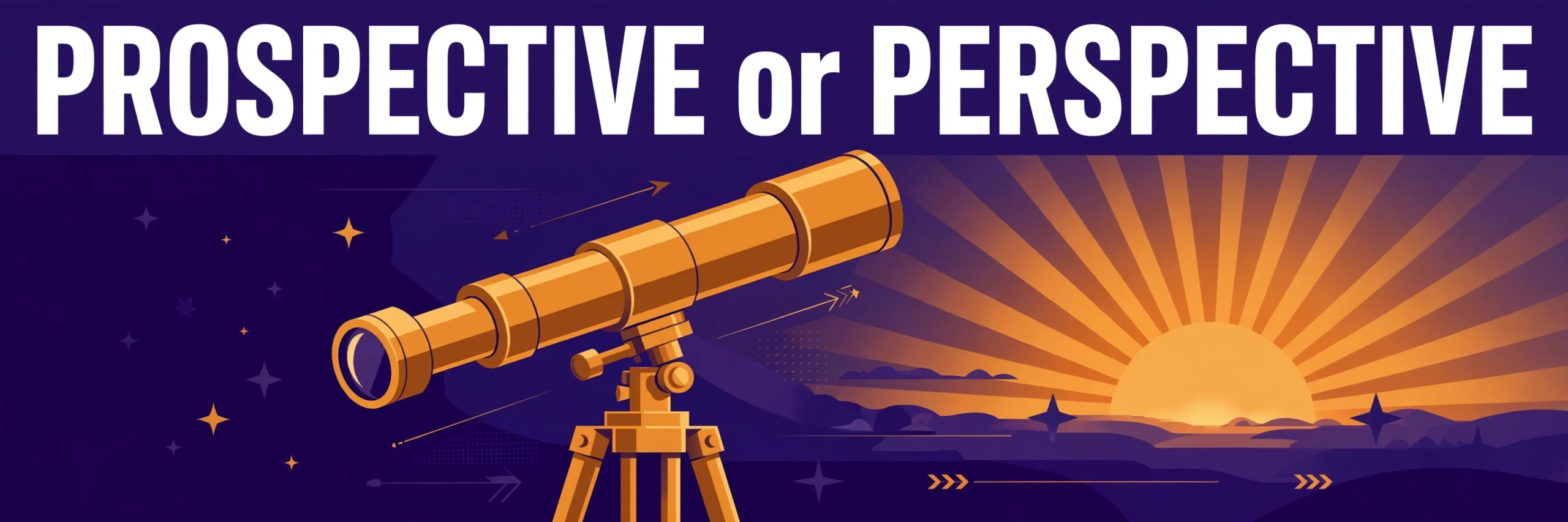
Prospective or Perspective: What’s the Difference?
Prospective and perspective are different words with different jobs — they are not spelling variants of each other. Prospective (/prəˈspektɪv/) is an adjective meaning likely, expected, or looking toward the future: prospective buyers, a prospective student. Perspective (/pəˈspektɪv/) is a noun meaning a point of view — or, in art, the technique of representing depth: from my perspective; to keep things in perspective. The confusion is almost entirely one-directional: people write perspective where prospective belongs (perspective buyers), and the grammar test below kills that error instantly.
Quick Answer
Prospective is always an adjective describing something in the future — prospective customers, prospective parents, prospective earnings (people or things expected to become something). Perspective is a noun meaning a point of view or way of seeing — from her perspective; a fresh perspective on the problem. Trick: pro- means forward, so prospective looks forward to the future; perspective is about how you perceive the present.
Prospective: the adjective that looks forward
Merriam-Webster defines prospective as “relating to or effective in the future”; Collins gives “looking towards the future” and “anticipated or likely”; Cambridge’s entry centers on people — “people who are expected to buy something, employ someone, become parents, etc.” The word does one thing: it stands in front of a noun and marks it as future, potential, not-yet-realized. Prospective buyers are not buyers yet. A prospective student has applied but not enrolled. Prospective earnings are forecast, not banked.
Two grammatical facts lock this down. First, prospective is only an adjective — it cannot be a noun, cannot take an article, cannot be the subject of a sentence. You cannot write “the prospective of the company”; the word must modify something. Second, it is almost always used attributively, directly before the noun (prospective employer, prospective bride, prospective study). That second example opens a specialist door worth knowing: in medicine and research, a prospective study is one that looks forward in time, following subjects into the future — the opposite of a retrospective study, which looks backward at existing records. The pro- = forward logic holds even in the laboratory.
Perspective: the noun that looks around
Perspective starts from a different Latin root and a different idea. Where prospective looks forward, perspective looks at — it is about vantage point. Its central meaning is a particular attitude toward something, a way of thinking about it: from the parents’ perspective; try to see it from his perspective; the novel gives a child’s perspective on war. Dictionaries also record the art-historical sense: the technique of representing three-dimensional space on a flat surface so that objects show their proper relative size and distance — linear perspective, forced perspective in photography.
The word carries a family of fixed idioms that are worth learning as units, because they are where perspective appears most in everyday prose. In perspective means in the correct proportions or judged sensibly (try to keep the setback in perspective). Put/keep things in perspective is the verb phrase built on it. From someone’s perspective and a fresh/new perspective cover the viewpoint senses. Note the grammar in every case: perspective sits after articles and prepositions (the perspective, in perspective, from her perspective) — positions an adjective like prospective can never occupy. That positional test is the whole battle, and it never fails.
The grammar core: adjective versus noun
Strip away everything else and the difference is one of word class, which makes it mechanically testable in a way most confusables aren’t:
| prospective | perspective | |
|---|---|---|
| Word class | Adjective — always | Noun — almost always (rare adjective use in art: perspective drawing) |
| Time direction | Future: likely, expected, potential | Present: how something is seen or judged |
| Typical slot | Before a noun: prospective member | After articles/prepositions: the perspective, in perspective |
| The test | Can you replace it with future or potential? → prospective | Can you replace it with viewpoint or outlook? → perspective |
| Example | prospective tenants (= future tenants) | the tenants’ perspective (= the tenants’ viewpoint) |
Run the substitution test on any doubtful sentence and the answer falls out. The estate agent showed the house to ___ buyers — “future buyers” works, “viewpoint buyers” doesn’t, so prospective buyers. ___ on the dispute has shifted — “viewpoint on the dispute” works, so perspective on the dispute. Two replacements, zero ambiguity.
Why they’re confused: one root, two prefixes
The words look alike because they are alike — both descend from Latin verbs of looking built on specere, “to look at.” Perspective comes via perspectīvus, “optical,” from perspicere, “to look at closely” (per-, “through,” + specere) — looking through at what is there. Prospective comes via prōspectus, “distant view,” from prōspicere, “to look into the distance” (pro-, “forward”) — looking ahead at what may come. The spectacle/spectacles family (glasses you look through) belongs to the perspective branch; prospect (a future possibility, a view into the distance) belongs to the prospective branch.
The practical confusion, though, is not etymological but phonetic and positional: in fast speech /prəˈspektɪv/ and /pəˈspektɪv/ blur, and both words turn up in business and admissions contexts (prospective clients vs. the client’s perspective), so writers reach for the more familiar shape. Perspective is the far more frequent word overall, which is why the error runs one way: the common word colonizes the rare word’s territory, producing perspective buyers, perspective students, perspective employers — all wrong, all instantly fixable by the substitution test.
Correct and incorrect, in sentences
- ✓ We interviewed several prospective tenants. — future tenants; adjective before noun.
- ✓ The course is aimed at prospective parents. — people expected to become parents (Cambridge’s own example pattern).
- ✓ Travel gives you a fresh perspective on home. — a new way of seeing; the idiom is fixed.
- ✓ The trial was a prospective study following patients for five years. — looking forward in time; the specialist sense.
- ✗ The agent showed the flat to perspective buyers. — wrong word: buyers who may buy in future are prospective buyers.
- ✗ Try to see it from my prospective. — wrong word: a viewpoint is a perspective; prospective can’t follow my.
- ✗ She brings a prospective that the team lacked. — wrong word class: after a you need the noun perspective.
Common mistakes
“Perspective buyers/students/clients.” The signature error, and the most common by far. Any noun phrase meaning “people who may become X” needs prospective. If your draft says perspective directly before a noun describing a future role, it is wrong — no exceptions, no regional variants, no debate.
“From my prospective” / “in prospective.” The mirror error: using the adjective where only the noun fits. Prospective cannot follow a possessive, an article, or a preposition standing alone. From my perspective, in perspective, a different perspective — the noun owns all of these slots.
Treating them as interchangeable “fancy” words. Some writers sprinkle one or the other into business prose for tone, assuming near-synonymy. They are not near-synonyms; they are not synonyms at all. Prospective talks about time, perspective talks about viewpoint, and swapping them changes the meaning of the sentence, not just its polish.
Forgetting the art sense of “perspective.” Less an error than a missed richness: perspective‘s oldest technical meaning is the painter’s craft of depth on a flat surface. Knowing it explains the idiom in perspective (things in their true relative proportions) and keeps the word’s history visible.
A compact memory rule: prospective has pro like protagonist — it moves the story forward into the future. Perspective has per like perceive — it is about how you see what’s in front of you. Forward versus seeing: adjective versus noun, future versus viewpoint.
FAQs
What’s the difference between “prospective” and “perspective”?
Prospective is an adjective meaning likely, expected, or relating to the future (prospective buyers). Perspective is a noun meaning a point of view or way of seeing (from my perspective), also the art technique of depicting depth. Different word classes, different meanings — they are never interchangeable.
Is it “prospective buyers” or “perspective buyers”?
Prospective buyers. Buyers who may buy in the future are prospective (future/potential). Perspective buyers is one of the most common errors in business writing — run the substitution test: “future buyers” works, “viewpoint buyers” doesn’t.
Can “prospective” be used as a noun?
No. Prospective is always an adjective in standard English — it must describe a noun (prospective member). If you need the noun slot, the word you want is perspective (a new perspective) or prospect (a good prospect).
What is a “prospective study”?
In medicine and research, a prospective study follows subjects forward in time, watching outcomes unfold — as opposed to a retrospective study, which looks backward at existing records. The pro- (forward) logic holds: the study looks ahead.
How do you pronounce them?
Prospective is /prəˈspektɪv/ (pruh-SPEK-tiv); perspective is /pəˈspektɪv/ (puh-SPEK-tiv). The stressed syllable is identical; the difference lives in the first syllable — pruh versus puh.
Takeaway
File them by word class and they never cross again: prospective is the adjective of the future — pro like forward, always before a noun, always about what may become (prospective students, prospective earnings, prospective studies). Perspective is the noun of the viewpoint — per like perceive, at home after articles and prepositions, always about how things are seen (a fresh perspective, in perspective, from her perspective). Two Latin verbs of looking, two prefixes, two jobs: when in doubt, substitute future and viewpoint and let the sentence choose for you.