Rather or Whether: What’s the Difference?
Rather and whether are easy to mix up because they look and sound somewhat similar, but they serve very different purposes in a sentence. One is commonly used to express a preference or degree, while the other introduces alternatives, uncertainty, or an indirect question. Knowing the difference makes phrases such as “would rather,” “whether to,” and “whether or not” much easier to use correctly.
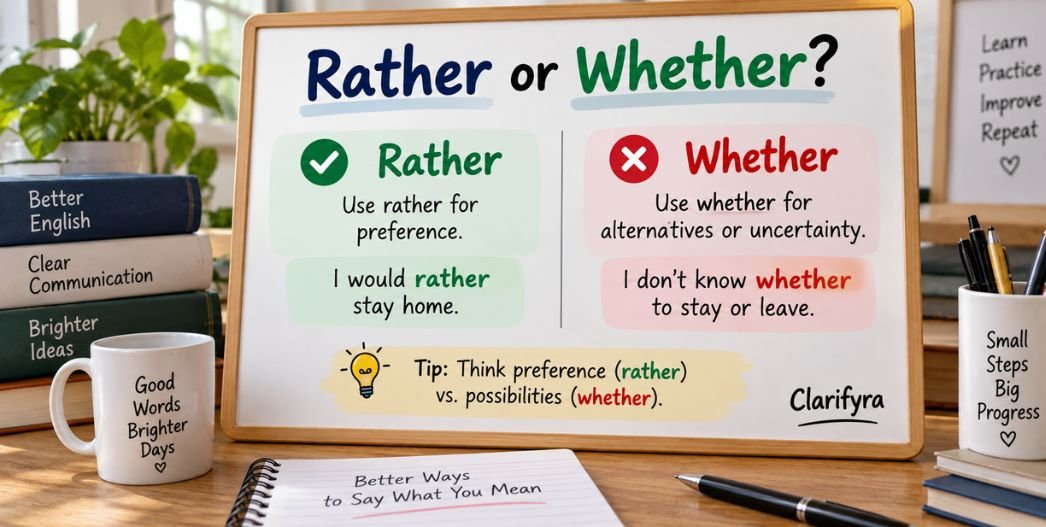
Rather and whether are both correct words, but they have different meanings. Use rather mainly for preferences, comparisons, degree, or corrections, as in “I would rather stay.” Use whether when discussing alternatives or uncertainty, as in “I don’t know whether to stay.”
Rather vs. Whether: The Key Difference
The simplest way to distinguish the two words is:
- Rather often means preferably, instead, or to some degree.
- Whether introduces alternatives or uncertainty, often meaning “which of two possibilities” or “if.”
Compare these sentences:
I would rather take the train.
The speaker is expressing a preference.
I don’t know whether to take the train.
The speaker is expressing uncertainty about the choice.
This difference is especially important because both words can appear in sentences involving choices, but they perform different grammatical jobs.
| Feature | Rather | Whether |
|---|---|---|
| Part of speech | Usually adverb | Conjunction |
| Main use | Preference, degree, correction | Alternatives and uncertainty |
| Common pattern | would rather + verb | whether + clause |
| Another common form | rather than | whether or not |
| Example | I’d rather stay. | I don’t know whether to stay. |
What Does “Rather” Mean?
Rather is an adverb with several uses. The most relevant one in this comparison is expressing a preference.
1. “Rather” for preference
The structure would rather + base verb is extremely common.
Examples:
- I would rather walk home.
- She would rather wait until tomorrow.
- We’d rather eat at home tonight.
- He would rather work alone.
- I’d rather not discuss it right now.
In these examples, the speaker is saying what they prefer.
For instance:
I would rather stay home.
has roughly the same meaning as:
I would prefer to stay home.
2. “Rather than” for choosing one option over another
Rather than is used when one option is preferred instead of another.
Examples:
We walked rather than took a taxi.
She chose to call rather than send an email.
I’d rather read a book than watch television.
The exact grammatical structure can vary, but the central idea is preference or substitution.
3. “Rather” can mean “quite” or “to some degree”
Rather is not always about preference.
It can modify an adjective or adverb:
- The instructions were rather confusing.
- It is rather cold today.
- The restaurant was rather expensive.
- She spoke rather quickly.
Here, rather indicates a degree or extent.
4. “Or rather” for correction
Another useful expression is or rather, which allows a speaker to correct or refine something they have just said.
For example:
He arrived on Monday—or rather, Tuesday.
She lives in Manchester, or rather, just outside the city.
The speaker first gives one description and then adjusts it.
What Does “Whether” Mean?
Whether is a conjunction used to introduce alternatives or uncertainty.
It commonly appears when someone does not know which possibility is true or which option should be chosen.
1. Use “whether” for uncertainty
Consider:
I don’t know whether she is coming.
The speaker does not know if she is coming.
Other examples include:
- I’m not sure whether this is the right answer.
- We need to find out whether the store is open.
- She wondered whether he had received the message.
- They haven’t decided whether the plan will work.
In each sentence, whether introduces something uncertain or being considered.
2. Use “whether” when there are alternatives
Whether is particularly useful when two possibilities are being presented.
Examples:
I can’t decide whether to stay or leave.
We need to determine whether to continue or stop.
Tell me whether you want tea or coffee.
The basic structure is often:
whether + option A + or + option B
3. “Whether or not”
The expression whether or not is also very common.
Examples:
I’ll go whether or not you come.
We need to know whether or not the information is accurate.
She will finish the project whether or not she receives additional help.
Here, the phrase emphasizes two possibilities: something happening or not happening.
When to Use Rather or Whether
If you’re trying to decide which word belongs in a sentence, first identify the meaning.
Choose “rather” when you mean preference
Ask yourself:
“What does someone prefer?”
For example:
I would rather stay home.
The person prefers staying home.
She would rather travel by train.
The person prefers traveling by train.
A useful substitution test is to see whether prefer fits naturally.
I would rather stay.
I would prefer to stay.
If the meaning remains essentially the same, rather is probably appropriate.
Choose “whether” when you mean uncertainty or alternatives
Ask:
“Is the sentence about whether something is true, or which possibility applies?”
For example:
I don’t know whether he is available.
This expresses uncertainty.
Or:
We must decide whether to leave now or wait.
This presents alternatives.
“Rather” and “Whether” in Side-by-Side Examples
Putting the words next to each other makes the difference easier to see.
Example 1
I would rather go by car.
Meaning: Going by car is my preference.
I don’t know whether to go by car.
Meaning: I haven’t decided if going by car is the right choice.
Example 2
She would rather work tomorrow.
Meaning: Working tomorrow is her preference.
She isn’t sure whether she can work tomorrow.
Meaning: She doesn’t know if working tomorrow is possible.
Example 3
I’d rather stay home.
Meaning: I prefer staying home.
I’m wondering whether I should stay home.
Meaning: I’m considering the alternatives and haven’t determined what to do.
The key difference is not the subject of the sentence or the choice being discussed. It is the relationship between the speaker and the choice: preference points toward rather, while uncertainty or alternatives usually call for whether.
Is It “Rather or Whether”?
Both are real English words, so neither is universally the “correct spelling.” The correct choice depends on what you want the sentence to mean.
Use rather in expressions such as:
- would rather
- rather than
- rather good
- or rather
Use whether in expressions such as:
- whether to
- whether or not
- whether … or …
- I don’t know whether…
For example:
Correct:
I would rather leave early.
Correct:
I don’t know whether I should leave early.
The first sentence expresses a preference. The second expresses uncertainty.
Common Mistakes to Avoid
1. Using “rather” for uncertainty
Incorrect:
I don’t know rather he will come.
Correct:
I don’t know whether he will come.
The sentence concerns uncertainty, so whether is needed.
2. Using “whether” after “would”
Incorrect:
I would whether stay home.
Correct:
I would rather stay home.
The construction for preference is would rather + base verb.
3. Confusing “rather or not” with “whether or not”
When you mean “regardless of whether something happens,” use whether or not.
Correct:
We will continue whether or not they agree.
Not:
We will continue rather or not they agree.
4. Forgetting the alternatives after “whether”
A sentence can use whether without an explicit “or”:
I don’t know whether she is available.
It can also introduce alternatives:
I don’t know whether she is available or busy.
Both constructions are possible.
Whether vs. If: A Related Point
Another word that can be confused with whether is if.
In many indirect questions, both are possible:
I don’t know whether he is coming.
I don’t know if he is coming.
However, whether is particularly useful when alternatives are explicitly stated and in constructions such as whether to.
For example:
I haven’t decided whether to accept the offer.
Here, whether to is the natural construction.
Whether is also commonly used with or not:
We need to decide whether or not to proceed.
The distinction between if and whether is therefore related to, but separate from, the distinction between rather and whether.
An Easy Way to Remember the Difference
Try this simple rule:
Rather = preference
Think:
I would rather…
If you’re saying what you prefer, use rather.
I would rather walk.
Whether = possibilities
Think:
I don’t know whether…
If you’re considering possibilities or uncertainty, use whether.
I don’t know whether to walk.
A second useful shortcut is:
Rather → prefer
Whether → which possibility?
This will solve most everyday cases.
Quick Practice
Choose rather or whether in each sentence.
- I would ___ stay home tonight.
- I don’t know ___ she is coming.
- Would you ___ have tea?
- We need to decide ___ to wait or leave.
- He chose to walk ___ than drive.
- I’ll attend ___ or not she joins us.
Answers
- rather
- whether
- rather
- whether
- rather
- whether
The pattern is consistent: preference uses rather, while uncertainty and alternatives use whether.
FAQ
Is “rather or whether” a spelling issue?
No. Both rather and whether are correctly spelled English words. The issue is usually one of meaning and usage, not spelling. Rather commonly expresses preference or degree, while whether introduces alternatives or uncertainty.
Can “rather” and “whether” be used interchangeably?
No. They normally cannot replace each other because they perform different grammatical functions. “I would rather leave” expresses a preference, whereas “I don’t know whether to leave” expresses uncertainty about a choice.
Is “whether or not” correct?
Yes. Whether or not is a standard English construction used to express two possibilities or the idea that something applies regardless of whether a condition is true.
Is “rather than” correct?
Yes. Rather than is a standard expression used to indicate preference or an alternative. For example, “She decided to walk rather than drive.”
What is the easiest way to remember the difference?
Associate rather with preference and whether with possibilities. If you could replace the idea with “prefer,” rather is often appropriate. If you’re asking or considering which possibility is true, whether is usually the right choice.
The Bottom Line
Use rather when expressing a preference, degree, substitution, or correction: I would rather stay, rather than drive, or or rather, Tuesday. Use whether when introducing uncertainty or alternatives: I don’t know whether he is coming or whether to stay or leave. Once you connect rather with preference and whether with possibilities, the distinction becomes much easier to remember. For more clear explanations of easily confused English words, Clarifyra helps you better understand the words you choose.