Doggy or Doggie: Which Is Correct?
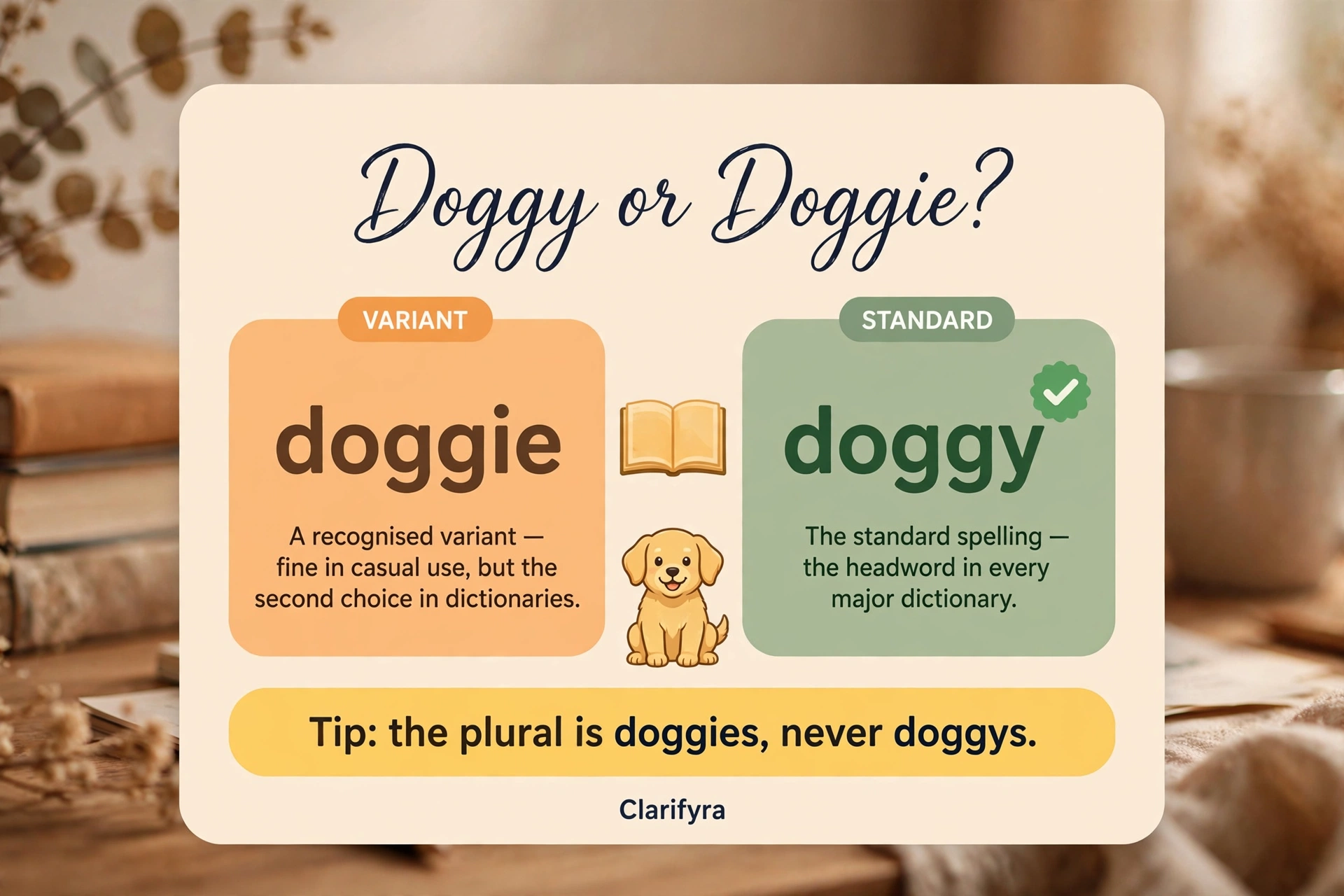
If you’ve ever typed the word for a small, cute dog and paused mid-keystroke — doggy or doggie? — you’re not alone. The two spellings look equally plausible, and autocorrect rarely complains about either. But the dictionaries do pick a favourite: doggy is the standard spelling, listed as the headword in Cambridge, Oxford Learner’s, Merriam-Webster, and Collins. Doggie is a recognised variant — a real word, but the second choice in every one of those dictionaries.
Quick Answer
Doggy is the correct standard spelling — the headword in all four dictionaries checked for this article (Cambridge, Oxford Learner’s, Merriam-Webster, Collins). Doggie is an accepted variant, so it isn’t a misspelling, but doggy is the safer choice in writing. Both are pronounced the same way, both mean a (usually small) dog, and the plural is doggies, never “doggys.”
What the Dictionaries Say
The cleanest way to settle a spelling question is to see which form the dictionaries give the full entry to — and here the verdict is unanimous.
Oxford Learner’s lists doggy as the headword: noun, informal, with “(also doggie)” in parentheses — the dictionary’s standard way of marking a secondary spelling. It defines it as “a child’s word for a dog” and gives the plural as doggies. Pronunciation: UK /ˈdɒɡi/, US /ˈdɔːɡi/.
Collins does the same. Its headword is doggy, with “or doggie” in British English and “Also: doggie” in American English. Collins also records the adjective word forms doggier and doggiest, and traces the word’s origin to dog + -y.
Merriam-Webster gives doggy the full entry — noun (“a usually small dog”) plus adjective senses. Tellingly, if you look up “doggie” on Merriam-Webster’s site, it resolves straight to the “doggy” entry: the dictionary doesn’t even treat “doggie” as a separate headword. MW records the first known use of the noun in 1692 and of the adjective in 1852.
Cambridge likewise lists doggy as the headword entry, while “doggie” appears only in its corpus example sentences — including the telling example that a leftover container is “commonly called a ‘doggy’ bag or ‘doggie’ bag” — showing the variant circulates in real usage without earning headword status.
So: “doggie” is not a typo and will never be “wrong” in the way a made-up spelling is. But “doggy” is the spelling the reference books lead with, and that’s the one to use when you want to be on solid ground.
What “Doggy” Means — Noun and Adjective
The spelling question is only half the story. “Doggy” also does more than one job in a sentence, and knowing its senses keeps you out of trouble.
As a noun
Oxford Learner’s calls it “a child’s word for a dog”; Merriam-Webster says “a usually small dog”; Collins says “a little dog or a puppy” or simply “any dog (a child’s word).” The register is informal throughout — it’s the word toddlers use and adults use when talking to them. Neither spelling changes the meaning: “doggy” and “doggie” as nouns are the same word wearing different clothes.
As an adjective
Collins defines the adjective as “of, like, or relating to a dog”; Merriam-Webster gives “concerned with or fond of dogs” and “resembling or suggestive of a dog.” This is the sense at work in a doggy smell, doggy people (Collins’s example for “fond of dogs”), and established compounds like doggy bag, doggy door, and doggy paddle.
A quick note on a lesser-known sense: Merriam-Webster also records “doggy” as meaning “not worthy or profitable; inferior,” as in doggy stocks. It’s a niche financial sense you’ll rarely meet, but it exists — and it’s spelled with a y, like all the rest.
The word’s origin is refreshingly simple: Collins traces it to dog + -y, the diminutive suffix that turns cat into kitty and dad into daddy. That’s also why both spellings sound identical — the vowel is the same unstressed -ee sound either way.
UK vs US: Any Difference?
It’s tempting to guess that one spelling is British and the other American, but the dictionaries record no such split. Oxford Learner’s and Collins both give British and American entries, and in each case “doggy” is the headword with “doggie” as the variant on both sides of the Atlantic.
What does differ is pronunciation, not spelling: UK /ˈdɒɡi/ (short o, as in lot) versus US /ˈdɔːɡi/ (as in paw). So write “doggy” wherever you are; just say it the way your variety of English says it.
Correct vs Incorrect Examples
Correct — standard spelling (noun):
- “What a good little doggy!”
- “The children ran to greet the doggies at the park.”
- “Say doggy!” (the classic toddler-teaching sentence)
Acceptable — variant spelling (noun):
- “What a cute little doggie!” — a real word, just the secondary spelling.
- “She volunteers at the shelter, walking the doggies every weekend.”
Correct — adjective and compounds:
- “Wipe your feet — there’s a doggy smell in the hallway.”
- “Could we get a doggy bag for the leftovers?”
- “The cat learned the doggy paddle faster than the actual dog.”
- “They’re doggy people — three rescues and counting.”
Incorrect:
- “Two doggys played in the yard.” ✗ — the plural of doggy is doggies (the y changes to ies, like puppy → puppies).
- “The leftovers went in a dogie bag.” ✗ — that’s a different word entirely (dogie is a motherless calf).
Common Mistakes
1. Pluralising it as “doggys”
This is the error most likely to actually trip you up with this word. Words ending in a consonant + y change the y to ies in the plural: puppy → puppies, kitty → kitties, doggy → doggies. “Doggys” is never correct, whichever base spelling you start from.
2. Treating “doggie” as a typo
Some spellcheckers and style guides flag “doggie,” but the dictionaries support the form: Oxford Learner’s and Collins both list it as an accepted variant. If a child’s book or a pet brand uses “doggie,” that’s a stylistic choice, not an error. The only risk is in formal or edited writing, where the standard “doggy” is expected.
3. Assuming a British/American divide
As shown above, there isn’t one. “Doggy” is the headword in both British and American dictionary entries. Don’t “correct” an American text’s “doggy” to “doggie” or vice versa on regional grounds — the evidence doesn’t support it.
4. Using “doggie” in fixed compounds
In established compounds, the dictionaries standardise on doggy: doggy bag, doggy door, doggy paddle. (Cambridge’s corpus examples quote “doggie bag”), so it won’t confuse anyone — but “doggy” is the spelling a dictionary would print.
FAQs
Is “doggie” a real word?
Yes. Oxford Learner’s lists it as an accepted variant of “doggy,” and Collins does the same in both its British and American entries. It’s informal, like “doggy,” but it’s a genuine recorded spelling — not a mistake.
Which is more common: doggy or doggie?
“Doggy” is the form the dictionaries lead with and the one used in fixed compounds, so it’s the safer default. “Doggie” is common in casual and commercial use — pet businesses, children’s products, and brand names love it — but in edited prose “doggy” is the standard.
Is it “doggys” or “doggies”?
Doggies. Consonant + y becomes ies in the plural. “Doggys” is always wrong.
Doggy bag or doggie bag?
Doggy bag is the dictionary-standard spelling of the compound (the bag you take restaurant leftovers home in). “Doggie bag” appears in real usage and is listed in corpus examples, but every major dictionary’s headword for the word is “doggy,” so use that form in the compound.
Is “doggy” formal enough for writing?
No — both spellings are informal. Oxford Learner’s labels “doggy” informal, and it’s primarily a children’s word. In formal writing, use dog, puppy, or canine instead.
How do you pronounce it?
The same for both spellings: UK /ˈdɒɡi/, US /ˈdɔːɡi/. The spelling difference is invisible in speech, which is exactly why the confusion exists.
The Takeaway
Use doggy. It’s the headword in Cambridge, Oxford Learner’s, Merriam-Webster, and Collins, the spelling used in fixed compounds like doggy bag and doggy paddle, and the correct form on both sides of the Atlantic. Keep doggie for what it is — a legitimate variant that’s fine in casual contexts but second choice in writing. And whatever you do, make the plural doggies.