Metre or Meter: Which Spelling Is Correct?
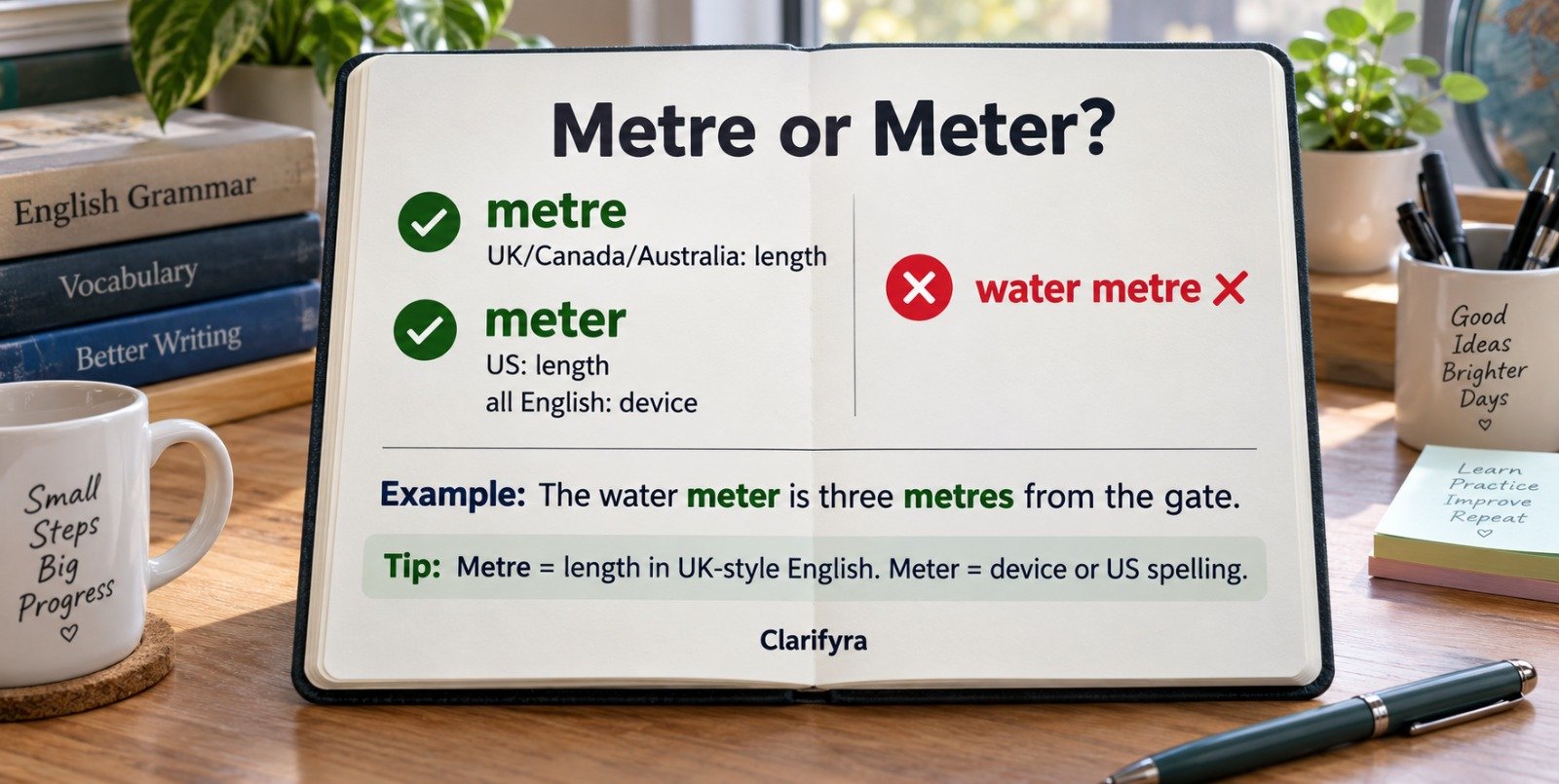
Metre and meter can both be correct, but the spelling you need depends on your variety of English and what the word means. British, Canadian, and Australian English generally use metre for the unit of length, while American English uses meter. However, a device that measures something—such as a water meter or electricity meter—is spelled meter even in British-style English. The same regional difference also appears when the word refers to rhythm in poetry.
Metre is the standard spelling for the unit of length in British, Canadian, and Australian English, while meter is the American spelling. When referring to a measuring device, such as a water meter, meter is normally correct in all of these varieties of English.
Metre or Meter: What’s the Difference?
The main metre or meter difference comes down to meaning and regional spelling.
| Use | Metre | Meter |
|---|---|---|
| Unit of length in British English | Yes | No |
| Unit of length in American English | No | Yes |
| Unit of length in Canadian English | Yes | Usually no |
| Unit of length in Australian English | Yes | Usually no |
| Measuring device | No | Yes |
| British spelling for poetic rhythm | Yes | Usually no |
| American spelling for poetic rhythm | No | Yes |
| Standard unit symbol | m | m |
Cambridge identifies metre as the UK spelling of the length unit and meter as its US equivalent. Canada’s official Language Portal makes an additional distinction: metre is the unit of length, while meter refers to a measuring device.
This means both spellings may appear in perfectly correct English, sometimes even in the same sentence.
For example:
The water meter recorded several cubic metres of water.
In that sentence, meter is a device, while metres is a unit of measurement.
Many English learners mix up similar-looking words such as Mum or Mom: Which Is Correct in English?
What Does “Metre” Mean?
A metre is a metric unit of length equal to 100 centimetres. Its standard symbol is m.
The spelling is commonly used in British English and in other English varieties that generally follow British spelling conventions.
Examples:
- The room is five metres wide.
- She stood about a metre from the door.
- We bought three metres of fabric.
- The runner competed in the 100 metres.
Cambridge defines metre as a unit of measurement equal to 100 centimetres and marks it as the UK form corresponding to American meter.
The same spelling appears in related metric words:
- centimetre
- millimetre
- kilometre
- square metre
- cubic metre
So, in British-style English, you might write:
The building is 20 metres high.
What Does “Meter” Mean?
Meter has two important uses.
First, it is the standard American spelling of the metric unit of length.
For example:
- The bridge is 300 meters long.
- He stood two meters away.
- The pool is 25 meters wide.
In American English, a meter is the same unit that British English spells metre.
Second, meter can mean an instrument or device that measures and records something.
Common examples include:
- water meter
- gas meter
- electricity meter
- parking meter
Cambridge defines this sense of meter as a device used to measure or record the amount of something used or present.
This second meaning is important because meter is not merely an American spelling. It is also the standard word for many measuring devices in British, Canadian, and Australian English.
Is It Metre or Meter in the UK?
For the metre or meter UK question, the rule is straightforward:
Use metre when talking about length.
Use meter when talking about a measuring device.
Correct UK examples
- The garden is ten metres long.
- He finished the race several metres ahead.
- Someone came to read the electricity meter.
- The parking meter was not working.
So these two spellings have different jobs in British English.
A British writer would normally write:
The plumber checked the water meter, which was several metres from the house.
Both words are correct because they refer to different things.
Is It Metre or Meter in American English?
American English makes the distinction simpler because meter is normally used for both meanings.
Length
- The wall is four meters high.
- The car stopped 20 meters away.
- She ran the 200 meters.
Measuring device
- Check the water meter.
- The gas meter needs replacing.
- I put money into the parking meter.
Therefore, if you are writing specifically for an American audience, meter is usually the appropriate spelling whether you mean the length unit or a measuring instrument.
Metre or Meter: Australian Spelling
The standard metre or meter Australian spelling follows the same basic distinction found in British English.
For a unit of length:
metre
Examples:
- The fence is two metres high.
- The beach is 500 metres away.
- We need six metres of cable.
For a measuring instrument:
meter
Examples:
- electricity meter
- parking meter
- water meter
Therefore, an Australian sentence could correctly contain both forms:
The electricity meter is about five metres from the front gate.
The important point is to choose the spelling according to meaning rather than assuming that meter is always American.
Is It Metre or Meter in Canada?
Canadian English normally uses metre for the unit of length.
Canada’s Language Portal explicitly distinguishes the two spellings: metre is the unit of length, while meter refers to a measuring device.
Examples:
- The road is 100 metres long.
- The building is several metres tall.
- The technician checked the gas meter.
- Our water meter is outside.
Canadian government language guidance also uses m as the symbol for metre.
So, for formal Canadian writing, the distinction is useful to remember:
metre = length
meter = measuring device
Water Metre or Meter: Which Is Correct?
The correct spelling is water meter.
A water meter is an instrument that measures the amount of water being used. Because the word refers to a measuring device rather than a unit of length, meter is the appropriate form.
Correct:
The plumber checked the water meter.
Not normally:
The plumber checked the water metre.
The same principle applies to:
- gas meter
- electricity meter
- parking meter
Cambridge also uses water meter for a device used to measure water consumption.
An easy example showing both spellings in British-style English is:
The water meter is three metres from the kitchen window.
Metre or Meter in Poetry
The word has another meaning that has nothing to do with physical distance.
In poetry, metre refers to a pattern of rhythm created by stressed and unstressed syllables. In American English, this is normally spelled meter.
Cambridge lists metre as a term for a pattern of rhythm in poetry.
For example:
British English:
The poem uses a regular metre.
American English:
The poem uses a regular meter.
You may also encounter terms such as iambic pentameter, which describes a well-known rhythmic pattern in English verse.
So when discussing metre or meter in poetry, neither spelling is automatically incorrect. The choice generally follows the regional variety of English being used.
How to Remember the Correct Spelling
A simple rule can prevent most mistakes:
British-style length → metre
American length → meter
Measuring device → meter
Think of this sentence:
The meter measured how many cubic metres of water were used.
The first word is a device, so it is meter.
The second is a measurement, so British-style English uses metres.
For American English, the sentence would use meters for the unit too:
The meter measured how many cubic meters of water were used.
Common Mistakes to Avoid
One frequent mistake is treating meter as incorrect everywhere outside the United States. That is not true. British, Canadian, and Australian English still use meter when referring to measuring devices.
Another mistake is writing water metre simply because the writer normally uses British spelling. The device is a water meter.
Writers may also mix regional styles unnecessarily:
Inconsistent: The building is 50 meters tall and several kilometres from town.
If you are consistently following British-style spelling, write:
The building is 50 metres tall and several kilometres from town.
For an American audience:
The building is 50 meters tall and several kilometers from town.
Consistency makes your writing look more polished and helps readers understand which English style you are following.
Metre, Meter, and the Symbol “m”
Regardless of whether you write metre or meter, the standard symbol for the unit is:
m
Examples:
- 5 m
- 20 m
- 100 m
You do not change the symbol according to American or British spelling.
Canada’s official guidance, for example, lists lowercase m as the symbol for metre.
Notice that the symbol itself does not become plural.
Correct:
25 m
Not:
25 ms when you mean metres
Writing the full word, however, normally requires the plural:
one metre
five metres
or in American English:
one meter
five meters
Final Verdict: Metre or Meter?
Both spellings are correct, but they are not always interchangeable. Use metre for the unit of length in British, Canadian, and Australian English, and use meter for that unit in American English. A measuring device is normally a meter regardless of these regional differences. For poetry, British-style English generally prefers metre, while American English uses meter. Choosing the form that matches your meaning and audience is the clearest approach—the kind of practical distinction Clarifyra aims to make easy to understand.
Frequently Asked Questions
Which is correct, metre or meter?
Both are correct. Metre is generally the British, Canadian, and Australian spelling for the unit of length, while meter is the American spelling. Meter is also used for measuring devices.
Is meter wrong in British English?
No. Meter is correct in British English when referring to an instrument such as a water meter, gas meter, or parking meter. For the metric unit of length, British English normally uses metre.
Is it water metre or water meter?
Water meter is correct. The term describes a device that measures water usage, so meter is used rather than metre.
Does Canada use metre or meter?
Canadian English normally uses metre for the unit of length and meter for a measuring device. For example, a Canadian writer might mention a water meter positioned several metres from a building.
Does Australia spell it meter or metre?
Australian English generally uses metre for length and meter for measuring devices. For example, something may be five metres long but measured by a meter.
Is it metre or meter when talking about poetry?
British-style English generally uses metre for the rhythmic structure of poetry, while American English generally uses meter. Both spellings can therefore be correct depending on the regional style being followed.
You May Also Read | Calendar vs Calender: Which Spelling Is Correct?