LB or LBs: Which Is Correct?
LB or LBs: Which Is Correct?
The short answer is that both exist, but they belong to different registers. In formal, scientific, and technical writing, the correct abbreviation is lb — for one pound and for a hundred pounds, because unit abbreviations don’t take a plural -s. In everyday informal writing, lbs is everywhere, widely understood, and increasingly accepted. The one thing that’s never right is mixing the logic: “1 lbs” is wrong in every register, because with the number one, the unit is singular.
What the Dictionaries Say
The dictionaries are consistent on the core facts and interestingly relaxed in practice:
- Cambridge Dictionary: pound — noun, countable, weight sense — “(written abbreviation lb).” Cambridge’s own example sentence reads: “One kilogram is roughly the same as 2.2 lbs.” Read that again: the dictionary that prescribes lb as the abbreviation uses lbs in its own example. That’s not a contradiction — it’s evidence that lbs is standard in informal use.
- Merriam-Webster (American): carries lb as the abbreviation of pound, and recognizes lbs in the plural abbreviation role.
- Oxford Learner’s Dictionaries and Collins: list lb as the abbreviation; Collins notes the plural abbreviation lbs for the pound unit of mass.
So the reference works agree: lb is the abbreviation; lbs is the informal plural form. The disagreement — and there is one — comes from style guides, which is where the real decision lives.
The Style-Guide Rule (and Why It Exists)
Every major style guide agrees on one principle: unit abbreviations don’t pluralize. You write 5 kg, not “5 kgs”; 3 ft, not “3 fts”; 10 oz, not “10 ozs.” By that logic, it’s 5 lb, not “5 lbs” — the abbreviation stays frozen whether the number is 1 or 1,000. Scientific and technical writing follows this absolutely: in a lab report, an engineering spec, or a nutrition label, lbs is simply not acceptable.
But everyday English never got the memo, and for a good reason: lb is an odd abbreviation. It doesn’t look like “pound” at all (more on why below), so readers don’t intuitively connect it to the plural of “pounds.” Writing “lbs” feels like adding the normal English plural -s to a word — because that’s exactly what it is. The result is a stable two-tier system: lb in formal/technical writing, lbs in casual writing, with both understood everywhere.
| Situation | Write this | Example |
|---|---|---|
| Formal, scientific, technical writing | lb (singular and plural) | “The sample weighed 4.5 lb.” |
| Informal writing (texts, social media, blogs) | lbs accepted | “Down 10 lbs this month!” |
| The number is 1 | lb only | “1 lb of flour” — never “1 lbs” |
| Before a noun (attributive) | lb (singular) | “a 5-lb bag of sugar” |
| End of sentence | lb. with period | “The limit is 50 lb.” (period = sentence end, not abbreviation) |
A note on the period: unit abbreviations like lb, kg, and oz don’t take a period in British style, and American style guides generally agree for metric-style units. If you see “lb.” mid-sentence, it’s usually an older or informal habit; at the end of a sentence, the period is just the sentence’s own full stop. And “lbs.” — with both the s and the period — is doubly informal; in formal writing, use neither.
Why “lb”? The Latin Story
The abbreviation looks nothing like “pound” because it isn’t from English at all. lb comes from the Latin libra — the Roman unit of weight, from the phrase libra pondo, “a pound by weight.” The Roman libra was about 329 grams, close to three-quarters of the modern pound; the abbreviation survived even as the unit evolved through the avoirdupois system (the modern pound: 16 ounces, 453.59237 grams exactly, per international agreement).
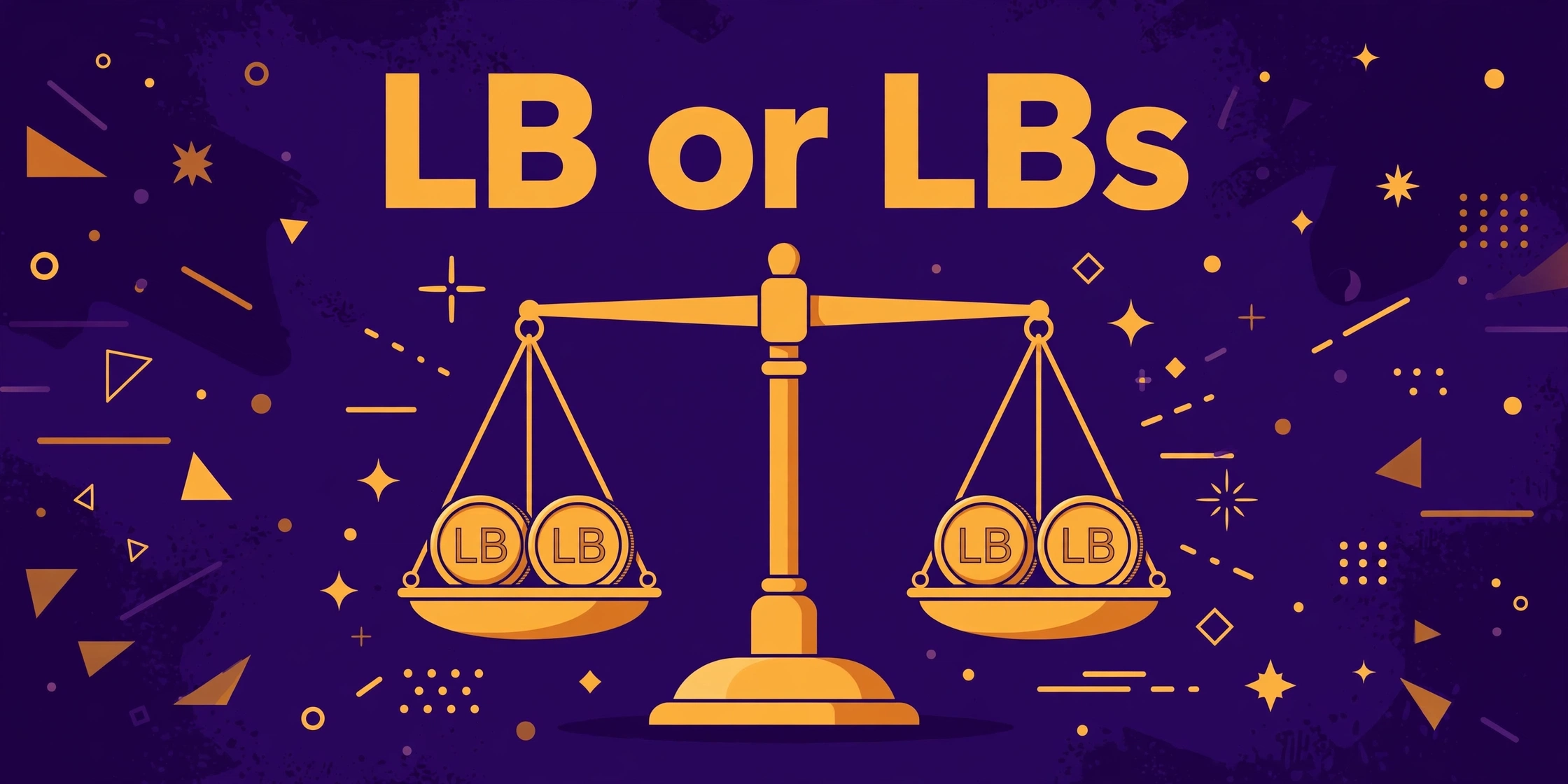
Libra also meant “balance” or “scales” — which is why the zodiac sign Libra is depicted as a weighing scale, and why the British pound sterling uses the symbol £, a stylized L from the same Latin root. So when you write lb, you’re using a two-thousand-year-old Roman abbreviation. That pedigree is part of why style guides are protective of it: lb isn’t just shorthand, it’s the historically correct form, and adding an English plural -s to a Latin abbreviation is, to a purist, a category error.
Where the Confusion Comes From
1. The abbreviation doesn’t match the word. “lb” gives no hint of “pound,” so the normal English instinct — add -s for plural — operates on the letters rather than the Latin root. Nobody writes “kgs,” but “kg” visibly abbreviates “kilogram”; “lb” visibly abbreviates nothing in English.
2. Everyday speech. Nobody says “ell-bee” in conversation; everyone says “pounds.” When converting speech to text, writers write the plural they hear: “ten pounds” becomes “10 lbs,” not “10 lb.” The informal spelling is a transcription of speech.
3. Dictionary examples legitimize it. As noted above, Cambridge’s own example sentence uses “2.2 lbs.” When the dictionary’s examples and the dictionary’s headwords disagree, writers reasonably conclude both are fine — and in informal contexts, they are.
4. The “1 lbs” hypercorrection. Some writers, having learned that “lbs” is the plural, apply it everywhere including after the number one. But “1” is singular — “1 pound,” “1 lb” — and “1 lbs” is wrong in every register, formal and informal alike.
Correct vs. Incorrect
- ✓ (formal) “The package weighs 15 lb.” (unit abbreviation, no plural -s — correct)
- ✓ (formal) “1 lb of butter” (singular — correct)
- ✓ (informal) “I need to lose 10 lbs.” (widely understood — acceptable casually)
- ✓ “The recipe calls for a pound and a half of flour.” (words, not abbreviation — always safe)
- ✗ “The package weighs 15 lbs.” (in a formal report) → ✓ “…15 lb.”
- ✗ “Add 1 lbs of sugar.” → ✓ “Add 1 lb of sugar.” (never “1 lbs”)
- ✗ “A five lbs bag” → ✓ “A five-lb bag” (attributive position stays singular)
Common Mistakes
1. Using “lbs” in formal writing. Lab reports, academic papers, technical specs, formal business documents: lb for all numbers. This is the one context where the choice genuinely matters.
2. Writing “1 lbs.” The numeral 1 is singular — “1 lb,” always. This error appears in informal writing too, and it reads as careless everywhere.
3. Writing “lbs.” with a period. In formal writing, unit abbreviations take no period (and no -s): lb. The period-plus-s combination is the most informal variant of all.
4. Pluralizing before a noun. Units stay singular in attributive position: “a 10-lb dumbbell,” “a 5-lb bag” — same rule as “a ten-ton bridge,” which the tons or tonnes guide covers for the larger units.
5. Capitalizing it (“LB”). The standard abbreviation is lowercase lb. Capitals appear on gym equipment and shipping labels for visibility, but in running text, lowercase is correct.
Frequently Asked Questions
Is it “lb” or “lbs” for plural?
Formally: lb for both singular and plural (“5 lb”). Informally: lbs is widely used and understood for the plural (“5 lbs”). Cambridge’s dictionary entry gives lb as the written abbreviation while using “2.2 lbs” in its own example sentence — which tells you everything about the two registers.
What does “lb” stand for?
The Latin libra (via libra pondo, “a pound by weight”) — the Roman unit of weight and the word for a balance or pair of scales.
Is “1 lbs” ever correct?
No. With the number one, the unit is singular: “1 lb,” “1 pound.” This holds in every register.
Do you put a period after “lb”?
Not as an abbreviation — lb, like kg and oz, takes no period in standard style. A period after “lb” at the end of a sentence is just the sentence’s own full stop.
How do you pronounce “lb”?
It’s read as the full word: “pound” (plural “pounds”). Nobody pronounces the abbreviation itself.
Final Takeaway
lb is the correct abbreviation — singular and plural — in formal writing, and it’s the form every dictionary lists. lbs is the informal plural you’ll see in texts, gyms, and social media: understood everywhere, fine casually, out of place in a lab report. Whatever you choose, it’s “1 lb” (never “1 lbs”), lowercase, and no period. The Roman libra has carried this abbreviation for two millennia; the least we can do is spell it right.