Tons or Tonnes: What’s the Difference?
If you’ve ever read that a ship carried 50,000 tons of cargo in one article and 50,000 tonnes in another, you’ve run into one of English’s most confusing pairs. Here’s the short version: a tonne is the metric unit (1,000 kg), while a ton is usually the American short ton (2,000 lb) — but in Britain, a ton can also mean the old imperial long ton (2,240 lb). Same word, three different weights, which is exactly why mixing them up matters.
Quick Answer
A tonne is the metric unit of 1,000 kilograms (2,204.6 lb), used in the UK and internationally. A ton is usually the US short ton of 2,000 lb, though in Britain it can also mean the imperial long ton of 2,240 lb. In American writing, say metric ton rather than tonne. And tons of something just means a lot of it — no weighing required.
Why This Is So Confusing
Most spelling questions on this site come down to two words. This one is worse: “ton” doesn’t name a single unit. Merriam-Webster defines ton as “any of various units of weight,” and Collins lists three under one entry — the long ton, the short ton, and the metric ton. Add a second spelling (tonne), a US/UK split, and an informal meaning (“tons of work”), and it’s no wonder readers hesitate.
The confusion is understandable because the overlap is real. Merriam-Webster even lists metric ton as one sense of plain ton, and one of its example sentences converts “10 million metric tons” into “(11,023,113 tons)” — proof that in American writing, ton doesn’t always mean 2,000 pounds.
The Three Tons
Let’s pin each one down with the figures the dictionaries actually give.
1. The Short Ton (US Ton)
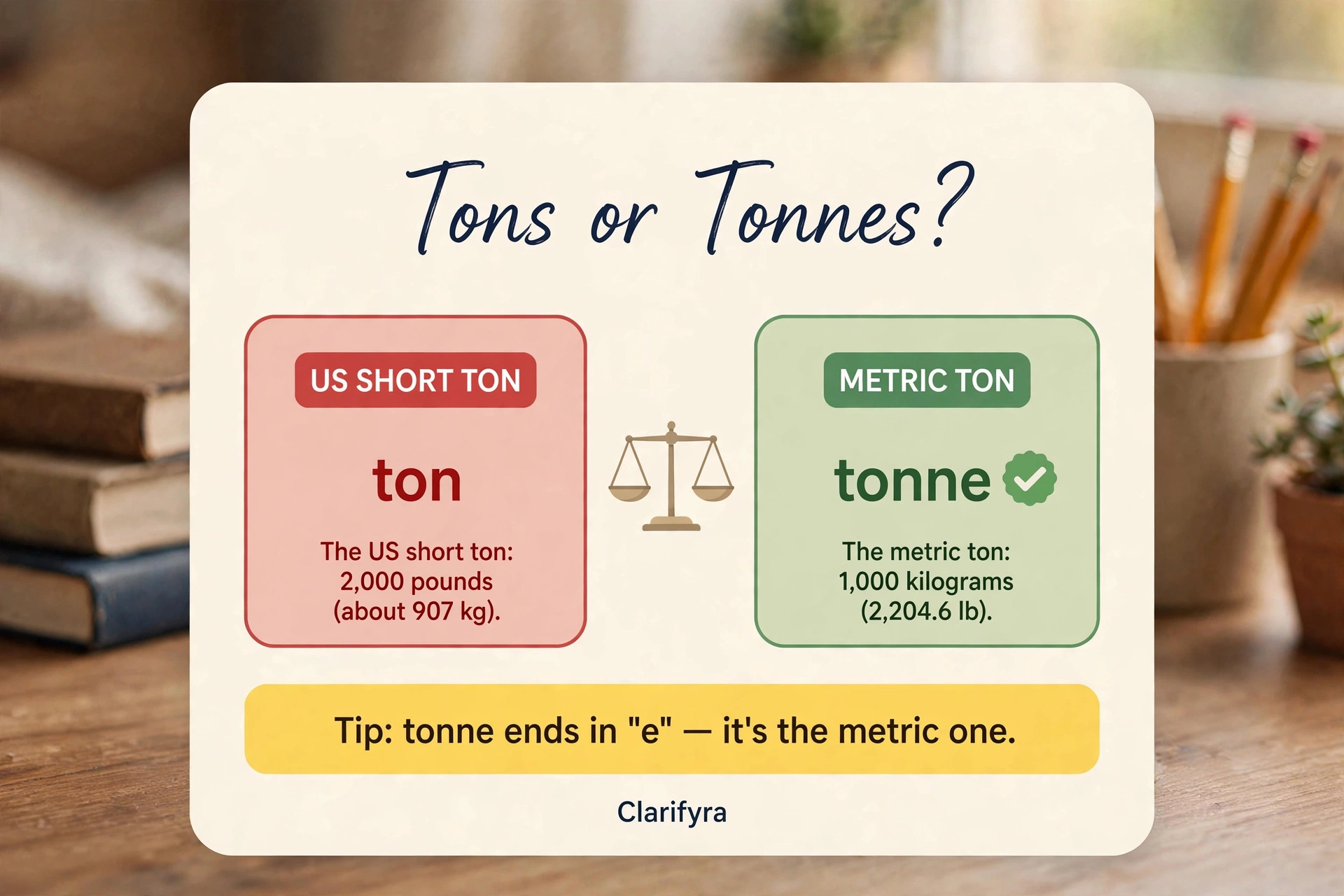
The short ton — also called the US ton or net ton — is 2,000 pounds, about 907 kilograms. Collins (in its American English entry, drawn from Webster’s New World) defines it as “equal to 2,000 pounds avoirdupois (907.1847 kilograms…), commonly used in the U.S., Canada, South Africa, etc.” This is the ton most American readers picture, and it’s the lightest of the three.
2. The Long Ton (Imperial Ton)
The long ton — the British imperial ton — is 2,240 pounds, about 1,016 kilograms. Collins’s British English entry defines it as “a unit of weight equal to 2240 pounds or 1016.046909 kilograms.” It survives mainly in historical figures, some shipping measurements, and older British texts; for modern trade the UK has moved on to the metric tonne.
3. The Metric Ton (Tonne)
The metric ton, spelled tonne in British English, is 1,000 kilograms — which Collins gives as 2,204.6 pounds, and Cambridge’s dictionary (via its PASSWORD English dictionary) as “2,204.6 lb (1,000 kilogrammes).” It sits between the other two: heavier than the US ton, lighter than the old British one.
| Unit | Also called | Pounds | Kilograms | Where you’ll meet it |
|---|---|---|---|---|
| Short ton | US ton, net ton | 2,000 lb | ≈ 907 kg | United States |
| Long ton | Imperial ton | 2,240 lb | ≈ 1,016 kg | UK — mostly historical and shipping |
| Metric ton / tonne | Tonne (UK spelling) | 2,204.6 lb | 1,000 kg | UK, international trade, science |
Note: the kilogram figures are rounded; the tonne’s 2,204.6-pound figure is quoted as given by Collins and Cambridge.
Ton vs Tonne: Who Uses Which?
Here’s where the honest answer gets more interesting than “tons is American, tonnes is British.”
Tonne is the British spelling of the metric unit — Collins labels it British, and its learner’s dictionary carries the usage note: “in AM, use metric ton.” Cambridge agrees in spirit: its English–Italian dictionary glosses “metric ton (UK tonne),” treating tonne as the UK form of the American metric ton.
But the divide isn’t absolute. Merriam-Webster — an American dictionary — has an entry for tonne, defined simply as “metric ton.” So the word is understood in the US; it’s just not the house style. Americans writing for an American audience overwhelmingly write metric ton.
And the UK uses ton too. Collins’s British English entry for ton leads with the long ton (2,240 lb), so “ton” is perfectly at home in British English — it just refers to the imperial unit. In modern British writing about metric weights, though, you’ll see tonnes. (This isn’t the only spelling split between the two varieties — British and American English also part ways on everyday words like defences and defenses.)
Bottom line: tonne always means the metric ton. Ton could mean any of the three, depending on who’s writing and when. When precision matters, never rely on the spelling alone — say short ton, long ton, or metric ton.
The Informal “Tons Of”
Then there’s the tons that has nothing to do with weighing anything. Dictionaries across both varieties record the informal sense:
- Cambridge Learner’s Dictionary: “tons of sth informal — a lot of something” (“We’ve got tons of cheese left”).
- Merriam-Webster: “a great quantity: lot” (“ate tons of cookies,” “has tons of money,” “a ton of work to do”).
- Collins (Webster’s New World): “often plural, informal — a very large amount or number.”
It’s usually plural — tons of homework — but the singular works too: a ton of work, and the idiom weigh a ton, which Cambridge glosses as simply “to be very heavy” (“These bags weigh a ton”). Notice that none of the dictionaries region-label this sense: it’s shared by British and American English alike.
Which Should You Use?
| Situation | Write this | Example |
|---|---|---|
| US audience, US customary weights | tons (short tons) | “The truck hauls 20 tons of gravel.” |
| UK or international audience, metric weights | tonnes | “The shipment weighed 20 tonnes.” |
| US audience, metric weights | metric tons | “The shipment weighed 20 metric tons.” |
| Science, engineering, international trade | tonne (t) or metric ton | “CO₂ emissions: 4.2 t per capita.” |
| Casual “a large amount” | tons of | “She has tons of patience.” |
Common Mistakes
- Using “tonne” for a US audience.
✗ “The Ohio factory produced 5,000 tonnes of steel.”
✓ “The Ohio factory produced 5,000 metric tons of steel.”
Collins’s usage note is explicit: in American English, use metric ton. - Writing “metric tonnes.”
✗ “A shipment of 10 metric tonnes arrived Tuesday.”
✓ “A shipment of 10 tonnes arrived Tuesday.”
Tonne already means metric ton, so the pairing is redundant — like saying “PIN number.” - Assuming every “ton” is 2,000 lb.
✗ “The 1912 manifest listed 10,000 tons — that’s 20 million pounds.”
✓ “The 1912 manifest listed 10,000 tons — but British tons of that era were 2,240 lb, so that’s 22.4 million pounds.”
Historical British sources mean long tons unless they say otherwise. - Pluralising the unit before a noun.
✗ “A five tonnes truck blocked the road.”
✓ “A five-tonne truck blocked the road.”
Like other units, it stays singular in attributive position: a ten-ton bridge, a two-tonne limit. - Mixing systems in one document.
Pick one system, state it once (“all weights in metric tons”), and stick to it. Readers shouldn’t have to guess which ton you mean paragraph by paragraph.
Memory Tricks
- Tonne is metric. The extra e at the end of tonne matches the e in metric — and the metric tonne is the internationally standard one.
- The longer word is the heavier unit — compared with the American ton, at least. Tonne (2,204.6 lb) outweighs the US ton (2,000 lb). (It still loses to the old British long ton at 2,240 lb.)
- The American ton comes up “short.” That’s literally its name — the short ton — and at 2,000 lb it’s the lightest of the three.
Frequently Asked Questions
Is a tonne the same as a metric ton?
Yes — they’re exact synonyms. Cambridge lists them together (“metric ton (also tonne)”), and Collins calls “metric ton” an alternative name for the tonne. The difference is purely regional: tonne is the preferred spelling in the UK and internationally, metric ton in the US.
Which is heavier, a ton or a tonne?
It depends which ton you mean. A tonne (2,204.6 lb) is heavier than the US short ton (2,000 lb) but lighter than the British long ton (2,240 lb). This is why careful writers specify short, long, or metric instead of leaving it to context.
Do Americans ever write “tonne”?
Rarely in practice. The word appears in American dictionaries — Merriam-Webster defines tonne as “metric ton” — so it will be understood, but US style guides and usage notes (including Collins’s “in AM, use metric ton”) point Americans toward metric ton.
Is the plural “tonnes” or “tonne”?
Tonnes is the standard plural (“65.5 million tonnes of coal,” per Collins). Cambridge also accepts tonne as a plural form, but tonnes is the safe, everyday choice. English has a few of these double-plural situations — matrixes and matrices is another.
What does “tons of” mean?
It’s informal for “a lot of” — tons of homework, a ton of emails. All the major dictionaries record this sense without a regional label, so it works in both British and American English. Related idiom: weigh a ton, meaning to be very heavy.
What does “do the ton” mean?
British slang for reaching 100 miles per hour — Collins records this sense as “Brit informal: a speed of 100 miles per hour.” It comes from the same family of “a hundred of something” slang, not from the unit of weight.
Final Takeaway
Tonne always means the metric ton: 1,000 kg (2,204.6 lb). Ton is the ambiguous one — usually the 2,000-lb US short ton, sometimes the 2,240-lb British long ton, and occasionally (even in American writing) shorthand for the metric ton. Match your spelling to your audience (tonnes for the UK and the world, metric tons for the US), specify short, long, or metric whenever the number actually matters, and save tons of for when you just mean “a lot.”