Bosses or Boss’s: Which Is Correct?
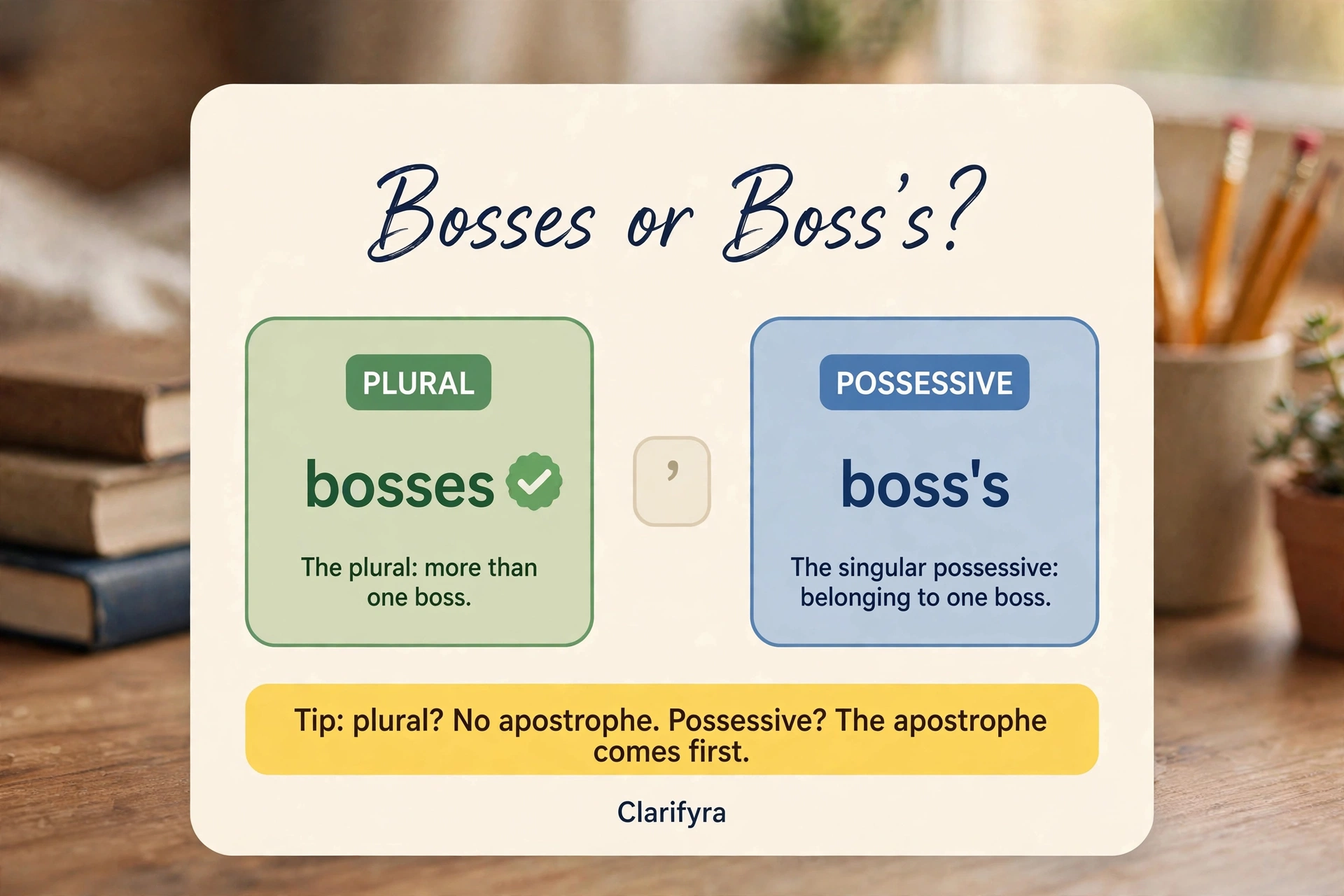
Bosses is the plural of boss (more than one boss). Boss’s is the singular possessive (belonging to one boss). Bosses’ is the plural possessive (belonging to several bosses). There is no such English word as bosss — it never appears in a dictionary and is always a typo.
Quick Answer
Bosses = more than one boss (Two bosses run the store). Boss’s = something belonging to one boss (My boss’s office). Bosses’ = something belonging to several bosses (The bosses’ meeting). Bosss is never correct — do not use it.
The Three Forms at a Glance
The confusion between bosses, boss’s, and bosses’ comes down to three separate jobs: plural, singular possessive, and plural possessive. Each has exactly one correct spelling, and the apostrophe tells you which job the word is doing.
| Form | Meaning | Example | Verdict |
|---|---|---|---|
| bosses | Plural — more than one boss | Our company has three bosses. | Correct |
| boss’s | Singular possessive — belonging to one boss | My boss’s car is parked outside. | Correct |
| bosses’ | Plural possessive — belonging to several bosses | The bosses’ meeting ran late. | Correct |
| bosss | None — no such word | ✗ The bosss are here. | Never correct |
A simple rule of thumb: the apostrophe always comes after the word’s basic form, never in the middle of it. Start with the right base — boss or bosses — then add the apostrophe. That order of operations eliminates most mistakes.
Why the Plural Is Bosses, Not Boss’s
To make a regular English noun plural, you usually just add -s: dog → dogs, car → cars. But words ending in -s, -ss, -sh, -ch, -x, or -z take -es instead. Cambridge’s English Grammar Today grammar guide states the rule exactly this way: if the noun ends in -ch, -s, -sh, -x, or -z, add -es (think box → boxes, bus → buses, watch → watches). Merriam-Webster lists bosses as the plural of boss, and Cambridge’s dictionary entry for boss treats it as a standard countable noun, so it follows the standard rule with no exception.
The reason is pronunciation, not tradition. Boss ends in a hissing s sound, and English adds a separate syllable — roughly “bos-iz” — when pluralizing sibilant endings, which is why the extra e appears. Without it, “bosss” would be unpronounceable. This same -es pattern shows up across the language: coach becomes coaches, not coach’s, for exactly the same reason.
One more check: bosses with no apostrophe is a pure plural and never shows possession. The bosses decided to merge is right; ✗ The boss’s decided to merge is wrong, because an apostrophe in that spot would turn the word possessive and leave the sentence without a subject.
Boss’s vs Bosses’: Singular vs Plural Possessive
Possessives in English follow two separate rules, and boss walks through both:
- Singular possessive: add ‘s to the singular noun — boss → boss’s. This holds even though the noun already ends in s. My boss’s assistant called means one boss has one assistant.
- Plural possessive: plural nouns already ending in s take just an apostrophe — bosses → bosses’. The bosses’ assistants called means several bosses, and their assistants, called.
Notice the apostrophe’s position is doing all the work. Before the s, it’s one boss (boss’s); after the s, it’s many bosses (bosses’). This is the same logic behind pairs like nobody’s and nobodies, where the apostrophe placement decides between possession and plurality — see nobodies or nobody’s for another look at the pattern.
What about “boss'” — apostrophe only?
You may occasionally see boss’ written with a bare apostrophe, and this is where honest style guidance matters. The two most-cited style guides actually agree on this particular word. The Chicago Manual of Style recommends ‘s for all singular nouns ending in s — the boss’s office. The Associated Press Stylebook, which is famous for using just an apostrophe in some cases (James’ book), limits that exception to singular proper names; for singular common nouns like boss, AP also gives the boss’s office.
So boss’s is the safe, universally accepted singular possessive of the common noun boss. The bare-apostrophe debate (James’ vs James’s) belongs to proper names, not to this word. If you write boss’s, no major style guide will mark it wrong.
Why “Bosss” Never Works
Bosss — the word with an extra s and no apostrophe — is not an English word. A check of the four major learner and general dictionaries finds no entry for it in Cambridge Dictionary, Oxford Learner’s Dictionaries, Merriam-Webster, or Collins: searching each for bosss returns nothing, only nearby real words like boss, bosses, and boss’s.
It is almost always one of two mistakes:
- A plural typed without the -es rule in mind: someone writes boss, knows the plural needs something, and tacks on another s to get bosss instead of applying the -es rule to get bosses.
- A possessive with the apostrophe dropped: someone means boss’s (as in my bosss car) but forgets the apostrophe, which collapses the possessive into an unpronounceable lump.
Because bosss has no dictionary entry anywhere, spellcheckers flag it and readers stumble on it. Every time you see it in your own writing, replace it with the intended form: bosses, boss’s, or bosses’.
Common Mistakes to Avoid
- Using an apostrophe in a plain plural. ✗ The boss’s will attend. → ✓ The bosses will attend. A plural of boss never takes an apostrophe unless it’s also possessive.
- Writing “bosss” as a plural. ✗ We have two bosss on this project. → ✓ We have two bosses on this project. Words ending in -s take -es for the plural, not an extra s.
- Writing “bosss” as a possessive. ✗ That’s my bosss decision. → ✓ That’s my boss’s decision. The apostrophe is mandatory in the possessive.
- Putting the apostrophe on the wrong side of the s. ✗ The bosses’s new policy (a double ending that no standard form uses). → ✓ The bosses’ new policy for several bosses, or ✓ The boss’s new policy for one boss.
- Mixing up possession and plurality in meaning. ✗ I’ll ask the bosses decision (ambiguous). → ✓ I’ll ask my boss’s decision if one boss decides, or ✓ I’ll ask the bosses’ decision if they decide together. The apostrophe position changes the meaning, so get it right.
Memory Tricks
- Ask “how many?”: if the answer is “more than one,” write bosses and keep the apostrophe in your pocket. Plurals don’t need apostrophes.
- Ask “whose?”: if one boss owns it, it’s boss’s (apostrophe before the final s); if several bosses own it, it’s bosses’ (apostrophe after the s).
- The “iz” test: if you would pronounce an extra syllable — “my boss-iz decision” — the ‘s belongs there: my boss’s decision. If you’d say just “bosses,” there’s no possession at all.
- Triple-s alarm: if you ever type three s’s in a row (bosss), something is wrong — either an apostrophe is missing or the -es plural rule was forgotten.
Frequently Asked Questions
Is it bosses or boss’s?
Both are correct, but they mean different things. Bosses is the plural: more than one boss (Both bosses approved the plan). Boss’s is the singular possessive: something belonging to one boss (My boss’s approval). Choose based on whether you mean “several bosses” or “belonging to one boss.”
Is bosss ever correct?
No. Bosss has no entry in Cambridge Dictionary, Oxford Learner’s Dictionaries, Merriam-Webster, or Collins, and it appears in no standard grammar. It is always a typo for bosses, boss’s, or bosses’ — add the missing -es ending or the missing apostrophe, depending on what you meant.
Should I write boss’s or boss’?
Write boss’s. The Chicago Manual of Style uses ‘s for all singular nouns ending in s, and even the AP Stylebook — which uses a bare apostrophe for singular proper names like James’ — uses the boss’s office for this common noun. So boss’s is accepted across the major style guides; the bare-apostrophe debate concerns proper names, not this word.
How do you make “bosses” possessive?
Add just an apostrophe after the plural: bosses’. The bosses’ schedules means the schedules belonging to multiple bosses. Do not add another s (bosses’s) — that double ending is not a standard English form.
What is the difference between boss’s and bosses’?
Only the apostrophe’s position — and the number of bosses. Boss’s (apostrophe before the s) belongs to one boss: The boss’s desk. Bosses’ (apostrophe after the s) belongs to several bosses: The bosses’ desks.
Final Takeaway
Bosses is the plural, boss’s is the singular possessive, and bosses’ is the plural possessive. Bosss is never correct in any context. When in doubt, build the form in two steps: pick the right base (boss or bosses), then decide whether an apostrophe belongs there. That habit alone prevents nearly every mistake this word pair causes.