This or These: Which Is Correct?
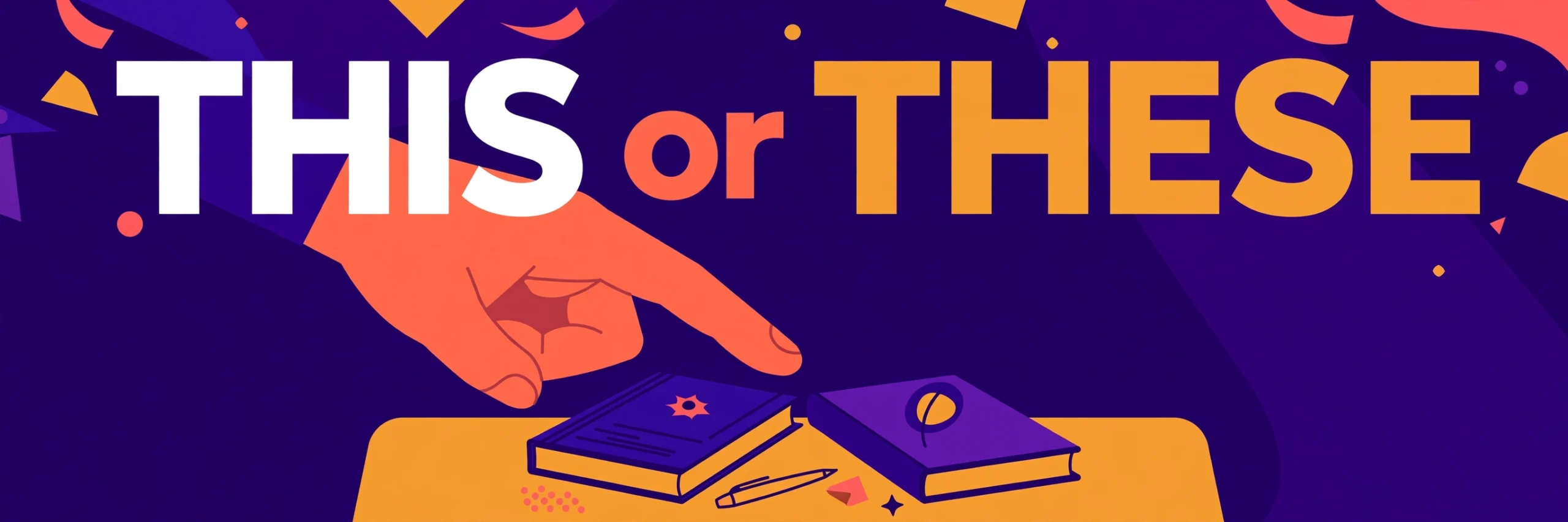
Four letters long, used a dozen times a day. This points to one thing that is near you — near in space, near in time, or near in the conversation. These points to more than one thing that is near you. The rule is short enough to fit on a sticky note, and yet the errors keep coming: “this are,” “these is,” “this books,” “these book.” The reason is that this and these do two grammatical jobs — determiner and pronoun — and the agreement rule changes with the job.
What the Dictionaries and Grammars Actually Say
| Source | What it records |
|---|---|
| Cambridge Dictionary — Grammar | These: “plural of this.” Cambridge Grammar on this, that, these, those: “This, that, these and those are demonstratives. We use this, that, these and those to point to people and things. This and that are singular. These and those are plural. We use them as determiners and pronouns.” As determiners, this and that go with singular and uncountable nouns; these and those go with plural nouns. As pronouns, they refer to things or ideas without a following noun. |
| Oxford Advanced Learner’s Dictionary | This, determiner and pronoun, /ðɪs/; these, determiner and pronoun, /ðiːz/ — the same pronunciation in British and American English. Oxford lists this and these as both determiner and pronoun, and these as the plural of this. |
| Collins English Dictionary | These, determiner and pronoun, pronounced (ðiːz): “You use these at the beginning of noun groups to refer to someone or something that you have already mentioned or identified.” Collins notes that these is also a pronoun, and gives the determiner and pronoun pronunciations as the same. |
Three facts from that table carry the whole article. First, the split is number: this is singular, these is plural, in both varieties of English. Second, the split is distance: this and these point to things near the speaker, while that and those point to things farther away. Third, both words do two jobs — determiner and pronoun — and the job determines what follows them. Everything else is application.
This: Singular and Near
This points to one thing. As a determiner, it stands before a singular or uncountable noun: “this book,” “this house,” “this morning,” “this information,” “this water.” As a pronoun, it stands alone, with the noun understood from context: “This is mine.” “What is this?” In both jobs the verb is singular: this is, this was, this looks, this seems.
“Near” is wider than arm’s reach. This points to things near the speaker in space (“this chair, not that one”), near in time (“this week,” “this morning,” “this year”), and near in the conversation — things just mentioned, or about to be mentioned. “Listen to this.” The time use is the one that surprises learners most: this week means the week we are in now, this morning means the morning of today, and both are near in time even though no pointing is involved.
These: Plural and Near
These is the plural of this, and it follows exactly the same logic with more than one thing. As a determiner, it stands before a plural noun: “these books,” “these houses,” “these shoes,” “these ideas.” As a pronoun, it stands alone: “These are mine.” “What are these?” In both jobs the verb is plural: these are, these were, these look, these seem.
The distance rule is the same. These points to things near the speaker — the books on this table, the shoes on these feet, the ideas in this paragraph — while those points to things farther away. “These shoes are comfortable; those shoes pinch.” The contrast is the point: this/these and that/those are two halves of one system, and you cannot use one half correctly without the other.
Determiner or Pronoun? The Same Word, Two Jobs
The most useful thing to know about this and these is that each of them does two jobs, and the job changes what comes next. As a determiner, the word comes before a noun and the noun does the agreeing: “this book is,” “these books are.” As a pronoun, the word stands alone and does the agreeing itself: “this is,” “these are.”
| Word | Job | Pattern | Example |
|---|---|---|---|
| This | Determiner | this + singular noun | “This book is mine.” “This house is old.” |
| This | Pronoun | this + singular verb | “This is mine.” “This looks wrong.” |
| These | Determiner | these + plural noun | “These books are mine.” “These shoes hurt.” |
| These | Pronoun | these + plural verb | “These are mine.” “These look wrong.” |
The distinction matters because the commonest error in this family is a mismatch between the word and the noun that follows it: “this books,” “these book,” “this informations.” The fix is mechanical. Look at the noun. One thing, or an uncountable mass — this. More than one thing — these. Then look at the verb. After this, the verb is singular; after these, it is plural.
The Agreement Test
Subject–verb agreement is where this and these actually bite, because the verb has to match a word that is doing two jobs at once. The rule is simple, but it has to be applied to the right word.
When this or these is the subject, the verb agrees with it: this is, these are, this was, these were, this has, these have. “This is the best cake I have ever tasted.” “These are the best cakes I have ever tasted.” The error to avoid is the crossed wire: “this are” and “these is” are both wrong, and both are common in fast writing and in speech, where the speaker starts the sentence with one number in mind and finishes it with another.
When this or these is a determiner, the verb agrees with the noun, not with the demonstrative — but the noun and the demonstrative already agree with each other, so the result is the same: “This book is mine” (singular noun, singular verb), “These books are mine” (plural noun, plural verb). The trouble starts with nouns that look plural but are not, or the other way round. “This news is good” is correct, because news is uncountable and takes a singular verb even though it ends in -s. “These scissors are blunt” is correct, because scissors is a plural-only noun. The demonstrative follows the noun’s real number, not its spelling, and the verb follows both.
Near vs Far: This/These Against That/Those
| Near the speaker | Far from the speaker | |
|---|---|---|
| Singular | this — “this book” | that — “that book” |
| Plural | these — “these books” | those — “those books” |
Pronunciation
This is pronounced /ðɪs/ — “thihss,” with a voiced th (the vocal cords vibrate, as in that and those) and a short i. These is pronounced /ðiːz/ — “theez,” with the same voiced th, a long ee, and a final z sound. The pronunciation is the same in British and American English, and Oxford gives /ðɪs/ and /ðiːz/ for both varieties.
Two pronunciation points matter for learners. The first is the final sound: this ends in a voiceless s, these ends in a voiced z. Saying “thees” with an s is a common learner error, and it makes the plural sound like a mispronounced singular. The second is the vowel: this has the short vowel of sit, these has the long vowel of see. Getting both right matters: the vowel and the final consonant are what separate the two words.
Correct vs Incorrect
| Sentence | Verdict | Why |
|---|---|---|
| “This book is mine.” | Correct | Singular demonstrative + singular noun + singular verb. |
| “These books are mine.” | Correct | Plural demonstrative + plural noun + plural verb. |
| “This is the best cake I have tasted.” | Correct | This as a pronoun, singular verb. |
| “This information is wrong.” | Correct | Information is uncountable, so it takes this and a singular verb. |
| “This books are mine.” | Incorrect | Plural noun needs these: “These books are mine.” |
| “These book is mine.” | Incorrect | Singular noun needs this: “This book is mine.” |
| “This are mine.” | Incorrect | This takes a singular verb: “This is mine.” |
Examples in Real Sentences
This (determiner): “This book is mine.” “This morning was freezing.” “This information is out of date.” “This is my sister, Sarah.”
These (determiner): “These books are mine.” “These shoes hurt.” “These ideas need more work.” “These days, everything moves faster.”
Common Mistakes
1. Crossing the number: “this books” and “these book.” The commonest error in this family, and the easiest to fix. Look at the noun first: one thing takes this, more than one takes these. The check takes a second, and it catches the error every time.
2. Crossing the verb: “this are” and “these is.” The verb must agree with the demonstrative when the demonstrative is the subject. “This is,” “these are” — say the pair aloud until it is automatic, because the ear will catch this error faster than the eye once the pattern is learned.
3. Using “these” with uncountable nouns. “These informations,” “these advices,” “these furnitures” are all wrong, because uncountable nouns have no plural and therefore take this: “this information,” “this advice,” “this furniture.” If the noun cannot be counted, it cannot take these.
Frequently Asked Questions
Is “these” the plural of “this”?
Yes. Cambridge defines these as the plural of this, and Oxford lists both as determiner and pronoun. This is singular, these is plural, in both varieties of English.
Is it “this is” or “these is”?
This is and these are. The verb agrees with the demonstrative: singular this takes is, plural these takes are. “These is” is always wrong.
What is the difference between “this” and “that”?
Distance. This points to something near the speaker — in space, in time, or in the conversation — and that points to something farther away. The plural pair works the same way: these is near, those is far.
Can I use “this” with an uncountable noun?
Yes: “this information,” “this advice,” “this water.” Uncountable nouns take this, never these, and they take a singular verb. The test is whether you can count the noun: if you cannot say “one information, two informations,” it takes this.
The Short Version
This or these? Count what you are pointing at. One thing, near you: this — “this book,” “this is mine.” More than one thing, near you: these — “these books,” “these are mine.” Both words work as determiners and as pronouns, and the verb must agree: this is, these are. Uncountable nouns take this, never these. For things far away, use that and those.
Sources: Cambridge Dictionary, “these” and Cambridge Grammar, “This, that, these, those”; Oxford Advanced Learner’s Dictionary, “this” and “these”; Collins English Dictionary, “these.” External links: Cambridge — these; Oxford Learner’s — these.