Complete or Completed: Which Should You Use?
The confusion between complete and completed rarely comes from spelling — most writers can spell both words — but from grammar: one of them is doing two different jobs, and the other is doing a third, and the three overlap just enough to make “Is the form complete or completed?” feel like a coin toss. The answer depends on which job you need. Complete works both as an adjective (“having every part; finished”) and as a verb (“to finish; to fill in”). Completed is the past tense and past participle of that verb — and, derived from it, a participle adjective meaning “finished.” Choosing between them is mostly a matter of noticing whether finished-ness or wholeness is what your sentence is actually claiming.
Quick Answer
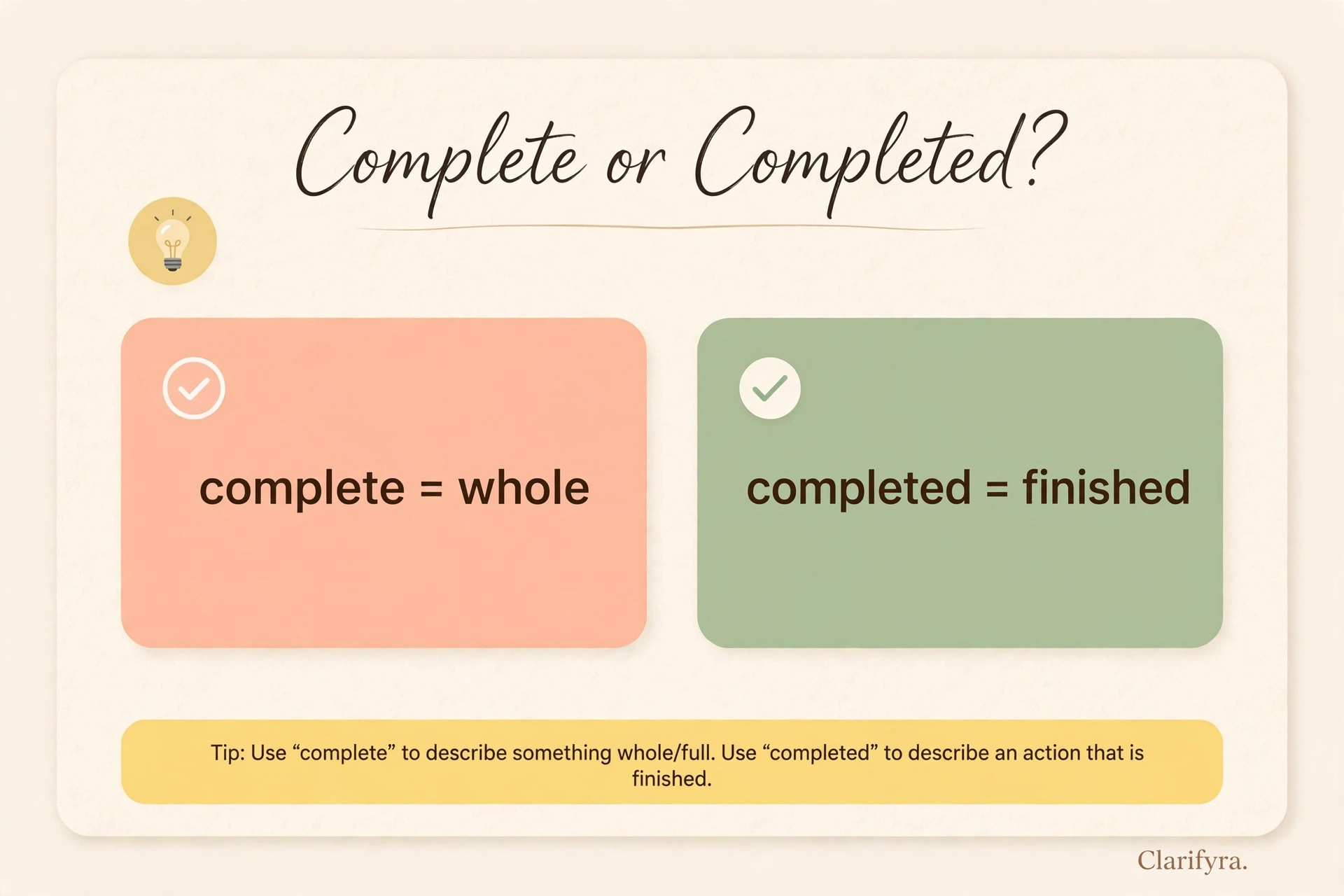
Use complete as the adjective for wholeness and totality — “a complete set,” “the complete works” — and as the base verb: “Please complete the form.” Use completed for the finished action, past or passive: “She completed the course in June”; “The form has been completed.” As predicative adjectives both “The work is complete” and “The work is completed” occur, but complete stresses the state (nothing missing) while completed stresses the finished process. When a form is filled in, edited English prefers completed.
Complete: One Word, Two Jobs
Start with the word itself. Merriam-Webster lists complete first as an adjective (kəm-ˈplēt, rhyming with repeat; comparatives completer, completest) and second as a verb (completed; completing). The adjective’s first sense is “having all necessary parts, elements, or steps” — “a complete diet,” beans and grains forming “a complete protein.” Oxford’s verb entry gives the matching action senses: “to finish making or doing something” (“to complete a course/project”; “She’s just completed a master’s degree in Law”), “to write all the information you are asked for on a form” (“2,000 shoppers completed our questionnaire”), and “to make something whole or perfect” (“I only need one more card to complete the set”).
As an adjective, complete has a wider reach than mere finishedness. Merriam-Webster’s second sense is “total, absolute” — complete silence — with “fully carried out: thorough” beside it: “a complete renovation.” This is the complete of “a complete idiot,” “complete nonsense,” “a complete stranger”: an intensifier that says the quality holds without exception. No one says “a completed idiot,” because the meaning there is totality, not a finished process. The adjective also carries specialist senses — a legally caught football pass, a highly proficient artist (“a complete artist”), a period “brought to an end: concluded” — but the everyday claims are wholeness and totality.
Etymology explains the overlap. Merriam-Webster traces the adjective to Latin complētus, past participle of complēre — “to fill, make up, carry to completion” (com- + plēre, “to fill”); the verb complete (Middle English completen) derives from the adjective. Complete was a participle in Latin first, which is why its state meaning sits so close to English completed. First known uses: adjective 14th century, verb 15th.
Completed: The Finished Action
Completed is, first of all, a verb form: the past tense and past participle of complete. “She completed her hat-trick in the 75th minute”; “He has recently completed his first year at Durham University”; “The work should be completed by December” — the Oxford examples show all three patterns: simple past, perfect, and passive. Whenever your sentence reports an act of finishing, filling in, or making whole, and that act is located in the past or presented as done, completed is the form.
The passive frame enforces the same choice. “Has the form been correctly completed?” (Oxford) — here completed is not optional, because be completed is the passive of the verb, and *been complete cannot carry that meaning. Likewise “The merger is expected to be completed by the end of the year,” “Arrangements for the trip have now been completed,” “It is unlikely that the repairs will be completed on time.” When an agent, a deadline, or a by-phrase is in the background — completed by December, completed by the builders — the participle is doing verbal work and complete cannot replace it.
Where They Genuinely Compete — and Where They Don’t
| Context | Complete | Completed |
|---|---|---|
| Before a noun: wholeness | ✓ “a complete set” (nothing missing) | “a completed set” (someone finished assembling it) — rare |
| Before a noun: totality | ✓ “complete silence”; “a complete stranger” | ✗ “completed silence” — never for totality |
| Before a noun: filled-in document | “a complete form” (all sections present) | ✓ “the completed form” (filled in) |
| Past action | ✗ “She complete the course.” | ✓ “She completed the course.” |
| Passive | ✗ “has been complete” | ✓ “has been completed“ |
| After is: state | ✓ “The work is complete.” (nothing left to add) | ✓ “The work is completed.” (the process is done) — standard, slightly process-flavoured |
| Intensifier | ✓ “a complete disaster” | ✗ “a completed disaster” |
Read the table by columns and the pattern emerges. Completed is tethered to an event: somebody finished something, at some point, and the result stands. Complete is tethered to a state or a scale: everything is present, or the quality is absolute. That is why “The project is complete” and “The project is completed” can both be printed by careful writers yet feel different to careful readers — the first presents the project as a finished whole, like a completed set with the lid on; the second reports that the finishing has been carried out, the way “The project has been completed” does with the verb in full view.
House style matters after is. Some editors prefer complete (“The work is complete”); most administrative and technical writing uses completed freely (“Registration is completed online”). Neither is an error. The real errors are at the edges: completed for totality (“completed silence”), complete in the passive (“has been complete”), and the attributive swap (“send the complete form” for the filled-in one).
Correct vs. Incorrect
- ✓ “Please complete the form and return it.” (base verb — Oxford sense: fill in)
- ✓ “Has the form been correctly completed?” (passive — only completed works)
- ✗ “Has the form been correctly complete?” → ✓ “been correctly completed“
- ✓ “Send us the completed application by Friday.” (filled-in document)
- ✓ “The dictionary comes with a complete set of examples.” (nothing missing)
- ✓ “It was a moment of complete silence.” (totality)
- ✗ “It was a moment of completed silence.” → ✓ “complete silence” (no finishing event is meant)
- ✓ “She has recently completed his first year at university.” (finished action — Oxford pattern)
- ✓ “The work is complete.” / ✓ “The work is completed.” (both attested; state vs. process flavour)
- ✗ “She complete her degree last year.” → ✓ “She completed her degree last year.”
- ✓ “You need one more volume to complete the set.” (verb: make whole)
- ✗ “a completed stranger” → ✓ “a complete stranger” (totality, not finishedness)
Common Mistakes
1. “Please find the completed form attached” vs. “the complete form.” If the reader must fill the form in and send it back filled, it is the completed form. A “complete form” in the attachment is merely a form with all its pages. Most workplace confusion between the two words lives in this one phrase; pick the participle for anything a person has filled in.
2. Using complete as a past tense. “Yesterday I complete my training” drops the verb’s past marker. The past tense and participle are completed: “I’ve fully completed my training” (Oxford). The mistake surfaces most in perfect tenses — *has complete — where the participle is obligatory: “has completed.”
3. Reaching for completed as an intensifier. “A completed disaster,” “completed nonsense,” “completed silence” — none of these work, because totality is the adjective complete‘s territory: “complete silence,” “a complete renovation,” “utter/complete nonsense.” If you could swap in total or absolute, the word is complete.
4. “More completed,” “very completed.” As a participle of a finishing verb, completed resists comparison the way finished does; things are finished or they are not. Complete, by contrast, has recorded comparatives in Merriam-Webster (completer, completest) and happily takes almost and nearly — “almost complete,” “nearly complete” — because wholeness is a scale. If your modifier is about degree of wholeness, the adjective is complete.
5. Mixing the senses. “Complete the questionnaire” (Oxford: “Participants completed a survey”) means fill it in, not perfect it. In British administrative English complete a form is the standard instruction where American English often says fill out a form.
6. Treating “is completed” as wrong. It is not: “The work should be completed by December”; “The project has now been successfully completed.” Prefer is complete for the stative flavour, but do not “correct” is completed — no dictionary rule forbids it.
Frequently Asked Questions
Is it “the form is complete” or “the form is completed”?
For a filled-in form, edited usage prefers completed: “Has the form been correctly completed?” (Oxford) — the passive makes the choice for you. “The form is complete” is grammatical but reads as “the form has all its sections,” which is rarely what the sender of a form means.
Can I say “the work is completed”?
Yes. The participle adjective is standard: “The work should be completed by December”; “The project has now been successfully completed.” “The work is complete” is equally correct and slightly more stative — choose it when you are contemplating the finished whole rather than reporting the finishing.
Why is it “a complete set” but “a completed form”?
Because the claims differ. A set is praised for wholeness — every piece present — and wholeness is the adjective complete. A form is praised for having been filled in — a finished process — and finished processes take the participle completed. “A completed set” would mean someone had finished assembling a set, a different and unusual claim.
Is “complete” a verb as well as an adjective?
Yes, in both major dictionaries. As a verb it means to finish (“to complete a task/mission”), to fill in (“to complete a form,” Oxford’s synonym “fill something in”), and to make whole (“Her latest purchase completes her collection,” Merriam-Webster). Its forms are regular: completes, completing, completed.
What about the spelling “compleated”?
Not a form of this verb in modern edited English. Compleat survives as an archaic adjective meaning quintessential or fully equipped — “the compleat modern misfit” — preserved in Izaak Walton’s The Compleat Angler (1653) and fossilized quotations. For the past tense of complete, the spelling is always completed.
The Takeaway
Complete is the adjective of wholeness and totality — “a complete set,” “complete silence,” “the complete works” — and the base verb of finishing and filling in: “complete the form.” Completed is that verb’s past and participle — “She completed the course”; “The form has been completed” — and the participle adjective for anything filled in or carried through: “the completed application.” After is, both are attested, with complete contemplating the finished state and completed reporting the finished process. Run the substitution test — whole/total points to complete, finished (with a finishing moment behind it) points to completed — and the coin toss disappears.