Formerly or Formally: What’s the Difference?
When you pause mid-sentence and wonder whether you need formerly or formally, the two words can feel interchangeable because they look almost identical and, in most spoken English, they are pronounced almost the same way. They are not interchangeable at all. Formerly points backward in time; formally points to manner, rules, and official recognition. Once you tie each spelling to its base word — former for time, formal for form and ceremony — the choice becomes straightforward in nearly every sentence.
Quick Answer
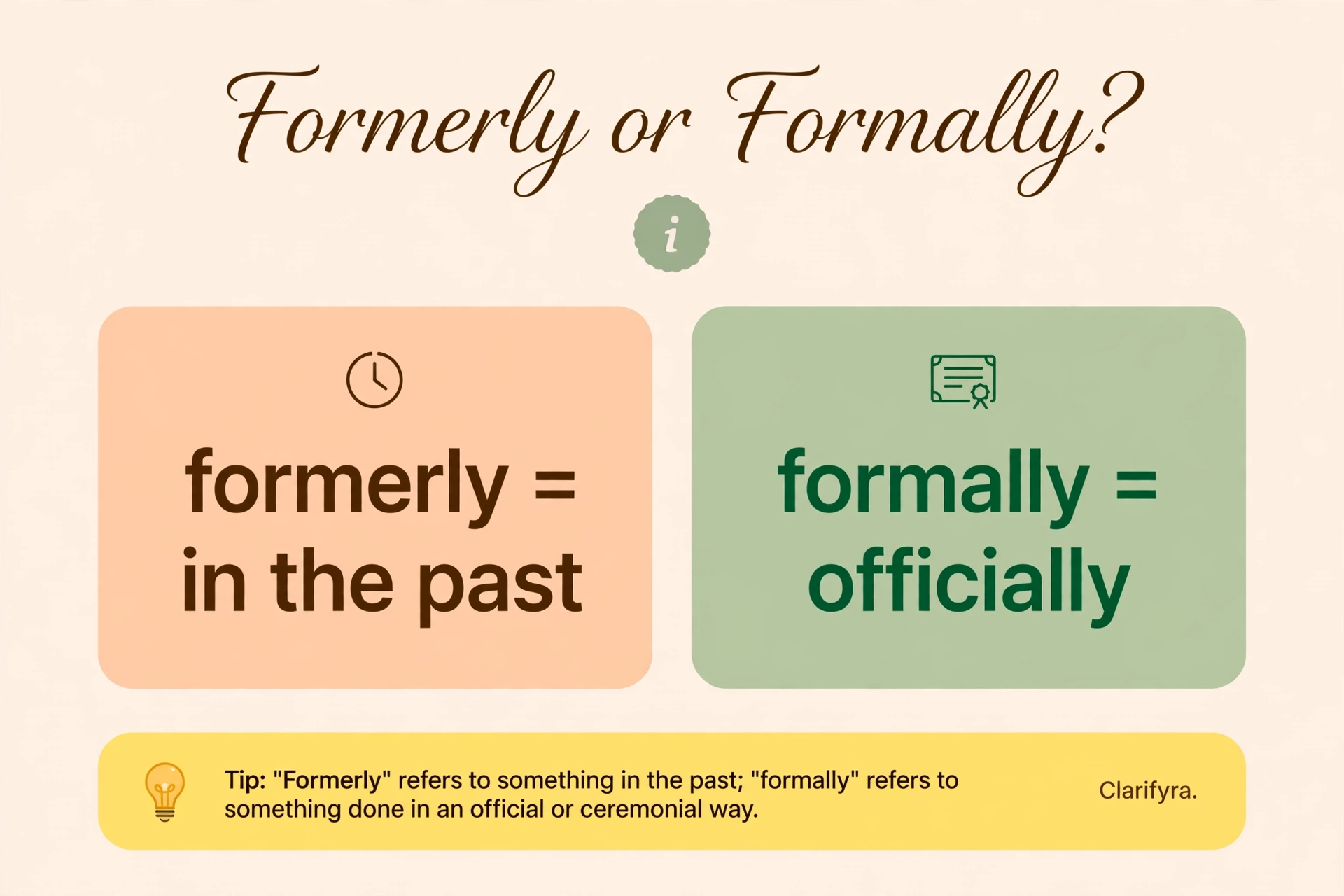
Formerly means “in the past; at an earlier time” and comes from former: “The European Union was formerly called the European Community.” Formally means “officially” or “in a serious, correct, ceremonious way” and comes from formal: “The deal will be formally announced on Tuesday”; “He was formally dressed.” Cambridge gives both words UK /ˈfɔː.mə.li/ and US /ˈfɔːr.mə.li/ — homophones for most speakers — so spelling, not sound, carries the distinction.
Formerly: The Word That Looks Backward
Formerly is an adverb built on former, the word for “earlier” or “previous.” The Cambridge Learner’s Dictionary defines formerly simply as “in the past,” and the Cambridge Advanced Learner’s tradition illustrates it with rename sentences — the pattern where it appears most often: “The artist formerly known as Prince.” Merriam-Webster’s thesaurus entry groups it with once, erstwhile, onetime, earlier, and previously, and gives two related senses: “at an earlier or previous time” and “so as to precede something in order of time.”
That temporal core shows up in a handful of natural patterns. The most recognizable is the renaming pattern: “Myanmar, formerly Burma, was renamed in 1989”; “The building was formerly used as a bank, but is now being turned into a bar”; “The house was formerly owned by the local council” — all examples in the Cambridge tradition. Here formerly tells the reader that a previous name, use, or owner no longer holds.
A second pattern is biographical: “He had formerly been in the Navy” (Collins); “Many formerly radical students now work for the government.” A third is historical contrast: “Formerly this large town was a small village.” In each case the sentence sets a past state against a changed present, and formerly is the hinge between the two.
Pronunciation offers no rescue. Cambridge prints the same UK /ˈfɔː.mə.li/ and US /ˈfɔːr.mə.li/ for both words (Collins American fɔrmərli, British fɔːʳməʳli), so listeners normally cannot hear the difference.
Formally: The Word for Official Form and Ceremony
Formally is the adverb of formal — and formal itself covers two territories that feed the adverb: official recognition, and correct ceremonial manner. Cambridge splits formally into exactly those two senses. The first, labelled OFFICIALLY, is defined as “officially”: “The deal will be formally announced on Tuesday”; “The ceasefire has yet to be formally agreed”; “The contract is not binding until it has been formally agreed by both parties”; “The driver was formally cautioned for exceeding the speed limit.” The second, labelled SERIOUSLY/CORRECTLY, is “in a serious and correct way”: “He was formally dressed in a grey suit”; “The professor greeted us very formally.”
That split explains the adverb’s range. In “The centre will be formally opened next year,” formally signals an opening with ceremony and official status, not just the day the doors unlock. In “The new library was officially opened yesterday,” dictionaries in the PASSWORD tradition gloss officially itself as formally, underlining how close the two adverbs sit in this sense. In legal and administrative prose, formally is the standard verb partner: formally declare, formally announce, formally agree, formally open, formally approve, formally charge. Collins’ translations capture the same cluster — announce officiellement, speak or address solennellement, dress de façon conventionnelle.
The ceremonial sense is equally ordinary: “Ron and Sara were formally introduced to each other”; “We weren’t formally introduced, but I know who you are”; “Office workers these days dress less formally than they did twenty years ago.” Here formally says nothing about the past. It says the introduction, the dress code, or the greeting followed the accepted form.
Pronunciation, again, is identical on paper: Cambridge, UK /ˈfɔː.mə.li/, US /ˈfɔːr.mə.li/ for formally exactly as for formerly. The noun partner tells the same story — formality (fɔrˈmæləti), “the quality of being formal” — which is why the old classroom jibe works: you would never write formerlity for formality, so don’t let the adverb drift either. Formal → formally → formality is one word family, concerned with form. Former → formerly is another, concerned with time.
One nuance deserves a sentence of its own. In academic and technical writing, formally can mean “in formal terms; precisely defined”: “A tree form is formally defined as follows”; “The term ‘rule’ should not be narrowly construed here to refer only to formally adopted norms” (Cambridge corpus examples). This is still the formal family at work — form as structure and definition — not the past.
Side-by-Side: Time Versus Manner
| Question | Formerly | Formally |
|---|---|---|
| Base word | former (earlier, previous) | formal (official, ceremonious) |
| Answers | When? At what earlier time? | How? In what official or correct way? |
| Core meaning | In the past; previously | Officially; ceremoniously; by the rules |
| Typical partners | known as, called, owned by, used as, been | announced, agreed, opened, dressed, introduced, charged |
| Pronunciation (Cambridge) | UK /ˈfɔː.mə.li/; US /ˈfɔːr.mə.li/ | UK /ˈfɔː.mə.li/; US /ˈfɔːr.mə.li/ |
| Substitution test | Works with previously / once / in the past | Works with officially / ceremoniously |
| Example | “Istanbul was formerly known as Constantinople.” | “The mayor will formally open the new station.” |
The table compresses the whole article into one habit: ask what your adverb is doing. If it is placing something in an earlier period — a name, a job, a use, a belief — you need the time word, formerly. If it is certifying an act as official, or describing behaviour that follows etiquette and correct form, you need formally. The great majority of confusions happen in exactly two phrases, and they are worth isolating.
“Formally known as” is the commonest error. The phrase means “previously known as,” so it is formerly known as: “the artist formerly known as Prince.” “Formerly dressed” is the mirror error: clothing follows form, so people are formally dressed.
Correct vs. Incorrect
- ✓ “Myanmar, formerly Burma, was renamed in 1989.” (past name)
- ✗ “Myanmar, formally Burma, was renamed in 1989.” → ✓ “formerly Burma” (a rename is time, not ceremony)
- ✓ “The deal will be formally announced on Tuesday.” (official announcement — Cambridge)
- ✗ “The deal will be formerly announced on Tuesday.” → ✓ “formally announced” (announcements follow official form)
- ✓ “The building was formerly used as a bank.” (previous use)
- ✓ “He was formally dressed in a grey suit.” (ceremonious dress — Cambridge)
- ✗ “He was formerly dressed in a grey suit.” → ✓ “formally dressed” (unless you mean he no longer wears grey suits)
- ✓ “The artist formerly known as Prince.” (previous name)
- ✗ “The artist formally known as Prince.” → ✓ “formerly known as” (no official ceremony is implied)
- ✓ “We weren’t formally introduced.” (no proper introduction took place)
- ✓ “Formerly this large town was a small village.” (historical contrast)
- ✓ “The ceasefire has yet to be formally agreed.” (official agreement pending — Cambridge)
Common Mistakes
1. “Formally known as.” The rename formula attracts the wrong spelling because formally is the more frequent word overall and spellcheckers accept it. Resist it: known-as sentences are about time. “The European Union was formerly called the European Community” (Cambridge) is the model.
2. Letting autocomplete choose. Modern keyboards finish “-ly” words eagerly, and because the two adverbs differ by one letter (e versus a after form-), the substitution slips through proofreading. A deliberate read-aloud pass — substituting previously or officially — catches it every time.
3. Using formerly for current officialdom. “The president formally welcomed the delegates” describes protocol at the moment of welcoming. Writing formerly welcomed relocates the welcome to the past and says it no longer happens. The tense of the verb rarely saves you, because both readings are grammatical; only the adverb decides.
4. Using formally for abandoned habits. “Formerly, he would have known the answer to that grammar query, but not now” is the natural sentence (Future Perfect’s example). Formally there would claim he once answered grammar queries with great ceremony — grammatical, but not what you meant.
5. Forgetting the third sense of formally. In definitions and technical prose — “formally defined,” “formally adopted,” “formally equivalent” — the adverb means “in precise, formal terms.” Writers who only know the dress-code sense sometimes “correct” these to formerly and wreck the sentence. Precision of form, not the past, is meant.
6. Pronouncing your way out of it. Writers occasionally insist the words sound different. In the dictionary record they do not: Cambridge prints the same UK /ˈfɔː.mə.li/ and US /ˈfɔːr.mə.li/ for both. British non-rhotic speech makes them identical, and most American speakers merge them too. Write the distinction; do not rely on hearing it.
Frequently Asked Questions
Is it “formally known as” or “formerly known as”?
Formerly known as. The phrase records a previous name, and formerly is the past-tense adverb: “the artist formerly known as Prince.” Formally would claim the name was conferred with official ceremony, which is not what the formula means.
Can formally mean “officially” as well as “in formal dress”?
Yes — Cambridge lists both as separate senses of the same adverb: OFFICIALLY (“The deal will be formally announced on Tuesday”) and SERIOUSLY/CORRECTLY (“He was formally dressed in a grey suit”). Context decides; neither sense involves the past.
Do formerly and formally sound different in British and American English?
On the dictionary page, no. Cambridge gives identical transcriptions — UK /ˈfɔː.mə.li/, US /ˈfɔːr.mə.li/ — for both words, while Collins prints American fɔrmərli for formerly. Careful speakers may lean on the r of former to signal the time word, but as a rule they are homophones, which is precisely why the spelling matters.
Is formerly a formal word?
Somewhat. Cambridge marks formerly as a formal adverb (B2), and in casual speech people more often say used to be or before: “This used to be a bank.” In writing — renames, histories, obituaries, institutional profiles — formerly remains the concise standard choice.
What’s the fastest way to remember the difference?
Keep the base words in view. Former is about earlier things — a former president held the job before. Formal is about form — formal dress, formal procedure, formality. Add -ly to the right base and the adverb follows: time takes formerly, ceremony and officialdom take formally.
The Takeaway
Formerly means “in the past”: it renames things, dates old jobs, and contrasts what was with what is — “Istanbul was formerly known as Constantinople.” Formally means “officially” or “in correct, ceremonious form”: it announces deals, opens buildings, agrees contracts, and dresses people for occasions — “The deal will be formally announced on Tuesday.” The two adverbs share a pronunciation (UK /ˈfɔː.mə.li/; US /ˈfɔːr.mə.li/) and differ by a single vowel, so let the substitution test decide: if previously fits, write formerly; if officially fits, write formally.