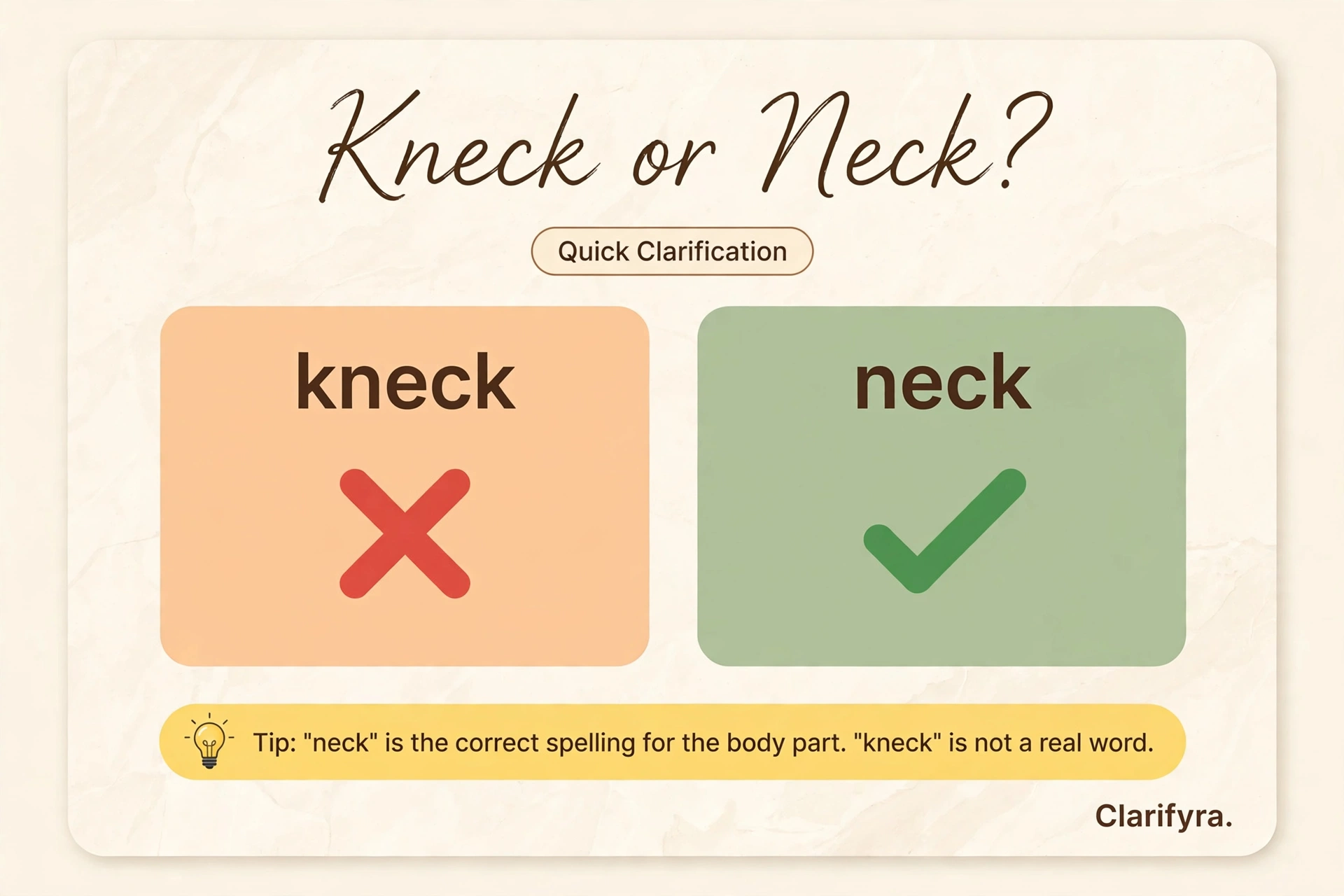
Kneck or Neck: Which Is Correct?
The correct spelling is neck — no k at the front. Kneck turns up in typed messages and schoolwork because English is full of words that begin with a silent kn — knee, knife, knock — and the pattern leaks onto a word that never had it. The part of the body that joins your head to your shoulders is neck, from Old English hnecca, and every modern dictionary enters it without the k. There’s one historical wrinkle worth knowing, covered below: kneck does appear in an old nautical sense and as an obsolete spelling, but neither makes it a correct way to write the body part today.
Quick Answer
Neck is the correct modern spelling for the body part — Collins: “the part of an organism connecting the head with the rest of the body,” pronounced (nɛk); Merriam-Webster: “the part of an animal that connects the head with the body.” Oxford Learner’s gives the pronunciation /nek/ in both British and American English. Kneck is not the standard spelling of that word: the Oxford English Dictionary records a separate, now-obsolete noun kneck (1706–1867, a nautical term related to kink), and old sources record kneck as an obsolete spelling of neck — but for anything written today, the body part, the bottle part, and the verb are all spelled neck.
The Word “Neck” Itself
Neck is one of the oldest everyday nouns in English. Collins traces it to Old English hnecca, related to Old High German hnack, and Merriam-Webster’s definition starts where every learner’s dictionary starts: “the part of an animal that connects the head with the body.” From that central sense radiates a tidy family of extended meanings, all spelled the same way: the part of a garment nearest the neck, the narrow end of a bottle, the slender part of a violin between body and head, a narrow strip of land, and the racing margin in “won by a neck.”
The word is also a verb. Informally, to neck means to kiss and embrace, and in British informal use it can mean to swallow a drink quickly — Collins’ example is “he’s been necking pints all night.” The verb forms keep the spelling intact: necks, necked, necking. At no point in the modern paradigm does a k appear, which is the practical fact to hold onto: if you are writing about heads, shoulders, bottles, or violins, the word is neck from start to finish.
Pronunciation offers no help in adding a k, because there is none to hear. Oxford Learner’s records /nek/ for British English and NAmE /nɛk/ for American English — the same single-syllable word on both sides of the Atlantic. Collins gives ( nɛk ) for both British and American entries. Nothing in the sound of the word suggests an initial k, which is precisely why the kneck error is a spelling-pattern error rather than a listening error.
Why the K Creeps In: The Silent-Kn Pattern
English keeps a visible fossil of an older pronunciation in its kn- words. Knee, knife, knight, knock, know, and knit were once pronounced with the k sounded; the k went silent in speech centuries ago but stayed in the spelling. A learner who has absorbed that pattern — quite reasonably — may extend it to other words that begin with an /n/ sound, and neck is a natural target: it starts with /n/, it’s a body word like knee, and it sits near knee in early vocabulary lists.
The historical record, however, goes the other way. Neck descends from Old English hnecca — its old initial consonant was h, not k — and Middle English spelled it nekke. It was never part of the kn- family. The kn- words come from a different Old English cluster, and their k is etymological, not decorative. English spelling is often accused of being arbitrary, but here it is quietly consistent: words with silent k earned it through their history, and neck‘s history has no k to earn.
So Is “Kneck” Ever a Word?
This is the nuance the dictionaries actually support, and it’s worth stating precisely rather than declaring kneck “not a word” and stopping there. The Oxford English Dictionary has an entry for the noun kneck: one meaning, now obsolete, last recorded around the 1860s, apparently a variant or alteration of kink, with its earliest evidence from 1706. Webster’s 1913 dictionary records the same nautical term: “(Naut.) The twisting of a rope or cable, as it is running out.” Separately, kneck is recorded in historical sources as an obsolete spelling of neck itself.
None of that rescues kneck as a modern spelling of the body part. A nautical term for a twisting rope, obsolete for over 150 years, and a spelling variant abandoned centuries ago, together amount to this: a sailor in 1750 could write kneck and be understood, but a student, journalist, or professional writing today will simply be marked wrong. Collins, Merriam-Webster, Oxford Learner’s, and Cambridge all enter the body part as neck — the checked dictionaries record no current sense in which kneck spells the thing between your head and your shoulders. (A piece of internet slang also uses kneck jokingly for the area between chin and chest; it is a deliberate joke spelling, not a dictionary sense.)
Neck at a Glance
| Use | Correct form | Example |
|---|---|---|
| Body part | neck | “She craned her neck to see.” |
| Bottle / violin part | neck | “He grabbed the neck of the bottle.” |
| Garment part | neck | “a round-neck sweater” |
| Verb (informal) | neck, necking | “They were necking in the corner.” |
| Obsolete nautical term | kneck (historical only) | A twisting of rope, recorded 1706–1867 |
The table’s last row is the whole story: kneck has a past, but it has no present. Every living sense — body, bottle, garment, verb — belongs to neck.
Correct vs. Incorrect
- ✓ “He broke his neck in the accident.” (Merriam-Webster’s example)
- ✗ “He broke his kneck in the accident.” → ✓ “He broke his neck in the accident.”
- ✓ “A giraffe has a very long neck.”
- ✗ “A giraffe has a very long kneck.” → ✓ “A giraffe has a very long neck.”
- ✓ “She wore a scarf around her neck.”
- ✗ “She wore a scarf around her kneck.” → ✓ “She wore a scarf around her neck.”
- ✓ “The horse won by a neck.”
- ✗ “The horse won by a kneck.” → ✓ “The horse won by a neck.”
Common Mistakes
1. Importing the silent-k pattern. The core error: because knee and knife start with silent kn, neck feels like it should too. It shouldn’t — its Old English ancestor hnecca began with h. A useful check: the genuine kn- words cluster around a few old word families (think know/knowledge, knight), and neck is in none of them.
2. Trusting a spellchecker gap. Older or minimal wordlists occasionally fail to flag kneck precisely because the obsolete nautical word exists in historical dictionaries. Absence of a red underline is not evidence of correctness; the modern dictionaries are unanimous for neck.
3. Mixing up “neck” relatives. The error sometimes spreads to compounds: necklace, neckline, necktie, and breakneck all keep the plain n start. If the base is neck, every word built on it is too — there is no compound in standard English that begins “kneck-“.
4. Confusing “neck” with “kneck” in the verb. The informal verb is to neck — “they were necking on the park bench,” in Merriam-Webster’s example. Writing knecking imports the same stray k into a form where it was never present.
5. Overcorrecting real kn- words. The opposite slip: having learned that neck has no k, a writer drops it where it belongs — nee for knee, nife for knife. The rule is word-specific, not a general ban on silent k: knee keeps its k, neck never had one.
Frequently Asked Questions
Is “kneck” a real word?
Historically, yes, in two narrow ways: the Oxford English Dictionary records kneck as an obsolete noun (1706–1867) related to kink, and old sources list it as an obsolete spelling of neck. In modern English it is not a standard spelling of the body part — Collins, Merriam-Webster, Oxford, and Cambridge all use neck.
Why do people write “kneck”?
Because of the silent-k pattern in knee, knife, and knock. The pattern is real but etymological: those words descend from Old English kn- clusters, while neck descends from hnecca and never had a k.
How is “neck” pronounced?
/nek/ — Oxford Learner’s gives /nek/ for British English and /nɛk/ (NAmE) for American English; Collins gives (nɛk). One syllable, short e, no trace of a k sound at the start.
What does “neck” mean besides the body part?
A great deal, per Collins and Merriam-Webster: the neck of a bottle or violin, the part of a garment around the neck, a narrow strip of land or water, and the racing margin in “won by a neck.” As a verb it means, informally, to kiss and embrace — and in British informal use, to swallow a drink quickly.
How can I remember the spelling?
Anchor it to its compounds: necklace and necktie are words you’ve seen a thousand times, and neither hides a k. If you can spell the jewellery, you can spell the body part — n-e-c-k, starting with the same plain n.
The Takeaway
The body part is spelled neck — /nek/, from Old English hnecca — in British and American English alike, along with the bottle part, the garment part, and the informal verb. Kneck survives only as a historical curiosity: an obsolete nautical word for a twisting rope and an obsolete spelling, neither current since the 1800s. The silent k in knee and knife belongs to a different word family. Leave it there, and write neck.