Theirself or Themself: Which Is Correct?
Choosing between theirself and themself can be confusing because both forms appear in English, especially when a sentence uses the singular pronoun they. However, they do not have the same status in standard English. Themself is increasingly used as the singular reflexive form of they, while theirself is mainly considered dialectal or nonstandard. There is also a third form—themselves—which remains common and accepted even when they refers to one person.
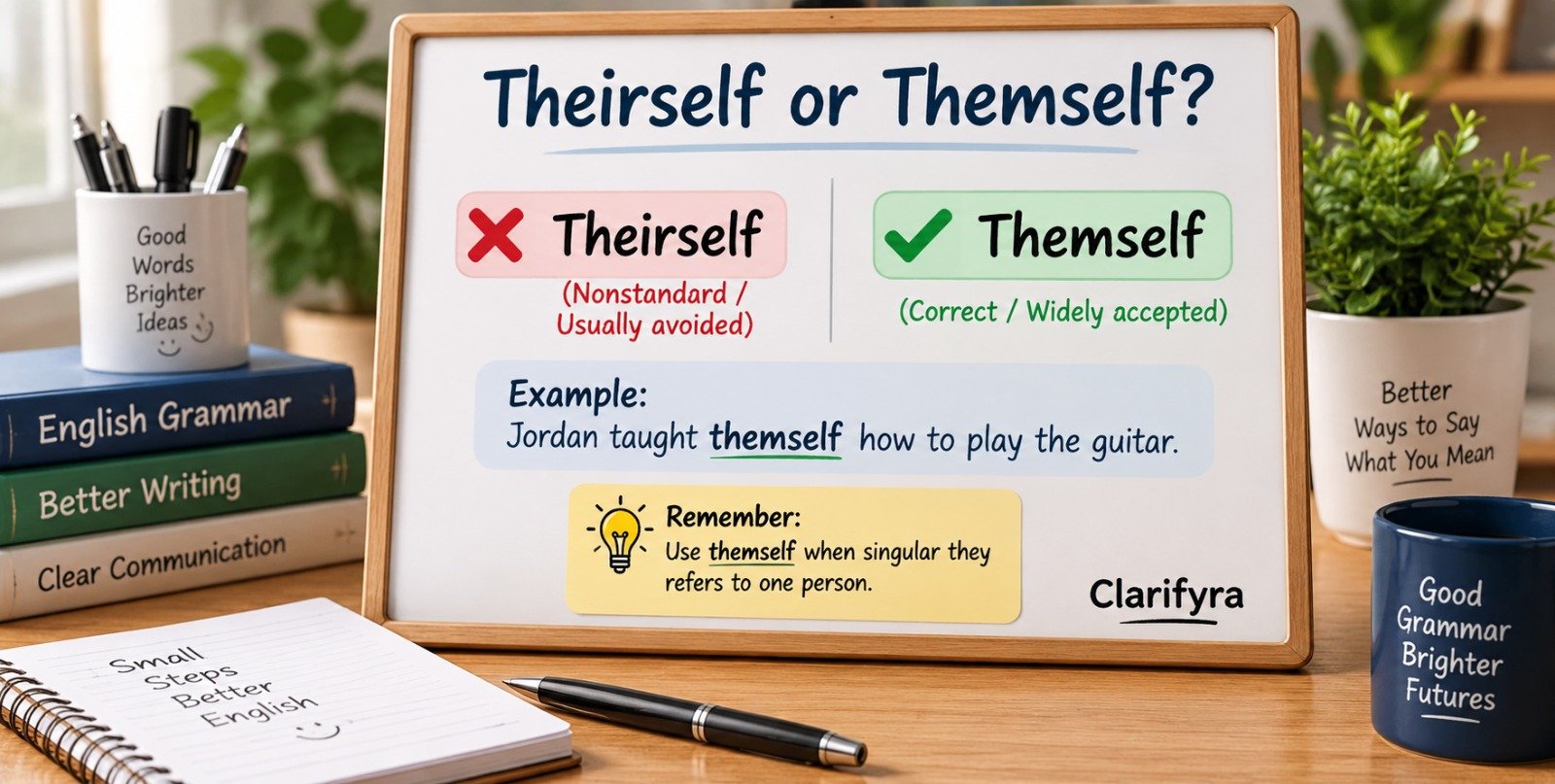
Themself is generally the better choice when singular they refers to one person. Theirself is a real word, but it is mostly dialectal or nonstandard and is usually avoided in formal writing. Themselves is also widely accepted with singular they.
Theirself or Themself: What’s the Difference?
The main difference is not meaning but standard usage.
Themself is a singular reflexive pronoun. It can refer back to one person who has already been described with they or them.
For example:
- Jordan taught themself how to play the guitar.
- Every applicant should give themself enough time.
- Taylor introduced themself to the group.
Theirself, by contrast, is used in some dialects and informal speech, but it is not normally recommended in standard edited English.
For example:
- Dialectal: Someone should look after theirself.
- Standard: Someone should look after themself.
- Also standard: Someone should look after themselves.
Quick Comparison
| Feature | Themself | Theirself |
|---|---|---|
| Is it a real word? | Yes | Yes |
| Standard English? | Increasingly accepted | Usually dialectal/nonstandard |
| Refers to | One person | Usually one person |
| Related pronoun | They/them | Their |
| Formal writing | Often acceptable, depending on style | Usually avoided |
| Example | Alex prepared themself. | Alex prepared theirself. |
You May Also Read | Is It Yall or Y’all? Learn the Correct Spelling
What Is Themself?
Themself is a reflexive or intensive pronoun used with singular they.
A reflexive pronoun refers back to the subject of a sentence:
- Morgan reminded themself about the appointment.
- A student should ask themself whether the answer is complete.
An intensive pronoun adds emphasis:
- Jamie completed the entire project themself.
- The manager themself approved the change.
The form is especially useful when they clearly refers to a single individual.
Compare:
- They finished the task themself. — one person
- They finished the task themselves. — may refer to several people, although themselves can also be used for one person
The second version is still extremely common, so themself is not always required simply because the antecedent is singular.
What Is Theirself?
Theirself is a reflexive form built from their + self.
It appears in some regional varieties of English and informal speech. It has also existed for centuries, so it should not simply be described as an invented spelling mistake.
However, dictionaries commonly classify it as dialectal or nonstandard.
You may hear or read sentences such as:
- Everybody needs to take care of theirself.
- A person should believe in theirself.
- Nobody wants to embarrass theirself.
In standard writing, these would normally be written with themself or themselves:
- Everybody needs to take care of themself.
- A person should believe in themself.
- Nobody wants to embarrass themselves.
Therefore, if you are writing an essay, report, article, email, or other formal text, theirself is usually not the safest choice.
Is Theirself a Word?
Yes, theirself is a word, but that does not automatically make it appropriate in every context.
English contains many words and forms that belong mainly to particular dialects. Theirself falls into this category in most modern dictionaries.
It is better to say:
“Theirself is a dialectal or nonstandard form.”
rather than:
“Theirself is not a word.”
That distinction matters because native speakers do genuinely use it, and it has a documented history in English.
The same principle applies to theirselves, which can occur as a dialectal alternative to themselves.
Themself vs Themselves
A closely related question is whether you should use themself or themselves for one person.
Traditionally, themselves is the established reflexive form of they:
- The children dressed themselves.
- The employees introduced themselves.
Here, the pronoun clearly refers to multiple people.
However, English also uses they as a singular pronoun:
- Someone left their phone here.
- Every employee should check their schedule.
- Jordan said they would arrive later.
Because singular they is common, both of these constructions may appear:
- Someone should ask themself what they really want.
- Someone should ask themselves what they really want.
The first makes the singular meaning particularly clear. The second follows the long-established form themselves and remains very natural in standard English.
When referring to a specific person who uses they/them pronouns, themself may also be preferred if that person uses the form for themselves.
Why Do People Say “Theirself”?
The confusion makes sense because English reflexive pronouns do not all follow exactly the same pattern.
Compare:
- my → myself
- your → yourself
- our → ourselves
- him → himself
- her → herself
- them → themselves
Because myself and yourself are formed from possessive-looking forms, speakers may naturally create:
their + self = theirself
At the same time, forms such as himself are built using an object pronoun. Following that pattern gives:
them + self = themself
English developed its reflexive pronouns through different historical patterns, which is one reason forms like theirself, themself, and themselves can coexist.
Theirself in a Sentence
If you come across theirself in a sentence, the intended meaning is usually easy to understand.
Examples of dialectal or informal usage include:
- Every person has to decide for theirself.
- Someone could easily hurt theirself doing that.
- Nobody should blame theirself for everything.
In standard English, these would normally become:
- Every person has to decide for themself.
- Someone could easily hurt themself doing that.
- Nobody should blame themselves for everything.
This shows why theirself or themself meaning is not really about two different definitions. Both forms point back to the same person; the important distinction is which form is considered standard.
Theirselves Examples
Theirselves follows a similar pattern to theirself. It appears in regional and dialectal English as an alternative to themselves.
Examples include:
- They built it theirselves.
- The children cleaned the room theirselves.
- The workers handled the repairs theirselves.
In standard written English, use:
- They built it themselves.
- The children cleaned the room themselves.
- The workers handled the repairs themselves.
Unlike themself, which has an important role as a singular reflexive form, theirselves normally has little reason to replace themselves in formal English.
How to Choose the Right Form
A simple rule can prevent most mistakes:
One person using singular they → themself or themselves
More than one person → themselves
Theirself → mainly dialectal; avoid it in formal writing
For example:
One person:
Robin gave themself another chance.
One person, traditional form:
Robin gave themselves another chance.
Several people:
Robin and Casey gave themselves another chance.
Dialectal/nonstandard:
Robin gave theirself another chance.
If you are unsure in a formal context, themselves is often the safest established option. If you specifically want to emphasize that singular they refers to one individual, themself can be clearer.
Common Mistakes to Avoid
Using “theirself” as the default formal form
Because we say their book and their decision, it may seem natural to write theirself. Standard English, however, generally favors themself or themselves.
Assuming “themself” is simply incorrect
Although some traditional style guidance has preferred themselves, themself is a recognized form with a long history and a clear modern use with singular they.
Using “themself” for several people
If the pronoun refers to multiple people, use themselves:
Correct: The students introduced themselves.
Incorrect: The students introduced themself.
Calling “theirself” a spelling error
It is more accurate to call it a dialectal or nonstandard form rather than a simple misspelling.
What Does Reddit Say About Theirself or Themself?
Discussions about theirself or themself on Reddit often reflect the same distinction found in dictionaries and grammar guidance.
People generally recognize themself as a logical singular counterpart to themselves, especially when they refers clearly to one person. Theirself is also understood, but many speakers regard it as regional, informal, or unsuitable for formal writing.
Reddit discussions can be useful for seeing how people actually speak, but everyday usage does not always match the conventions expected in academic or professional English. For edited writing, themself or themselves remains the safer choice.
Easy Way to Remember
Think of this pattern:
him → himself
her → herself
them → themself
If one person is represented by them, then themself follows naturally.
For multiple people:
them → themselves
You can remember theirself as the dialectal alternative—not the form you would normally choose for standard formal English.
Final Verdict: Which Form Should You Use?
Use themself when singular they refers reflexively to one individual, especially when you want the singular meaning to be clear. Themselves is also widely accepted with singular they and remains the safest traditional choice in many formal contexts. Theirself exists, but because it is generally treated as dialectal or nonstandard, it is best avoided in edited writing.
Frequently Asked Questions
Is it theirself or themself?
For standard English, themself is usually preferable when referring to one person with singular they. Theirself is mainly dialectal or nonstandard.
Is theirself a real word?
Yes. Theirself is a recorded English word, but dictionaries generally classify it as dialectal or nonstandard rather than the preferred form in formal writing.
Is themself grammatically correct?
Yes, themself is used as a singular reflexive form of they. Some traditional styles still favor themselves, but themself is well established and particularly useful when they refers to one person.
Should I say “someone hurt themself” or “someone hurt themselves”?
Both forms occur. Someone hurt themself clearly treats someone as one individual, while someone hurt themselves uses the traditional reflexive form and is also standard and natural.
Can I use theirself in formal writing?
It is usually better not to. In formal, academic, or professional writing, choose themself or themselves unless you are intentionally reproducing a regional dialect.
Is theirselves correct?
Theirselves exists in dialectal English, but standard English normally uses themselves for a plural reflexive pronoun.
The simplest distinction is that themself can refer to one person, themselves works for multiple people and commonly for singular they, while theirself is mainly dialectal. Keeping that rule in mind makes it much easier to choose the appropriate form, which is exactly the kind of practical English distinction Clarifyra aims to make clear.
You May Also Read | Personel or Personnel: Which Spelling Is Correct?