Cubby or Cubbie: Which Spelling Is Correct?
The words cubby and cubbie look almost identical, so it is easy to wonder which one belongs in standard English. The confusion is especially understandable because the plural of cubby is cubbies, which makes the singular form look as though it might be cubbie. In modern standard English, however, cubby is the usual spelling for a small storage compartment, cubbyhole, or similar small space. Cubbie does exist in some regional, historical, informal, and name-related contexts, but it is not normally the spelling you want for the everyday storage meaning.
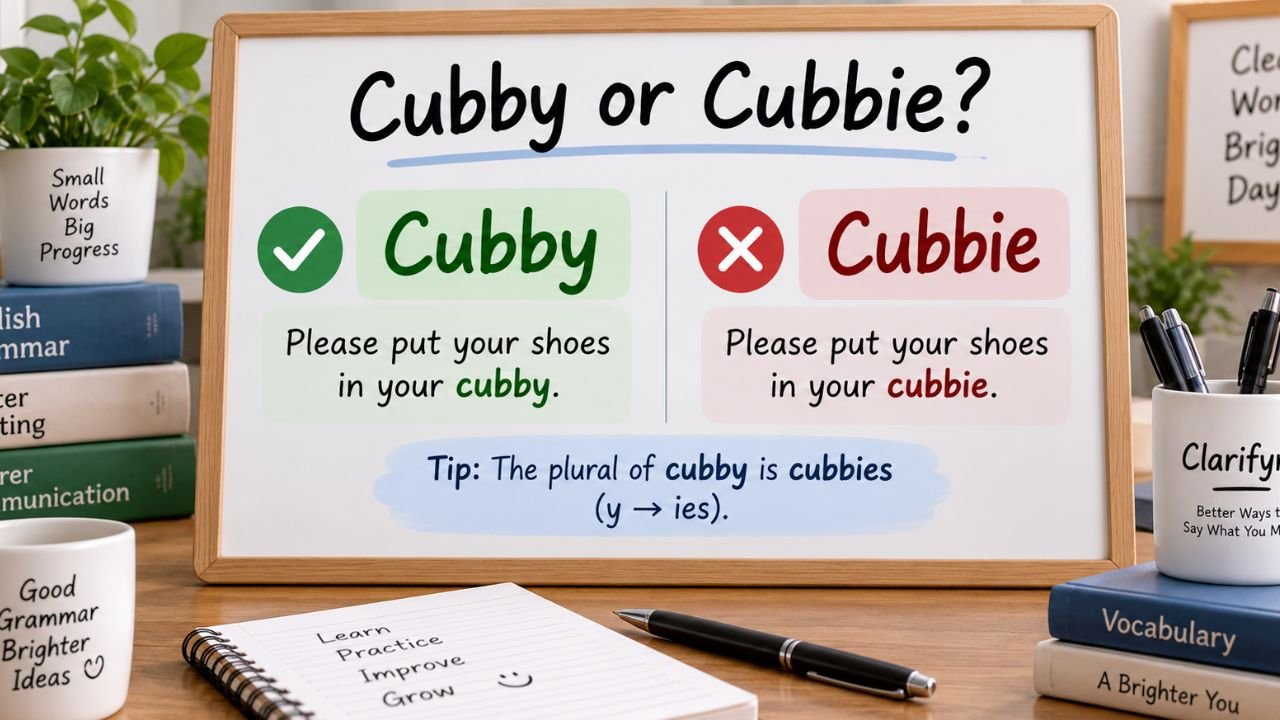
Cubby is the standard spelling when you mean a small storage space, compartment, or cubbyhole. Its plural is cubbies. Cubbie can be found in some specialized, regional, historical, or informal uses, but it is not the usual modern spelling for this meaning.
Cubby or Cubbie: Which Is Correct?
If you are talking about a small compartment where someone keeps books, shoes, toys, bags, or other belongings, cubby is the correct choice.
For example:
- Please put your shoes in your cubby.
- Each child has a cubby at school.
- I keep my keys in the small cubby beside the entrance.
The plural is cubbies:
- The classroom has 20 cubbies.
- The children decorated their cubbies.
- All the backpacks are stored in the cubbies.
This spelling can cause the original confusion. Because cubby becomes cubbies in the plural, some writers assume that the singular might be cubbie. That is not how the standard spelling works.
Quick comparison
| Feature | Cubby | Cubbie |
|---|---|---|
| Standard spelling for a storage compartment | Yes | No |
| Common modern English word | Yes | Limited |
| Meaning: small storage space | Yes | Not the usual form |
| Plural of cubby | Cubbies | — |
| Suitable for formal writing | Yes | Depends on the specific use |
What Does “Cubby” Mean?
Cubby is a noun referring to a small room, compartment, enclosure, or storage space.
It is particularly common when talking about places where children keep their belongings at school, nursery, or daycare. It can also describe a small compartment in furniture, an office, or another setting.
For example:
The teacher asked everyone to put their lunch boxes in their cubbies.
Here, cubbies means individual small storage compartments.
Another example:
There is a little cubby underneath the desk.
In this sentence, the word describes a small enclosed storage area.
A closely related word is cubbyhole, which can refer to a very small compartment or snug space.
Examples of “cubby” in sentences
- Emma put her backpack in her cubby.
- The office provides each employee with a small cubby.
- His desk has a useful cubby for storing notebooks.
- The children left their coats in their cubbies.
What Does “Cubbie” Mean?
Cubbie is not simply the standard alternative spelling of cubby.
The form can be found in particular regional, historical, informal, or name-related uses. Historical English sources, for example, record cubbie alongside cubby in certain regional Scottish vocabulary. That does not mean that cubbie should replace cubby in ordinary modern English.
So if you are writing a sentence about a classroom storage compartment, the natural standard form is:
The children put their books in their cubbies.
Not:
The children put their books in their cubbies.
Notice that the plural cubbies actually comes from the standard singular cubby.
Why Do People Confuse the Two Spellings?
The main source of confusion is the plural spelling.
English nouns ending in a consonant followed by y often change the y to ies when they become plural.
For example:
- baby → babies
- city → cities
- puppy → puppies
- library → libraries
- cubby → cubbies
Because cubbies ends in -ies, it is easy to work backward incorrectly and assume the singular must be cubbie.
But the pattern is:
cubby → cubbies
not:
cubbie → cubbies
This is a spelling rule rather than a change in pronunciation.
Cubby Spelling and the Plural Form
The correct spelling pattern is straightforward:
| Number | Correct form | Example |
|---|---|---|
| Singular | cubby | This is my cubby. |
| Plural | cubbies | These are our cubbies. |
When cubby becomes plural, the final y changes to ies.
Correct
She has a cubby for her school supplies.
Correct plural
The classroom has several cubbies.
Incorrect standard spelling for the storage meaning
She has a cubbie for her school supplies.
The third example is not the standard modern form for this particular meaning.
Is “Cubbie” a Misspelling?
Not in every possible context.
Calling cubbie an absolute misspelling would be too broad because the form has appeared in specific historical and regional English uses. It can also occur as an informal name or nickname in contexts unrelated to the ordinary noun cubby.
However, if your question is simply:
“How should I spell the word for a small storage compartment?”
the answer is cubby.
This distinction is useful because dictionaries and historical language sources can record words that are not the normal choice in contemporary standard English.
For everyday writing, school instructions, workplace communication, and general English:
Use cubby.
Cubby or Cubbie Bear: What About “Bear”?
The phrase cubby bear can create another layer of confusion.
A young bear is normally called a bear cub or simply a cub. Cubby is not the standard dictionary term for a young bear.
For example:
The mother bear stayed close to her cub.
Here, cub is the word for a young animal, including a young bear.
You may encounter Cubby or Cubbie as a name, nickname, character name, or informal expression associated with bears or other subjects. Such a specific name does not change the standard spelling of the storage noun.
So:
- bear cub = a young bear
- cubby = a small compartment or space
- Cubbie/Cubby = may occur as a name or nickname in particular contexts
Context matters.
Cubby vs. Cubbyhole
Cubby and cubbyhole are closely related, but they are not always interchangeable.
A cubby is generally a small compartment or storage space.
A cubbyhole can mean a very small enclosed compartment or space and may also be used more broadly for a tiny, snug place.
For example:
The students put their coats in their cubbies.
But:
She found a quiet cubbyhole where she could read.
The first emphasizes organized storage. The second emphasizes a very small or enclosed space.
Correct Usage Examples
Here are some natural examples to make the distinction clear.
Correct: singular
Each student has a cubby near the classroom door.
Correct: plural
The students keep their bags in their cubbies.
Correct: workplace use
I left the documents in the storage cubby.
Correct: furniture
The shelf has a small cubby for books.
Incorrect for standard storage usage
Please leave your lunch in your cubbie.
Better
Please leave your lunch in your cubby.
The same principle applies whether the compartment is at school, home, daycare, an office, or inside a piece of furniture.
An Easy Way to Remember It
The easiest rule is:
One cubby, two cubbies.
Think of the spelling pattern:
baby → babies
puppy → puppies
cubby → cubbies
The singular retains the y, while the plural changes y to ies.
This also explains why cubbies does not prove that cubbie is the singular form.
Common Mistakes to Avoid
1. Treating “cubbie” as the normal singular form
If you mean a small storage compartment, use cubby.
2. Assuming “cubbies” comes from “cubbie”
It does not. The standard formation is:
cubby → cubbies
3. Confusing “cub” with “cubby”
A cub can mean a young animal, including a young bear. A cubby normally refers to a small space or compartment.
4. Calling every use of “cubbie” a spelling error
Some historical, regional, informal, or name-related uses exist. The important point is that cubbie is not the standard everyday spelling for the storage meaning.
Is It American or British English?
Cubby is used in both American and British English, so this is not primarily a case of American English versus British English.
You should not treat cubby and cubbie as equivalent to pairs such as color/colour or center/centre. Those are established regional spelling differences. The situation here is different: cubby is the ordinary standard form for the storage-related meaning in modern English.
FAQ
Is “cubby” or “cubbie” correct?
Cubby is the standard spelling when referring to a small storage compartment or cubbyhole. Cubbie can occur in specialized or informal contexts, but it is not the usual modern spelling for this meaning.
How do you spell the plural of cubby?
The plural is cubbies. The spelling changes from y to ies, just as in baby → babies and puppy → puppies.
Is “cubbie” a real word?
Cubbie does appear in historical, regional, informal, and name-related contexts. However, it is not the standard modern spelling to use when referring to an ordinary storage compartment.
Is a cubby the same as a cubbyhole?
They have closely related meanings. A cubby is usually a small compartment or storage space, while cubbyhole can describe a very small enclosed space or compartment.
Is a cubby a bear?
No. A young bear is normally called a bear cub. Cubby has a different primary meaning when used as an ordinary English noun: a small compartment or space.
What is the easiest way to remember the spelling?
Remember “one cubby, two cubbies.” The singular is spelled with -y, while the plural changes the ending to -ies.
Final Verdict: Cubby or Cubbie?
For the ordinary modern meaning of a small storage compartment or enclosed space, cubby is the spelling to choose. Its plural is cubbies, which follows the familiar -y → -ies plural pattern. While cubbie can be found in specific historical, regional, informal, or name-related contexts, it should not normally replace cubby in standard everyday writing. For clear word choices and practical English guidance, Clarifyra helps you choose the form that best fits the context.