Savor or Savour: Which Spelling Is Correct?
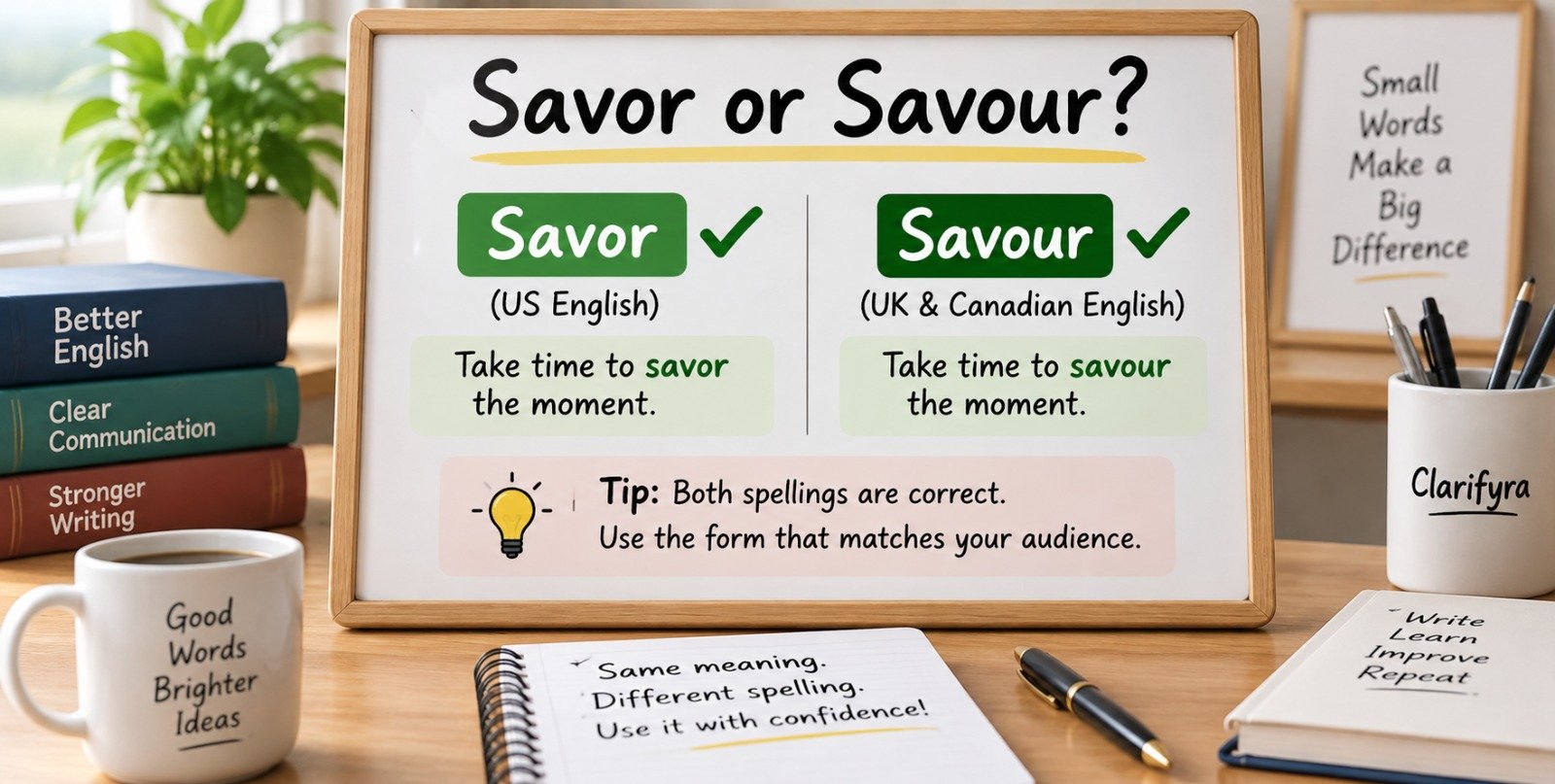
If you want to describe enjoying a meal, a memory, or a special experience slowly and fully, should you write savor or savour? The good news is that both spellings are correct. The difference comes down mainly to regional English. Savor is standard in American English, while savour is preferred in British English and is also commonly used in Canadian English. They have the same meaning, so the right choice depends on your audience and the spelling style you are following.
Both savor and savour are correct. Use savor in American English and savour in British English. The two spellings have the same meaning: to enjoy or appreciate something slowly and fully.
Savor or Savour: What Is the Difference?
The difference between these words is spelling, not meaning.
| Feature | Savor | Savour |
|---|---|---|
| Correct? | Yes | Yes |
| Main usage | American English | British English |
| Canadian usage | Less traditional | Common and traditional |
| Meaning | To enjoy or appreciate something fully | Same meaning |
| Pronunciation | Roughly “SAY-ver” | Roughly “SAY-ver” |
| Example | Savor the moment. | Savour the moment. |
This follows the familiar American and British spelling difference seen in pairs such as color/colour, favor/favour, and flavor/flavour.
The most important rule is consistency. If you are writing in American English, use savor, savored, and savoring throughout. If you are following British spelling, use savour, savoured, and savouring.
You May Also Read | Mat or Matt: What’s the Difference?
What Is Savor?
Savor is the standard American English spelling.
As a verb, it means to enjoy, appreciate, or experience something slowly so that you can get as much pleasure from it as possible.
It is often used with food:
- She took her time to savor every bite of the dessert.
- He paused to savor the rich flavor of the coffee.
However, the word is not limited to taste. It can also describe enjoying experiences, achievements, memories, or moments.
- They wanted to savor their final evening on vacation.
- She sat quietly and savored the feeling of success.
- He is still savoring the team’s victory.
In American writing, these forms are standard:
savor → savored → savoring
What Is Savour?
Savour is the British English spelling of the same word.
Its meaning does not change. You can savour food, an experience, a victory, a memory, or any other pleasant moment that you want to appreciate fully.
Examples:
- We sat outside to savour the peaceful evening.
- She savoured every mouthful of the meal.
- He spent a few minutes savouring his achievement.
- They wanted to savour their last day together.
The usual British forms are:
savour → savoured → savouring
So savor and savour are not two different vocabulary words. They are regional spellings of the same word.
Is It “Savor the Moment” or “Savour the Moment”?
Both expressions are correct.
In American English, write:
Savor the moment.
In British English, write:
Savour the moment.
The expression means to slow down and fully appreciate what is happening rather than rushing immediately to the next thing.
For example:
- You have worked hard for this, so take a minute to savor the moment.
- After receiving the award, she stood quietly and savoured the moment.
- We knew the holiday would soon be over, so we tried to savour every moment.
The meaning is exactly the same in each spelling.
What Does “Savouring the Moment” Mean?
Savouring the moment means deliberately appreciating a pleasant experience while it is happening.
Imagine that you have just achieved an important goal. Instead of immediately moving on to your next task, you stop for a few minutes and enjoy the feeling. You are savouring the moment.
In American English, the phrase is normally written:
savoring the moment
In British English:
savouring the moment
The expression can apply to both major life events and small everyday pleasures.
For example:
- She sat by the window, savouring the moment of complete silence.
- He was savoring the moment after finishing his first marathon.
- They stayed at the table longer, savouring their time together.
Savor or Savour in the US and UK
The US–UK spelling difference is straightforward.
American English
Use:
- savor
- savored
- savoring
Examples:
- I want to savor this experience.
- She savored the final bite.
- They are still savoring the win.
British English
Use:
- savour
- savoured
- savouring
Examples:
- I want to savour this experience.
- She savoured the final bite.
- They are still savouring the win.
Neither set is grammatically better than the other. Choose the form that matches the variety of English you are using.
Savor or Savour in Canada
For Canadian English, savour is generally the more traditional spelling.
Canadian spelling often keeps the u in words that also use it in British English, including:
- colour
- favour
- flavour
- honour
- savour
However, Canadian readers are also very familiar with American English, so savor may occasionally appear.
If you are writing specifically for a Canadian audience and want to follow conventional Canadian spelling, savour is usually the better choice.
Savor or Savour Pronunciation
The spelling changes, but the pronunciation is essentially the same.
A simple pronunciation guide is:
SAY-ver
The word has two syllables:
SAY-ver
In phonetic notation, American English is commonly represented as approximately /ˈseɪ.vɚ/, while British English uses approximately /ˈseɪ.və/ or a similar non-rhotic form depending on accent.
The extra u in savour is not pronounced as a separate sound.
So you should not say something like:
“say-voo-er.”
Both spellings sound almost identical in ordinary speech.
Savor or Savour in a Sentence
Seeing both spellings in natural sentences can make the distinction easier.
American English examples
- Take a moment to savor the view before we leave.
- She slowly savored the homemade soup.
- He wanted to savor every second of the celebration.
- We are still savoring our vacation memories.
- You should savor opportunities like this.
British English examples
- Take a moment to savour the view before we leave.
- She slowly savoured the homemade soup.
- He wanted to savour every second of the celebration.
- We are still savouring our holiday memories.
- You should savour opportunities like this.
Notice that the sentence structure does not change. Only the spelling does.
Useful Synonyms for Savor
A good savor synonym depends on the sentence.
Possible alternatives include:
- enjoy
- appreciate
- relish
- cherish
- treasure
- delight in
- take pleasure in
For example:
She savored every minute of the trip.
You could also say:
She enjoyed every minute of the trip.
Or:
She cherished every minute of the trip.
However, these words are not always perfect replacements. Savor often carries the extra idea of taking time to appreciate something deeply or deliberately.
Compare:
I enjoyed the meal.
This simply says the meal was pleasant.
I savored the meal.
This suggests that you ate slowly and paid special attention to the experience.
Can Savor and Savour Be Nouns?
Yes, although the verb use is much more familiar in everyday English.
As a noun, savor or savour can refer to a distinctive taste, smell, quality, or sense of enjoyment.
For example:
- The herbs added a delicate savor to the dish.
- The experience had a special savour that he never forgot.
This noun usage can sound more literary or formal in some contexts, so most everyday sentences use the word as a verb.
Common Mistakes to Avoid
One common mistake is treating one spelling as universally incorrect.
Writing savour is not wrong simply because an American publication uses savor, and savor is not a misspelling simply because a British writer prefers savour.
Another mistake is mixing regional spelling styles without a reason.
For example, this looks inconsistent in a formal article:
She wanted to savour the holiday and savor every meal.
Choose one style instead:
British:
She wanted to savour the holiday and savour every meal.
American:
She wanted to savor the vacation and savor every meal.
Also remember that the spelling pattern continues in related verb forms:
American: savor, savored, savoring
British: savour, savoured, savouring
An Easy Way to Remember the Difference
Think of savor/savour in the same way as color/colour.
American English usually drops the u:
color → savor
British English keeps the u:
colour → savour
If you already know which form of color/colour you normally use, you can follow the same pattern here.
Final Verdict: Which Spelling Should You Use?
Both forms are standard English. Choose savor for American English and savour for British English; savour is also the conventional choice in Canadian English. The meaning remains the same: to enjoy or appreciate something slowly and fully. Whichever spelling you choose, keep your regional style consistent throughout your writing—one of the simplest ways Clarifyra helps you say exactly what you mean.
Frequently Asked Questions
Is savor or savour correct?
Both are correct. Savor is the standard American spelling, while savour is the British spelling and is also commonly used in Canadian English.
What does savor mean?
As a verb, savor means to enjoy or appreciate something slowly and fully. You can savor food, a memory, an achievement, a conversation, or a special experience.
Should I write “savor the moment” or “savour the moment”?
Write savor the moment in American English and savour the moment in British English. Both expressions mean to appreciate the present experience fully.
Is savour used in Canada?
Yes. Savour is the traditional Canadian spelling and follows the same pattern as Canadian forms such as colour, favour, and flavour.
Are savor and savour pronounced differently?
Not in any important way. Both are pronounced roughly “SAY-ver.” Differences you may hear usually come from regional accents rather than the presence or absence of the letter u.
What is a good synonym for savor?
Depending on context, good alternatives include enjoy, appreciate, relish, cherish, and treasure. However, savor often suggests taking extra time to appreciate something fully.
Many English learners mix up similar-looking words such as Palette or Pallet: What’s the Difference?